February 5

Home / Uncategorized / February 5

By now every high school and college teacher has read one of the collections of student bloopers that circulate relentlessly on the Internet. “Francis Drake,” we are told, “circumcised the world with a hundred-foot clipper.” “Joan of Arc was Noah’s wife”. “Socrates died from an overdose of wedlock”, etc. It behooves me, therefore, to salute some of my University of Manitoba students who in their essays and exams contributed these gems.

• Who defeated the Spartans at Thermopylae? “The Persian emperor Xerox”.

• Aristotle was one of the “Immorals of Science”.

• Emperor Charles V “abolished Luther at the Doctrine of Worms”.

• Clovis, king of the Franks was a “barbaric worrier”.

• Define “buboes”: “The black plaque that hid Europe.”

• Define hedonism: “Geek pleasure”.

• One of Luther’s doctrines? “The just shall live by fate.”

• One of the contributions of medieval philosophy? “Ockham’s Raisin”.

• At what point did the French Revolution become less radical? “The 1794 Thermodynamic Reaction”.

• Who were the Flagellants? “The people who wiped themselves”.


February 4

Home / Today in History / February 4

1836 Politics by candle-light

The Speech from the Throne is a solemn moment in the conduct of business in those legislatures which have adopted the British parliamentary system (the supreme form of government ever conceived by humans.) In it the monarch (or his vice-regal representative) enters the Upper House (being forbidden to enter the House of Commons since Charles I’s invasion of 1642) and reads the speech which outlines the government’s plans for the forthcoming session. What follows is the 19th-century account of such a speech going awry.

The opening-day of the Session of Parliament in 1836 (February 4), was unusually gloomy, which, added to an imperfection in the sight of King William IV, and the darkness of the House, rendered it impossible for his Majesty to read the royal speech with facility. Most patiently and good-naturedly did he struggle with the task, often hesitating, sometimes mistaking, and at others correcting himself. On one occasion, he stuck altogether, and after two or three ineffectual efforts to make out the word, he was obliged to give it up; when, turning to Lord Melbourne, who stood on his right hand, and looking him most significantly in the face, he said in a tone sufficiently loud to be audible in all parts of the House, ‘Eh! what is it?’ Lord Melbourne having whispered the obstructing word, the King proceeded to toil through the speech; but by the time he got to about the middle, the librarian brought him two wax-lights, on which he suddenly paused; then raising his head, and looking at the Lords and Commons, he addressed them, on the spur of the moment, in a perfectly distinct voice, and without the least embarrassment or the mistake of a single word, in these terms:

My Lords and Gentlemen, I have hitherto not been able, from want of light, to read this speech in the way its importance deserves; but as lights are now brought me, I will read it again from the commencement, and in a way which, I trust, will command your attention.

The King then again, though evidently fatigued by the difficulty of reading in the first instance, began at the beginning, and read through the speech in a manner which would have done credit to any professor of elocution.

February 3

Man_writing_Corpus_Christi_College_Cambridge_MS._389590

Gregory the Great is elected pope.

It would be hard to name a more influential pope of the early Middle Ages than St. Gregory I (540-604), called the Great. (Supporters of the claim of Leo I, also the Great and also a saint, may send their arguments on a postcard to St Margaret’s Church, Winnipeg.) Born into a wealthy Roman family with a pope and many high-ranking officials on his family tree, he was superbly educated in the liberal arts and entered at an early age into political life, becoming Prefect of Rome (the highest rank in the city) by his early 30s. He took office at a miserable time in the history of Rome with Italy ravaged by the barbarian Lombards and still recovering from the depopulation and chaos caused by the Byzantine attempt at reconquest and the plague.

On the death of his father he converted his family villa into a monastery and became a monk, soon rising in influence in the Church. In 579 he was chosen by the pope to lead an embassy to the emperor in Constantinople to whom Rome still owed allegiance. His attempt to convince the emperor to send troops to Italy to stop the Lombard advance was fruitless.

In 590, much against his will, he was elected Pope to replace Pelagius II who died of the plague. He took on this task with great energy and succeeded by the time of his death 14 years later in elevating the status and reach of the Roman papacy. For the previous century the bishops of Rome had had little positive influence on the lands of the western empire which had been lost to the Germanic invaders. Britain had lost contact with civilization for almost a century; Spain was dominated by Arian heretics; and the Church in Gaul was in the hands of the Frankish landowners who had little thought for evangelism. Under Gregory the papacy reached out to assert the international leadership of the Bishop of Rome once more. One of his great achievements was sending the mission of Augustine, a monk from his own monastery, to England to spread Christianity to the German tribes there. He reformed the liturgy and encouraged the music we now call Gregorian chant. He reformed the management of church lands which came to provide food and revenue for the poor of Rome. His book Pastoral Care was translated by Alfred the Great into English and was one of the civilizing books every church had to have a copy of.

February 2

Home / Today in History / February 2

220px-Otto_I_Manuscriptum_Mediolanense_c_1200

962 The first Holy Roman Emperor

Some consider Charlemagne’s coronation on Christmas Day 800 as the first creation of a Holy Roman Emperor, but credit should really go to Pope John XII crowning German king Otto I. Otto the Great united Germany, added other conquests, sparked the Ottonian Renaissance and saved Europe from barbarian invasion by defeating the Magyars at the Battle of Lechfeld.

240px-Groundhogday2005

1857 The first celebration of Groundhog’s Day

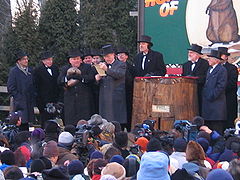
Growing out of immigrant German customs in Pennsylvania, the first official Groundhog’s Day is observed in Punxsutawney. Promoted by Clymer H. Freas, the editor of the local Punxsutawney Spirit, the town’s annual celebration is still the biggest of its kind and the model for the immortal Bill Murray comedy, Groundhog’s Day.

220px-Bundesarchiv_Bild_183-E0406-0022-011,_Russland,_deutscher_Kriegsgefangener

1943 Germans surrender at Stalingrad

From August 1942 to February 1943 almost two million men contested control of the city of Stalingrad on the Volga River. Hitler’s 6th Army wished to seize the area as part of the German plan to control the oil supplies of the Caucasus; Stalin’s troops fought to keep Volga river traffic open and prevent a propaganda coup in losing a city named after their Supreme Leader.

In November Soviet counterattacks succeeded in surrounding the city and creating what the Germans called “the kettle”. Hitler refused permission for his men to withdraw believing that they could be supplied by air and that his other forces could break the encirclement. It was not to be. Out of food and ammunition, 95,000 German and Romanian troops surrendered on this date. Only 5,000 of them, mostly officers, ever saw their homes again.

February 1

iur

1516

Erasmus dedicates his revised version of the New Testament to Pope Leo X.

Erasmus of Rotterdam (1466-1536) was the leading public intellectual of his time, a humanist who used new attitudes and techniques to critique the Christian Church of the early modern period. Born the illegitimate son of a Catholic priest, he became a priest himself but spent his life pursuing humanistic studies and being supported by a series of patrons of the new learning. He travelled widely and became something of a literary celebrity, winning fame for his works in Latin such as Utopia and Praise of Folly, which was critical of Church teaching on purgatory and indulgences.

Influenced by John Colet’s historical approach to Scripture, Erasmus applied his knowledge of Greek and Latin to produce a revised version of the New Testament, amending numerous errors in the Vulgate, the 1,000-year-old Latin version. Though his translation work had papal approval, Erasmus’s Greek New Testament was a spur to many vernacular versions including Luther’s highly influential German version.

Erasmus had enemies on both sides of the religious wars that soon erupted. He and Luther disagreed on the possibility of free will and the nature of the Eucharist while later popes placed his works on The Index of Prohibited Books.

January 31

220px-Reliquary_of_Pope_Sylvester_I_PEAE_Zadar

314

Accession of Pope Sylvester I.

Few popes could have reigned at a more important time in the history of the Church. It was during his pontificate that the emperor Constantine was converted to Christianity and that religion began to openly flourish in the Roman empire. This was also the time when the first great churches were erected, especially St Peter’s Basilica in Rome, which endured for over 1,000 years before it was levelled to make way for the neo-classical building that now exists on that site.

Sylvester may be even more important for the legends that surrounded him after his death than anything he accomplished in life. Early in the sixth century stories began to be written about an especially close relationship between Sylvester and Constantine, stories in which the emperor, out of gratitude for being cured of leprosy, is said to have elevated the bishop of Rome above all other church figures and submitted himself to him. By the 700s this legend took the form of one of the great forgeries of all time, the Donation of Constantine, which claimed that Constantine, before moving east to his new capital in Constantinople, had granted the papacy sovereignty over the western empire. This document was used by later popes in their political quarrels with emperors and kings before being exposed as fake in the 1400s by Lorenzo Valla.

1550

The birth of Henri, Duc de Guise.

Guise was the leader of the ultra-Catholic faction during that phase of the French Religious Wars known as The War of the Three Henrys, in which Guise battled the centrist monarch Henri III and the Protestant leader Henri de Navarre. Guise, who had urged the St Bartholomew’s Day Massacre of French Huguenots, was assassinated by Henri III in 1588.

1561

Death of Menno Simons.

Simons (1496-1561) was a Dutch Catholic priest who converted to Anabaptism in 1536 after the death of his brother Pieter who had been a follower of the radical Münsterites. Simons rejected the violent path that his brother and other Anabaptists had taken, preaching a pacifist message of separation from the world and adult believer baptism. Many Anabaptist denominations sprang up following his teachings.

January 30

Home / Today in History / January 30

1661

Oliver Cromwell is executed post-mortem

Oliver Cromwell (1599-1658) was a leading figure in the revolution that overthrew King Charles I and abolished the British monarchy. Cromwell was a successful general in the Parliamentary armies that defeated royalist forces in the Civil War, distinguishing himself as a cavalry commander at the battles of Marston Moor (1644) and Naseby (1645). He favoured putting Charles on trial and signed the warrant for the king’s execution, thus becoming one of 59 “regicides” marked for vengeance should the monarchists regain the upper hand. After the establishment of the republic known as the Commonwealth, Cromwell led an army against Irish Catholics and Royalists in a campaign of massacre and atrocity that is still resented on the Emerald Isle. From 1653-58 he governed England as Lord Protector before dying of septicaemia.

The Restoration of the monarchy in 1660 meant a reckoning for those who had advocated executing Charles I. Those regicides still living either fled for safety to the Continent or the American colonies, or were put on trial — most were imprisoned but 9 were given the traitor’s death of being hanged, drawn and quartered. The bodies of three dead regicides — Cromwell, his son-in-law Henry Ireton, and John Bradshaw — were disinterred from Westminster Abbey, mutilated and hanged in chains, after which the dismembered corpses were thrown in a pit. Cromwell’s head was preserved and is buried in a Cambridge college chapel. 

January 29

Home / Today in History / January 29

1963

The Pro Football Hall of Fame names its first inductees. How many names can you recognize? Do you recall which one was “Johnny Blood”, the “Galloping Ghost”, the “Old Master”, “Old Indestructible”, or the “Big Dog”? In alphabetical order they are:

“Slingin” Sammy Baugh, quarterback, punter, and defensive back with the Washington Redskins, 1937-52.

Bert Bell, founder and coach of the Philadelphia Eagles, and NFL Commissioner, 1933-59.

Joseph Carr, owner of the Columbus Panhandles and NFL President, 1920-39.

Dutch Clark, running back with the Portsmouth Spartans/Detroit Lions, 1931-38.

Harold “Red” Grange, halfback with the Chicago Bears and New York Yankees, 1925-34.

George Halas, end, coach, and owner, Chicago Bears, 1920-83.

Mel Hein, centre, New York Giants, 1931-45.

Pete Henry, tackle, Canton Bulldogs, Pottsville Maroons, and New York Giants, 1920-28.

Cal Hubbard, tackle, Green Bay Packers, New York Giants, Pittsburgh Pirates, 1927-36.

Don Hutson, end, safety, and kicker, Green Bay Packers, 1935-45.

Earl “Curly” Lambeau, halback, coach, and manager, Green Bay Packers, 1919-53.

Tim Mara, owner New York Giants, 1925-59.

George Preston Marshall, owner Boston Braves/Washington Redskins, 1932-69.

John McNally, halfback,Milwaukee Badgers, Duluth Eskimos, Pottsville Maroons, Green Bay Packers, Pittsburgh Pirates, 1925-38.

Bronko Nagurski, fullback, linebacker, Chicago Bears, 1930-37, 1943.

Ernie Nevers, fullback and coach, Duluth Eskimos, Chicago Cardinals, 1926-39.

Jim Thorpe, halback, coach, first NFL President, Canton Bulldogs, Cleveland Indians, Oorang Indians, Rock Island Independents, New York Giants, Chicago Cardinals, 1915-28.

January 28

1521

The Diet of Worms opens.

Th religious turmoil begun by Martin Luther’s posting of his 95 Theses in 1517 reached a climax when the German parliament (Diet) met in the town of Worms. Luther’s defenders had demanded that he be tried only in a German setting and so he was summoned to meet the emperor Charles V and representatives of the Church and nation. His defiance of these authorities would result in his outlawing and the beginnings of a separate religious movement that later in the decade would come to be known as Protestantism.

1547

Henry VIII dies.

The death of the king who had pulled the Church of England from obedience to the pope meant the succession of young Edward VI who, along with his closest advisers, were committed to a deeper reformation of that church along Protestant lines. Within six years England will have a new theology, married clergy, ceremonies in English, and an English prayer book but the population will remain split between Catholic supporters, those content with the new order, and those who wanted further reform. These divisions will continue for decades more.

1962

The birth of a prosperity preacher.

Few clergymen have been as aptly named as Creflo Dollar, a clergyman who ended up boasting the ownership of two Rolls-Royce automobiles, multiple multi-million dollar residences and a private jet. Born in Georgia, he began his ministry in 1986 in a school auditorium with only 8 people in the congregation. Preaching the message that God wishes his followers to be be wealthy and healthy, Creflo succeeded in creating a church of 30,000 members, satellite churches across America and an international organization, World Changers Church. His television program is broadcast around the globe. Dollar’s wife Taffi is co-pastor and is developing an outreach to women in the sex trade.

January 27

Home / Today in History / January 27

Burtonsbook

1640, the burial of a melancholy author

One of the most interesting books of the 17th century is The Anatomy of Melancholy, a massive treatise on mental illness, particularly depression. It is the work of the Oxford scholar Robert Burton (1577-1640). According to Dr Samuel Johnson, it was the only book that ever took him out of bed two hours sooner than he wished to rise.

Of his own mental condition Burton said:  “a kind of imposthume in my head, which I was very desirous to be unladen of and could imagine no fitter evacuation than this … I write of melancholy, by being busy to avoid melancholy. There is no greater cause of melancholy than idleness, no better cure than business”. In his view, melancholy was “a disease so frequent … in our miserable times, as few there are that feele not the smart of it”, and he said he compiled his book “to prescribe means how to prevent and cure so universall a malady, an Epidemicall disease, that so often, so much crucifies the body and mind.”

Here are some of his observations:

“He that increaseth wisdom, increaseth sorrow.”

“What cannot be cured must be endured.”

“Wine is strong, the king is strong, women are strong, but truth overcometh all things.”

“Let thy fortune be what it will, ’tis thy mind alone that makes thee poor or rich, miserable or happy.”
“It is an old saying, ‘A blow with a word strikes deeper than a blow with a sword’; and many men are as much galled with a calumny, a scurrile and bitter jest, a libel, a pasquil, satire, apologue, epigram, stage-plays, or the like, as with any misfortune whatsoever.”
“Now go and brag of thy present happiness, whosoever thou art, brag of thy temperature, of thy good parts, insult, triumph, and boast; thou seest in what a brittle state thou art, how soon thou mayst be dejected, how many several ways, by bad diet, bad air, a small loss, a little sorrow or discontent, an ague, &c.; how many sudden accidents may procure thy ruin, what a small tenure of happiness thou hast in this life, how weak and silly a creature thou art.”