Death of a noble bigamist
Kitty Cannon was a pretty girl from the village of Thorpe in Essex. Her beauty led to her being courted by a number of young nobles but, none of these titled individuals condescended to breathe in her ear a single word about matrimony; so, when she was just twenty, she gave her hand, and (it is to be presumed) her heart also, to the rector of Thorpe, a Reverend Mr. Dough.
A quiet and remote parsonage, however, was not exactly suited to the taste of a young lady who had once sipped the cup of flattery from gentlemen who belonged to the clubs about St. James’s, and who moved in courtly circles. Accordingly, one evening when she was staying in London, being present at a ball in the neighborhood of the then fashionable district of Covent Garden, she managed to slip out, unobserved by her husband, and to run away with John, Lord Dalmeny, heir to vast estates and the title of the Earl of Rosbery, who was only a few years older than herself. She had no children, and doubtless his lordship was led to believe that she was a widow, and quite at her own disposal.
The pair went abroad, and remained for two or three years traveling in the sunny south; but in the early summer of 1752 Kitty Cannon, or Kitty Gough, was taken seriously ill at Florence. Her illness turned into a galloping consumption, and in the May or June of that year she died. A few hours only before her death, she wrote upon a scrap of paper, ‘I am really the wife, of the Reverend Mr. Gough, vicar of Thorpe, near Colchester, Essex ; my maiden name was Kitty Cannon, and my family belong to the same parish. Bury me there.’
Lord Dalmeny’s young wife, as he always thought her to be, was gone before he was able to realize the full meaning of the lines which she had written. At first he was disposed to reject them, as a creation of her sick brain; it was impossible for him to believe that the dear companion of his last few years was guilty of bigamy. But, whether true or false, he at once resolved, as she lay in her coffin at Florence, to give effect to her last wish, and he instantly prepared to carry her remains over to England.
The body of this lovely woman was embalmed, and secured in ‘a very fine oaken coffin’, decorated with six large silver plates, and it was then put into a strong outer case of common deal, which concealed the ominous shape of its contents. The jewelry and wardrobe of the lady were packed in other chests, and with this cumbersome baggage Lord Dalmeny set out upon his melancholy journey by land to the south of France. At Marseilles he was able to engage a vessel to carry him and his packages by sea round to Dover, under the assumed name of Mr. Williams, a merchant of Hamburg; and on landing at Dover he transferred his belongings to a small coaster, which he hired to carry him to Harwich, then a busy and bustling port, only a few miles distant from Thorpe. The vessel, however, was forced by contrary winds to make for Colchester instead, where the Custom House officers came down to the Hythe to examine the freight before they would allow it to be landed. They could not recognize in the elegant and polished gentleman, whom they saw dressed in the deepest of black and bowed down by grief, a common business man from Hamburg; and they very naturally thought, as only seven years had passed since the rebellion of 1745, that he was some emissary of ‘the Pretender.’ So their loyalty took the alarm.
It certainly was the plain duty of Custom House officials to see that no French tobacco, gloves, lace, or brocade was brought over in these large boxes without paying duty to King George. Accordingly, without giving any attention to the remonstrance’s of Mr. Williams, they were about to plunge their knives into the larger case, when the Hamburg merchant drew his sword and told them to desist. He at once made a clean breast of the affair, telling them that he was an Englishman, and, what was more, an English nobleman, and that the chest upon the wharf contained the body of his dead wife. But this explanation did not satisfy the officers, who were not sure that there was not a murder at the bottom of the transaction. They therefore at once broke the outer chest, tore open the coffin lid, and lifted the cere-cloths from the face of the embalmed corpse. Lord Dalmeny was taken, along with the coffin, to a church near at hand, where he was detained until he could prove the truth of his story.
The news soon spread about, and crowds of the neighboring villagers came to see the fair lady’s face as she lay in her coffin. Many of these identified her features as those of the Kitty Cannon who had spent her childhood at Thorpe, and who had disappeared soon after her marriage with the vicar of that parish.
But here was a further difficulty for his lordship; for, though the rest of his story was transparently true, it was clear that the lady was not really his lawful wife. A communication was at once forwarded to the vicar, who lost no time in coming over to the Hythe and recognizing the corpse as that of his vanished partner. But what a mystery the whole affair was to him as well as to Lord Dalmeny, to whom at first, as may be supposed, he entertained and expressed no very friendly feelings. But he was soon pacified. Possibly he had preached but lately a sermon enforcing forgiveness of even intended wrongs, and here was a wrong which clearly was not intended. Accordingly as soon as he was able to contemplate the matter in all its bearings—the deception which had been practiced on the poor young nobleman, and the passionate constancy which had borne him up through his toilsome journey by land and voyage by sea in order to gratify his supposed wife’s last prayer, and the faithfulness with which, like a dog, he watched beside her coffin in the church—he felt that he could not refuse to forgive the wrong, and he consented to meet Lord Dalmeny on a friendly footing.
The interview between the two rival husbands is said in a family record to have been very moving, and no doubt must have been touching in the extreme; the only wonder is that it has not been taken by play-writers to work out as a plot for the stage. Lord Dalmeny assured the husband of his entire innocence of fraud, and of the honest intentions with which he had acted throughout. Even the discovery of his long-lost Kitty’s deceit and guilt did not put his love to shame, or shake his determination to follow her to her last resting-place. And the same was the feeling of his lordship. The next day, as soon as the magistrates were satisfied that the law had not been broken, both husbands accompanied the loved remains to Thorpe Church, where the poor frail lady was buried with all the pomp and show which could have been accorded to a real peeress. Which of the two paid the undertaker’s bill is not stated; but I have every reason to believe that the cost was paid by Lord Dalmeny, or amicably settled between them. It is said that the funeral cortege was stopped for a few minutes at the gates of the vicarage, and that the young nobleman walked into the house, from which he presently came forth arm-in-arm with Mr. Gough, who was clothed in mourning as deep as his own, and with scarf and headband to match. This happened on July 9, 1752 and seems to be the first time an Englishwoman had two husbands attend her funeral at the same time.

One hundred years ago, a Canadian army helped defeat the Imperial German army and forced the enemy high command to consider the war lost.
Eleven divisions — 3 British, 4 Canadian, and 4 Australian — 75,000 men, more than 500 tanks and nearly 2,000 planes attacked the Germans who had not dug in, as they expected to continue their own offensive.
The keys to the victory were surprise — troops and equipment were moved only at night and at the last minute — the use of Canadians and Australians as shock troops, and coordination of tanks, guns, and aircraft.
By noon the Canadians had taken over 5,000 prisoners and 161 guns at a cost of 3,500 casualties; the Australians had taken nearly 8,000 prisoners and 173 guns, and their losses were less than 3,000. The total German losses for the day, on their own estimate, were between 26,000 and 27,000. Their official account says:
As the sun set on the 8th August on the battlefield the greatest defeat which the German Army had suffered since the beginning of the war was an accomplished fact.

Once much of central and western Asia was populated by Christians of the Church of the East, descendants of the Nestorians who fled persecution by seeking refuge beyond the borders of the Roman Empire. The Church was largely wiped out by the Mongols of Timur but pockets survived in mountainous places.
One such remnant was the Assyrian Church living in what is now Turkey, Syria and Iraq. During the First World War the same wave of mass murders that the Turks perpetrated on their Armenian Christian minority engulfed many Assyrians.
In August, 1933 a new wave of massacres was aimed at the Assyrians, as Kurds and Arab nationalists carried out a number of massacres. A British observer described the scene at the village of Simele which was attacked on August 7:
A cold blooded and methodical massacre of all the men in the village then followed, a massacre which for the black treachery in which it was conceived and the callousness with which it was carried out, was as foul a crime as any in the blood stained annals of the Middle East. The Assyrians had no fight left in them, partly because of the state of mind to which the events of the past week had reduced them, largely because they were disarmed. Had they been armed it seems certain that Ismail Abawi Tohalla and his bravos would have hesitated to take them on in fair fight. Having disarmed them, they proceeded with the massacre according to plan. This took some time. Not that there was any hurry, for the troops had the whole day ahead of them. Their opponents were helpless and there was no chance of any interference from any quarter whatsoever. Machine gunners set up their guns outside the windows of the houses in which the Assyrians had taken refuge, and having trained them on the terror stricken wretches in the crowded rooms, fired among them until not a man was left standing in the shambles. In some other instance the blood lust of the troops took a slightly more active form, and men were dragged out and shot or bludgeoned to death and their bodies thrown on a pile of dead.
These actions led to the coining of the word “genocide”. The symbol above in Syriac commemorates the date August 7


The French Revolution had begun. The king Louis XVI had summoned the nation’s political classes to meet at Versailles in the form of the antique Estates-General (which had not met since 1610). There, the Third Estate, representing all Frenchmen not in either the clergy or the nobility, had declared itself the true national assembly and compelled the other two estates to join them. The possibility of true reform had Paris in a frenzy of excitement but the king’s dismissal of the Finance Minister Jacques Necker was seen as a conservative counter-coup. Rumours of the use of mercenary troops to crush the new Assembly were rife. Camille Desmoulins, a young radical lawyer, pistol in hand, declared to a crowd: “Citizens, there is no time to lose; the dismissal of Necker is the knell of a Saint Bartholomew for patriots! This very night all the Swiss and German battalions will leave the Champs de Mars to massacre us all; one resource is left; to take arms!”
(Desmoulins, the false-news firebrand, rose high in the councils of the insurgents but eventually fell foul of the inevitable social law which states “Revolutions eat their own children.” He was sent to the guillotine by those even more ruthless than he.)
On July 13, various Parisian mobs broke into royal armouries and seized weapons; local militias now had muskets and cannons at their disposal. The next day the target was the Bastille, the medieval prison which dominated central Paris. The fortress had a grim reputation; it often housed those enemies of the crown who had been whisked away behind its walls never to be seen again. On July 14, however, its inmates only numbered seven: 4 forgers, two lunatics and the Comte de Lorges, an aristocrat accused of incest, but who may have been sent there by relatives as part of a property dispute. The expenses of the latter three were all paid by their families. The real target of the rebels was probably the gunpowder housed in the fortress.
The siege of the Bastille lasted all afternoon. The defending troops resisted the attackers, killing 98 of them for the loss of one of their own, but having no supplies to endure a long conflict, the governor, the Marquis de Launay, surrendered at 5:30 pm. He and five of his men were lynched by the mob and their heads paraded about on pikes by capering rebels. The seven released inmates were also paraded about for a time and made much of, until it was realized just what kind of men they were. The forgers were soon returned to prison, the madmen were found asylums, and the aristocrat alone was allowed to go free.
Quite why the French should treat this bizarre incident as the occasion for annual national rejoicing remains a mystery.
Of all the occupations that one might expect to find among the warlike, human-sacrificing cannibals known as the Aztecs, the least expected would be moral philosopher. And yet …
Read this fascinating article: https://aeon.co/essays/aztec-moral-philosophy-didnt-expect-anyone-to-be-a-saint

Best wishes to our American friends on the 242nd anniversary of their disastrous decision to leave the British Empire.

I would like to draw everyone’s attention to the royal reply to the Declaration of Independence and ask our southerly neighbours to soberly assess the consequences of the path not taken.
The British expressed regret at the misguided actions of the American Congress, but announced that the king was still willing to negotiate and to revise those points over which the colonists felt themselves aggrieved. They asked the rebels to “reflect seriously upon their present Condition and Expectations, and to judge for themselves whether it be more consistent with their Honour and Happiness to offer up their Lives as a Sacrifice to the unjust and precarious Cause in which they are engaged, or to return to their Allegiance, accept the Blessings of Peace, and be secured in a free enjoyment of their Liberty and Properties.”
The road not taken led straight to the continuation of slavery for another almost 90 years, genocidal war with native tribes, and a civil war whose effects are still being felt.
It is not too late to come back home, American cousins. The Empire, like the father of the Prodigal Son, awaits your penitent knock on the door.
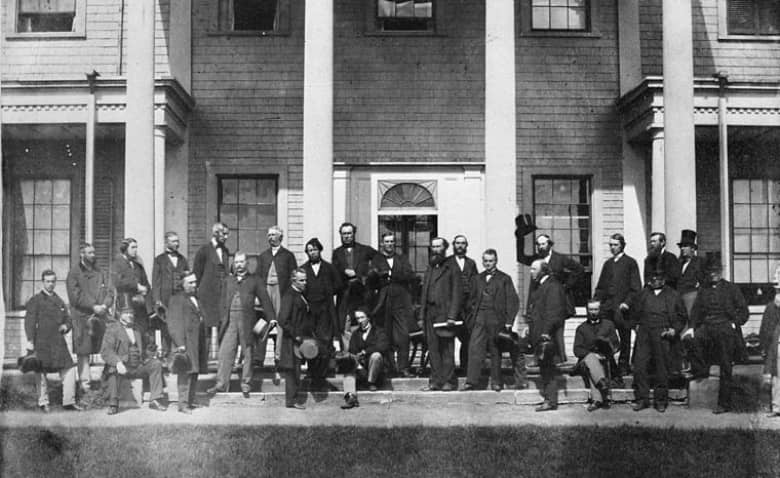
Canada’s founding fathers (o, the patriarchy!) at the 1864 Charlottetown Conference. Remember: diversity is our strength.