August 15


636

Christians lose control of the Levant

On this day in 636 began the Battle of Yarmouk in which forces of the first Islamic Caliphate defeated a Byzantine army in what is now Syria. It was a long-held part of Byzantine strategy to avoid major winner-take-all battles but the arrival of a massive Arab army that had already rolled up Persian and Christian holdings in the Middle East forced the Byzantines to concentrate their forces. They were outmaneuvered and driven from the field leading to a rapid Islamic conquest of the eastern shore of the Mediterranean, territory that would not be regained until the First Crusade in 1099.

A plethora of other Church-related activity also took place on this day.

747

Frankish co-ruler Carloman retires to a monastery leaving his brother Pepin the Short in charge. Within a few years Pepin will win papal approval for deposing the Merovingian dynasty and setting up the Carolingian line. In return Pepin will invade Italy to defeat enemies of the pope and grant the Bishop of Rome the lands that become the Papal States.

1070

Lanfanc, a Benedictine monk from Italy, will be named Archbishop of Canterbury. Working with the recently-victorious William the Conqueror he will reform the English church, cutting down on corruption and sexual immorality in the clergy. He will also resist papal pressure and avoid entangling England in the battles between church and state that raged on the Continent.

1248

The cornerstone for the most striking of all Gothic cathedrals will be laid in Cologne. The building would house the relics of the Three Magi and be finished only in 1880.

1309

The Knights of St John seize the island of Rhodes and use it as a base against Islamic states in the eastern Mediterranean. They will stay in their huge fortress until being driven out by Suleiman the Magnificent in 1521.

1483

Pope Sixtus IV consecrates the Sistine Chapel.

Take the gorgeous Virtual Tour. Copy this link into your browser.

http://www.vatican.va/various/cappelle/sistina_vr/index.html

August 14

Home / Uncategorized / August 14

1040 Macbeth’s forces slay King Duncan

William Shakespeare was not one for historical accuracy if altering the facts could make for a better plot. His 1606 thriller Macbeth portrayed Duncan’s death as a midnight murder at the hands of the thane of Cawdor and his wife, but, in reality ,the king of Scotland was killed in a punitive raid on Macbeth territory. Serves him right.

1385 Battle of Aljubarotta

This was the fight that secured Portuguese independence from Spanish kingdoms. Aided by French heavy cavalry, King John I of Castile invaded his neighbour in an attempt to incorporate the Portuguese realm into his own. He was met by a combined force of English longbow men and Portuguese infantry protected by ditches and the slope of a hill. The result was a bloody encounter that ended in a massacre of the invaders and the establishment of the Aviz dynasty.

1720 Defeat of the Villasur expedition

In the early 18th-century, penetration of the interior of North America by the French and the Spanish led to clashes as claims to territory overlapped. In 1720 the Spanish authorities in New Mexico sent a small force of cavalry and native Apache and Pueblo warriors into the Great Plains, where French priests and traders had been becoming active. At the confluence of the Loup and Platte Rivers in what is now Nebraska, the Spanish were ambushed by Otoe and Pawnee fighters who resented the intrusion. Very few survivors made it back to Santa Fe and the result of the battle was an end to Spanish interest in that area.


August 13

1553

Arrest of a Spanish Heretic

Michael Servetus was born in Aragon about 1510 to a respectable family of the lower nobility. Well educated at the universities of Toulouse, Paris and Montpellier, Servetus demonstrated brilliance in a wide variety of fields: medicine, astronomy, law, geography and Biblical languages but it was his unorthodox views on the Godhead that brought him persecution and death.

In 1530 Servetus became a very junior part of the court of the Holy Roman Emperor Charles V (he who had faced Luther at Worms in 1521). In his travels with the emperor he encountered a number of Reformation thinkers and books and began to drift away from the Catholic faith. For the next decade Servetus became a renowned scientist and physician while also publishing works attacking the traditional notions of the Trinity. Despite a friendly correspondence with John Calvin in Geneva Servetus also condemned the notion of predestination, which helped lead to a break in his relations with Calvin who said: “Servetus has just sent me a long volume of his ravings. If I consent he will come here, but I will not give my word; for if he comes here, if my authority is worth anything, I will never permit him to depart alive.”

By 1553 Servetus had discovered the pulmonary circulation of the blood but the authorities were closing in on his heretical views. Forced to flee France, he headed for Italy with an ill-advised stop-over in Geneva. He was recognized in a church service on August 13, was denounced and arrested on charges of denying the Trinity and of attacking infant baptism. Calvin pressed hard for his execution, though since Servetus was neither a resident nor had he taught any doctrine in the city, banishment was the legal punishment. On October 27, 1553 he was burnt alive on a pile of his own books. Though most Protestant leaders supported the execution, it is an act that has blotted Calvin’s reputation to this day.

Shameless Self-Promotion

Home / Uncategorized / Shameless Self-Promotion

From the man who brought you The Kindly Curmudgeon, God and The Simpsons, and Santa Claus: A Biography comes this collection of wit, wisdom, and whimsy, gleaned from the most interesting writers through the ages. Socrates? He’s here. Goethe? Got him. What about P.G. Wodehouse? Yes, there’s lots of that guy. Also Woody Allen, Spike Milligan, Dorothy Parker, and O. Henry. Eric Hoffer, Jordan Peterson, Mother Teresa, and Leon Trotsky.

There’s a chapter on How to Be Happy Though Married, a selection of nasty personal invective, and the best speech ever made. With over one thousand observations on life, the universe, and everything.

A shark could swim faster than me, but could probably run faster than a shark. So in a triathlon, it would all come down to who is the better cyclist.
Emma Manzini

If you have anything better to be doing when death overtakes you, get to work on that.
Epictetus

The church is near but the road is icy; the bar is far away but I’ll walk carefully.
Russian proverb

Wisdom is the recovery of innocence at the far end of experience.
David Bentley Hart

This splendid bathroom book is now available on amazon.com and amazon.ca, and even amazon.co.uk.

August 12

Home / Today in History / August 12

1952

Night of the Murdered Poets

On August 12, 1952, thirteen major Soviet Jewish figures were executed. Their alleged crimes included espionage, bourgeois nationalism, “lack of true Soviet spirit,” and treason, including a plot to hand the Crimea over to American and Zionist imperialists.  In the group were famous writers such as Peretz Markish (above, winner of the Stalin Prize) , David Bergelson, and Itsik Fefer—which is why the date has come to be marked annually as the Night of the Murdered Poets—but the murdered also included an actor, a former deputy foreign minister, a scientist, and a general.  A fourteenth defendant died during the four years the group suffered in Moscow’s dreaded Lubyanka prison, and a fifteenth was merely sentenced to exile.

Though Jews such as Trotsky, Zinoviev, and Kamenev had featured prominently in the leadership of the Bolshevik Revolution, the fate of Judaism in the Soviet Union was not a happy one, especially during the Purges of the 1930s. During World War II when Stalin needed the help of the West, members of the Jewish Antifascist Committee were sent to the United States to raise money and awareness. After the war this connection to international Judaism was perceived as a threat. In 1948 a series of murders and arrests by the secret police took a toll among the Jewish intelligentsia. In the grim cells of the Lubyanka Prison went former artistic luminaries, including men like Fefer who had loyally toed the Party line and informed on his fellows. They suffered years of torture to produce false confessions and were finally put on trial in 1952 when Stalin’s anti-Semitism was increasingly unchecked.

Following a cursory, secret trial, the thirteen were executed. After Stalin’s death in 1953 the new Soviet government reexamined their cases and declared them posthumously rehabilitated.

August 11

1519

Death of Johann Tetzel, provoker of Martin Luther

Seldom has the financing of public works had such profound consequences. In the early sixteenth century, the papacy was engaged in a long-standing and expensive renewal of Rome and its churches; the centre-piece of this project was the enormous St Peter’s Basilica. The old St Peter’s, dating back to the 300s, had been torn down and the finest architects and artists had been engaged to produce a splendid successor — Bramante, Bernini, and Michelangelo all worked on the building. Their talents were costly, so popes were always looking for ways to find funding for this Renaissance masterpiece. In 1517 Pope Leo X, in return for a large sum of money, granted a waiver of canon law to allow Archbishop Albrecht of Mainz to hold two sees simultaneously. In order that Albrecht not suffer too much financially, the pope also granted him the franchise to preach an indulgence campaign in parts of Germany. Half of the money raised would go to the building of St Peter’s and the other half to Albrecht.

The catechism defines an indulgence as “a remission before God of the temporal punishment due to sins whose guilt has already been forgiven, which the faithful Christian who is duly disposed gains under certain prescribed conditions through the action of the Church which, as the minister of redemption, dispenses and applies with authority the treasury of the satisfactions of Christ and the saints”. In the summer of 1517 the Dominican monk Johann Tetzel raised funds in Saxony in return for indulgences that would reduce the pains of Purgatory for those purchasing them or those already dead. Tetzel was an experienced preacher of such drives and his sermons were very effective. Unfortunately, he abused the permissible limits of indulgences by claiming in his sale pitch that “as soon as a coin in the coffer rings, a soul from Purgatory springs.”

Tetzel did not take his entourage to Wittenberg because its ruler, Frederick of Saxony, already possessed the rights to sell indulgences but word of Tetzel’s claims reached the ears of Augustinian monk Martin Luther. Luther was so incensed, both by the doctrine of indulgences and Tetzel’s fraudulent claims that he posted “97 Theses” on the doctrine of Purgatory and papal powers over the afterlife. This was the first shot in the battle we call the Protestant Reformation.

Tetzel was caught up in the controversy and was forced to retire in disgrace. Despite their disagreement, when Luther heard that Tetzel was dying he wrote to absolve him from responsibility for the firestorm that had erupted, telling him “not to be troubled, for the matter did not begin on his account, but the child had quite a different father.”

August 10

St Lawrence

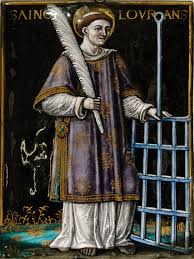
The Church is proud of its martyrs. It assigns days of the year to their remembrance; it adorns its buildings with their statues and paintings; it bids us name our children after them. It recommends that those suffering from disorders pray for the intercession of a saint whose suffering was similar — thus Job, who sat on a dunghill scraping his lesions with a shard of broken pottery, is petitioned by those with skin diseases. The Church also makes them patrons of places and professions and in doing the latter often manifests a grim sense of humour. The saint for August 10 is St Lawrence who is, among other things, the patron of short-order cooks. Why? Thereby hangs a tale.

Lawrence was an arch-deacon in Rome in 258, in the midst of the Valerian persecution, a wide-ranging attack on Christianity ordered by the imperial government. After the execution of Pope Sixtus II, Lawrence was left as the highest-ranking churchman in the capital. Knowing that it would not be long before he too would be arrested, he charitably gave away the Church’s funds lest they be seized by the pagan government. On August 10, 258 Lawrence was summoned to trial and ordered to bring the treasury of the Church with him. He appeared before the authorities accompanied by a train of orphans, beggars, and the sick, saying that these were the “true treasures of the Church”. He was then executed by being placed on a red-hot grid-iron (see illustration) which led to him being the patron saint of cooks and kitchen workers. He can also be appealed to by those who have been burnt or suffering from lumbago. His patronage of comedians comes from the remark he made while undergoing torture on the grid-iron. “Turn me over,” he is supposed to have said, “I’m done on this side.”

August 9

Home / Uncategorized / August 9

1945 The destruction of Nagasaki

At 11:02 on the morning of August 9, 1945 an American B-29 bomber dropped an atomic weapon on the Japanese port of Nagasaki. That city was not the original target, but smoke and clouds over Kokura would have prevented an assessment of the damage that would have been inflicted by this experimental bomb, so the pilot diverted his plane to the secondary objective. The result was an explosion that obliterated the city centre, killed tens of thousands immediately, and doomed more tens of thousands to die later from burns or radiation sickness. The casualty list was overwhelmingly civilian, including Korean slave labour, as well as a small number of Allied prisoners of war. 

Ironically, Nagasaki was the most Christian city in Japan and the one, historically, most open to foreign influence. Throughout the more than 200 years of self-imposed isolation from the rest of the world, Nagasaki had been the only port at which European vessels were allowed to land. The area in which the secret Christian congregations had lived during those years was hardest hit by the bomb. The 19th-century Catholic cathedral (see above) was the largest in east Asia.

Debate continues over the necessity and morality of the atomic warfare waged against Japan, but it is difficult to escape the conclusion that these horrific weapons saved millions of lives that would otherwise have been lost to a continued naval blockade, a Soviet-American invasion, or the continuation of firebombing. Malcolm Gladwell’s latest book The Bomber Mafia discusses the effect of the urban bombing strategy carried out by Curtis LeMay.

August 8

Home / Today in History / August 8

1827

Death of Prime Minister George Canning

There is a certain moral grandeur popularly ascribed to the doctrinaire which is denied to the statesman. There are few politicians who receive the unreserved admiration accorded to those who have done nothing but write books, or yielded their lives to the advocacy of a single cause. The doctrinaire—the propounder of a fixed set of opinions— advises mankind, but does not under-take to manage them. Through a long series of years he may publish his convictions with pertinacious uniformity, without hindrance and without responsibility. Such consistency is sometimes contrasted with the wavering tactics of the statesman, to the unfair disadvantage of the latter. A statesman sets himself to lead a people, and is less careful to entertain them with his private convictions than to discover what principles they are inclined to accept and to commit to practice. The doctrinaire’s business is to proclaim what is true, whether men hear or reject; the statesman’s is to ascertain and recommend what is practicable.

The statesman is often compelled to defer his private judgment to popular prejudice, and to rest content with bending what cannot be broken. Sir Robert Peel was a free-trader long before free-trade was possible. These reserves are inseparable from statesmanship, nor need they involve dissimulation. A statesman, being a practical man, regards all speech as lost labour which is not likely to be reproduced in action. There is, as all know, a base statesmanship, which does not aspire to lead from good to better, but which panders to popular folly for selfish ends. Of this we do not speak. We merely note the f act, that the consistency of the doctrinaire is an easy virtue compared with the statesman’s arduous art: the first tells what is right; the other persuades millions to do it. A statesman who has led with any credit a free people, has necessarily encountered difficulties and temptations of which the solitary student has had no experience, and possibly no conception.

George Canning, whilst one of the ablest European statesmen of the present century, was not doctrinally far in advance of his generation; yet for England he did much worthy service, and through his genius English principles acquired new influence the world over. He was born in Marylebone, London, on the 11th of April 1770. His father was a young gentleman, whose family had cast him off for making a poor marriage; and, while Canning was an infant, he died, it is said, of a broken heart. His mother commenced school-keeping for her support, but it did not pay, and then she tried the stage, but with little better success. An uncle meanwhile intervened, and sent Canning to Eton, where he quickly made his mark by his aptitude for learning.

From Eton he passed to Oxford, and thence to Lincoln’s Inn, with the intention of studying for the bar; but such was his readiness in debate, that his friends persuaded him that politics were his true vocation. At this time he was on familiar terms with Sheridan and Fox, and other leading Whigs, but to their disappointment he sought alliance with Pitt, and under his auspices he entered parliament in 1793. As soon as by trial Pitt had tested the quality of his young recruit, he placed him on active service, and left him to bear the brunt of some formidable attacks. Canning enjoyed and grew under this discipline, and found wit and eloquence equal to all demands. With the Anti-Jacobin periodical—begun in 1797 and concluded in 1798, to resist and ridicule democratic opinions—he was largely concerned, and its best verses and jeux dèsprit were written by him. His Needy Knife-Grinder, a burlesque of a poem by Southey, is known to everybody, being a stock-piece in all collections of humorous poetry.

In 1800, Canning was married to Joan Scott, a daughter of General Scott, who brought with her a dowry of £100,000. Canning’s life, from 1793 to 1827, is inwrought with the parliamentary history of England, sometimes in office, and sometimes in opposition. He was a steady enemy of the French Revolution and of Napoleon; he advocated the Irish union, the abolition of the slave trade, and Catholic emancipation; but resisted parliamentary reform, and the repeal of the Test and Corporation Acts. As secretary of state for foreign affairs, he was peculiarly distinguished. His sympathies were heartily liberal; and the assertion of Lord Holland, that Canning had ‘the finest logical intellect in Europe,’ seemed to find justification in his state-papers and correspondence, which were models of lucid and spirited composition. Against the craft of the Holy Alliance he set his face steadily, and was always ready to afford counsel and help to those who were struggling after constitutional freedom. With real joy he recognised the republics formed from the dissolution of Spanish dominion in America, and one of his last public acts was the treaty which led to the deliverance of Greece from the Turks.

Canning was only prime minister during a few months preceding his death. On the resignation of the Earl of Liverpool, through illness, Canning, in April 1827, succeeded him as premier; and as a consequence of his known favour for the Catholics, Lord Eldon, the Duke of Wellington, Sir Robert Peel, and other Tories threw up their places. Canning had, therefore, to look for support to the Whigs, and with much anxiety and in weak health he fought bravely through the session to its close in July, when he retired to the Duke of Devonshire’s villa at Chiswick, and there died on the 8th of August 1827.

August 7

Home / Uncategorized / August 7

2007 Barry Bonds hits record-breaking home run

I am old enough to remember when athletes were publicly revered, when their personal peccadillos were largely overlooked by the media, and their pictures were featured more often on the sports pages than in police mug shots. There was one heavyweight boxing champion of the world and every schoolboy knew his name. Every fan knew who held the world mark for the mile run and the hundred-yard dash. We thrilled when Roger Bannister broke the 4-minute barrier and when Sebastian Coe, Steve Ovett, and John Walker duelled in track meets around the world.  Babe Ruth had long held the record for most home runs hit in a season and in a career and the toppling of these numbers by Roger Maris and Hank Aaron were the concern of every newspaper, radio station, and television channel. Then along came drugs and mega millions and everything went sour.

Track and field was once the focus of global attention but the drug accusations that brought down Ben Johnson and which dogged the careers of Florence Henderson, Carl Lewis and that generation of American stars sent the sport into a decline from which t has not recovered. Who holds the world 1500 metre record? Who is the world record holder in the women’s high jump. I used to know.

What the late 80s did to track and field, the late 1990s and early 2000s did for baseball. Mark McGwire, Sammy Sosa and Barry Bonds, sporting wonderfully bulked-up torsos, all smashed the home run records that had stood for years. McGwire admitted to using steroids but denied that it had aided his batting; Sosa was caught with a corked bat; Bonds was caught up in legal problems involving use of steroids but never copped to employing them. On this day in 2007 Bonds broke the Sultan of Swat’s career total. The Commissioner of Baseball was not in attendance, perhaps subtly signalling that there was a shadow over the achievement, but Bonds was the recipient of congratulations by President Bush. 

No major league team was interested in signing Bonds after that season and neither he, McGwire, nor Sosa have been voted into the Baseball Hall of Fame. The ball which Bonds hit to set the record is inthe Hall of Fame but if you examine the picture above, you will note that it is marked with a huge asterisk.