The View From Tokyo

Home / Today in History / The View From Tokyo

December 7 is the anniversary of the 1941 Japanese attack on Pearl Harbor as well as on British and American installations in Asia.  For the Japanese, across the International Date Line, it was December 8 as the English-language Tokyo paper above shows.

Here is the imperial rescript (decree) which is printed in that paper giving the Japanese reasons for war:

We, by grace of heaven, Emperor of Japan, seated on the Throne of a line unbroken for ages eternal, enjoin upon ye, Our loyal and brave subjects:

We hereby declare War on the United States of America and the British Empire. The men and officers of Our Army and Navy shall do their utmost in prosecuting the war. Our public servants of various departments shall perform faithfully and diligently their respective duties; the entire nation with a united will shall mobilize their total strength so that nothing will miscarry in the attainment of Our war aims.

To insure the stability of East Asia and to contribute to world peace is the far-sighted policy which was formulated by Our Great Illustrious Imperial Grandsire [Meiji emperor] and Our Great Imperial Sire succeeding Him, and which We lay constantly to heart. To cultivate friendship among nations and to enjoy prosperity in common with all nations, has always been the guiding principle of Our Empire’s foreign policy. It has been truly unavoidable and far from Our wishes that Our Empire has been brought to cross swords with America and Britain. More than four years have passed since China, failing to comprehend the true intentions of Our Empire, and recklessly courting trouble, disturbed the peace of East Asia and compelled Our Empire to take up arms. Although there has been reestablished the National Government of China, with which Japan had effected neighborly intercourse and cooperation, the regime which has survived in Chungking, relying upon American and British protection, still continues its fratricidal opposition. Eager for the realization of their inordinate ambition to dominate the Orient, both America and Britain, giving support to the Chungking regime, have aggravated the disturbances in East Asia. Moreover these two Powers, inducing other countries to follow suit, increased military preparations on all sides of Our Empire to challenge Us. They have obstructed by every means Our peaceful commerce and finally resorted to a direct severance of economic relations, menacing gravely the existence of Our Empire. Patiently have We waited and long have We endured, in the hope that Our government might retrieve the situation in peace. But Our adversaries, showing not the least spirit of conciliation, have unduly delayed a settlement; and in the meantime they have intensified the economic and political pressure to compel thereby Our Empire to submission. This trend of affairs, would, if left unchecked, not only nullify Our Empire’s efforts of many years for the sake of the stabilization of East Asia, but also endanger the very existence of Our nation. The situation being such as it is, Our Empire, for its existence and self-defense has no other recourse but to appeal to arms and to crush every obstacle in its path.

The hallowed spirits of Our Imperial Ancestors guarding Us from above, We rely upon the loyalty and courage of Our subjects in Our confident expectation that the task bequeathed by Our forefathers will be carried forward and that the sources of evil will be speedily eradicated and an enduring peace immutably established in East Asia, preserving thereby the glory of Our Empire.


December 6

Home / Today in History / December 6

1917 The Halifax Explosion

In the midst of World War I, Halifax harbour was an important shipping point for materiel headed to the Western Front. On December 6, 1917 two ships collided in that harbour, setting off the largest man-made explosion in history before the advent of the atomic bomb.

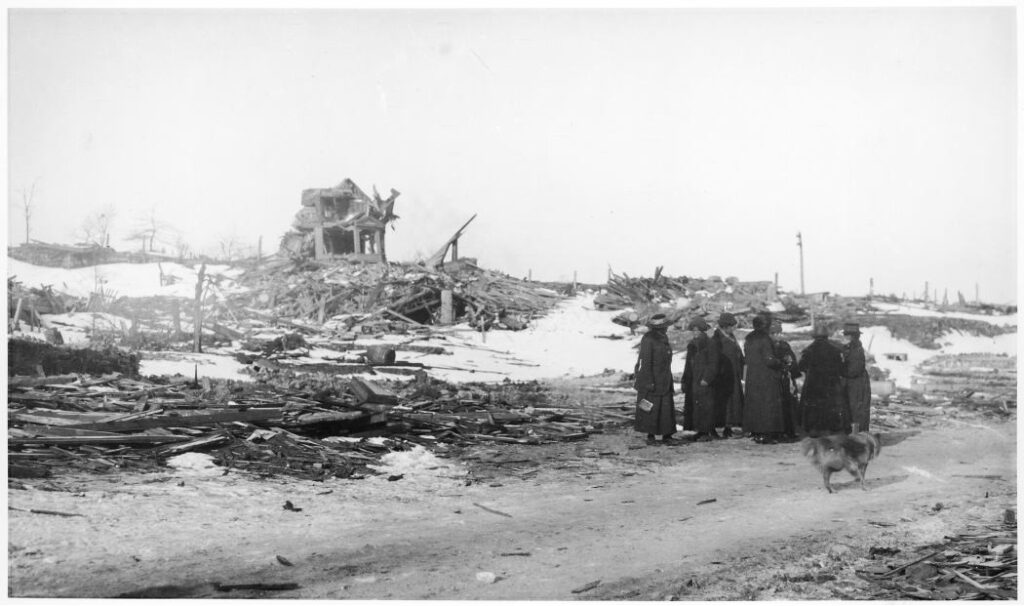
The two ships were the Norwegian merchant vessel Imo, en route to New York to pick up relief supplies for war-torn Belgium, and the other was the French ship Mont-Blanc, filled with tons of benzol, picric acid, TNT and gun cotton, set to join a convoy across the Atlantic. The Imo, steaming on the wrong side of the channel struck the Mont-Blanc, setting it ablaze. The French vessel’s crew abandoned ship leaving Mont-Blanc to drift closer to the populated shore. At 9:05 in the morning it exploded, destroying much of Halifax and damaging buildings 100 km away.

In her  Curse of the Narrows Laura MacDonald describes the effect of the explosion:

The air blast blew through the narrow streets, toppling buildings and crashing through windows, doors, walls, and chimneys until it slowed to 756 miles an hour, five miles below the speed of sound. The blast crushed internal organs, exploding lungs and eardrums of those standing closest to the ship, most of whom died instantly. It picked up others, only to thrash them against trees, walls, and lamp posts with enough force to kill them. Roofs and ceilings collapsed on top of their owners. Floors dropped into the basement and trapped families under timber, beams and furniture. This was particularly dangerous for those close to the harbour because a fireball, which was invisible in the daylight, shot out over a 1–4 mile area surrounding the Mont-Blanc. Richmond houses caught fire like so much kindling. In houses able to withstand the blast, windows stretched inward until the glass shattered around its weakest point, sending out a shower of arrow-shaped slivers that cut their way through curtains, wallpaper and walls. The glass spared no one. Some people were beheaded where they stood; others were saved by a falling bed or bookshelf. . . . Many others who had watched the fire seconds before awoke to find themselves unable to see.

The north end of the city was wiped out by the blast and subsequent tsunami. Nearly 2,000 people died, another 9,000 were maimed or blinded, and more than 25,000 were left homeless. An international rescue effort was put in place, one which is still recognized by Haligonians who every year send a giant Christmas tree to Boston to acknowledge the aid that city sent.

December 5

innocent_viii

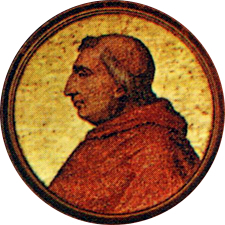
1484 Pope Innocent VIII issues the witch-hunting bull Summis desiderantes.

Though using magic in harmful ways (maleficium) was illegal in most cultures, we cannot speak of a witch craze in Europe until the late fifteenth century when Dominican Inquisitors began to persuade the Church that witchcraft was a variety of heresy and thus worthy of extirpation. Two documents were instrumental in provoking a social concern with witchery that lasted over two centuries. One was Malleus Maleficarum or The Hammer of Witches by Sprenger and Kramer, two German Dominicans; the second was the papal decree of 1484 Summis desiderantes. The latter begins:

 It has recently come to our ears, not without great pain to us, that in some parts of upper Germany, as well as in the provinces, cities, territories, regions, and dioceses of Mainz, Cologne, Trier, Salzburg, and Bremen, many persons of both sexes, heedless of their own salvation and forsaking the catholic faith, give themselves over to devils male and female, and by their incantations, charms, and conjurings, and by other abominable superstitions and sortileges, offences, crimes, and misdeeds, ruin and cause to perish the offspring of women, the foal of animals, the products of the earth, the grapes of vines, and the fruits of trees, as well as men and women, cattle and flocks and herds and animals of every kind, vineyards also and orchards, meadows, pastures, harvests, grains and other fruits of the earth; that they afflict and torture with dire pains and anguish, both internal and external, these men, women, cattle, flocks, herds, and animals, and hinder men from begetting and women from conceiving, and prevent all consummation of marriage; that, moreover, they deny with sacrilegious lips the faith they received in holy baptism; and that, at the instigation of the enemy of mankind, they do not fear to commit and perpetrate many other abominable offences and crimes, at the risk of their own souls, to the insult of the divine majesty and to the pernicious example and scandal of multitudes.

Over the next 200 years the Church and local authorities in some parts of Europe, especially Germany, arrested thousands of suspected witches, executing probably about 50,000 of them. This was not a “Female Holocaust” with 9,000,000 victims as some, including the National Film Board of Canada, have laughably asserted but a set of panicked reactions to an age of upheaval and violence. The Church feared heresy, secular officials feared disorder and ordinary people feared supernatural harm. Where judicial torture was legal, bizarre confessions were the result; where torture was illegal, as in England or Ireland, witchcraft confessions were few. Despite its black reputation the Spanish Inquisition was among the first to call a halt to these trials, seeing in them only deluded ravings.

December 2

Home / Uncategorized / December 2

Advent does not begin with a fixed date because the period can begin anywhere from November 27 to December 3. Consequently there is no one common custom to kick off the season. In Honduras there is a masked dancer called the Warini or Christmas Herald who goes door to door accompanied by singers and drummers to announce the season. And in Twente in Holland long wooden horns, carved out of saplings are sounded over a well to produce a deep foghorn like tone. In Oldenzaal trumpeters blow in Advent from the four corners of a medieval tower. Moravian churches will make the occasion by the erection of their famous multi-pointed stars.

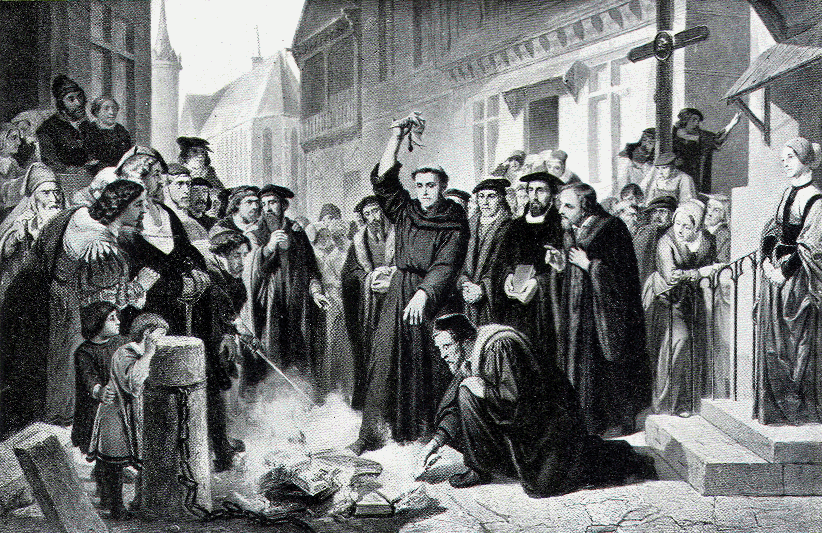
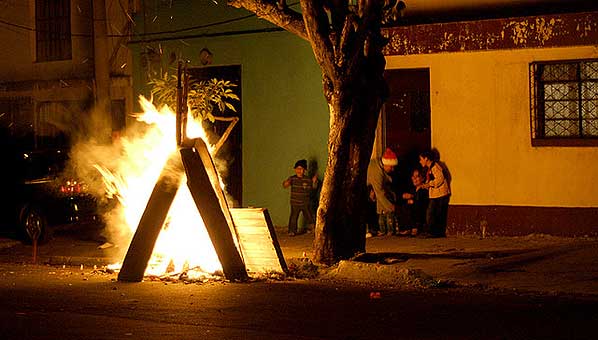
Almost everywhere there is the compulsion to clean the house.  In fifteenth century Florence a religious revival led by the monk Savonarola resulted in the famous “Bonfire of the Vanities”, a public burning of luxuries that were deemed to keep the minds of believers off of God and salvation. A similar spectacle occurs every year at the beginning of the Christmas season in Guatemala. On December 7 (also the day to celebrate the Immaculate Conception of the Virgin Mary) Guatemalans haul out of their homes the things they think they don’t need anymore and set them on fire in a ceremony called “The Burning of the Evil” — with their homes thus purged of unnecessary encumbrances their souls can prepare for the coming of Christmas. In Trinidad and Tobago the house must be given a thorough cleaning and decorated; a portion of the Christmas budget always goes to buying something new for the house at this time of year. New curtains are hung, windows are washed, furniture is recovered, long-delayed repairs are made, a new piece of linoleum is laid and the paint brush is busy. In northern Europe Advent is also a time to tend to the graves of the family dead as well as sprucing up the house. In Moravian settlements in Labrador a common expression or question heard in December is “Is you ready yet?” This means basically, “Do you have your house thoroughly cleaned?”

Advent

Home / Uncategorized / Advent

For such a momentous occasion as the birth of the baby-god Jesus, one might think that the first Christians would be quick to celebrate the event. Christmas is the second-highest festival on the Christian calendar and the most widely-celebrated holy day in history, but the fact is that it was an after-thought to the early church. The first generations of believers concentrated on the death and resurrection of Jesus and lived in profound expectation of his imminent return. What need was there to make a fuss over his humble origins when he would soon return again in glory to judge the living and the dead and to usher in a new heaven and a new earth?

As the years went by, and Christ seemed to be tarrying, the circumstances of his birth attracted more interest. Pagan critics of the new religion, such as Celsus, made mock of the claims of a virgin birth and asserted that Jesus was the illegitimate product of an adulterous union. Certain 2nd-century Christians, influenced by Greek Gnosticism, were skeptical of the idea of a god dwelling in human flesh – this was a repellent notion to the philosophers; the very purpose of the soul was not to become trapped in a body but to escape its earthly prison of meat and bone. These criticisms prompted the second-century Church to emphasize the truth of the nativity stories told in the gospels of Matthew and Luke and even to add to them in pious fictions such as The Protoevangelium of James which invented details about the youth of Mary and introduced the character of Salome, a midwife, to the events in Bethlehem.

By the year 200 Christian writers had begun to speculate about when the birth of Jesus had taken place and numerous dates were bandied about. This does not mean that Christians were seeking to know the date of the birth of Jesus in order to celebrate it. The theologian Origen declared that only pagan rulers had their birthdays trumpeted and, indeed, King Herod Antipas had given birthdays a bad name in the Christian community when he had used the occasion of his to order the execution of John the Baptist. Despite such a view, believers were growing fonder of recounting the story of the birth of Jesus. In Rome, where Christians gathered to worship in the funeral caves outside the city, they decorated a wall with a picture of the Nativity scene. The catacomb of St Priscilla bears an image of three Magi advancing toward the seated Virgin and child while a man standing beside her (probably meant to represent an Old Testament prophet) points to the guiding star in the heavens. Second and third-century pseudo-gospels such as The Revelation of the Magi were particularly interested in the appearance of the wise men who, guided by this miraculous star, became the first Gentiles to worship the Christ Child.

With the accession of the emperor Constantine in 312, Christianity became a legal religion, free to marks its holy days publicly, and the celebration of the Nativity soon was celebrated joyfully. During the 300s and 400s Christmas grew in importance on the church calendar as music, drama and liturgy were added in spectacular fashion. And then it occurred to someone – we know not who or where – that Christmas deserved a period of preparation such as Easter had with Lent. By the 500s there seems to have been a formally recognized fast beginning in mid-November on St Martin’s Day, a custom starting first in the Frankish church and then spreading in the West; other restrictions include a ban on matrimony, feasting  and games. In Rome itself the Advent period, as it was now known, named for the Latin “coming”,  was shorter, less penitential and more joyful and by the high Middle Ages the contrary tendencies had merged – the season had become shortened to a four-week fast with Lenten-type behaviour required.  These restrictions, however, were abolished in the twentieth century and the season is now one of reflection and spiritual preparation.

For liturgical churches of the West it marks the beginning of the Christian year. It is reckoned as a period of four Sundays beginning with the one closest to St Andrew’s Day on November 30. The faithful are to use this time to prepare themselves worthily to celebrate the anniversary of the Lord’s coming into the world as the incarnate God of love and also to make themselves ready for His final coming as judge, at death and at the end of the world. In church services, there are glorious hymns and lessons that point us to the prophecies and promises of coming redemption and the importance of heeding the injunction “prepare ye the way of the Lord.” 

November 30

Home / Today in Church History / November 30

November 30 is Saint Andrew’s Day. Andrew was a fisherman, the brother of Simon Peter and a follower of John the Baptist. He recognized Jesus as the Messiah and was called by the Lord to be an apostle. Andrew appears a number of times in Gospels, such as when Jesus discusses the end of the world in Mark 13 and at the Feeding of the Five Thousand in John 6.

Legend says that after the death of Jesus Andrew travelled widely, spreading the faith to Asia Minor, the Caucasus, what is now Ukraine and Russia, Byzantium and the Balkans. The churches in Constantinople and Georgia thus claim an apostolic founder. In Greece he was martyred on an X-shaped cross which became his symbol. The saltire or St Andrew’s cross is on the flag of Scotland, which claims him as a patron saint, and on the naval flag of Russia, where he is also a patron. Because Andrew was the first disciple called by Jesus, his feast day heralds the start of the Christian calendar.

November 30 is also the birthday of Winston Churchill and Mark Twain, and the anniversary of the death of Oscar Wilde.

For Winston Spencer Churchill I have nothing but praise. The greatest Briton of his era (and of all time according to a BBC poll which placed Princess Diana third, far ahead of Isaac Newton and William Shakespeare) he saved civilization at the cost of the British Empire. He assumed office as the Allied position in the west was collapsing and the French government and army were too intent on speed-reading their German phrase books to defend their country. But herein lies a salutary lesson for those who think that the events of 1940 prove that Gauls are, by nature, cheese-eating surrender monkeys. Antony Beevor’s monumental history Berlin: The Downfall, 1945 notes that in the final few days of World War II, when Hitler lay dead and the survivors of the Nazi hierarchy were scuttling like rats out of the ruins of Berlin, the last Axis defenders in the city were Frenchmen. These remnants of the SS Charlemagne Division fought on in the wreckage of the Third Reich until they were overrun by the Red Army.

Mark Twain is little appreciated outside of the United States and for good reason. Next to Walt Whitman he is the most insufferable of American writers and next to Herman Melville the most unreadable.

There was a lot that was insufferable about Oscar Wilde too. He continually betrayed a loving wife and found furtive pleasure on the bodies of under-age servant boys and rancid young aristocrats. He made almost an entire career of far-too-artfully polished apothegms (‘All women become like their mothers. That is their tragedy. No man does. That is his.’) and a smirking inversion of received truths (‘As for the virtuous poor, one can pity them, of course, but one cannot possibly admire them.’) He brought his sad end upon himself, but for the sake of his children’s stories, Oscar Wilde will be forgiven much. Requiescat in pace.

November 29

Home / Today in Church History / November 29
 

A great day for massacres

On November 29, 1729 the Natchez tribe rose up against French settlers in Louisiana. Vexed by French encroachment on their territory the Natchez attacked Fort Rosalie and settler farms, killing over 200 colonists. The French reacted vigorously and allied with Choctaw warriors, traditional enemies of the Natchez, they destroyed many villages and enslaved hundreds. By 1736 the Natchez had ceased to exist as an independent people.

On this date in 1781 the crew of the English slave ship Zong, faced with a lack of drinking water, threw 130 enslaved Africans overboard. As was customary, the lives of these slaves had been insured and the woners of the Zong made a claim for their losses. A jury found that the slavers could recive compensation for the people thay had murdered by an appeal court reversed that ruling. The incident was a great spur to the abolition movement, leading to laws prohibiting such insurance claims, mandating better treatment in shipping slaves, and finally an end to British participation in the African slave trade.

In the early years of the American Civil War, the Cheyenne tribe took advantage of Washington’s preoccupation in subduing the southern rebellion by fighting back against white settlement in the territory they claimed, carrying out a number of massacres and atrocities. On this date in 1864 a troop of volunteer cavalry under Colonel John Chivington attacked and destroyed a village of Cheyenne and Arapaho people in southeastern Colorado Territory, killing and mutilating an estimated 70–500 Native Americans, about two-thirds of whom were women and children. A subsequent inquiry was scathing in its assessment:

As to Colonel Chivington, your committee can hardly find fitting terms to describe his conduct. Wearing the uniform of the United States, which should be the emblem of justice and humanity; holding the important position of commander of a military district, and therefore having the honor of the government to that extent in his keeping, he deliberately planned and executed a foul and dastardly massacre which would have disgraced the veriest savage among those who were the victims of his cruelty. Having full knowledge of their friendly character, having himself been instrumental to some extent in placing them in their position of fancied security, he took advantage of their in-apprehension and defenceless condition to gratify the worst passions that ever cursed the heart of man.

On November 29, 1986 the Surinamese army attacked the village of Moiwana, killing at least 35 of the inhabitants, mostly women and children, and burning the house of rebel leader Ronnie Brunswijk who was leading a fight to protect the rights of the maroon (descendants of escaped African slaves) minority. The survivors fled with thousands of other inland inhabitants over the Marowijne River to neighboring French Guiana. An end to the conflict was eventually negotiated and Brunswijk is now vice-president of the country.

November 28

Home / Today in Church History / November 28
bunyan

1628 Birth of John Bunyan

John Bunyan was born in Bunyan’s End, Bedfordshire to a family of small means. As a teenager he followed the tinker’s trade and then served in the rebel armies during the English Civil War. At the war’s end in 1649 he returned home where he underwent a religious conversion and joined a congregation of nonconformist Protestants. In 1655, though unlearned in anything except the English scriptures, he began to preach and write tracts. He had been cautioned for unlicensed preaching in 1659 but his real troubles began with the return of the English monarchy in 1660 and the reestablishment of the Anglican Church which cracked down on the radical sects and demanded that all services be conducted according to the Book of Common Prayer. Bunyan refused to abandon his calling and was arrested and imprisoned numerous times for unlicensed preaching and abstaining from attendance at a lawful church. After 1672 the government relaxed its oppression of nonconformists for a time; Bunyan was released from prison and became a popular minister, even being named chaplain to the Lord Mayor of London.

Bunyan was an indefatigable writer, producing some 6o tracts and books of a religious nature. His spiritual autobiography, Grace Abounding to the Chief of Sinners, and The Life and Death of Mister Badman are still read, but most of his other works such as Seasonal Counsel or Suffering Saints in the Furnace – Advice to Persecuted Christians in Their Trials & Tribulations are not. His masterwork is Pilgrim’s Progress or to give it its full title, The Pilgrim’s Progress from This World to That Which Is to Come; Delivered under the Similitude of a Dream, published in 1678. It follows the journey of sin-burdened Christian from the City of Destruction past the Slough of Despond, Vanity Fair, the Valley of Humiliation, the Hill of Difficulty and other trials to his destination in the Celestial City. Along the way he will meet Evangelist, Mr Worldly Wiseman, Simple, Sloth, Presumption and the demonic Apollyon. Pilgrim’s Progress is the most famous allegory in the English language, a monument of religious literature which has inspired many. It has been translated into more than 200 languages and has never been out of print. Modern-language versions are now being produced for those whose taste does not run to seventeenth-century English prose.

November 27

Home / Today in Church History / November 27
images

511 Death of the first Christian king of France.

Early in the 400s the Roman empire was invaded by a host of Germanic tribes moving down out of northern and central Europe. The empire in the east with its capital at Constantinople had the money and troops to defend itself, but the western half of the empire was overrun. Rome was sacked, the last emperor was deposed by a German warlord, and what had once been a single state was now a motley collection of barbarian kingdoms established by Ostrogoths, Visigoths, Burgundians, Angles, Saxons, Vandals and Jutes. One of the most formidable of the new states was the Kingdom of the Franks which covered most of what had been Gaul and which was ruled by the ruthless Clovis who managed to claw his way to the top over the bodies of rival Frankish leaders.

Most of the original inhabitants of Clovis’s new kingdom were Catholic Christians while invaders such as the Franks were either pagan or Arian Christian. On Christmas Day in 496 Clovis agreed to a Catholic baptism in order to better secure his rule, associating himself with the religion of his people and of Rome. This baptism was miraculously marked by the arrival of a container of holy oil from heaven which was used to anoint Clovis and many subsequent kings of what became France. French monarchs could thus claim the title of “Most Christian King”.

Clovis had brutally united his kingdom and many historians consider this the foundation of the French nation and Clovis the founder of the Merovingian dynasty. However, the Franks followed the custom of partible inheritance whereby a father divided his land equally among his sons and on the death of Clovis in 511 his kingdom was partitioned among his four sons. The tawdry history of the Merovingian Franks is one long story of conquest, unification, partition, battle and reunification. Why Dan Brown in The Da Vinci Code chose the thuggish family of Clovis to be the supposed bloodline of Jesus remains a mystery best left unsolved.

November 26

Home / Today in History / November 26

casa-wall01

1942 The premiere of the world’s greatest movie

The movie Casablanca, directed by Michael Curtiz, and starring Humphrey Bogart, opens in New York. Released to take advantage of the invasion of North Africa and buoyed by the Casablanca Conference of 1943, the film did well at the box office but it was not a smashing success. Only after the Second World War did it become a cult hit and viewed as a critical triumph.

The film, based on the unproduced play Everybody Comes to Rick’s, charts the dilemma of night-club owner Rick Blaine in French Morocco; he claims to stick his neck out for no one but will his good instincts and chivalry trump his love for another man’s wife?

The cast was superb. Everyone remembers the luminous Ingrid Bergman but there were two other radiant beauties involved with Rick: the lovely Yvonne (played by 19-year old French refugee Madeleine Lebeau who in real life was married to the actor who played he roulette croupier) and Annina, the Bulgarian newlywed (Joy Page). Claude Rains was never better than as corrupt Captain Louis Renault; Peter Lorre oiled his way on screen as the odious Ugarte (“You despise me, don’t you Rick?”); and Conrad Veidt (the highest-paid member of the cast) sneered as German Major Heinrich Strasser. Only Paul Henried underperformed as the wooden resistance leader Victor Lazlo. Dooley Wilson enchanted as the piano player Sam, singing “As Time Goes By” and “Knock on Wood”.

Consider these great lines:

Rick: Of all the gin joints, in all the towns, in all the world, she walks into mine.

Yvonne: Where were you last night?  RickThat’s so long ago, I don’t remember.  Yvonne: Will I see you tonight?  Rick: I never make plans that far ahead.

Strasser: You give him credit for too much cleverness. My impression was that he’s just another blundering AmericanRenault: We musn’t underestimate “American blundering”. I was with them when they “blundered” into Berlin in 1918.

Renault: I’ve often speculated why you don’t return to America. Did you abscond with the church funds? Did you run off with a Senator’s wife? I like to think that you killed a man. It’s the romantic in me.
RickIt’s a combination of all three.
Renault: And what in Heaven’s name brought you to Casablanca?
RickMy health. I came to Casablanca for the waters.
RenaultThe waters? What waters? We’re in the desert.
RickI was misinformed.

Renault: Major Strasser has been shot… round up the usual suspects.

Roger Ebert claimed Casablanca was “probably on more lists of the greatest films of all time than any other single title, including Citizen Kane“. Leonard Maltin said it was the best loved of all Hollywood films. But clever people who talk loudly in restaurants had other ideas. Pauline Kael thought it was far from great, Umberto Eco thought it was mediocre, a “a comic strip, a hotch-potch, low on psychological credibility, and with little continuity in its dramatic effects” while the New Yorker deemed the film “pretty tolerable”.  Ha!