January 12

Home / Today in History / January 12

1131

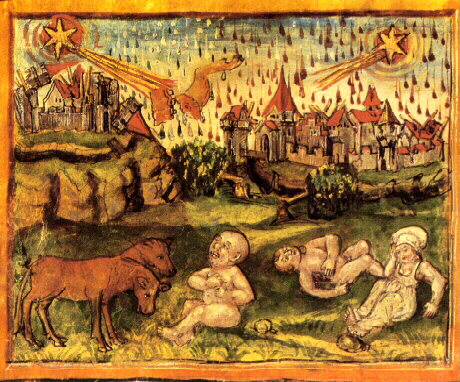
It was a tough year in England. According to the Anglo-Saxon Chronicle:  This year, after Christmas, on a Monday night, at the first sleep, was the heaven on the northern hemisphere all as if it were burning fire; so that all who saw it were so dismayed as they never were before. That was on the third day before the ides of January. This same year was so great a murrain [infectious disease] of cattle as never was before in the memory of man over all England. That was in neat cattle [horned oxen] and in swine; so that in a town where there were ten ploughs going, or twelve, there was not left one: and the man that had two hundred or three hundred swine, had not one left. Afterwards perished the hen fowls; then shortened the fleshmeat, and the cheese, and the butter. May God better it when it shall be his will.

January 11

Home / Today in History / January 11

The first lottery in England took place on the 11th of January, 1569, at the west door of St. Paul’s Cathedral. The scheme, which had been announced two years before, shows that the lottery consisted of forty thousand lots or shares, at ten shillings each, and that it comprehended ‘a great number of good prizes, as well of ready money as of plate, and certain sorts of merchandize.’ The object of any profit that might arise from the scheme was the reparation of harbours and other useful public works.

Today, the lottery is a tried and trusted way of government revenue collection with prizes in the tens or even hundreds of millions of dollars. In 2016 a prize of $1.58 billion was shared among three winners of the Powerball lottery. The biggest single winner’s ticket yielded $1,537 billion.

It is interesting to consider this 19th-century view of the habit: Lotteries, by creating illusive hopes, and supplanting steady industry, wrought immense mischief. Shopmen robbed their masters, servant girls their mistresses, friends borrowed from each other under false pretences, and husbands stinted their wives and children of necessaries—all to raise the means for buying a portion or the whole of a lottery ticket. But, although the humble and ignorant were the chief purchasers, there were many others who ought to have known better. In the interval between the purchase of a ticket and the drawing of the lottery, the speculators were in a state of unhealthy excitement. On one occasion a fraudulent dealer managed to sell the same ticket to two persons; it came up a five hundred pound prize; and one of the two went raving mad when he found that the real ticket was, after all, not held by him. 

January 10

220px-william_laud

1645

The death of an archbishop.

William Laud (1573-1645) was an English churchman during the reigns of Elizabeth I, James I and Charles I, a time when Anglicanism was being defined and when ecclesiastical issues were literally matters of life and death.

Under Elizabeth the Church of England sought a religious via media, with a Protestant theology mated with the rule of bishops and an ornate ceremonial. It was opposed by Catholics who sought a return to Rome and by Puritans who wished to purge the “popish dregs” of ceremony and episcopacy. In 1605 the attempt by Catholic conspirators to murder the entire royal family, political class and church leadership in the Gunpowder Plot convinced most Englishmen that Catholicism meant foreign tyranny and that Protestantism meant patriotism.

The latter belief became problematic when King Charles I married a Catholic French princess and covertly allowed Catholic clergy at court. The problem was exacerbated when Charles nominated William Laud to be, first, Bishop of London (1628) and then Archbishop of Canterbury (1633). Through church courts, Laud enforced a novel theology on Anglicanism, his version of Arminianism which challenged some long-held doctrines and imposed a very Catholic-looking ceremonial, and drove out Puritan leaning preachers and professors. His persecution of the dissident writer William Prynne, who was sentenced to judicial mutilation and imprisonment, was very unpopular. Prynne had been branded on the forehead with the letters “SL”, meaning “seditious libel” but which the victim claimed really represented “Stigmata Laudis” — “the marks of Laud”. By 1640 anger between the royal party and large sections of public and political opinion were at a boiling point.

After years of trying to rule on his own Charles was obliged to call Parliament which called for the arrests of the king’s chief advisors, Laud and William Wentworth. Wentworth went to the block in 1641 but Laud’s trial was delayed. He was accused of bribery, attempting to impose a tyranny, sponsoring Catholic influence, undermining Parliament and having “treacherously endeavoured to subvert the Fundamental Laws of this Realm; and to that end hath in like manner endeavoured to advance the Power of the Council-Table, the Canons of the Church, and the King’s Prerogative, above the Laws and Statutes of the Realm”. Laud was executed on this day in 1645.

Laud was exactly the wrong man for the high positions he held at the time he was appointed to them; aggressive and intolerant, he helped create the crisis that led to the English Civil War and the execution of himself and the king he served.

January 9

It is St Fillan’s Day. Fillan was an 8th-century Scottish saint,  known for his piety and good works. He spent a considerable part of his holy life at a monastery which he built in Pittenweem. While engaged here in transcribing the Scriptures, his left hand sent forth sufficient light to enable him, at night, to continue his work without a lamp. For the sake of seclusion, he finally retired to a wild and lonely vale, called from him Strathfillan, in Perthshire, where he died, and where his name is still attached to the ruins of a chapel, to a pool, and a bed of rock.

The uses to which the locale was put tell us much about the treatment of mental illness in Medieval Scotland: At Strathfillan, there is a deep pool, called the Holy Pool, where, in olden times, they were wont to dip insane people. The ceremony was performed after sunset on the first day of the quarter, and before sunrise next morning. The dipped persons were instructed to take three stones from the bottom of the pool, and, walking three times round each of three cairns on the bank, throw a stone into each. They were next conveyed to the ruins of St. Fillan’s chapel; and in a corner called St. Fillan’s bed, they were laid on their back, and left tied all night. If next morning they were found loose, the cure was deemed perfect, and thanks returned to the saint. The pool was visited  in the nineteenth century, not by parishioners, who had no faith in its virtue, but by people from other and distant places.

January 8

unknown-1

2009

Richard John Neuhaus dies.

Richard John Neuhaus (1936-2009) was in his time a Canadian, an American, a liberal civil rights advocate, Lutheran priest, Catholic priest, magazine editor, conservative presidential advisor, and fierce defender of the role of religion in public life.

Born in Pembroke, Ontario, he moved with his family to the United States where he became, like his father, a Lutheran pastor. In the 1960s he became an outspoken critic of the war in Vietnam and marched with Martin Luther King in demanding greater rights for racial minorities. Neuhaus’s life took a different direction after the 1973 “Roe v Wade” Supreme Court decision on abortion; growing more conservative he sought to create a united voice for Christianity in social and political matters. He helped found the journal  First Things, where Protestant, Catholic and Jewish thinkers could “advance a religiously informed public philosophy for the ordering of society” and wrote or edited influential books such as The Naked Public Square: Religion and Democracy in America, Guaranteeing the Good Life: Medicine and the Return of Eugenics and American Babylon: Notes of a Christian Exile. With Chuck Colson he produced Evangelicals and Catholics Together: Toward a Common Mission. In 1990 he joined the Roman Catholic Church and in the next year he was ordained into the priesthood. Few have done as much to bring religious thinking to bear in the public square.

On the question of absolute truth and religious tolerance he proposed “Neuhaus’s Law”, which states, “Where orthodoxy is optional, orthodoxy will sooner or later be proscribed.”

January 7

Home / Today in History / January 7

2015, the Charlie Hebdo Massacre

Charlie Hebdo is a weekly French satire magazine, known for its uncompromising (not to say crude) attacks on right-wingers, religions of all sorts, and politicians. In 2006 the magazine printed cartoons which mocked Islam and its founder, Muhammed. This provoked lawsuits but Charlie was undeterred, continuing to satirize Islam. A 2011 issue listed Muhammed as one of the editors and claimed that he was opposed to religious violence. Their offices were firebombed shortly thereafter but Muslim-targeted cartoons continued.

On January 7, 2015, two brothers, Saïd and Chérif Kouachi, French-born of Algerian descent entered the Charlie Hebdo offices and killed 12 people and wounded others, some of them journalists but also police officers, a janitor, and passers-by. They claimed to be operating under the sanction of al-Qaeda and shouted “Allahu Akbar! Allah is greatest!” as they escaped. Two days later the gunmen were cornered and killed as they tried to shoot their way past police. During this standoff, one of their supporters in Paris took hostages in a kosher grocery story and killed four shoppers.


January 6

Home / Today in History / January 6

January 6 is Epiphany on the Christian calendar, one of those days when coronations often took place in the Middle Ages. Consider the following:

440px-knut_der_grose_cropped

1017 Cnut (or Canute) is crowned King of England

Cnut (995-1935) is known as Cnut the Great, having formed a North Atlantic empire composed of England, Denmark, and Norway. He was an effective king of England  but his composite kingdom fell apart on his death, leading to a restoration of the Anglo-Saxon dynasty.

unknown-1

1066 Harold II is crowned King of England

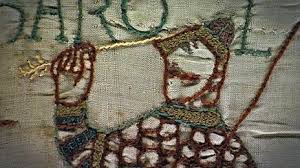
Harold (1022-1066) was the last of the Anglo-Saxon kings of England. He succeeded his brother-in-law, the childless Edward the Confessor, but faced two rivals for the throne. The first was an invasion of the Viking Harald Hardrada who was aided by Harold II’s treacherous brother Tostig. Before the decisive battle of Stamford bridge Harold tried unsuccessfully to woo back his brother, but ended up killing him and Hardrada in battle. Harold was less successful against the invasion by William of Normandy, falling to an arrow in the eye at the Battle of Hastings.

stefan_decanski_ktitor

1322 Stefan Uroš III is crowned King of Serbia

Balkan politics have always been a blood sport. As a youth Stefan (1285-1331) was sent by his father to be a hostage in the hands of the Mongol Golden Horde. Having survived that he quarrelled with his father who sent him to Constantinople, the capital of the Byzantine Empire, with secret instructions that the Byzantines blind him, rendering him unfit to succeed his father. The blinding was not total and when, on the death of his father, Stefan faced rivals for the throne he was able to win support by claiming that a divine miracle had restored his sight.

constantine_palaiologos

1449 Constantine XI is crowned Byzantine Emperor

Constantine (1405-1453) was the last Christian ruler of Constantinople, the last Roman emperor. This Byzantine empire had fallen on hard times and had shrunk to a few holdings in Greece and along the Black Sea coast and the capital itself. In 1453 the Turks under Mehmet the Conqueror stormed the city and Constantine died in the fighting. His body was never recovered and legend says he will return one day and drive out the Turks.

January 5

tumblr_inline_ndiqjijb6x1qagjj4

1534

Radical Anabaptists enter Münster.

Though the Protestant Reformation caused division and violence throughout Germany there were cities where an uneasy truce between Lutherans and Catholics was maintained, often because neither side was a sufficiently numerous to oppress the other. One such city was Münster in Westphalia, nominally under the rule of a Catholic prince-bishop but so evenly divided between factions that the city developed a reputation for religious tolerance. Seeking that freedom from persecution, in January 1534 large groups of Anabaptists began migrating to the city, lured by the promise that this was the “New Jerusalem”. Making common cause with many local Lutherans the Anabaptists soon gained control of the city, driving Catholic inhabitants out and demanding that adult baptism become compulsory. A Dutch  baker named Jan Matthys assumed leadership, preaching a message of Christian communism and the expectation of the End of Time; Münster had become the centre of a radical form of Protestantism that called on the people of Germany and the Netherlands to come to their aid to break the siege that the expelled bishop had surrounded the city with.

On Easter Sunday 1534 Matthys led an ill-advised sortie against the bishop’s troops which resulted in his death. Jan of Leiden, a tailor, took over the city, proclaiming himself king, the successor of David, with the former mayor Bernard Knipperdolling as his sword-bearer and executioner. Polygamy was the order of the day with Jan taking sixteen wives and murdering one who refused to wed him. Though all goods were to be held in common, the inhabitants of the city starved while Jan sat on a gold throne and his circle dined well. Finally, the gates of Münster were opened by a desperate Anabaptist and the army of the bishop poured in, intent on loot and massacre. Leiden and Knipperdolling were tortured and hoisted up in steel cages on the town’s highest church steeple where their remains were visible for centuries as a lesson against radical excesses.

January 4

Home / Today in History / January 4

1999, Death of a cultural appropriator

In a 1971 public service announcement so iconic that it made The Simpsons, Iron Eyes Cody, seemingly a nature-loving native American, is depicted crying at the litter that pollutes the landscape. On this day in 1999 that actor died.

Iron Eyes Cody appeared in over 200 films and 100 television episodes making a comfortable living portraying the Indian part of “Cowboys and Indians”: Chief Black Feather, Chief Sky Eagle, Chief Watashi, Chief St Cloud, Chief Thundercloud, Chief Big Cloud, Chief Grey Cloud, Chief Yellow Cloud, Crazy Horse, Crazy Foot, Crow Foot, etc.

To the end of his days, Mr Cody insisted that he was a Cherokee, or a Cree, or some other sort of tribesman. In fact, he was the son of Italian immigrants, born Espera Oscar de Corti. He began his Hollywood career as an extra and ended it having his own star on the Walk of Fame.


January 3

1521

With the papal bull Decet Romanorum Pontificem (“It Pleases the Roman Pontiff”), Pope Leo X excommunicates Martin Luther.

“Since God has given us the papacy, let us enjoy it”. So said Giovanni de’ Medici (1475-1521) on his election to the papacy as Leo X in 1513. A great patron of the arts, he was a bumbler in his dealings with the beginnings of the Protestant Reformation. He failed to prevent Luther from spreading his ideas throughout Germany and northern Europe despite condemning his writings in 1520 and excommunicating him in 1521.

440px-statue_of_amakusa_shiro_at_shimabara_castle_20090906

1638

The forces of the Japanese shogun defeat Christian peasant fighters during the Shimabara Rebellion. Provoked by oppressive rule, heavy taxation and anti-Christian legislation, peasants and masterless samurai of Kyushu rose up against their overlords. They will eventually be wiped out and the shogunate will enact harsher anti-foreigner and anti-Christian rules, resulting in an almost total isolation of Japan for centuries. A statue of the rebel leader Amakusa Shiro stands on the grounds of Shimabara Castle today.

1892

Birth of J.R.R. Tolkien, author of the Lord of the Rings and The Hobbit. As a member of the Inklings literary club, he was influential in the conversion of C.S. Lewis to Christianity.