Doing dangerously silly things is usually the province of men, who for hormonal reasons are much more prone to teasing alligators, climbing icy mountains and trying to go fast in a rocket-power shopping cart.
Imagine the surprise of the world, therefore, when on October24, 1901 an elderly woman climbed into a barrel constructed of oak and iron and padded with a mattress and floated down the Niagara River toward the famous falls. Annie Edson Taylor, on her 63rd birthday, clutching her lucky heart-shaped cushion, was the first person to survive a trip over the mighty cataract.
Her motive was financial but she made little money from her perilous drop, especially after her manager ran away with her barrel.
Of her stunt she would say: “If it was with my dying breath, I would caution anyone against attempting the feat … I would sooner walk up to the mouth of a cannon, knowing it was going to blow me to pieces than make another trip over the Fall.”
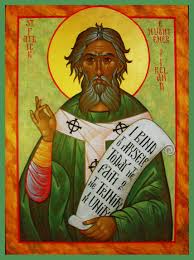
We expect saints to perform miracles. These days, proof of a miraculous cure or two is one of the ways the Catholic Church decides that an individual has exhibited saintly prowess. We do not routinely expect, however, that saints go about lugging their severed heads, but hagiographies abound in cephalophores (head-carriers) and today we celebrate the first of them: St Denis.
St Denis seems to have been sent from Italy to evangelize Roman-occupied Gaul in the third century. He converted so many in the region of what is now Paris that the authorities were alerted to his presence and he, with two companions, was beheaded on the city’s highest point, Montmartre. This execution does not seem to have deterred Denis from picking up his severed sense-organ cluster and walking six miles to his burial site, with the detached head preaching a sermon of repentance all the way.
Other cephalophoric saints include Nicasius of Rheims who was reading a psalm when he was decapitated — his head finished reciting the verse he was on — and St Gemolo who, after his execution, picked up his head mounted a horse and rode off to meet his uncle. St Paul’s head was separated from his body by a sword but, nevertheless, was reputed to have cried out “Jesus Christus” fifty times.
Denis is not to be confused (though he was for centuries) with Dionysius the Areopagite who was converted by Paul in Athens. And of the latter’s imposter, Pseudo-Dionysius the Areopagite, we shall remain silent.
On October 2, 2006, an employed church-going husband and loving father named Charles Carl Roberts IV entered a one-room schoolhouse in West Nickel Mines, Pennsylvania and took the teacher and students hostage. After allowing some of his prisoners to leave, Roberts then lined up the remaining ten students, all girls, and began to shoot them. He killed five and wounded five others before killing himself as police broke in to the building. His suicide notes gave a variety of reasons for his actions, including a history of sexual molestation and anger at God.
What astonished the world after these deaths was the reaction of the local Amish community which reacted not with anger or frustrated calls for vengeance but with compassion for the killer and pity for his family. A spokesman said, “I don’t think there’s anybody here that wants to do anything but forgive and not only reach out to those who have suffered a loss in that way but to reach out to the family of the man who committed these acts.” Amish residents attended Roberts’s’ funeral and embraced his relatives. These extraordinary examples of Christian behaviour helped healing in the lives of all concerned. The killer’s wife, Marie Roberts, said that she and her three young children had been overwhelmed by the community support. “Your love for our family has helped to provide the healing we so desperately need,” she wrote. “Gifts you’ve given have touched our hearts in a way no words can describe. … Your compassion has reached beyond our family, beyond our community, and is changing our world, and for this we sincerely thank you.” Terri Roberts, the killer’s mother, still volunteers to care for one of the victims, confined to a wheel-chair for life.
There is nothing to say that saints have to live long and arduous lives; hagiographies are full of the tales of young people who have been canonized for flashes of sanctitude or a single action. Few saints of tender years can have had so great an influence as this French woman who died at the age of 24 after a long battle with tuberculosis.
Marie-Françoise-Thérèse Martin (1873-97) was born into a pious middle-class family in northwestern France and decided at an early age she wished to be a nun, a resolve that strengthened when she experienced a vision of the Virgin. At 15 she entered the Discalced (Shoeless or Barefoot) Carmelites, a contemplative order of cloistered women with a house at Lisieux, Normandy which her sisters had already joined. She took the religious name Theresa of the Child Jesus and the Holy Face. The rest of her short life she spent inside the walls of her convent, praying, serving and writing.
Love proves itself by deeds, so how am I to show my love? Great deeds are forbidden me. The only way I can prove my love is by scattering flowers and these flowers are every little sacrifice, every glance and word, and the doing of the least actions for love.
It is through her exposition of “the little way” that made Theresa famous, winning her sainthood after her death and the title Doctor of the Church. In her poetry and her autobiography, The Story of a Soul, Theresa advocated a life of child-like trust and small loving actions. She is the patroness of African missions, those suffering from AIDS or tuberculosis, air crews and florists.
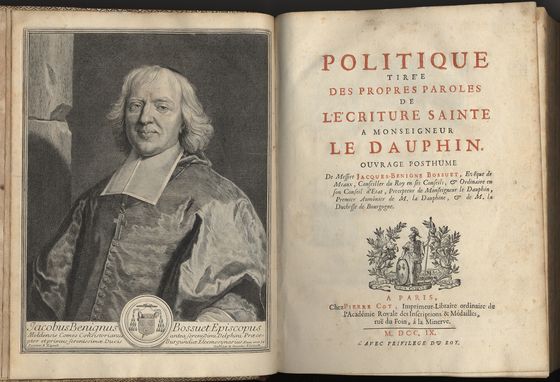
Jacques-Bénigne Bossuet (1627-1704) has been called the greatest pulpit orator ever; his name is a byword for elegance of speech. As a preacher and Catholic bishop he engaged in the great religious controversies of his time, taking on Protestants, Quietists, ultramontanists and secularists; as a tutor to the heir to the throne he failed miserably.
Bossuet was born to a prosperous provincial family of lawyers with powerful connections. He was destined by his family for the Church and in the amiable corruption of the age became tonsured at age 10 and a canon of the cathedral of Metz at 13. Though he continued to take advantage of sins against canon law such as absenteeism, Bossuet took his religious commitment seriously; he studied for the priesthood under St Frances de Sales and received his Doctor of Divinity.
Even in his teens Bossuet had a reputation as a brilliant public speaker and he eventually attracted the attention of the court of Louis XIV. He preached before royalty and was rewarded with a bishopric and the post of tutor to Louis’ oldest son, the Grand Dauphin. His efforts in this regard were misplaced and wasted. To school the lumpish lad he wrote three grand tomes, a treatise on knowing God and oneself, a history of the world, and a creaky master-piece entitled Politique Tirée des Propres Paroles de L’Ecriture Sainte. [This is the book I translated as Political Theory Drawn from the Very Words of Holy Scripture for part of my Master’s thesis.] The latter was the last bold attempt at defending absolute monarchy, no surprise from a courtier of the Sun King, but it fell on deaf ears — not only those of the Dauphin but the larger world about to experience the Enlightenment and the Age of Revolutions. It may be said that Bossuet was born a generation too late but that his golden expressions are still valued by lovers of the French language.
In the 19th century, Sudanese territory was claimed by Egypt, which ran a corrupt and oppressive rule over the territory. In 1881 a devout Muslim religious scholar named Muhammad Ahmad declared himself the Mahdi, the legendary prophesied figure that would appear at the end of time and who would herald the arrival of Isa (Jesus) and the Final Judgment. He was able to rally the disaffected tribes of the Sudan against the Egyptians, conquering much of the upper Nile valley. Like ISIS and their caliphate, the Mahdi attempted to reintroduce the pure, harsh Islam of the 7th century.
After several military attempts to defeat the Mahdi, the British (who now controlled Egypt) decided to pull out of the Sudan and sent the charismatic, popular hero General Charles Gordon to arrange the evacuation. Gordon, instead, chose to stay and fight. He and his troops were massacred in the capital Khartoum in 1884, causing an enormous scandal back in Britain. Though the Mahdi soon died, his successor, known as the Khalifa, built a powerful Mahdist state that attempted to spread its variety of Islam by the sword.
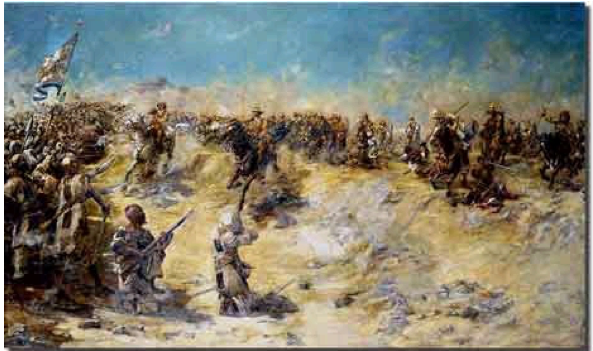
In 1898 the British decided to put an end to this threat to European imperialism in Africa, sending an army up the Nile, under General Herbert Kitchener. The Mahdist forces greatly outnumbered Kitchener’s troops but the British had machine guns and artillery. Near the confluence of the Blue and White Niles at Omdurman, the wild charges of the Mahdists (called “dervishes” or “Fuzzy-Wuzzy” by the British) were mowed down by disciplined fire of the more modern army.
Four Victorian Crosses were awarded for that day’s action including one to a Canadian, Captain Raymond de Montmorency of the 21st Lancers (whose charge is depicted here.)
The citation for the medal reads: “At the Battle of Khartum on the 2nd September 1898, Lieutenant de Montmorency, after the charge of the 21st Lancers, returned to assist Second Lieutenant R. G. Grenfell, who was lying surrounded by a large body of Dervishes. Lieutenant de Montmorency drove the Dervishes off, and, finding Lieutenant Grenfell dead, put the body on his horse which then broke away. Captain Kenna and Corporal Swarbrick then came to his assistance, and enabled him to rejoin the Regiment, which had begun to open a heavy fire on the enemy.”
De Montmorency was born in Quebec in 1867, the son of a British general, and he joined the British Army at the age of 20. After Sudan, de Montmorency was assigned to South Africa where he fought in the Boer War, dying at the Battle of Stormberg in 1900.
The classic 1939 movie “The Four Feathers” recreates the Battle of Omdurman with a cast of tens of thousands. It’s quite impressive. Do not, on any account, watch the putrid remake of 2003.
One of the joys of being a medieval historian is understanding the nicknames of famous leaders of the day. A single battle in 1066, for example, transformed William “the Bastard” into William “the Conqueror” while a lifetime of feckless behaviour earned Ethelred the label of “the Unready”. Wonderful stories lie behind the origins of sobriquets like “Bushy-Brow”, “the Impotent”, “the Boneless”, “Hare-Foot”, “the Twister”, and “Blood-Axe”. But what about Kaupo of Livonia who ended up being known as “the Accursed”?
The last parts of Europe to be Christianized lay at the eastern end of the Baltic, between the Orthodox lands of Russia and Catholic Germany and Poland, inhabited by tribes of Finns, Livonians, Latvians, etc. Attempts to peacefully evangelize them were met with resistance, prompting a series of Northern Crusades by military orders such as the Teutonic Knights or Knights of the Sword who combined missionary work with brutal conquest.
As these German-speaking orders pressed eastward, one of the first Livonians to accept baptism was Kaupo of Turaida, a local chieftain who so impressed the Bishop of Riga that he took him to Rome where he was presented to the pope. On his return to his native land, however, Kaupo was rejected for his new religion and alliances with foreigners. He had to reconquer his own castle and died fighting along side crusaders against pagan Estonians; for his divided loyalties he was labelled a traitor and “the Accursed”. It was not until the early 1300s that the territory was nominally Christianized.
I pause here to draw your attention to two Canadians of whom you have never heard. They were not particularly great, and they are not men of the 20thcentury, so they will not pop up on my list – but their appearances in history are remarkable.
If one were to ask what were the most interesting battles of the 19thcentury, the answer would certainly include Waterloo in 1815, where Wellington defeated Napoleon, or Sedan in 1870 where the Prussians smashed the French under Napoleon III. Both battles ended French empires. But for sheer excitement, you can’t beat the Charge of the Light Brigade at Balaclava during the Crimean War in 1854 or the Battle of Omdurman, where the jihadists of Sudan faced the British in 1898. Today, I’ll tell you about Balaclava.
For the first time in over 600 years, the British and French armies were allies, not enemies. Their governments decided to prop up the shaky Ottoman Empire of the Turks and protect it from Russian ambitions to drive Turkey out of Europe, retake Constantinople and have an outlet to the Mediterranean. (The world would have been a better place if they had been allowed to do so, but that’s a topic for a rant on another day.) This explains what badly-equipped and atrociously-led French and British armies were doing on the Crimean peninsula, besieging Sevastopol in 1854.
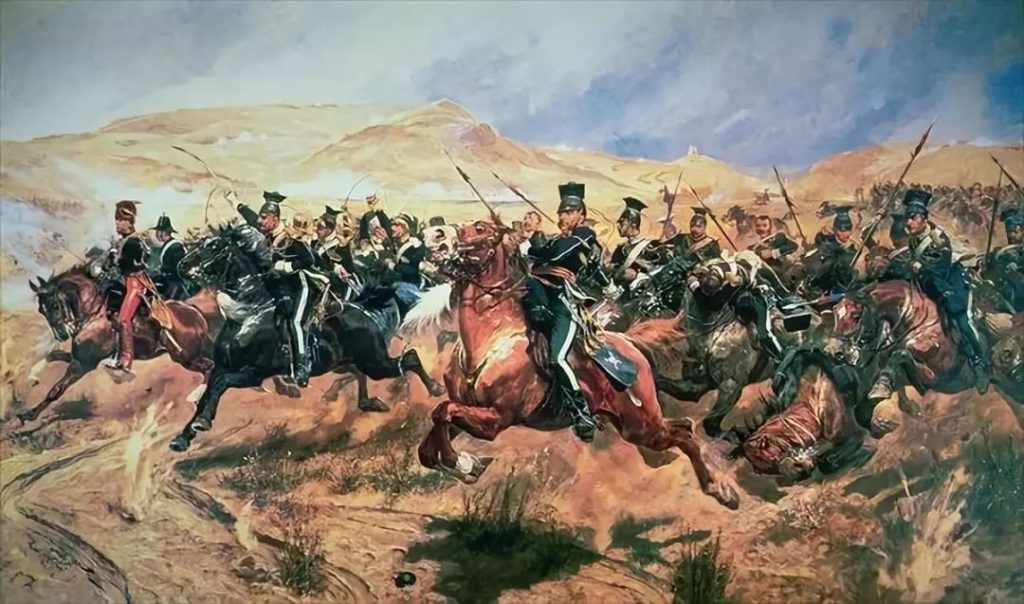
On October 25, a misunderstood communication between the commander, Lord Raglan, and his light cavalry forces resulted in disaster and glory. Raglan meant to send his troops to recapture some British artillery that had been hauled away by the Russians but his messenger, Captain Nolan screwed up, and pointed the cavalry, led by the Earl of Cardigan, toward a heavily defended valley lined with Russian artillery. The exchange went like this:
“Attack, sir!”
“Attack what? What guns, sir?”
“There, my Lord, is your enemy!” said Nolan indignantly, vaguely waving his arm eastwards. “There are your guns!
And so, Cardigan, knowing full well that this was madness, ordered his 670 horsemen up the valley to attack 20 battalions of dug-in infantry and 50 artillery pieces. This charge was suicidal but it was carried out successfully. The men and horses were shredded by Russian guns for over a mile before they reached the end of the valley where they destroyed some Russian positions and rode back out, under heavy fire again from three sides.
The cost was 118 men killed, 127 wounded, and about 60 taken prisoner, with 335 horses destroyed. The various generals all blamed each other and Captain Nolan, but Alfred Tennyson immortalized the engagement in his poem “The Charge of the Light Brigade”.
So why am I telling you all this? Because, to my astonishment, I learned that a Canadian had taken part in the charge and, better yet, had been awarded a Victoria Cross. More about him, Alexander Roberts Dunn and his mysterious grave, tomorrow.
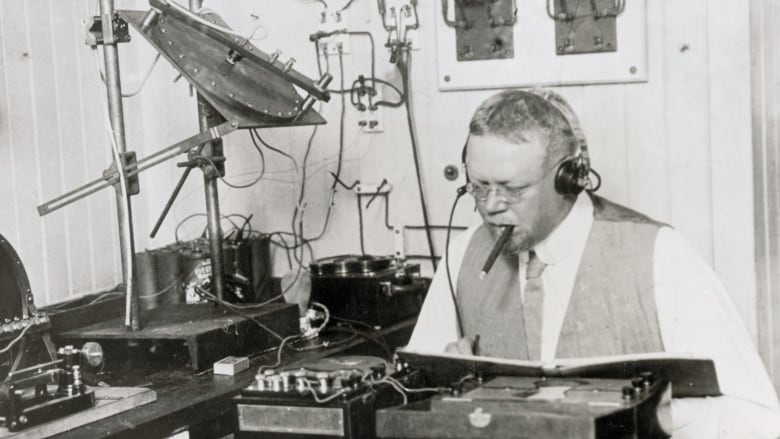
Next up on our whirlwind tour of the Top 10 Canadians of the 20thCentury is Reginald Fessenden, born in Quebec in 1866, the son of an Anglican minister. He was a bright kid but bounced from one educational facility to another but never seeming to get a degree. Despite knowing nothing about electricity, he got a job as a lab assistant for one of Thomas Edison’s departments. Using that experience he got a job in the electrical engineering department of what became the University of Pittsburgh where he began to experiment with the newly discovered “wireless telegraphy”.
Fessenden pioneered many electronic principles and devices that made signals more powerful and capable of sending voice messages, instead of just Morse code. The result of this was the invention of AM radio. Here is how the Encyclopedia Britannica explains his idea:
He developed the idea of superimposing an electric signal, oscillating at the frequencies of sound waves, upon a radio wave of constant frequency, so as to modulate the amplitude of the radio wave into the shape of the sound wave. (This is the principle of amplitude modulation, or AM.) The receiver of this combined wave would separate the modulating signal from the carrier wave and reproduce the sound for the listener.
Using this notion, he was responsible for the world’s first radio program. Fessenden had a contract to provide ships of the United Fruit Company with wireless receivers and on Christmas Eve 1906, he beamed these vessels a broadcast of recorded and live music (played by Fessenden) and a passage from the Gospel of Luke.
Despite this triumph by one of its native sons, the Canadian government gave the Italian inventor Marconi exclusive rights to build wireless stations in Canada
After his work with radio, which produced enormous legal headaches for years, he went on to engineer the Niagara Falls power plant, and invent sonar, microfilm, tracer bullets, seismological techniques, a turboelectric drive for battleships, and television apparatus. After many years of litigation and struggle over patents he became wealthy when his intellectual property was finally recognized; he retired to Bermuda where he died in 1932.
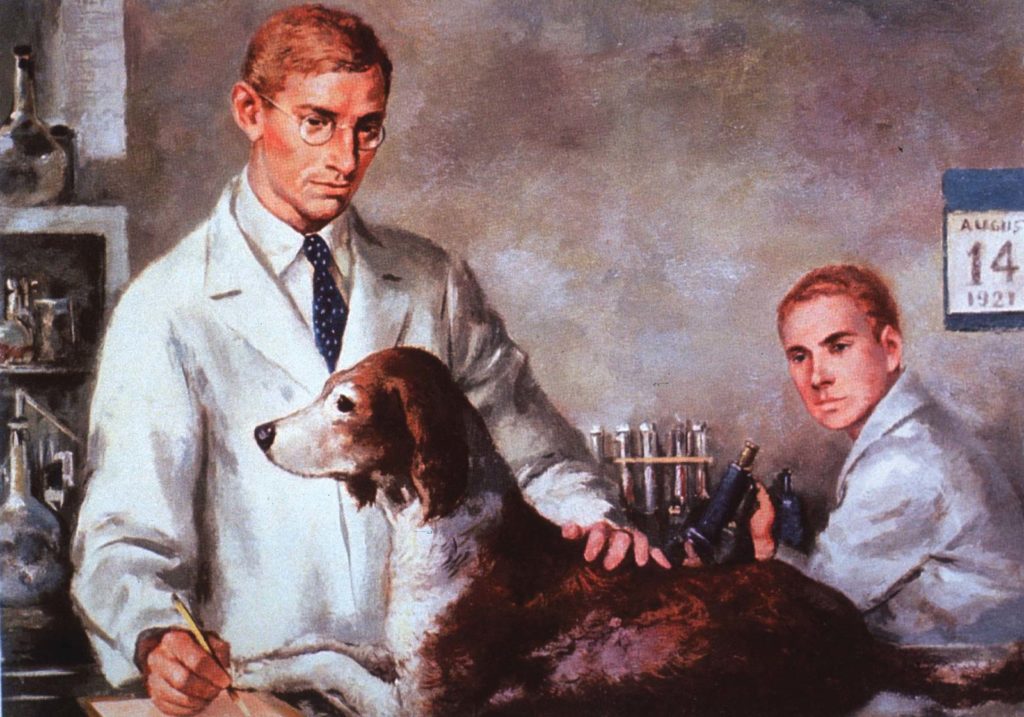
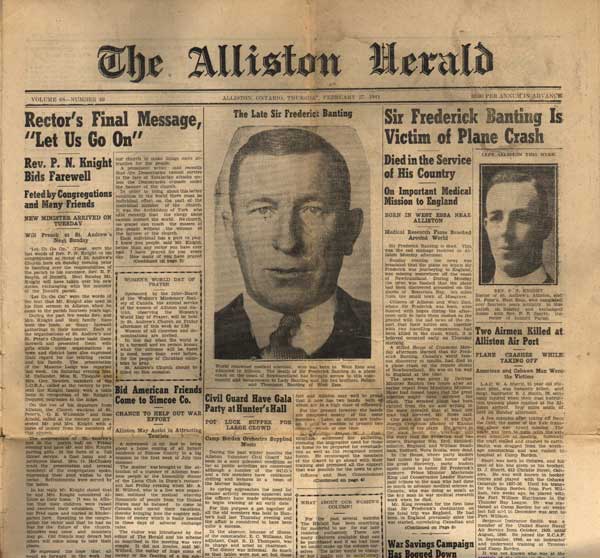
Next to appear on the list of the Ten Greatest Canadians of the 20th Century is one of those dead, white, heterosexual males who are so harmful to society: Frederick Banting (1891-1941), the co-inventor of insulin and the youngest-ever Nobel laureate in Medicine.
Banting was to a farm family born in Alliston, Ontario and as a young man distinguished himself by flunking his first year of university in an Arts program at the University of Toronto. Nonetheless, Banting was admitted to Medicine in the following year, proving conclusively that those who fail in the Humanities may, nonetheless, go on to lead productive lives. The First World War broke out during his studies; Banting joined the Army which fast-tracked his medical training. He was sent overseas as a military doctor, was wounded in battle, and was awarded the Military Cross for bravery.
After the war, Banting’s medical career did not flourish but he was a respected lecturer on physiology. In 1920 he began to research diabetes and proposed a particular method by which insulin could be isolated from the pancreas and used to treat the disease. By 1922 he was able to save the lives of patients who would otherwise have died and the next year he was awarded the Nobel Prize for his discovery, along with the supervisor of the laboratory, J.J.R. Macleod who lent Banting his student Charles Best and the help of a biochemist, James Collip. Banting shared his prize money with Best, and Macleod shared his with Collip.
In 1934, Banting was knighted by King George V. He was involved in research for the Royal Canadian Air Force when World War II erupted. He was killed in 1941 in a plane crash while on the way to England to test a flying suit that would prevent pilots from blacking out.