December 20

Home / Today in History / December 20

its_a_wonderful_life_movie_poster

1946

Premiere of It’s A Wonderful Life

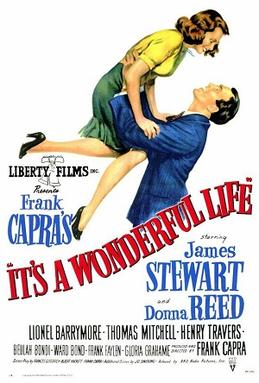
“Merry Christmas, you beautiful old savings and loan!  Merry Christmas, you beautiful beat-up old house!” So shouts George Bailey (Jimmy Stewart) who has just been saved from suicide by an apprentice angel who convinces him of the value that his life has had by showing what the town of Bedford Falls would have looked like without his influence.

Philip Van Doren Stern wrote a short story called “The Greatest Gift” but could not interest any publisher in his work so he printed up the story as a Christmas card and sent it to 200 friends. Among the recipients was a Hollywood agent who convinced RKO studio that it would make a great movie. And it did. It was shown in theatres under the title It’s a Wonderful Life for the first time on this date in 1946.

This enormously popular Christmas-time movie was not a success when it was first released in 1946 and when its copyright expired in 1974 no one bothered to renew it, allowing television stations to broadcast it without charge. This allowed new generations to discover this finely-crafted Frank Capra film which also featured Donna Reed as Mary Bailey, Lionel Barrymore as nasty Mr. Potter and Ward Bond and Frank Faylen as the original Bert and Ernie. (Republic Entertainment assumed control of the copyright in 1993 and broadcast fees are once again in effect.) Remakes of the film include It Happened One Christmas and Merry Christmas, George Bailey.

December 18

Home / Today in History / December 18

lesser_coa_of_the_empire_of_russia-svg

1833 First performance of the new Russian national anthem

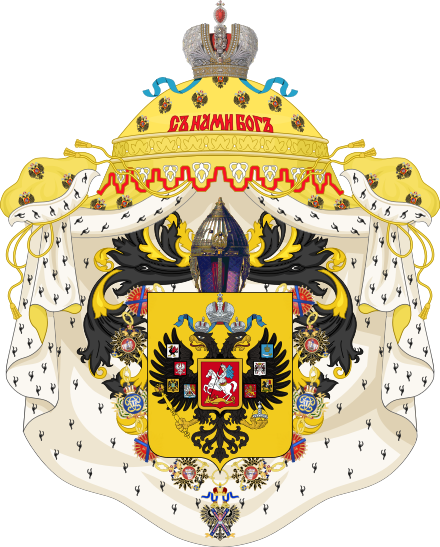
Composed by Alexei Lvov, lyrics by court poet Vasily Zhukovsky, this song was the anthem of the Russian empire until the overthrow of the Romanovs in 1917.

God save the Tsar!
Strong, sovereign,
Reign for glory, For our glory!
Reign to foes’ fear,
Orthodox Tsar.
God, save the Tsar!

Though the words are less-than-inspired, the music was quoted several times by Tchaikovsky, including in “The 1812 Overture”, Glinka, Gounod, and in the score to the film Dr Zhivago. A number of American institutions haved used the tune. It is the alma mater song of Macalester College, in St Paul, Minnesota, titled “Dear Old Macalester”.  The deathless lyrics of the latter are:

Dear Old Macalester, ever the same 
to those whose hearts are thrilled 
by thy dear name. 
Cherished by all thy sons 
loved by all thy daughters, 
Hail, hail to thee 
our college dear. 

Macalester students have an unofficial song which they are pleased to sing at sports matches against any of the local Christian colleges:

Drink blood!/ Smoke crack!/ Worship Satan!/ Go Mac!

December 16

Home / Today in History / December 16

boston_tea_party_currier_colored

1773 The Boston Tea Party

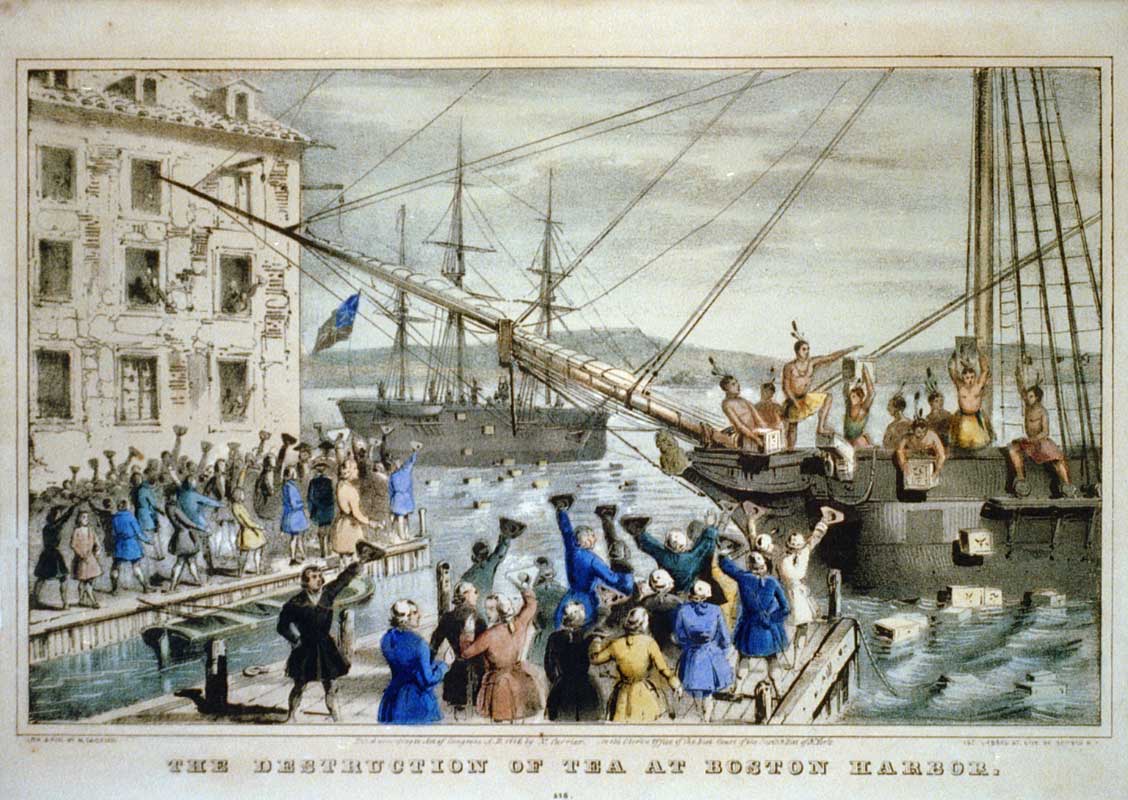
Relations between some of the British colonies in North America and the home country were getting a tad antsy by 1773. Tax-averse Americans were reluctant to pay for their own defense in the absence of representation in the UK Parliament. They wished, against British wishes, to penetrate the lands held by native tribes and they objected to the freedom of religion and social customs which had been permitted in the colony of Quebec. Violence and thuggery was the response of some of the more high-spirited American lads. Colonial officials were attacked, ships and homes burnt, and in December the focus was on obstructing the importation of tea from Britain.

The mercantilist system of economics employed by most European powers in the 18th century regarded colonies as territories to be exploited for the benefit of the metropolis. For example, colonies were forbidden to trade directly with other nations and all shipping had to be done by domestic carriers. In the case of America, colonists found it cheaper to resort to some goods, such as tea, smuggled in from non-British sources. However, when the British Tea Act worked to lower the price of legally imported tea, the colonists were outraged. Those merchants who had made a tidy living smuggling now found themselves undercut — greed and nativism combined to prompt action.

At a protest meeting chaired by John Adams, a breakaway group of vandals, calling themselves the Sons of Liberty, disguised themselves as Mohawks, boarded tea-laden vessels in Boston Harbour and dumped the valuable cargo into the water. Adams professed himself in awe of this deed:

This is the most magnificent Movement of all. There is a Dignity, a Majesty, a Sublimity, in this last Effort of the Patriots, that I greatly admire. The People should never rise, without doing something to be remembered—something notable And striking. This Destruction of the Tea is so bold, so daring, so firm, intrepid and inflexible, and it must have so important Consequences, and so lasting, that I cant but consider it as an Epocha in History.

The British responded with a series of coercive measures that sped the outbreak of the American War of Independence and coffee rose to replace tea as the freedom-lover’s beverage of choice.


December 11

Home / Today in History / December 11

edward_abdication

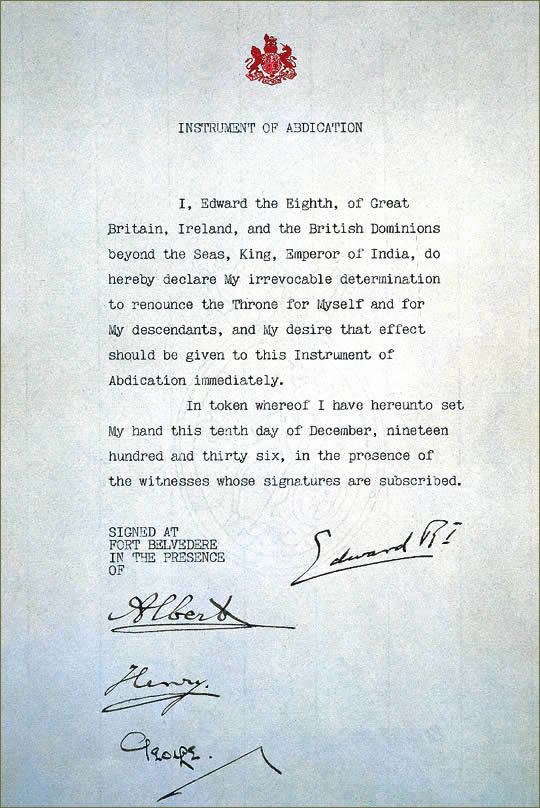
1937 Edward VIII’s abdication becomes official

There is a long history of antipathy between English monarchs and his heirs, particularly when the son has had to wait many years for their father to pass away. Henry II had to fight wars with three of his sons, and the mutual hatred between the Hanoverian dynasts George I, II, III and IV is legendary. Queen Victoria had little respect for her son (she said, “I never can, or shall, look at him without a shudder”) and so the future Edward VII led a long life of dissipation as the Prince of Wales (he was 60 years old when his mother died.) And so it was with Prince Edward Albert Christian George Andrew Patrick David, the heir to George V.

“David”, as he was known to his family, was a very popular Prince of Wales, representing the royal family in world tours and visits to parts of Britain. He was a handsome young man and remained unmarried past an age where earlier princes had been advantageously wed. His association with women of ill-repute and his affairs with married women were notorious and troubling to his parents and the government. In 1931 he met an American woman, Wallis Simpson, whose previous husband was a navy pilot and who was still married to a shipping executive. They began a romance that would shake the British empire. To this day, historians still puzzle over the hold Wallis held over her lover with rumours of domination, sexual secrets of the mystic East, and physical deformity all considered.

In January 936 George V died and David became king, with the regnal title Edward VIII. He was uncomfortable with the restrictions that kingship placed on him, particularly where his love life was concerned. By this time his relationship with the twice-married American was a scandal in the press outside of Britain (where the newspapers still kept royal secrets) and a troubling constitutional question. As head of the Church of England, which did not allow remarriage after divorce, Edward would be jeopardising his relationship with the national church, and in any event, Simpson was still married and her first divorce was on shaky legal ground in the United Kingdom. Would the king be committing both adultery and bigamy?

It is quite likely that Simpson would have been happy to remain the King’s mistress (that sort of relationship was considered quite acceptable to the upper classes) but Edward was determined to make her his wife. His family was opposed, the British government and those of the Dominions, such as Canada, were also against such a union. Edward suggested a compromise — a “morganatic union” where Wallis would not be termed Queen and any children would not be considered in the line of succession but the politicians turned him down. He resolved then to abdicate.

On December 10, 1937 he signed the above document which became official the next day. His brother ascended the throne as George VI and Edward left the country as the Duke of Windsor. Wallis would join him later when her second divorce became final.

This love story had a long tawdry ending. The Windsors were courted by the German Nazis and there was talk of Edward being sympathetic to their cause. During the Second World War he was allowed no post of any importance and was humiliatingly posted as Governor of the Bahamas to get him out of the way. The couple lived a life of impoverished ostentation in a luxurious Paris house, forbidden for years to return to Britain. One historian summed up their end: “Denied dignity, and without anything useful to do, the new Duke of Windsor and his Duchess would be international society’s most notorious parasites for a generation, while they thoroughly bored each other”.
December 10

Home / Today in History / December 10

brown_dog_statue_battersea_london2

1907 Brown Dog Affair

The use of live animals in medical experiments has been a subject of controversy since the late 19th century, particularly when this vivisection is performed without anaesthesia. In Britain these experiments fell under the Cruelty to Animals Act of 1876 which encouraged anaesthesia and more humane treatment of the specimen. Even so, opposition to animal testing was intense.

In 1903 a pair of female anti-vivisectionists from Sweden infiltrated the lab in London where such experiments were performed for the benefit of medical students. Their detailed notes, particularly of one procedure carried out on a small brown dog, created a scandal when they were published. A libel suit vindicated the accused doctor but feelings continued to run high.

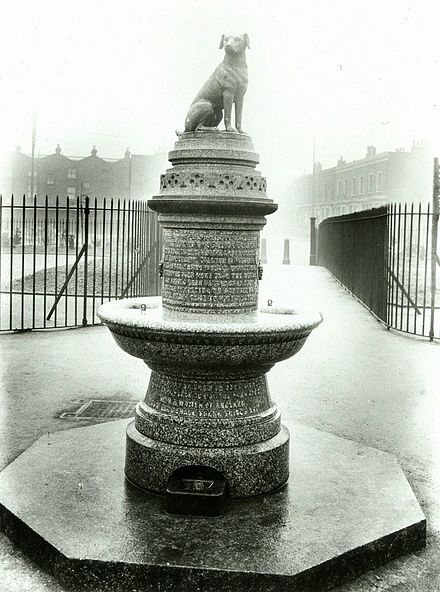
In 1907 a statue of a terrier like the one used in the vivisection was erected in a park in Battersea, bearing the following inscription.

In Memory of the Brown Terrier
Dog Done to Death in the Laboratories
of University College in February
1903 after having endured Vivisection
extending over more than Two Months
and having been handed over from
one Vivisector to Another
Till Death came to his Release.

Also in Memory of the 232 dogs Vivisected
at the same place during the year 1902.
Men and Women of England
how long shall these Things be?

This outraged London’s medical students who felt that they had been vilified. The statue was repeatedly attacked and the disorders continued for years with left-wing groups battling it out on the streets with future doctors. On December 10, 1907, students from University College, King’s College, Guy’s and the West Middlesex Hospitals carried out raucous demonstrations that turned into a riot with 1,000 students facing 400 policemen, backed by trade unionists and suffragettes. (Women radicals tied the campaign against vivisection into their struggle for votes.)

To spare the city future riot the Battersea Council eventually had the statute (pictured above) torn down and melted.

December 7

Home / Today in History / December 7

Landscape

1941 The unfortunate events at Pearl Harbour

By late 1941, Japan had decided that war against the Western powers was the only way to secure the vital raw materials it would need to expand its empire, or what it called “The Greater East-Asia Co-Prosperity Sphere”. Its politicians had considered the “Strike North” option which was to invade Siberia, but had decided on a “Strike South” plan that would gobble up southeast Asia and bring it into conflict with the British, Dutch, and Americans who held possessions in that area. Admiral Isoruko Yamamoto realized that for Japan to succeed it would need a year to consolidate its gains. “I shall run wild considerably for the first six months or a year, but I have utterly no confidence for the second and third years,” he observed. He reckoned that if the American naval base at Pearl Harbour were destroyed, it would give the Japanese those necessary twelve months; therefore he ordered an attack on Hawaii along with coordinated attacks on the Dutch East Indies, Hong Kong and the Philippines.

At 7:02 a.m., on December 7, American radar operators on Oahu spotted large groups of aircraft in flight toward the island from the north, but, with a squadron of B-17s expected from the United States at the time, they were told to sound no alarm. Thus, the Japanese air assault achieved complete surprise. At 7:55 a.m. On December 7 a Japanese dive bomber bearing the red symbol of the Rising Sun of Japan on its wings appeared out of the clouds above the island of Oahu. 360 Japanese warplanes descended on the U.S. naval base at Pearl Harbour while a fleet of midget submarines tried to penetrate the area.

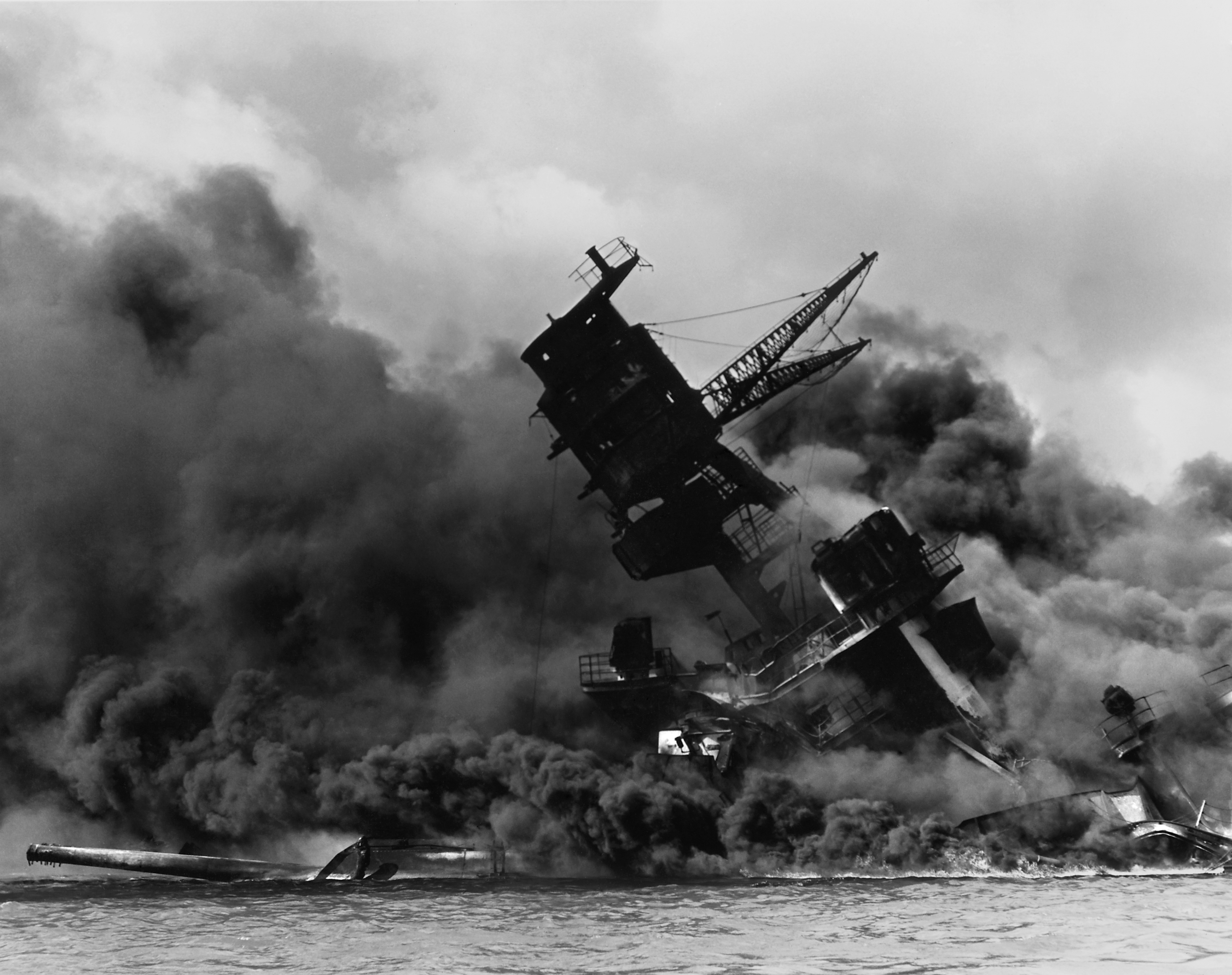
At the cost of only 30 planes and 5 submarines, the Japanese destroyed most of the Pacific surface fleet. Five battleships, three destroyers, and seven other ships were sunk or severely damaged, and more than 200 aircraft were destroyed. A total of 2,400 Americans were killed and 1,200 were wounded. Fortunately, the three American aircraft carriers were at sea and missed being sunk; these ships would lead the fightback that began with the June 1942 Battle of Midway. Yamamoto was not given his twelve months and is reported to have said of the missed opportunity, “I fear all we have done today is to awaken a great, sleeping giant and fill him with a terrible resolve.”

December 5

Home / Today in History / December 5

christ_saviour_explosion

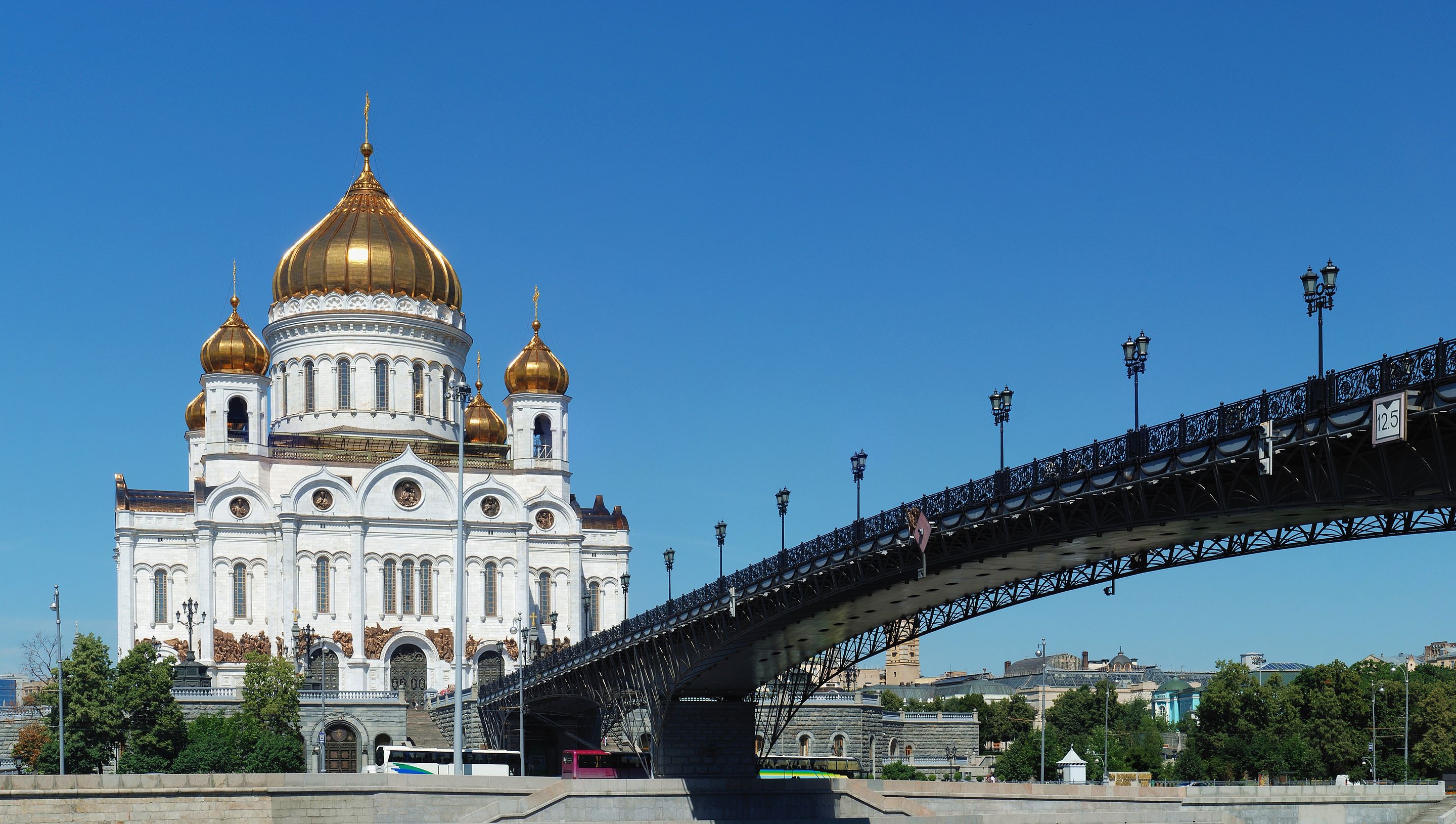
1931 Destruction of Moscow’s Christ the Saviour Cathedral

The new government of the Soviet Union was determined to be the world’s first atheist state. It murdered or imprisoned thousands of priests, seized church property, and actively discouraged the practice of religion, be it Christian, Muslim, or Jewish. It sponsored the League of the Militant Godless, an organization which sought to inculcate atheism into the population.

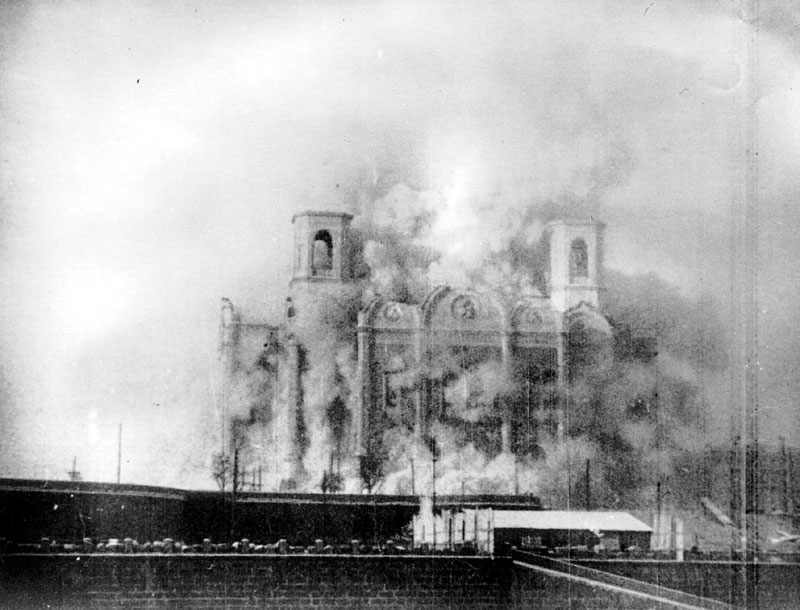
Russia’s spectacular Orthodox churches, however, stood as visible reminders of a spiritual power which the Soviets wished to be rid of. Some churches were converted into museums of atheism, some were used as potato warehouses and, in 1931, the largest Christian church in the country was ordered destroyed. Tons of gold on the dome and interior were stripped away and some of the glorious mosaics were saved but much of the church where Tchaikovsky’s “1812 Overture” was premiered was doomed. On December 5, a series of explosions levelled the building so thoroughly that it took a year just to clear away the rubble. For years the site remained a large outdoor swimming pool.

After the fall of the Soviet Union, plans were made to rebuild a replica of the original on the same site, financed largely by ordinary citizens of Moscow. Work began in 1992 and the cathedral was consecrated in 2000, the year in which the murdered Czar Nicholas II and his family were canonized as saints.

moscow_july_2011-34a

December 2

Home / Today in History / December 2

396px-andrew_jacksonjohnqadams

1824 American presidential election controversy

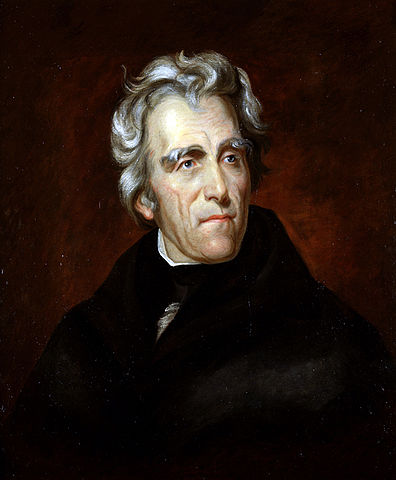
Those Americans who complain that their candidate for president was not elected despite having won a plurality of the popular vote; those who complain about “fake news” influencing the election; and those with qualms about the electoral college, should examine the election of 1824.

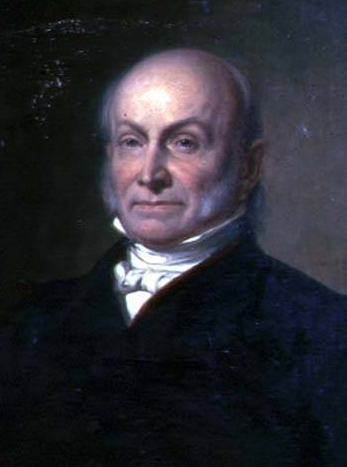
When voting ended on December 2, 1824, Tennessee’s Andrew Jackson was found to have received the most votes (41.4%), outpolling John Quincy Adams, William H. Crawford and Henry Clay. All four were from the Democratic-Republican Party which had failed to unite behind a single candidate. Jackson, however, had fallen short in electoral college votes — needing 131 to win, he had received only 90. The Twelfth Amendment of the constitution stated:

The person having the greatest Number of votes for President, shall be the President, if such number be a majority of the whole number of Electors appointed; and if no person have such majority, then from the persons having the highest numbers not exceeding three on the list of those voted for as President, the House of Representatives shall choose immediately, by ballot, the President. But in choosing the President, the votes shall be taken by states, the representation from each state having one vote; a quorum for this purpose shall consist of a member or members from two-thirds of the states, and a majority of all the states shall be necessary to a choice. 

Thus, the 1824 election rested in the hands of the House of Representatives on February 29, 1825. Henry Clay, who detested Jackson, threw his support behind Adams with the result being an upset victory for the man from Massachusetts. Rumours accused Clay of having been bribed by Adams with the offer of the position of Secretary of State, the so-called Corrupt Bargain — and indeed, that was the post taken up by Clay in the Adams administration.

The 1828 rematch saw Jackson at last triumph over Adams.

December 1

Home / Today in History / December 1

440px-sergei_kirov

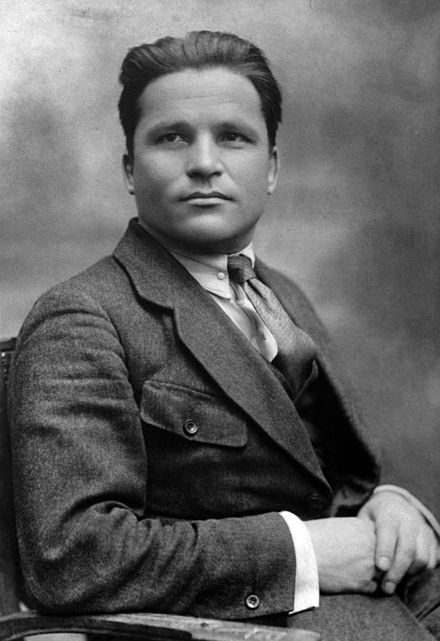
1934 The Murder of Sergei Kirov

Revolutions eat their own children, the saying goes. This was certainly true in the case of the Russian Revolution which produced the world’s first Communist state, the Union of Soviet Socialist Republics. Few of those who led the revolution survived to old age, most often falling victim to their fellow Bolsheviks.

Sergei Kirov was considered a leading light of the young USSR. He had paid his dues as a revolutionary in his youth, taking part in the 1905 uprising and continuing to back Vladimir Lenin’s Bolshevik faction in the Russian Civil War as a commissar in the Caucasus. He had been named Communist Party chief in Leningrad (formerly St Petersburg) in 1926 and was very popular with party insiders. Though Kirov was a supporter of Lenin’s successor, Joseph Stalin, his growing renown made the paranoid Stalin suspicious. When Kirov looked to be favouring a relaxation of some of the dictator’s harsher economic policies, his fate was sealed; Stalin ordered him assassinated.

The choice of murderer fell on disgruntled Leonid Nikolayev who was given money and a pistol; most of Kirov’s security detail had disappeared and the entrance to his offices were left unguarded. On December 1, Nikolayev shot and killed Kirov.

Blaming fascist opponents of Communism, Stalin ordered swift retribution. Nikolayev  was swiftly executed, followed by most of his family. Prisoners, already under arrest, were deemed to be part of this international plot, and were exterminated, as were any officials involved in arranging the murder. But these were just the start. Stalin used the murder to eliminate high-ranking Bolsheviks whom he deemed to be his opponents. Leaders of the 1917 revolution like Kamenev and Zinoviev were expelled from the party and later executed after show trials. Over all, the purges of the 1930s took at least a million lives, sent millions more into exile and eviscerated the highest levels of the party and military.

November 30

Home / Today in History / November 30

440px-john_mccrae_in_uniform_circa_1914

1872 Birth of John McCrae

John McCrae was born in Guelph, Ontario into a family of soldiers and doctors. McCrae became both, serving as an artillery officer in the Boer War and becoming a physician. When the First World War began, he was appointed to the rank of major and made the Medical Officer of an artillery unit. In 1915 during the Second Battle of Ypres on the Western Front a close friend of his was killed, inspiring McCrae to write the poem for which he is best known.

In Flanders fields the poppies blow
Between the crosses, row on row,
That mark our place; and in the sky
The larks, still bravely singing, fly
Scarce heard amid the guns below.

We are the Dead. Short days ago
We lived, felt dawn, saw sunset glow,
Loved and were loved, and now we lie
In Flanders fields.

Take up our quarrel with the foe:
To you from failing hands we throw
The torch; be yours to hold it high.
If ye break faith with us who die
We shall not sleep, though poppies grow
In Flanders fields.

Though the poem is often read nowadays as a tragic anti-war piece, McCrae meant it otherwise, as a prod to enlistment and service. It inspired a number of enthusiastic responses including:

America’s Answer

R.W. Lillard

Rest ye in peace, ye Flanders dead
The fight that you so bravely led
We’ve taken up. And we will keep
True faith with you who lie asleep,
With each a cross to mark his bed,
And poppies blowing overhead,
When once his own life-blood ran red
So let your rest be sweet and deep
In Flanders Fields.

Fear not that ye have died for naught;
The torch ye threw to us we caught,
Ten million hands will hold it high,
And freedom’s light shall never die!
We’ve learned the lesson that ye taught
In Flanders’ fields.

McCrae never lived to return from the war. He succumbed to pneumonia in January 1918 and is buried in France.