Befana 1921

Home / Christmas / Befana 1921

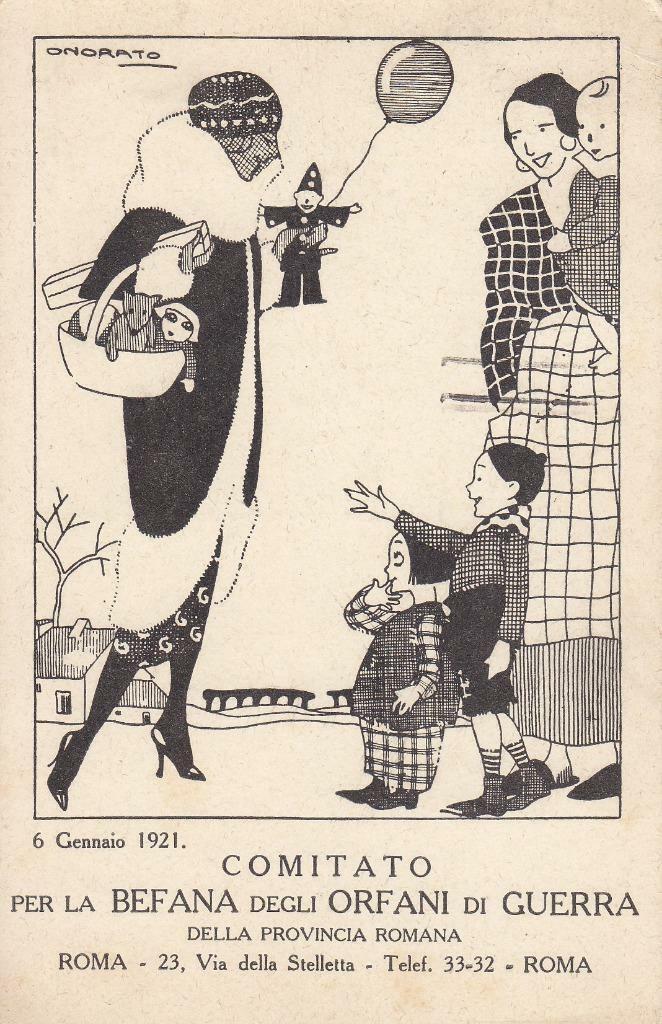
In Italian, Befana can refer either to Epiphany (January 6), the traditional time for Christmas gift-giving, or to the kindly witch of that name who delivers the presents. 

In this 1921 image a kindly rich woman delivers presents to children of the working class who have been orphaned by World War One.

Christmas Propaganda

Home / Christmas / Christmas Propaganda

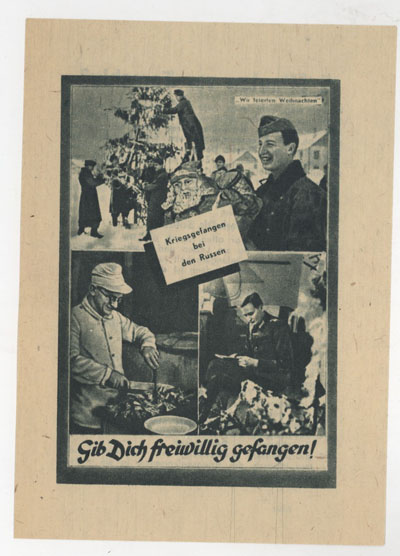
During the Second World War, all sides made propaganda appeals to enemy soldiers to weaken their morale, to encourage desertion, or to promote the idea of voluntary surrender. Here is a particularly duplicitous example printed by the Soviets for distribution across enemy lines to German troops.

Note the use of Christmas images — German prisoners with Santa Claus, gaily decorating a huge Christmas tree. The food is lavishly plentiful and letters from home are read. The reality for Germans captured by the Red Army was much more grim. Of those soldiers taken prisoner at Stalingrad, 95% died in captivity. Hundreds of thousands of Wehrmacht soldiers were kept as slave labour in the USSR for 10 years after the war.

Soviet Christmas in War Time

Home / Christmas / Soviet Christmas in War Time

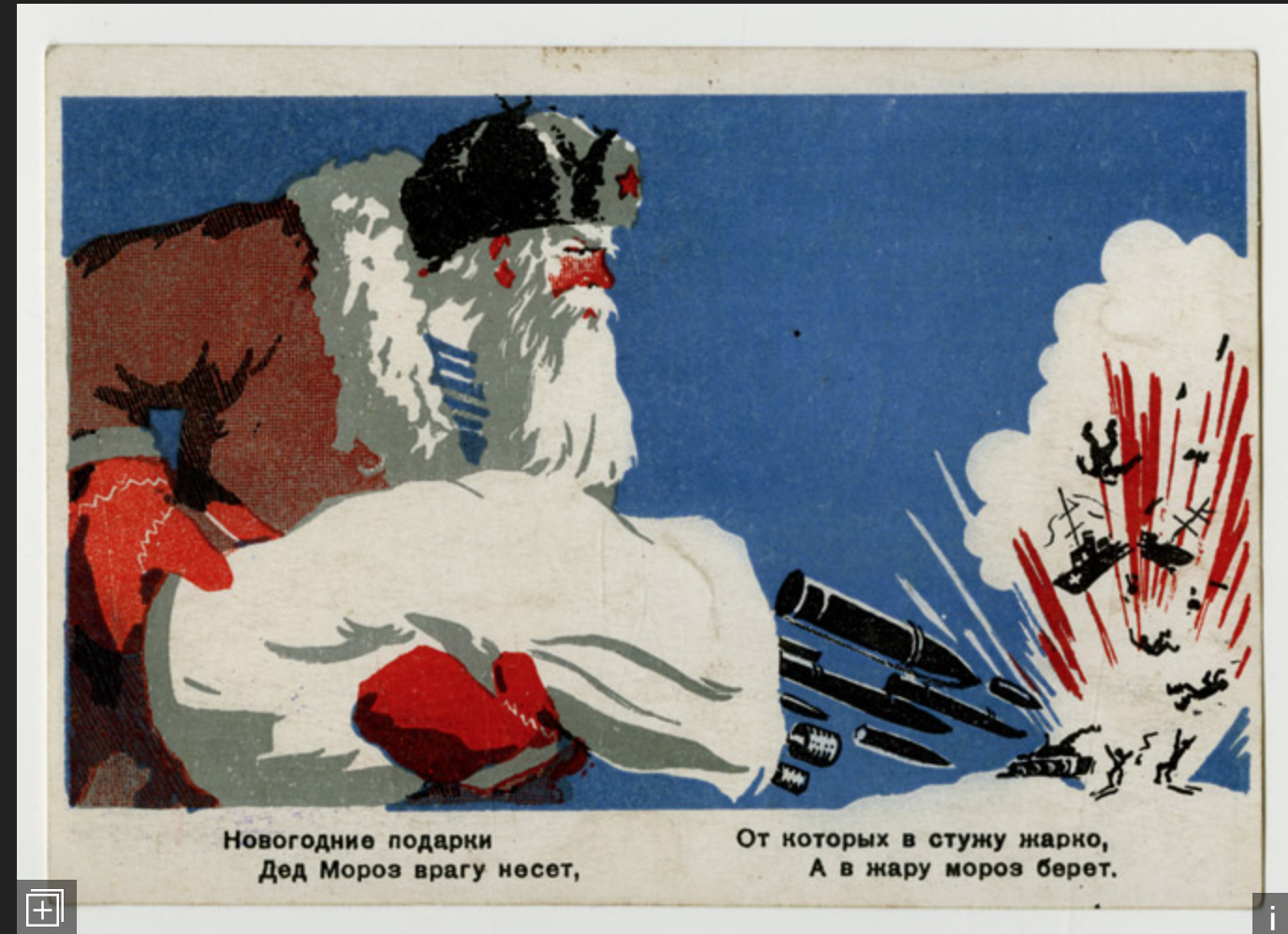
As part of their drive against the practice of religion, Soviet leaders did their best to discourage the observance of Christmas but the people’s lingering love of the holiday and the need for social unity in the fight against the Nazi invasion, led the Kremlin create a pseudo-Christmas centred on New Year’s. Thus the Christmas tree became the New Year’s tree, Christmas cards became New Year’s cards, gifts were exchanged on January 1, and St Nicholas was replaced by the secular Des Moroz, or Grandfather Frost. Because the Soviet state had converted to the Gregorian calendar while the Orthodox Church clung to the Julian calendar, the Communist New Year celebrations took place BEFORE Orthodox Christmas. This allowed the state to provide holiday goodies for January 1 but cut off the supplies for Christmas on January 7.

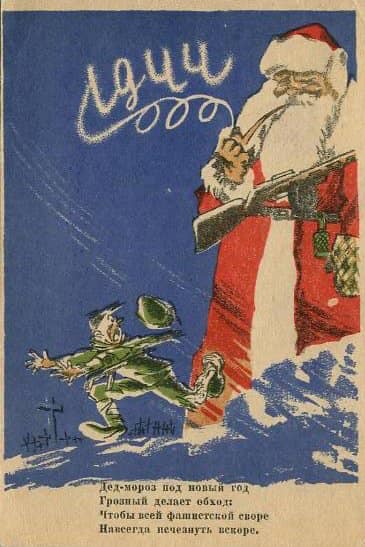
A number of New Year’s cards published during the war show a very militant Grandfather Frost routing the German invaders.

The caption reads: ‘Grandfather Frost Makes a Fearsome Tour To Get The Entire Pack of Fascists To Disappear Forever Soon’

Even More Christmas Quotes

Home / Christmas / Even More Christmas Quotes

Monday is a gift of socks under life’s Christmas tree. – maggiesfarm.com, 2021

To be honest, to be kind — to earn a little and to spend a little less, to make upon the whole a family happier for his presence, to renounce when that shall be necessary and not be embittered, to keep a few friends, but these without capitulation — above all, on the same grim condition, to keep friends with himself — here is a task for all that a man has of fortitude and delicacy. He has an ambitious soul who would ask more; he has a hopeful spirit who should look in such an enterprise to be successful. There is indeed one element in human destiny that not blindness itself can controvert: whatever else we are intended to do, we are not intended to succeed; failure is the fate allotted. – Robert Louis Stevenson, “A Christmas Sermon”, 1887

I could go on and on about the suffering we’ve endured and the adaptations we’ve made, but to me, our species’ crowning jewel is that on the shortest day of the year, when the sun spends most of its time swallowed, when everything is frozen, when nothing can grow, when the air is so cold our voices stop right in front of our faces we put a string of lights on a universe that is currently doing nothing to earn it. We not only salvage an otherwise desolate time of year, we make it the best time of year. – Dan Harmon, “Drunk High Christmas Greetings!”, 2008

One Christmas was so much like another, in those years around the sea-town corner now and out of all sound except the distant speaking of the voices I sometimes hear a moment before sleep, then I can never remember whether it snowed for six days and six nights when I was twelve or whether it snowed for twelve days and twelve nights when I was six. – Dylan Thomas, A Child’s Christmas in Wales, 1952

For children, Christmas is everything they might be given; for an adult, Christmas is everything we have lost. – Mark Forsyth, A Christmas Cornucopia
Cross-Dressing and Christmas

Home / Christmas / Cross-Dressing and Christmas

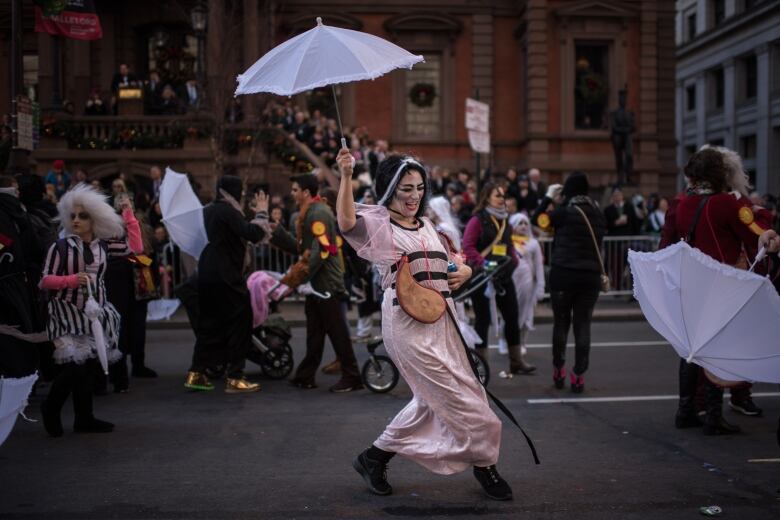
A clear signal that social inversion is in effect and that festive misrule and license will be tolerated temporarily is for one sex to assume the dress of another. This has its origins in the Roman feast of Saturnalia held in late December and it continued after the Christianization of Europe. Numerous edicts exist from the Middle Ages in which authorities decry transvestism at Christmas amongst the lower clergy and popular folk customs. In 1445 by the Paris Faculty of Theology complained: “Priests and clerks may be seen wearing masks and monstrous visages at the hours of office. They dance in the choir dressed as women, panders or minstrels.” The Staffordshire Horn Dance has a cross-dressing cast member called Maid Marian while guisers on the Scottish borders provide comic relief with the figure of Bessie the Besom, a man dressed as an old woman. In Newfoundland mumming both sexes will participate dressed as the other, with young women disguised as sailors and men known as “ownshooks” clad as women. In Nova Scotia the females who went belsnickling dressed as Wise Men were called Kris Kringles.

St Joseph

nativity-icon1

You might think that the earthly father of Our Lord would get a little more attention but the general attitude toward him is shown by the Nativity icon above — Joseph is old, bewildered and remote from the action.

Joseph appears first in the gospels as the betrothed of Mary. When he learns she is pregnant he is dissuaded from abandoning her by an angelic visit that tells him the child has been conceived by the Holy Spirit. He takes Mary, late in her pregnancy, to Bethlehem to be enumerated and there she gives birth to Jesus. Warned in a vision to flee Herod he takes his wife and child to Egypt and then back to Nazareth. The last glimpse we have of him in the canonical scriptures is on a visit to Jerusalem when Jesus was twelve and eluded his anxious parents to stay and talk with learned men in the Temple.

Legend and apocryphal scripture treat Joseph in much more detail. There he is always depicted as an older man, a widower with sons, who won Mary as a bride after supernatural intervention. In Nativity art he appears in depictions of his encounters with the angels, the Journey to Bethlehem, the manger scene and the Flight Into Egypt. In these settings he is often portrayed somewhat apart from Jesus — as a sign that he is not the child’s true father — and often looking bemused or thoughtful at the amazing turn of events.

Joseph is patron of the universal Church, Austria, Belgium, Canada, fathers, carpenters, house hunters and social justice. In the West his feast is on March 19 and in the Eastern churches it is the first Sunday after Christmas. As Joseph the Worker he is also celebrated on May 1. Because the Holy Family were in need of shelter both in Bethlehem and on the Flight to Egypt some homeowners today wishing to sell their house bury a statue of St Joseph upside down in the yard. A detailed discussion of this superstition with helpful tips for placement of the image may be found here: http://saint-josephstatue.com/Where_to_bury_a_St_Joseph_statue.html