Santa Claus or Kris Kringle?

Home / Christmas / Santa Claus or Kris Kringle?

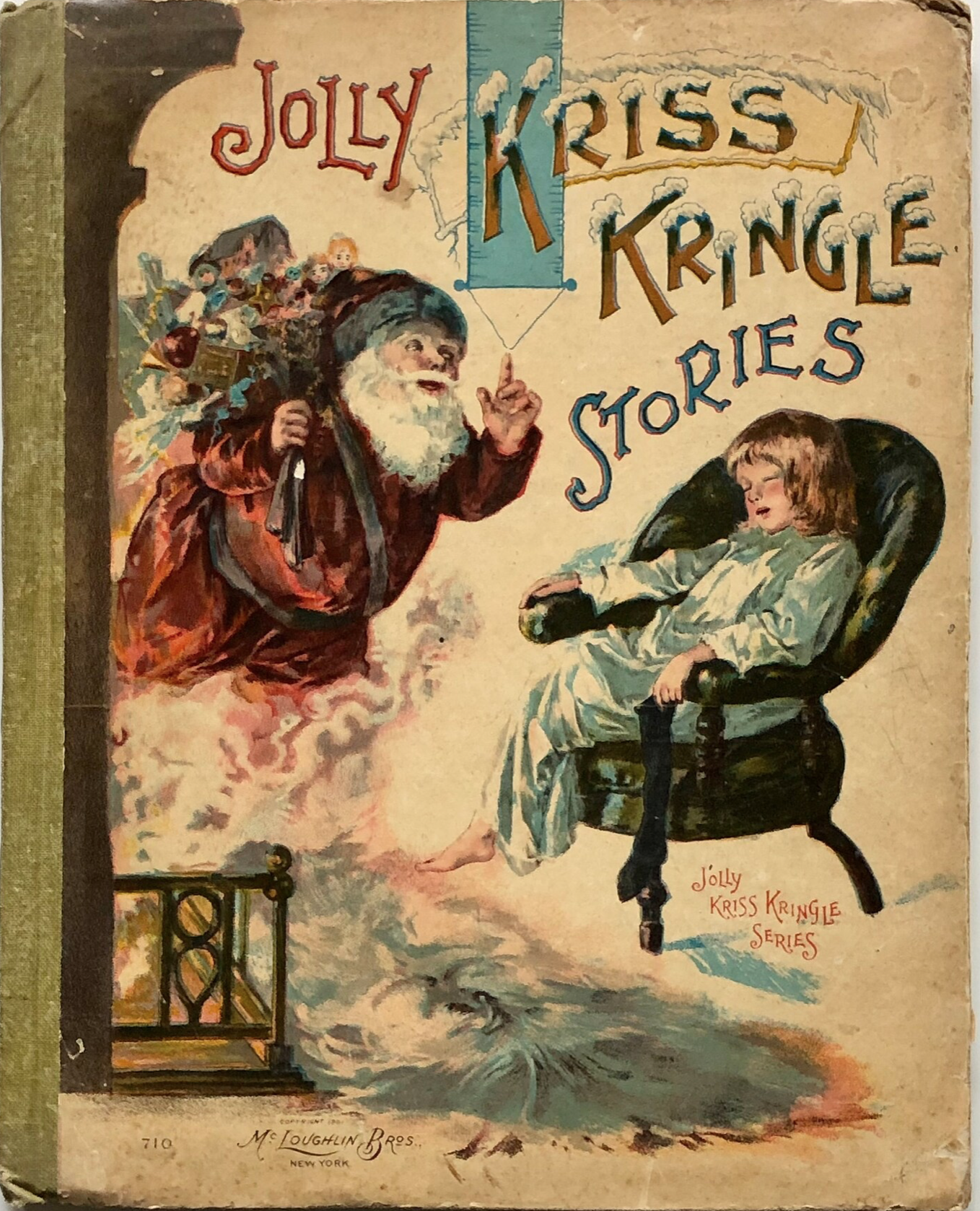
In mid-nineteenth-century America, the elfin gift-bringer had more than one name depending on his locale. In New York he was Santa Claus or St Nicholas; in Philadelphia he was Kriss Kringle or Belsnickel. At one time, as we have seen these names meant very different characters, Kriss Kringle was an American corruption of das Christkindl, the Christchild, portrayed either as an infant or as a white-clad adolescent; Belsnickel was a shaggy and fearsome creature, often accompanying St Nicholas or the Christchild. By the 1840s, however, the allure of Santa Claus was such that though Pennsylvanians clung to the familiar names, the gift-bringer they were attached to was that described by Clark Clement Moore in “ ‘Twas The Night Before Christmas”. We can see this in works published in Philadelphia such as Kriss Kringle’s Book and Kriss Kringle’s Christmas Tree where the generous elf in question is clearly the newly minted Santa Claus and no Germanic import. In an 1855 article in Putnam’s Monthly, the narrator, Mr. Sparrowgrass implores his wife to mind her language:

“My dear,” said I after a pause, “speaking of children I wish you would not teach the young ones so many of your Philadelphia phrases….Mrs. Sparrowgrass, next Christmas Santa Claus, if you please – no, Kriss Kringle. Santa Claus is the patron saint, Mrs. Sparrowgrass, of the New Netherlands, and the ancient Dorp of Yonkers; he it is who fills the fireside stockings; he only can come down Westchester chimneys, and I would much prefer not to have the children’s minds and the flue occupied with his Pennsylvania prototype.”
The Church of the Nativity

Home / Christmas / The Church of the Nativity

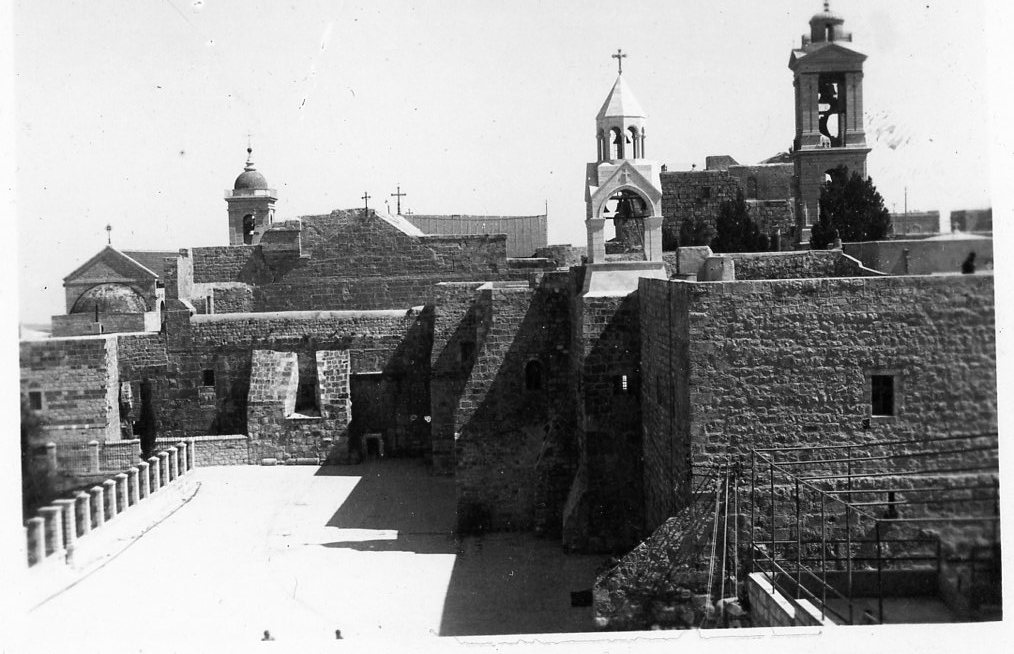
A large fortress-like church complex on Manger Square in Bethlehem is centred on the site where Jesus was said to have been born. The picture above was taken in 1944 by my father when he was stationed in Palestine with the RAF.

As early as the second century local tradition claimed that the Nativity of Christ had taken place in a stable-cave, the location of which was sufficiently well-known that the Roman emperor Hadrian established a pagan grove there dedicated to Adonis in order to discourage Christian worship on the site. In the third century Origen and other visitors were still being directed to the spot. The theologian reported: “In Bethlehem the cave is pointed out where He was born, and the manger in the cave where He was wrapped in swaddling clothes, and the rumor is in those places and among foreigners of the Faith that indeed Jesus was born in this cave.”

The first Church of the Nativity was built over the cave by Saint Helena, mother of the emperor Constantine, Rome’s first Christian ruler. This church was later damaged in an uprising and was rebuilt in the sixth century at the command of the Byzantine emperor Justinian. When the area was overrun by Persian invaders in 614, legend claims that the Church of the Nativity was spared because of depictions in a mosaic of Magi in Persian dress.

 The cross-shaped Church of St Mary of the Nativity, 170 feet long and 80 feet wide, stands above the small grotto where a silver star marks the spot where Jesus was born; the inscription reads Hic De Virgine Maria Jesus Christus Natus Est — “Here Jesus Christ was Born of the Virgin Mary.” Nearby is a chapel where the manger stood in which the infant was placed. Surrounding the Church of the Nativity are other chapels and convents of the Catholic, Orthodox and Armenian churches; these three denominations share the administration of various parts of the complex. Quarrels between them in the nineteenth century took on dangerous overtones. The Russian goverment supported the Orthodox claims while the Catholics were backed by the French government; these hard feelings were one of the reasons for the outbreak of the Crimean War in the 1850s.

More on Candlemas

Home / Christmas / More on Candlemas

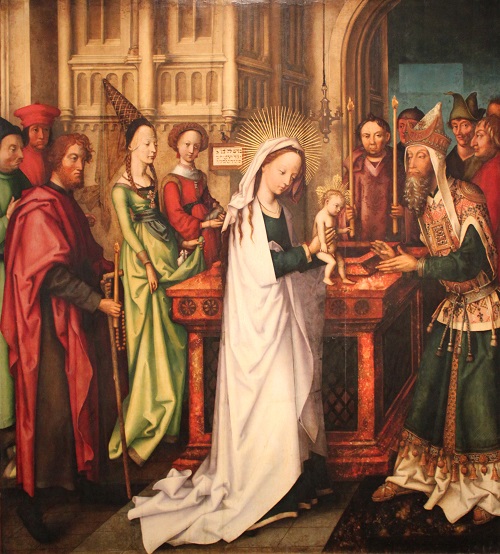
February 2; since the sixth century the day of the Feast of the Purification of the Blessed Virgin Mary, and now known as the Feast of the Presentation, marked the ritual in the Temple required by Jewish law law forty days after the birth of a male child.

When the infant Jesus was brought to the Temple, Simeon spoke of him as “a light to lighten the Gentiles” (Luke 2:32) and so light is the theme of the day. Believers bring a candle to the church to be blessed; these candles are thought to possess magical powers against sickness and thunder storms.  In England the Yule log for the next Christmas was selected and set to dry; in Mexico it is the Dia de Candelaria when the image of the baby Jesus is removed from the cradle. On Candlemas, Scottish school children used to bring money to their teacher to buy candles to light the school room, a practice that turned into simply bringing gifts to the master. The boy who brought the most money (the term for this gratuity was bleeze-money) was named Candlemas King whose reign lasted six weeks and who was allowed to remit punishments.

The custom of predicting the weather based on conditions on Candlemas has turned into Groundhog Day wherein North Americans watch the emergence of particular groundhogs from their hibernation — if they see their shadows on February 2, six more weeks of winter will follow. (Americans scrutinize the reaction of the Pennsylvania groundhog named Punxsutawney Phil while Canadians observe Ontario’s Wiarton Willie.) Candlemas was also believed to be a time when the soul of Judas was temporarily allowed out of Hell to ease his torment in the sea.

Across many cultures it is the last day of the Christmas season when all ornaments must be taken down and greenery burnt. My friend and Tudor history colleague John Murphy tells me that In Ireland holly was kept from the greenery to use as kindling for the fire to make the pancakes on Shrove Tuesday. The Irish originally burnt this holly exclusively at the shines to the goddess Brigid whose festival was kept at Imbolc – again at early February – Goddess Brigid was patroness of poets and healing amongst many things – attributes passed over to the Irish Saint Brigid whose feast day is 1st Feb. I think at these dates were originally a bit moveable as they conformed rather to the interface of solar and lunar cycles. St Blaise on 3rd February has blessing of throats – so the healing powers associated with the holy candles of Candlemas looked beyond its place in the Christian sanctoral calendar to the ceremonies from a pagan past.

Sing We Yule til Candlemas

Home / Christmas / Sing We Yule til Candlemas

In the modern world many tend to see the Christmas season over on December 26th. In fact, it is just beginning. One hears of the Twelve Days of Christmas which end on Epiphany but really Christmastide is forty days long and only comes to completion on Candlemas, February 2. Here is a 15th-century English carol to remind us.

1. The first day of Yule have we in mind,
How God was man born of our kind;
For he the bonds would unbind
Of all our sins and wickedness.

2. The second day we sing of Stephen,
Who stoned was and rose up even
To God whom he saw stand in heaven,
And crowned was for his prowess. [bravery]

3. The third day belongeth to Saint John,
Who was Christ’s darling, dearer none,
To whom he entrusted, when he should gone, [when he had to die]
His mother dear for her cleanness. [purity]

4. The fourth day of the children young,
Whom Herod put to death with wrong;
Of Christ they could not tell with tongue,
But with their blood bore him witness.

5. The fifth day belongeth to Saint Thomas,
Who, like a strong pillar of brass,
Held up the church, and slain he was,
Because he stood with righteousness.

6. The eighth day Jesu took his name,
Who saved mankind from sin and shame,
And circumcised was, for no blame,
But as example of meekness.

7. The twelfth day offered to him kings three,
Gold, myrrh, and incense, these gifts free,
For God, and man, and king was he,
Thus worshipped they his worthiness.

8. On the fortieth day came Mary mild,
Unto the temple with her child,
To show herself clean, who never was defiled,
And therewith endeth Christmas.

Adam and Eve and Christmas

Home / Christmas / Adam and Eve and Christmas

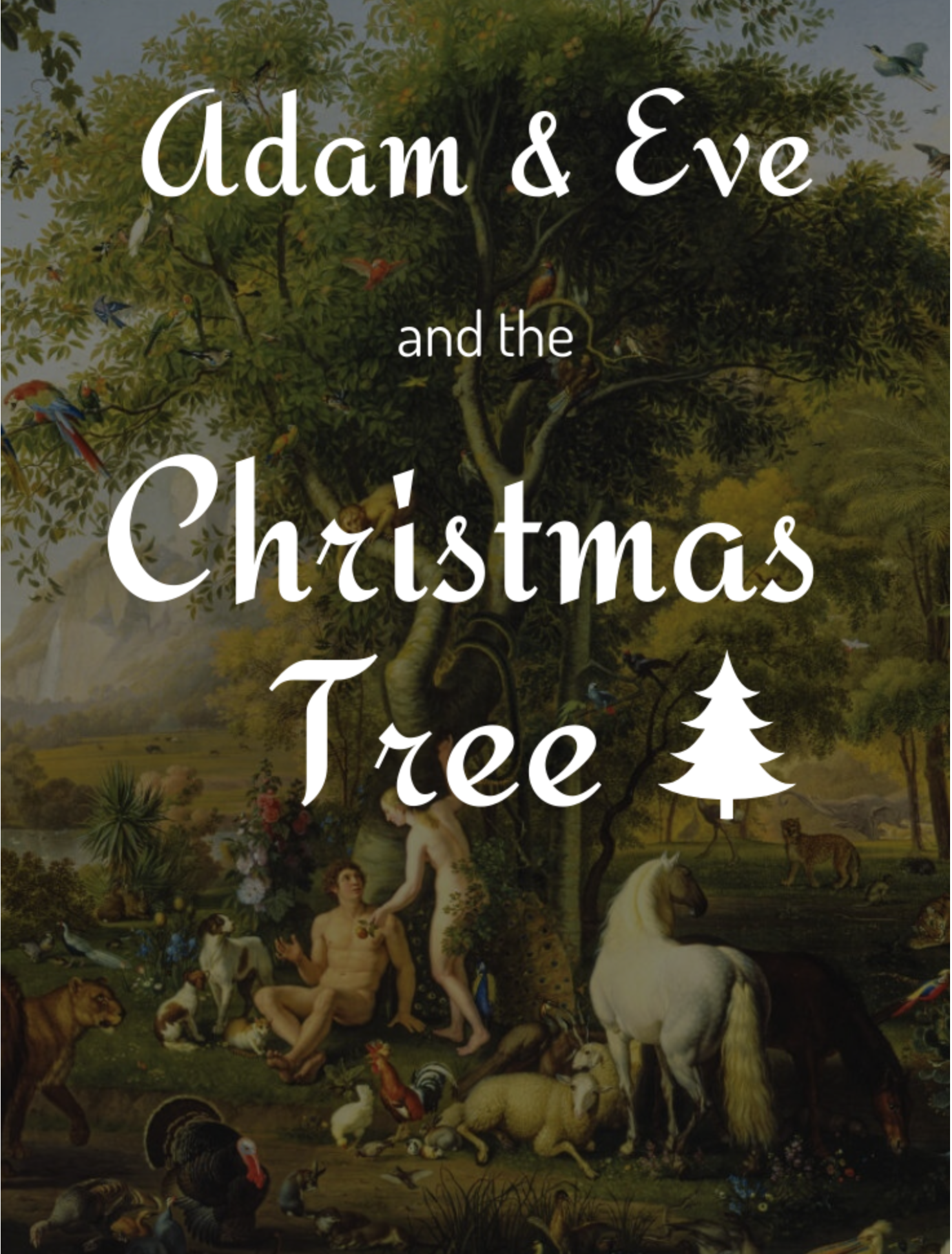
Adam and Eve, the ancestors of the human race, were first honoured as saints in the churches of Eastern Christianity and during the Middle Ages their cult spread into the West. Though the Catholic church never officially recognized them with a feast day, popular veneration of Adam and Eve was widespread, particularly on December 24 when it was thought fitting that those responsible for the Fall of mankind be linked with the birth of the Saviour who came to redeem humanity.

 Medieval dramas which told the story of Adam and Eve had as a stage prop a tree representing the Garden of Eden and the Tree of the Fruit of the Knowledge of Good and Evil. This tree was decorated with apples or round wafers representing the host of the Mass and it is this “Paradise Tree” which some historians (not me) see as a precursor to the modern Christmas tree. This link is evident when we note that as late as the nineteenth century some American and German Christmas trees had images of Adam and Eve and the Serpent underneath them. Godey’s magazine claimed “an orthodox Christmas-Tree will have the figures of our first parents at its foot, and the serpent twining itself. The apples were placed on the table on Christmas Eve to recall those through whose sin mankind first fell as well as the Virgin Mary, the new Eve.