Twelfth Night

Home / Christmas / Twelfth Night

The night of January 5, the vigil or eve of Epiphany, is so called because it is the twelfth night from Christmas, if Christmas is counted as the first. (The Twelve Days are not calculated in the same way everywhere. In some places Christmas is counted making Epiphany the thirteenth day. In England it is particularly confusing because January 6 is Twelfth Day but January 5 is Twelfth Night.)

In England, Twelfth Night had long been a period of partying marking the end of the Christmas season. Masquerading was a common activity on Twelfth Night along with dancing, cross-dressing, and gambling. It was a time of social inversion when a mock king was elected to supervise the misrule. 
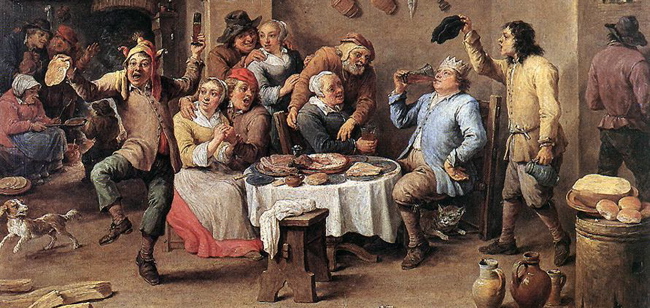
By the nineteenth century its reputation of riotousness was working against it and Twelfth Night was losing out to Christmas as the date for festivities. Victorian values were making the season more respectable and domestic. The gender-swapping and role reversals were theatricalized and absorbed by the pantomime where they became harmless family fare.

Since January 6, Epiphany, is celebrated as the arrival of the Magi or Three Kings, it is customary in many parts of the world to eat a “king cake”, a treat that comes in all shapes and sizes. Readers who remember the Second Gulf War may recall that American petulance at the French refusal to join in the coalition invading Iraq led to many renaming “French fries” as “Freedom fries.” Those who scorned such linguistic pettifoggery may be surprised to learn that our Gallic cousins were first into this fray. During the French Revolution of the 1790s, bakers were told that “gateaux des rois” were no longer politically correct — king cakes now had to be gateaux de Liberté: freedom cakes.
Santa School

Home / Christmas / Santa School

From an article on the blog of The Golden Glow of Christmas Past:

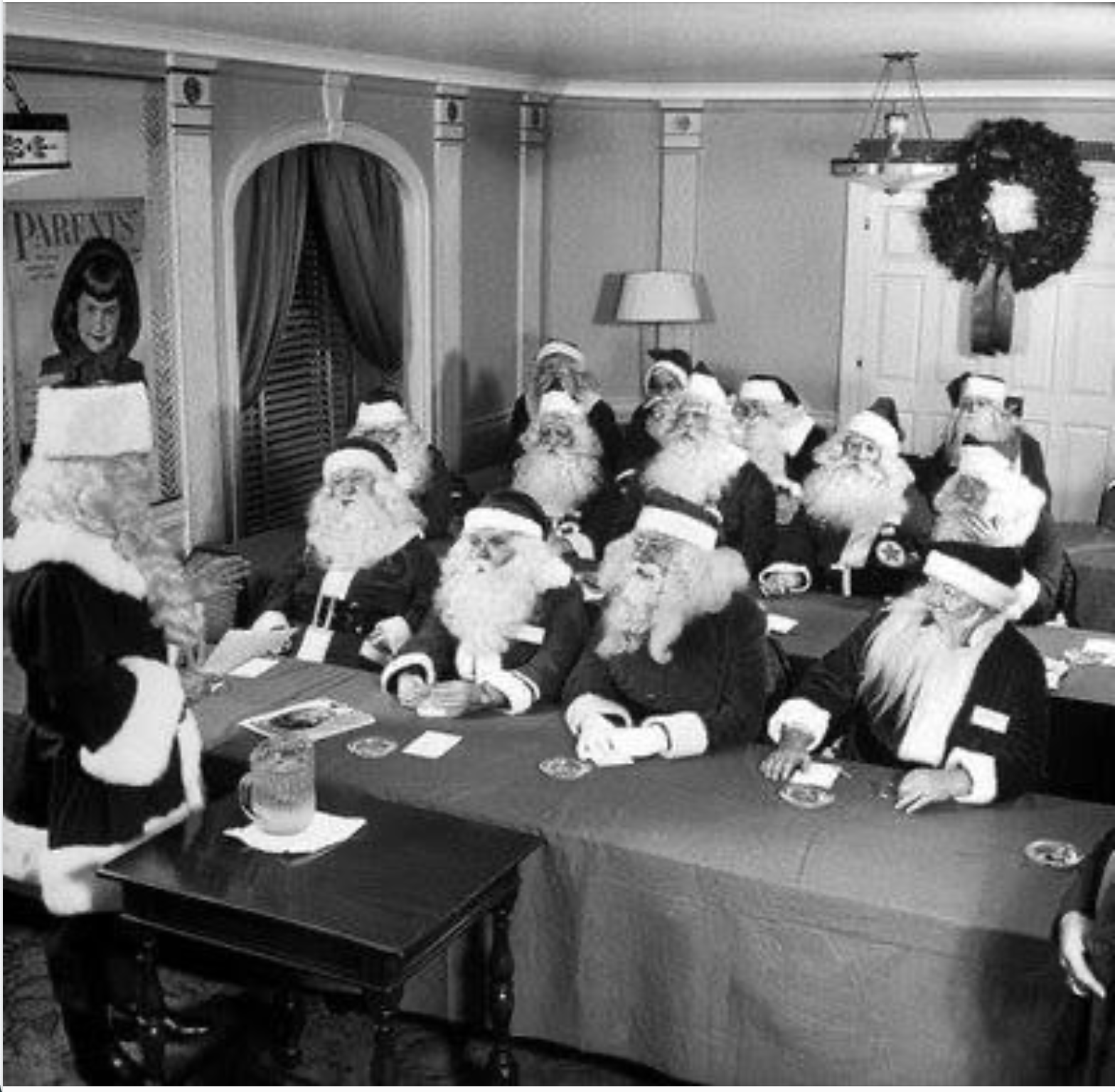
In 1937, Charles W. Howard established the first Santa Claus School which today is the oldest continuously-run Santa school in the world. At the suggestion of a local journalist, he opened a Santa Claus School in Albion New York, to disseminate his Santa philosophies and methods. He initially held classes in his own home. In the late 1940s, he developed Christmas Park adjacent to his house, an attraction for children throughout western New York, which had space for his school’s classroom and dressing room. New Santas could get practice interacting with children by portraying Santa and his helpers at the park. Department stores across the country sent Santas and executives both to his school.

There have been changes to the School since that article. Under new management the School’s website proclaims:

In 1937, Charles W. Howard a farmer in Albion, New York established a Santa school in direct response to his displeasure with seeing other Santas in frayed suits and cheap beards, and a shockingly inadequate knowledge of reindeer. He decided that he could start a school to make a better Santa. The first class consisted of three men, including a welder from New Jersey, his friend, and a neighbor. Charles eventually had a Christmas-themed park, with several barns, a train and some reindeer. Children for miles around would visit, including Tom Valent, who is originally from a town called Salamanca, about an hour’s drive from Albion.


“As a little girl I sat on Charles Howard’s lap, too,” Holly Valent said. “We were from a small town. Every child wanted to go to Christmas Park.” From 1948 to 1965, Charles Howard was the featured Santa Claus in the Macy’s Thanksgiving Day Parade, perhaps the most visible Santa in the United States.


The school was taken over by Nate Doan in the 1960s, another famous Santa who in 1968 moved the school to Bay City, Michigan. Tom first attend the CH Santa School in 1975 when expecting his first child.
Today, the Charles W. Howard Santa Claus School continues running under the direction of Tom and Holly Valent and is carried on in Midland, Michigan with an eager student body of about 300 joyful and jolly new and returning students each year.

In 1995, Tom and Holly conducted the first World Santa School in Illulisatt, Greenland. The participating countries included: Germany, Ireland, England, Norway, Sweden, Denmark, Canada, Spain, Australia, Greenland, South Africa, Switzerland, as well as the United States.  This Santa School has been taught in Australia, Greenland, and England. Tom and Holly have participated in the weeklong St. Nicholas festivities in Zurich, Switzerland, Oslo, Norway and Stockholm Sweden.

January 2

Home / Christmas / January 2

About that foreskin. Yesterday’s blog post was about the medieval celebration of the Circumcision of Jesus and curious readers may be asking: whatever happened to that particular prepuce? Thereby hangs a tale.

While the bodies of Christian saints have yielded thousands of relics, the bodies of Christ and the Virgin Mary, both of which were taken into Heaven, are much less productive of remains. The faithful believed that some of the Virgin’s breast milk and hair were preserved for veneration and that drops of the blood of Jesus at his crucifixion had been saved, but the only body part of Christ that was available as a relic was his foreskin.

How it came to be safeguarded is told in a pseudo-gospel called the Arab Infancy Gospel from the fifth or sixth centuries: And when the time of his circumcision was come, namely, the eighth day, on which the law commanded the child to be circumcised, they circumcised him in a cave. And the old Hebrew woman took the foreskin (others say she took the navel-string), and preserved it in an alabaster-box of old oil of spikenard. And she had a son who was a druggist, to whom she said, “Take heed thou sell not this alabaster box of spikenard-ointment, although thou shouldst be offered three hundred pence for it.” Now this is that alabaster-box which Mary the sinner procured, and poured forth the ointment out of it upon the head and feet of our Lord Jesus Christ, and wiped it off with the hairs of her head.

In the year 800 the Frankish emperor Charlemagne gave the relic to Pope Leo III, telling him that he had received it from an angel. It was preserved in Rome until the city was sacked by Germans in 1527 when it was stolen. The Italian village in which it was recovered kept the foreskin in its reliquary until it disappeared either in 1945 or 1983.

But fear not, because as many as 18 other foreskins of Christ were said to be in circulation during the Middle Ages, though none now can be found. The Catholic Church eventually grew weary of celebrating the Feast of the Circumcision and removed it from the church calendar.

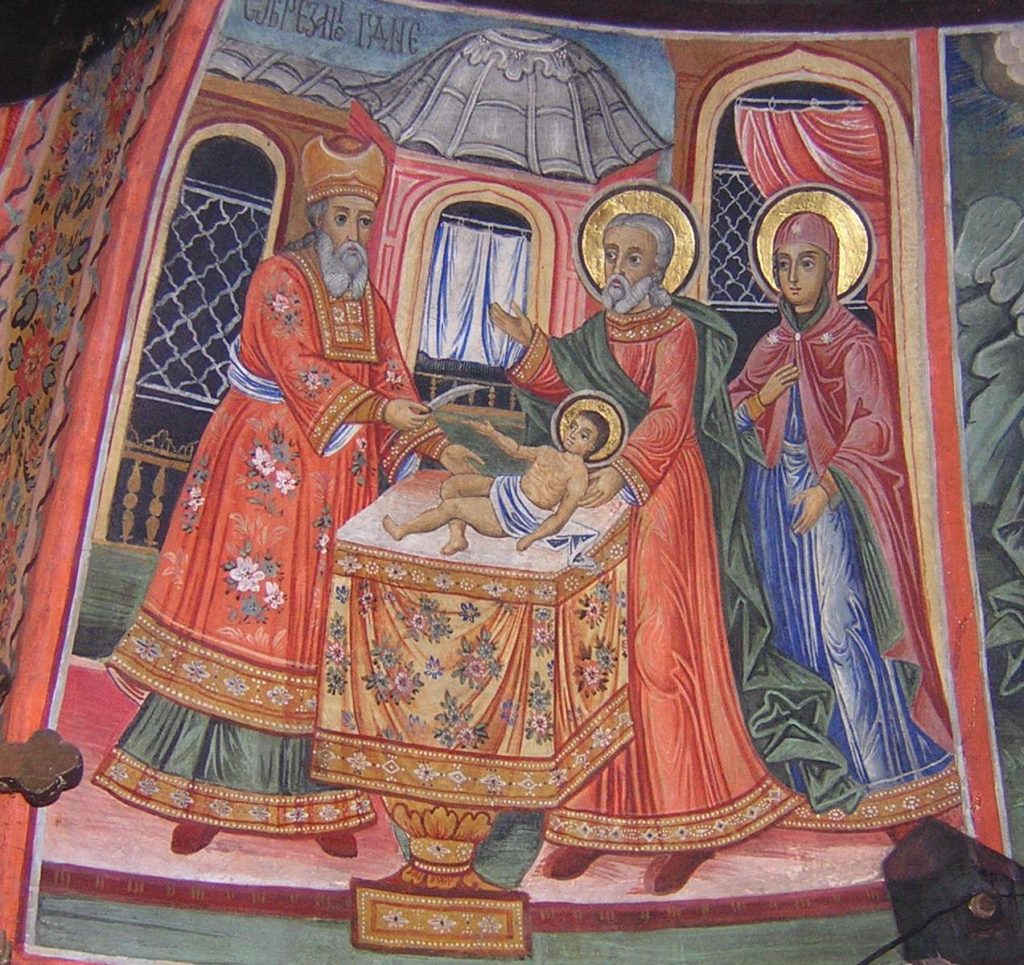
The Circumcision of Jesus

Home / Christmas / The Circumcision of Jesus

January 1, one of the Twelve Days of Christmas, is termed “The Octave of the Nativity” on the Roman Catholic calendar and is also called “Feast of the Holy Name of Jesus”, marked by Catholics and Anglicans. For a long time, however, the date had a different name, as explained here by the late theologian Larry Hurtado:

From about the 6th century or so in the Western churches, 1 January was designated as the Feast of the Circumcision of Jesus (eight days after 25 Dec).  Luke 2:21 mentions Jesus’ circumcision and formal naming.  In the medieval period, however, the date was treated as another feast dedicated to Jesus’ mother, Mary.  This is indicative of the growing centrality of Mary-devotion in the medieval period (in practical terms, overshadowing Jesus in popular piety), and it may also reflect a certain lack of concern or even an uneasiness about Jesus’ Jewishness.

The readiness to acknowledge Jesus the Jew has varied, with much of church history appearing to ignore or have little to say about the topic.  This is even evident in church art.  If you go through the many paintings of the infant Jesus (often pictured with the infant John the Baptist), typically a nude Jesus with his genitals showing, it’s interesting to note how many appear to show an uncircumcised Jesus.

So, I think that it’s important in historical terms to have in the church calendar a reminder that Jesus was not some generic human, but a quite specific person:  male and most definitely Jewish.  Perhaps especially in light of the sad history of Christian treatment of Jews, it’s particularly appropriate.  It at least does justice to history.