June 3

1905

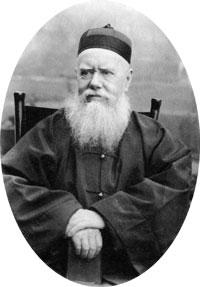
Death of missionary Hudson Taylor

China in the mid-nineteenth century was in a dreadful state. The decadent Qing (or Manchu) dynasty was unable to deal with challenges posed by natural disasters and the intrusion of the outside world after years of relative isolation. The British East India Company had encouraged a massive drug problem in order to alleviate its balance of payment problems and the Chinese governments’ attempts to counter this were met by the Opium Wars. China was forced to open its doors at the point of a gun and in poured foreign merchants, ideas and missionaries. One of those missionaries gave a pamphlet entitled “Good Words to Admonish the Age” to a young Chinese man named Hong Xiuquan, a failed candidate for the civil service exams. After reading Christian tracts and undergoing visions, Hong proclaimed himself the younger brother of Jesus and began a rebellion that would lead to the death of 20,000,000 of his fellow countrymen. Into this chaos stepped Hudson Taylor (1832-1905).

Taylor was the son of an English Methodist lay preacher who desired that his son become a missionary to Asia. To prepare himself for this task Taylor studied medicine and Mandarin. In 1853 he set sail for Shanghai under the auspices of the China Evangelization Society but he soon abandoned that unreliable organization and conducted himself according to his own principles. Unlike other western missionaries Taylor dressed in the Chinese style, shaved his forehead and wore his hair in a pig tail. He shunned the company of Europeans and headed inland distributing tracts and Bibles. He was often robbed and caught up in riots; mission stations were overrun by combatants; his supplies were destroyed in a fire; and he encountered the vicissitudes of a land undergoing civil war. His wife and 4 young children died in China. During the Boxer Rebellion many of his colleagues and their families were murdered in the anti-foreigner uprising. Despite these challenges Taylor continued his work and built the China Inland Mission into the country’s biggest evangelistic endeavour. He died in 1905 and was buried in China. Today there are tens of millions of Chinese Christians and Taylor’s work continues to be carried on by the Overseas Missionary Fellowship (International).
June 1

1453

Better a turban than a tiara

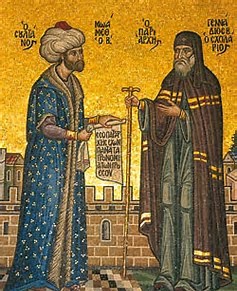
Gennadius II becomes the first ecumenical patriarch of the Orthodox Church to serve under a Muslim ruler when Mohammed II invests him with staff and mantle.

As the Byzantine empire shrank under the attacks of various Turkish tribes, it consistently called to western European Christians for aid. Time and again, the Orthodox Byzantines were told that the price of military help was conversion to Catholic theology and submission to the pope. A number of emperors decided to pay that price and converted, at least in name, but they could never convince their population that they should abandon Orthodoxy. The people always replied that they would prefer rule by Muslims who would allow them to keep their traditional religion than to take western aid and abandon their faith. “Better a turban than a tiara” was the cry in the streets.

In the 1450s as the situation in Constantinople grew increasingly dire, the emperor Michael XI Paleologus decided that he had no choice but to give in to the pope’s demands. In return for some western troops Michael announced that he had converted to Catholicism. His chief opponent in this was the monk and scholar Georgios Kourtesios Scholarios (1400-73), known as Gennadius. Gennadius had earlier in his career been a supporter of the ecclesiastical union of Eastern and Western Christianity but in 1453 told those who came to him for counsel: ”O unhappy Romans [the name always used by Byzantines to refer to themselves], why have you forsaken the truth? Why do you not trust in God, instead of in the Italians? In losing your faith you will lose your city. Have mercy on me, O Lord! I protest in thy presence that I am innocent of the crime.”

When the city fell on May 29, Gennadius was taken prisoner by the Turks but he was set free by the new conqueror Mehmet II. It was Mehmet’s plan that Constantinople be resettled and rebuilt with Orthodox Christian help. To that end he granted them limited religious self-government under their Patriarch. Mehmet named Gennadius to this post, knowing him to be one who would not be seeking assistance from the West. Though he was uneasy as Patriarch, Gennadius initiated the subservience of his office to the Turkish state, a condition which exists to this day. In 1953 the Turkish republic issued a stamp celebrating the 500th anniversary of Mehmet investing the Patriarch with his staff of office.