May 17

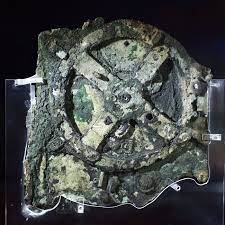
1902 Discovery of the Antikythera Mechanism

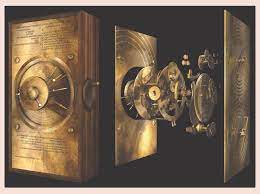
Amongst the remains of a 2,000-year-old shipwreck off the Greek island of Antikythera, archaeologists identified bits and pieces of an ancient device. Over the past century, investigators have probed its secrets and identified it as the world’s earliest analogue computer. Reconstructed, it would have looked like this:

A complicated series of gears rotated by hand would have performed a series of astronomical tasks. 

  • Little stone or glass orbs would have moved across the machine’s face to show the motion of Mercury, Venus, Mars, Saturn, and Jupiter in the night sky
  • The position of the sun and moon, relative to the 12 constellations of the zodiac
  • Another dial forecasting solar and lunar eclipses
  • A solar calendar, charting the 365 days of the year
  • A lunar calendar, counting a 19-year lunar cycle
  • A tiny pearl-size ball that rotated to show you the phase of the moon
  • A dial that counted down the days to regularly scheduled sporting events such as the Olympic Games

May 16

St John of Nepomuk

Butler’s Lives of the Saints tells us:

JOHN was born, in answer to prayer, 1330 [or 1345 according to some], of poor parents, at Nepomuc in Bohemia. In gratitude they consecrated him to God; and his holy life as a priest led to his appointment as chaplain to the court of the Emperor Wenceslas, where he converted numbers by his preaching and example. Amongst those who sought his advice was the empress, who suffered much from her husband’s unfounded jealousy. St. John taught her to bear her cross with joy; but her piety only incensed the Emperor, and he tried to extort her confessions from the Saint. He threw St. John into a dungeon, but gained nothing; then, inviting him to his palace, he promised him riches if he would yield, and threatened death if he refused. The Saint was silent. He was racked and burnt with torches; but no words, save Jesus and Mary, fell from his lips. At last set free, he spent his time in preaching, and preparing for the death he knew to be at hand.

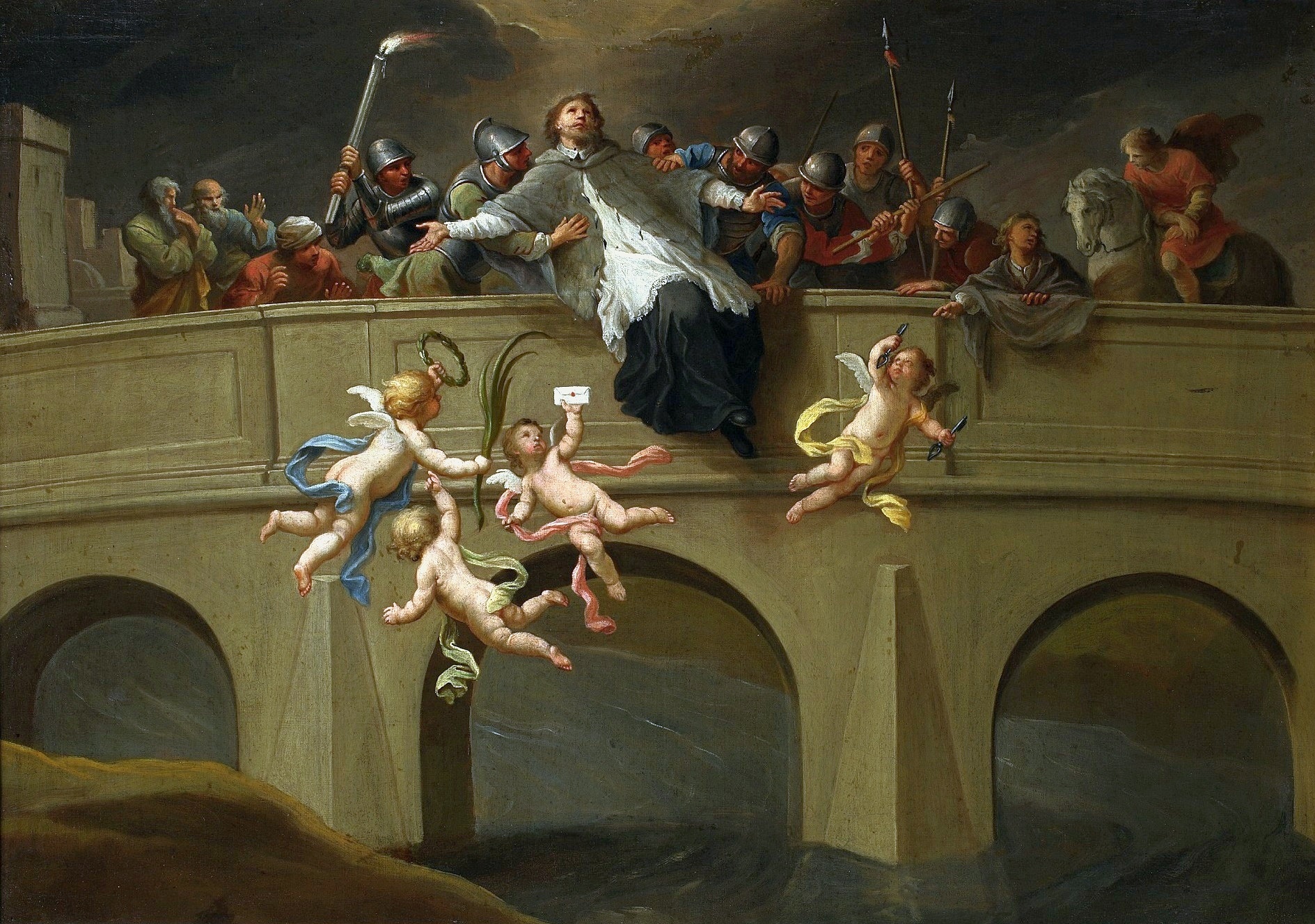
On Ascension Eve, May 16, [1393] Wenceslas, after a final and fruitless attempt to move his constancy, ordered him to be cast into the river, and that night the martyr’s hands and feet were bound, and he was thrown from the bridge of Prague. As he died, a heavenly light shining on the water discovered the body, which was buried with the honours due to a Saint. A few years later, Wenceslas was deposed by his own subjects, and died an impenitent and miserable death.

In 1618 the Calvinist and Hussite soldiers of the Protestant Elector Frederick tried repeatedly to demolish the shrine of St. John at Prague. Each attempt was miraculously frustrated; and once the persons engaged in the sacrilege, among whom was an Englishman, were killed on the spot. In 1620 the imperial troops recovered the town by a victory which was ascribed to the Saint’s intercession, as he was seen on the eve of the battle, radiant with glory, guarding the cathedral. When his shrine was opened, three hundred and thirty years after his decease, the flesh had disappeared, and one member alone remained incorrupt, the tongue; thus still, in silence, giving glory to God.

John was canonized in 1729 and is one of the favourite Czech saints. He is the patron of those suffering from untrue calumnies and a protector from floods and drowning.

May 15

1919 The Winnipeg General Strike begins
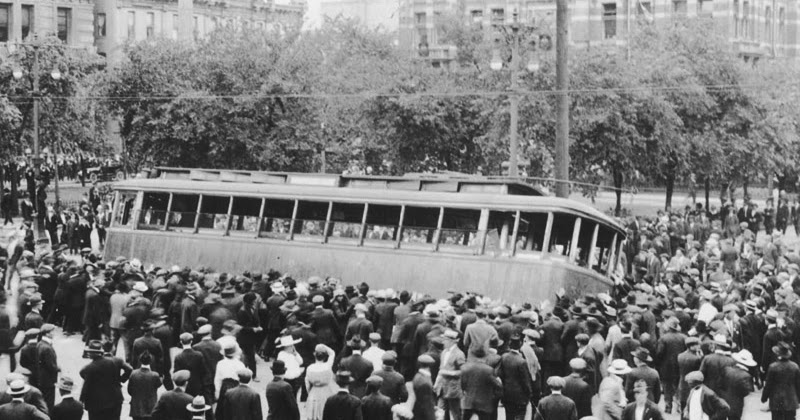
There is no doubt that the economic situation in the year following the end of the Great War was not a happy one for the labouring classes of Winnipeg. Prices had risen sharply during the war years of 1914-18, much more sharply than wages. Returning veterans often found it hard to get their old jobs back and were particularly resentful when it seemed that these jobs were now held by immigrants, aliens who had not fought for King and Country. Some discontented veterans turned to anti-foreign bigotry; some turned to more radical politics than they would have espoused before their war experiences.

If a Winnipegger in early 1919 were to read one of the numerous newspapers that the city boasted, they would see that the world was on fire. In Russia a full-scale civil war was in progress with murderous armies of Reds, led by V.I. Lenin’s Bolsheviks, and Whites killing and starving miilions. Inspired by Bolshevik successes, soviet revolutions broke out over Europe. On January 5 in Berlin, the left-wing Spartacists led by Rosa Luxembourg and Karl Liebknecht, rose up to establish a communist republic, prompting battles with the right-wing Freikorps. Two days later, anarchists rebelled in Argentina. Two weeks after that, a revolution took place in Portugal, and Irish rebels began a civil war. Over the next few months, there were labour riots in Glasgow necessitating the calling in troops, disturbances in Czecholslovakia, a General Strike was launched in Seattle, Egypt broke out in rebellion, and Canadian troops overseas mutinied on British bases. In Moscow the Comintern was formed to coordinate Marxist rebellions on a global scale; soviet republics were set up in Hungary and Bavaria. Mexico was in the throes of revolution: the rebel Emiliano Zapata was assassinated and Pancho Villa was on a rampage. In Europe, in response to left-wing activism, veterans, such as Adolf Hitler and Benito Mussolini, were creating new fascist parties.

Class tensions and potential violence were not absent from Winnipeg. A well-attended meeting at Winnipeg’s  Walker Theatre in December 1918, co-sponsored by the Trades and Labour Council and the Socialist Party of Canada, had heard speakers denounce capitalism, and demand that Canadian troops be withdrawn from the expedition to fight the Reds in Russia. The Chairman, John Queen, then called for three cheers for the Russian Revolution. The meeting ended with deafening cries of “Long live the Russian Soviet Republic! Long live Karl Liebknecht! Long live the working class!” A telegram of congratulations to the Bolsheviks was to be sent. Late in the following month , a mob  of returned veterans in Winnipeg attacked socialists mourning the deaths of Luxembourg and Liebknecht, marched on a meat-packing pant to demand that immigrant workers be fired, vandalized businesses, and forced suspected foreigners to kiss the Union Jack.

 In March of 1919, the Western Labour Conference opened in Calgary with a large delegation from Manitoba, including men such as R.B. Russell, Andy Scoble, and R.J. Johns who would be involved in the Winnipeg General Strike. Johns was noted back in Winnipeg for opposing conscription and urging a general strike during wartime. The conference called for the formation of One Big Union, the ultimate weapon in the labour arsenal, and the replacement of capitalism with industry controlled by workers’ soviets. Among two of the motions passed unanimously were one placing those present “on record as being in full accord and sympathy with the aims and purposes of the Russian Bolshevik and German Spartacan Revolutions” and accepting “the principle of ‘Proletariat Dictatorship’ as being absolute and efficient for the transformation of capitalistic private property to communal wealth, and that fraternal greetings be sent to the Russian Soviet Government, the Spartacans in Germany, and all definite working class movements in Europe and the world, recognizing they have won first place in the history of the class struggle.” Russell was dispatched back to Winnipeg to carry out “propaganda” on behalf of these resolutions.

National and provincial officials were not unaware of these tensions and were seeking to understand the situation better. The Manitoba government had proposed an Industrial Disputes Commission but the Trades and Labour Council in Winnipeg refused to nominate labour members to it. The Borden government in Ottawa had set up the Mathers Commission (under the Chief Justice of Manitoba) to investigate industrial relations across Canada – but again the TLC refused to cooperate or testify before the commission went it came to Manitoba.

This was the situation on May 15, 1919 when the General Strike was launched – a world in turmoil, Marxist revolutionaries in bloody rebellion, local labour leaders praising Bolshevism, and using the language of class warfare. If the strikers were misunderstood, if the pro-establishment  Citizens’ Committee of One Thousand, local newspapers, and the Borden government over-reacted in perceiving revolutionary intent, the Left had nobody to blame but itself.

The strike lasted until late June when it was abandoned in what was seen at the time as a failure, but it lives on in progressive folk memory as a moral victory.

May 14

1610 Assassination of Henri IV

Frenchmen spent the last half of the 16th century persecuting each other over the question of religion. The last stage of these conflicts was known as The War of the Three Henris because each of the factions was led by (you guessed it) someone named Henri. The last of the Valois dynasty, which pursued a variable middle course, that of the so-called “Politiques”, was Henri III. Henri, Duc de Guise, led the ultra-Catholic League, while Protestant forces were under Henri of Navarre. In 1588 Henri III had Guise murdered and in the next year a Catholic partisan took revenge by knifing the king to death. This left Navarre next in line to the throne but he only won nation-wide acceptance when he converted to Catholicism, becoming Henri IV, first of the Bourbon dynasty.

But old hatreds died hard. In 1610, François Ravaillac approached the coach of Henri IV as it was stuck in a Parisian traffic jam and plunged his dagger into the king. Though he swore, under hideous torture, that he had no accomplices and was motivated by a desire to punish someone who was no true Catholic, a recent historian has speculated that he was aided by a noblewoman, the Marquise de Verneuil, who was a spiteful discarded royal mistress, and the Duc d’Epernon who had never reconciled himself to Henri’s rule.

Ravaillac was executed in a gruesome fashion which the loathsome Michel Foucault recounted in some detail in Discipline and Punish. Suffice it here to say only that he was, after much other unpleasantness, torn apart by six horses. The standard text on the affair is Roland Mousnier, The Assassination of Henry IV.

May 13

1917

The first Marian apparition at Fátima.

Of the hundreds of appearances of the Virgin Mary reported to the Church throughout history, only twelve (though some sources say fifteen) are officially recognized by the Vatican. The earliest of these was in Guadalupe, Mexico in 1555 and the most recent was in Rwanda in 1982. One of the most famous of them all and, certainly the most public, was a series of apparitions that occurred in 1917 to three Portuguese peasant children in Fátima.

In the spring of 1916 Lucia dos Santos (age 9) and her cousins Jacinta and Francisco Marto (ages 7 and 6) were herding sheep on a field known as Cova da Iria when they claimed to have been visited three times by an angel who instructed them in prayer and worship. On May 13, 1917 the children were in the same field when they beheld an apparition of a shining lady, whom they identified as the Virgin Mary, in an oak tree. The vision said she had come from heaven and would return in the same place and time on the thirteenth day of the coming months.  During these visits the children were given three secrets. The first was a vision of Hell; the second was a prediction of war; and the third was kept private by Louisa, but was eventually written down and conveyed to the pope.

News of these apparitions leaked out and caused considerable controversy. Crowds gathered at the spot, though they saw, at first, nothing of what the children claimed to see. At one point the three youngsters were arrested and threatened with torture if they did not reveal the secrets, but they resisted. The apparition had promised that at her final visit in October she would produce a miracle that would cause many to believe. On October 13, 1917 before a crowd numbered in the tens of thousands, the sun seemed to behave erratically. In the words of one observer: “Before the astonished eyes of the crowd, whose aspect was biblical as they stood bare-headed, eagerly searching the sky, the sun trembled, made sudden incredible movements outside all cosmic laws – the sun ‘danced’ according to the typical expression of the people.” This “Miracle of the Sun” was widely reported in the media and Fatima became a site of massive pilgrimage.

Both Jacinta and Francisco soon perished in the great influenza epidemic but Louisa became a nun and lived until the ripe old age of 97, dying in 2005. Pope John Paul II credited Our Lady of Fatima for saving him from an assassination attempt. On his pilgrimage to the site, he left the bullet that was extracted from his body and it now rests in the crown of the Virgin’s statue in the chapel. In 2017, Pope Francis announced the canonization of Jacinta and Francisco after miracles had been attributed to their intercession. Lucia is also on the path to sainthood.

May 12

1885

Métis defeat at Batoche

In 1885, the Métis settlers of the South Saskatchewan River valley and a number of western native tribes arose in rebellion against the Canadian state, motivated by fears of loss of land, dwindling natural food resources, and government mismanagement. They were led by the mad visionary Louis Riel, and chiefs Poundmaker and Big Bear. After a number of rebel successes against white settlers, militia and police, a Canadian army led by General Frederick Middleton advanced against the centre of resistance, the village of Batoche.

After two days of shelling and outflanking maneuvers had failed to dislodge the Métis from their rifle pits, the army tried another unsuccessful attack on May 12, which failed because of miscommunication between units. Finally, frustrated Canadian regulars belonging to the Winnipeg Rifles, the Royal Grenadiers and the Midland regiment staged a mass frontal charge that overwhelmed the outnumbered and outgunned rebels. The surrender of Louis Riel hastened the end of the uprising, which would end in July when the last of the native warriors gave themselves up.

The rebellion was ill-advised and resulted in hard times for the Métis, though Riel remains a hero in the eyes of many.

May 11

Home / Uncategorized / May 11

1812 The Assassination of Spencer Perceval

The only assassination of a British Prime Minister took place on this date when Spencer Perceval was gunned down outside the House of Commons. For some reason, political murders are rare in the British Commonwealth, much less frequent than in presidential systems. Yet another advantage of a constitutional monarchy.

A near-contemporary account reveals the fate of the assailant and his motives.

A weak ministry, under a premier of moderate abilities, Mr. Spencer Percival, was broken up, May 11, 1812, by the assassination of its chief. On the evening of that day, Mr. Percival had just entered the lobby of the House of Commons, on his way into the house, when a man concealed behind the door shot him with a pistol. He staggered forward with a slight exclamation, and fell expiring. The incident was so sudden, that the assassin was at first disregarded by the bystanders. He was at length seized, and examined, when another loaded pistol was found upon him. He remained quite passive in the hands of his captors, but extremely agitated by his feelings, and when some one said, ‘Villain, how could you destroy so good a man, and make a family of twelve children orphans?’ he only murmured in a mournful tone, ‘I am sorry for it.’ It was quickly ascertained that he was named John Bellingham, and that a morbid sense of some wrongs of his own alone led to the dreadful deed. His position was that of an English merchant in Russia: for some mercantile injuries there sustained he had sought redress from the British government; but his memorials had been neglected.

Exasperated beyond the feeble self-control which his mind possessed, he had at length deliberately formed the resolution of shooting the premier, not from any animosity to him, against which he loudly protested, but ‘for the purpose,’ as he said, ‘of ascertaining, through a criminal court, whether his Majesty’s ministers have the power to refuse justice to [for] a well-authenticated and irrefutable act of oppression committed by their consul and ambassador abroad.’ His conduct on his trial was marked by great calmness, and he gave a long and perfectly rational address on the wrongs he had suffered, and his views regarding them. There was no trace of excitable mania in his demeanour, and he refused to plead insanity. The unhappy man, who was about forty-two years of age, met his fate a week after the murder with the same tranquillity. He probably felt death to be a kind relief from past distresses, for it was his own remark on his trial, ‘Sooner than suffer what I have suffered for the last eight years, I should consider five hundred deaths, if it were possible for human nature to endure them, far more to be preferred.’ He had left a wife of twenty years, with a babe at her breast, in St. Petersburg, waiting to be called to England when his affairs should be settled. A more affecting image of human misery can scarcely be conceived.

May 10

1849

The Astor Place Riot

A quarrel over the merits of American and British actors led to an astonishing outbreak of violence in New York.

Theatres in the nineteenth century were a place where citizens of all social classes could gather and where loud expressions of opinion and taste could burst into riotous disorder. In 1849 the issue was whether American actors, exemplified by 45-year-old star Edwin Forrest, had attained an excellence in their portrayal of Shakespearean characters that was the equal of British actors, such as the touring player, the venerable Edwin Charles Macready. The two men had a history of hostility dating back to earlier tours of England which had resulted in threats of lawsuits and nasty letters to newspapers. Back in the U.S.A., Forrest had pressed the question by following Macready’s troupe about the country and challenging him by performing the same roles. Throw in the anti-British sentiment espoused by American patriots and recent Irish immigrants and you have an explosive situation in the making. Worse yet, was Forrest’s appeal to working class toughs and street gangs who claimed to prefer his rugged “American” style of acting to the more refined techniques of his foreign rival.

On May 7, 1849, Macready’s performance of Macbeth was interrupted by elements in the audience who pelted the stage with fruit, pennies and rotten eggs, while ripping up seats, hissing, and crying “Shame!” Though the actors tried to continue, the show had to be cancelled. The elderly Macready vowed to return to Britain in high dudgeon but influential New Yorkers urged him to stay and assured him that the better natures of the townsfolk would prevail. Alas it was not to be; the lower orders resented the interference of the upper class and were bent on mayhem.

Three nights later, Macready attempted to put on the Scottish play once more, and once more sections of the audience were determined to drive him from the stage. But the real problems were outside the theatre where a mob of 10,000 had gathered, armed with stones and bottles. For them, opposition to Macready was a patriotic act — street posters had stirred them up, demanding “SHALL AMERICANS OR ENGLISH RULE THIS CITY?” Someone attempted to set the theatre on fire.

Knowing that the local police were not up to the task, the Governor had summoned the state militia to protect the performance and to guard the residences of the well-to-do. When the mob would not disperse, a tragic decision was taken. In the words of a contemporary account:

At last the awful word was given to fire—there was a gleam of sulphurous light, a sharp quick rattle, and here and there in the crowd a man sank upon the pavement with a deep groan or a death rattle. Then came a more furious attack, and a wild yell of vengeance! Then the rattle of another death-dealing volley, far more fatal than the first. The ground was covered with killed and wounded—the pavement was stained with blood. A panic seized the multitude, which broke and scattered in every direction. In the darkness of the night yells of rage, screams of agony, and dying groans were mingled together. Groups of men took up the wounded and the dead, and conveyed them to the neighboring apothecary shops, station-houses, and the hospital.

The result was up to 30 dead, most innocent bystanders, and a sharpening of class hostility in New York.

May 9

1671

Colonel Blood Steals the Crown Jewels

This day, in the year 1671, witnessed one of the most extraordinary attempts at robbery recorded in the annals of crime. The designer was an Irishman, named Thomas Blood, whose father had gained property, according to the most probable account, as an iron-master, in the reign of Charles I.

When the civil wars broke out, the son espoused the cause of the parliament, entered the army, and rose to the rank of colonel; at least, in subsequent times, he is always spoken of as Colonel Blood. As, at the Restoration, we find him reduced to poverty, we may conclude that he had either squandered away his money, or that his property had been confiscated, perhaps in part both, for he seems to have laboured under the impression of having been injured by the Duke of Ormond, who had been appointed lord lieutenant of Ireland, and against whom he nourished the bitterest hatred.

In 1663, he formed a plot for surprising Dublin Castle, and seizing upon the lord lieutenant, which, however, was discovered before it could be carried into execution. Blood then became a wandering adventurer, roaming from one country to another, until he established himself in London, in the disguise of a physician, under the name of Ayliffe. Such was his position in 1670, when he made another attempt on the life of his enemy, the Duke of Ormond. On the evening of the 6th of December in that year, as the duke was returning home from a dinner given to the young Prince of Orange, in St. James’s Street, he was stopped by six men on horseback, who dragged him from his coach, and having fastened him with a belt behind one of them, were carrying him off towards Tyburn, with the intention of hanging him there. But, by desperate struggling, he succeeded in slipping out of the strap which bound him, and made his escape, under favour of the darkness, but not without considerable hurt from the brutal treatment he had undergone. A reward of a thousand pounds was offered for the discovery of the ruffians concerned, but in vain.

It was not many months after this event, that Colonel Blood formed the extraordinary design of stealing the crown of England, and he contrived his plot with great artfulness. The regalia were at this time in the care of an aged but most trustworthy keeper, named Talbot Edwards, and Blood’s first aim was to make his acquaintance. Accordingly, he one day in April went to the Tower, in the disguise of a parson, with a woman whom he represented as his wife, for the purpose of visiting the regalia. After they had seen them, the lady pretended to be taken ill, upon which they were conducted into the keeper’s lodgings, where Mr. Edwards gave her a cordial, and treated her otherwise with kindness. They parted with professions of thankfulness, and a few days afterwards the pretended parson returned with half-a-dozen pairs of gloves, as a present to Mrs. Edwards, in acknowledgment of her courtesy.

An intimacy thus gradually arose between Blood and the Edwardses, who appear to have formed a sincere esteem for him; and at length he proposed a match between their daughter and a supposed nephew of his, whom he represented as possessed of two or three hundred a-year in land. It was accordingly agreed, at Blood’s suggestion, that he should bring his nephew to be introduced to the young lady at seven o’clock in the morning on the 9th of May (people began the day much earlier then than now); and he farther asked leave to bring with him two friends, who, he said, wished to see the regalia, and it would be a convenience to them to be admitted at that early hour, as they were going to leave town in the forenoon.

Accordingly, as we are told by Strype, who received his narrative from the lips of the younger Edwards, ‘at the appointed time, the old man had got up ready to receive his guest, and the daughter had put herself into her best dress to entertain her gallant, when, behold! parson Blood, with three more, came to the jewel house, all armed with rapier blades in their canes, and every one a dagger and a pair of pocket pistols. Two of his companions entered in with him, and a third stayed at the door, it seems, for a watch.’ At Blood’s wish, they first went to see the regalia, that his friends might be at liberty to return; but as soon as the door was shut upon them, as was the usual practice, they seized the old man, and bound and gagged him, threatening to take his life if he made the smallest noise. Yet Edwards persisted in attempting to make all the noise he could, upon which they knocked him down by a blow on the head with a wooden mallet, and, as he still remained obstinate, they beat him on the head with the mallet until he became insensible; but recovering a little, and hearing them say they believed him to be dead, he thought it most prudent to remain quiet. The three men now went deliberately to work; Blood placing the crown for concealment under his cloak, while one of his companions, named Parrot, put the orb in his breeches, and the other proceeding to file the sceptre in two, for the convenience of putting it in a bag.

The three ruffians would probably thus have succeeding in executing their design, but for the opportune arrival of a son of Mr. Edwards from Flanders, accompanied by his brother-in-law, a Captain Beckman, who, having exchanged a word with the man who watched at the door, proceeded upstairs to the apartments occupied by the Edwardses. Blood and his companions thus interrupted, immediately decamped with the crown and orb, leaving the sceptre, which they had not time to file.

Old Edwards, as soon as they had left the room, began to shout out, ‘Treason! Murder!’ with all his might; and his daughter, rushing out into the court, gave the alarm, and cried out that the crown was stolen. The robbers reached the drawbridge without hindrance, but there the warder attempted to stop them, on which Blood discharged a pistol at him. As he fell down, though unhurt, they succeeded in clearing the other gates, reached the wharf, and were making for St. Katherine’s-gate, where horses were ready for them, when they were overtaken by Captain Beckman.

Blood discharged his second pistol at the captain’s head, but he escaped hurt by stooping, and immediately seized upon Blood, who struggled fiercely; but finding escape impossible, when he saw the crown wrested from his grasp, he is said to have exclaimed, in a tone of disappointment, ‘It was a gallant attempt, however unsuccessful; for it was for a crown!’ A few of the jewels fell from the crown in the struggle, but all that were of any value were recovered and restored to their places. Blood and Parrot (who had the orb and the most valuable jewel of the sceptre in his pocket) were secured and lodged in the White Tower, and three others of the party were subsequently captured.

The king, when informed of this extraordinary outrage, ordered Blood and Parrot to be brought to Whitehall to be examined in his presence. There Blood behaved with insolent effrontery He avowed that he was the leader in the attempt upon the life of the Duke of Ormond, in the preceding year, and that it was his intention to hang him at Tyburn; and he further stated that he, with others, had on another occasion concealed themselves in the reeds by the side of the Thames, above Battersea, to shoot the king as he passed in his barge; and that he, Blood, had taken aim at him with his carbine, but that ‘his heart was checked by an awe of majesty,’ and that he had not only relented himself, but had prevented his companions from proceeding in their design. This story was probably false, but it seems to have had its designed effect on the king, which was no doubt strengthened by Blood’s further declaration that there were hundreds of his friends yet undiscovered (he pretended to have acted for one of the discontented parties in the state), who were all bound by oath to revenge each other’s death, which ‘would expose his majesty and all his ministers to the daily fear and expectation of a massacre.

But, on the other side, if his majesty would spare the lives of a few, he might oblige the hearts of many; who, as they had been seen to do daring mischief, would be as bold, if received into pardon and favour, to perform eminent services for the crown.’ The singularity of the crime, the grand impudence of the offender, united perhaps with a fear of the threatened consequences, induced the king to save Blood from the vengeance of the law. He not only pardoned the villain, but gave him a grant of land in Ireland, by which he might subsist, and even took him into some degree of favour. It is alleged that Blood occasionally obtained court favours for others, of course for ‘a consideration.’ Charles received a rather cutting rebuke for his conduct from the Duke of Ormond, who had still the right of prosecuting Blood for the attempt on his life. When the king resolved to take the ruffian into his favour, he sent Lord Arlington to inform the duke that it was his pleasure that he should not prosecute Blood, for reasons which he was to give him; Arlington was interrupted by Ormond, who said, with formal politeness, that ‘his majesty’s command was the only reason that could be given; and therefore he might spare the rest.’

Edwards and his son, who had been the means of saving the regalia—one by his brave resistance, and the other by his timely arrival—were treated with neglect; the only rewards they received being grants on the exchequer, of two hundred pounds to the old man, and one to his son, which they were obliged to sell for half their value, through difficulty in obtaining payment.

After he had thus gained favour at court, Blood took up his residence in Westminster; and he is said by tradition to have inhabited an old mansion forming the corner of Peter and Tufton streets. Evelyn, not long after the date of the attempt on the crown, speaks of meeting Blood in good society, but remarks his ‘villanous, unmerciful look; a false countenance, but very well spoken, and dangerously insinuating.’ He died on the 24th of August, 1680.

May 8

May 8

Julian of Norwich

The term “anchoress” refers to a type of female hermit. In the late 1300s a woman known to history as “Julian of Norwich” (c. 1342-c. 1416), whose true name is unknown and who was called after the church in which she lived, moved into a little cell in a church in Norwich to spend the rest of her life in contemplation of God. She proved to be one of the great mystics of the late Middle Ages and the first female author of a book in English.

In 1373 she experienced the first of a series of visions which she described in her book Revelations of Divine Love. Later she wrote of her theological speculations on these visions in a book known as The Long Text. For Julian God is a god of love, not of anger or punishment: “For I saw no wrath except on man’s side, and He forgives that in us, for wrath is nothing else but a perversity and an opposition to peace and to love.” She is famous for having spoken of Jesus in maternal terms and for the saying “All shall be well, and all shall be well, and all manner of thing shall be well”. Her works are still in print study and are the subject of much academic interest. Recently, Denys Turner’s book Julian of Norwich, Theologian, has sparked interest in her as more than simply a mystic but a genuine Doctor of the Church.