April 5

1534

Jan Matthys dies outside Münster

Jan Matthys van Haarlem (c. 1500-1534) was a Dutch baker who converted to Anabaptism in the 1520s. By 1533 he had convinced himself that he was the reincarnated prophet Enoch and began to preach the coming Apocalypse. His followers infiltrated the city of Münster in Westphalia and summoned Matthys in January 1534 to become the leader of the New Zion. They drove out the Catholic inhabitants of the city and instituted a regime of the godly who were awaiting the End Times. Community of goods, simple living, adult baptism, and theocracy was the new order of things with Matthys as the deciding voice. The seizure of the city led the Catholic bishop to summon help from German princes to crush this dangerous heresy and Münster was soon under siege (pictured above).

In the middle of a wedding banquet Matthys was seized by the Holy Spirit, and cried out, “Father, not as I will, but as Thou wilt.” With a deep sense of gloom he bade farewell to his followers and left the room, claiming that he had been supernaturally instructed that he should go out of the city to confront his enemies. On the next day, at high noon on Easter Sunday, he imitated Gideon and chose thirty companions to sally forth against the Bishop’s army. The poor loon, no warrior by any means, and his band were quickly killed. Matthew’s head was paraded around the walls on a pole and his genitals were nailed to the town gates. His death meant that leadership devolved on the even more radical John of Leiden whose rule of the doomed Anabaptists became bizarre and tragic.

April 4

Home / Today in History / April 4

1609

Spain expels the Moriscos

The Iberian peninsula was invaded by Arab and Berber conquerors in the eighth century. In addition to the Islamic religion, these migrants brought with them new crops and agricultural techniques and connects to the wider Muslim world of trade and culture. This made for a rich and prosperous culture, in which many Christian subjects decided to participate and change religions. There was considerable intermarriage between the original inhabitants and the newcomers. The Moors, as they were called, did not succeed in subjugating the whole peninsula, however; for centuries, Christian kingdoms in the north of Spain fought back, gradually driving Islamic dominions southward. Muslim Spaniards tended to not wish to live under Christian rule and when their rulers were defeated they most often migrated too, leaving the land to be resettled by Catholics.

In 1492, Ferdinand of Aragon and Isabella of Castile completed the Christian reconquest of Spain. Despite promises of religious toleration, they soon demanded that those Muslims unwilling to convert should leave the country (a similar demand was made of Jews.) Thousands left and resettled in North Africa but many stayed behind and changed religions (at least on the surface). These “Moriscos” were always regarded with suspicion by the government who believed that their real allegiance was to Islam, at a time when Spain was fighting for control of the Mediterranean with Muslim powers. From 1568-73 an attempt by Philip II to ban the use of Arabic and Arab clothing, and to force church education on Morisco children resulted in several rebellions. Relations between these New Christians and the Old Christians was always tense, and increasingly so as the Spanish economy failed to prosper despite the influx of gold from the Americas.

Pressure grew on the government of Philip III to expel the ex-Muslim population as a threat to Spanish security. The king was also attracted to the notion of confiscating their property for the crown and so in April, 1609, the first of a series of expulsions was enforced at the point of a sword. The refugees could take only what they could carry; their land and homes were to be confiscated, and any vandalism to this property as they left was punishable by death. Rebellions broke out, especially as those yet to be expelled learned of the harsh treatment given to them in North Africa. Historians are still debating the number of those expelled; estimates range from 300,000 to 1,000,000.

Like many of the Spanish government’s religious and racial policies, this atrocity was self-defeating. Whole towns were left deserted; agricultural production in many provinces of Spain collapsed — prices rose, rents had to be raised on remaining (Christian) tenants, landlords with no cheap Morisco labour to draw on were bankrupted. The expulsion was unpopular with much of the Christian population who often helped their Muslim neighbours evade the order or who aided them to return later. The government of Philip IV gave up on further prosecutions and looked the other way when Moriscos returned.

April 3

Home / Today in History / April 3

1968 

Martin Luther King gives his final speech

By 1968 Martin Luther King Jr., the Baptist clergyman who was a leading figure in the American civil rights movement and the winner of the 1964 Nobel Peace Prize, was an even more controversial figure than he had been during the campaigns of the 1950s and 1960s. Many white Americans who had supported him during the Montgomery bus boycott, the March on Washington, or the demonstrations in Selma had grown uneasy when he spoke of his opposition to the war in Vietnam, economic reparations for blacks, and what sounded like socialist economic solutions to poverty. To King, however, these issues were all of a piece and were a seamless appeal for justice. That commitment brought him to Tennessee in the spring of 1968 to support a strike by African-American sanitation workers against the city of Memphis (pictured above).

On April 3, 1968 in the Mason Temple, headquarters of the Church of God in Christ, King gave his last speech, one that was eerily prophetic and ended with this affirmation:

Well, I don’t know what will happen now. We’ve got some difficult days ahead. But it really doesn’t matter with me now, because I’ve been to the mountaintop. And I don’t mind.

Like anybody, I would like to live a long life. Longevity has its place. But I’m not concerned about that now. I just want to do God’s will. And He’s allowed me to go up to the mountain. And I’ve looked over. And I’ve seen the Promised Land. I may not get there with you. But I want you to know tonight, that we, as a people, will get to the promised land!

And so I’m happy, tonight. I’m not worried about anything. I’m not fearing any man. Mine eyes have seen the glory of the coming of the Lord.

Within 24 hours King was dead from an assassin’s rifle bullet.

April 2

1885

The Frog Lake Massacre

In 1885 some native tribes and Metis settlers in the Canadian Northwest Territories rose in rebellion. While most historians have focused on land claims, government inaction and the decline of the great buffalo herds as reasons for the uprising, there was a significant religious justification for it in the mind of Metis leader Louis Riel. There were also fatal consequences for some Catholic clergy.

In late March, violence broke out in the South Saskatchewan River Valley where a Metis militia defeated a government force at Duck Lake. This victory seems to have inspired some native bands to take up arms: the town of Battleford was looted as were a number of Hudson’s Bay Company posts. A Cree raiding party attacked the settlement at Frog Lake in what is now eastern Alberta. The leader of this group, Wandering Spirit (also known as Kapapamahchakwew), shot the local Indian agent in the head, and his followers murdered eight others before sacking and burning the village and mission. Seventy settlers were taken prisoner although sympathetic natives sheltered some and kept them safe. (A 2006 article in Alberta History suggests that there was a tenth man killed, the mission school teacher, A. Michaud, recently arrived from France.)

Among the dead were two priests, Leon Fafard and Felix Marchand. Father Fafard, a native of Quebec was 36 years old and had worked among the natives in the Fort Pitt district for past ten years, founding the mission of Notre Dame du Bon Conseil; Father Marchand, age 26, was a native of France and had not been in Canada long. Both were members of the Missionary Oblates of Mary Immaculate, a French order. Media depiction of the killings helped to arouse the federal government to send out an army to oppose the rebels.

After the rebellion was crushed, Wandering Spirit and his accomplices Round the Sky, Bad Arrow, Miserable Man, Iron Body, Little Bear, Crooked Leg, and Man Without Blood were convicted of treason for their actions in the Frog Lake Massacre; they were hanged on November 27 with two other Cree murderers in the largest mass execution in Canadian history and the last public hanging in Canada.

April 1

1375 St. Catherine of Siena receives the stigmata

Caterina di Giacomo di Benincasa (1347-80) was born in Siena, Italy, the twenty-fourth of twenty-five children. (Has anyone considered her mother for sainthood?)  By the age of seven she had vowed herself to a religious life and at 16 she took the vows of a Dominican nun. During her short career she was known for her care of the sick and for the divine messages she received in a state of ecstatic transport. Her four treatises called “The Dialogues” are considered masterpieces of Italian prose.

At the age of 21, Catherine experienced what she called her “mystical marriage” to Christ. Some early accounts of her life assert that her wedding ring was the foreskin of Jesus. In 1375 Catherine received upon her body the five wounds that had pierced Christ at the Crucifixion, though these wounds were not visible until after she had died. (But see the painting by Tiepolo above where her hand clearly shows the sign of the supernatural nail.)

Catherine undertook to involve herself in the grander affairs of the church and successfully undertook to end the Babylonian Captivity that had seen the capital of Christianity move from Rome to the French town of Avignon. In 1377, at Catherine’s behest, Pope Gregory IX moved back to the Eternal City. (Unfortunately within a year the Papal Schism had broken out, with a pope in both Avignon and Rome.)

Catherine of Siena was canonized in 1461, and named Patron Saint of Italy in 1940. Pope Paul VI named her a Doctor of the Church in 1970, one of only three females with such a title (St. Teresa of Avila and St. Therese of Lisieux are the other two)

March 31

Home / Today in History / March 31

1930

The Motion Picture Production Code is introduced

Movie-making in the Hollywood of the 1920s was often lurid and violent. Arab sheiks kidnapped virtuous white girls and made them their love slaves; Jazz Age flappers and playboys cavorted; Asian women beguiled and Asian men used drugs; divorce and adultery were frankly treated; and off-screen scandals involved movie stars. Various states introduced local censorship but it was not until the Production Code took effect that Hollywood was tamed for over three decades.

A Catholic layman and a Jesuit priest drew up a suggested list of approved and forbidden topics which was submitted to studio heads. They agreed to implement it but for years enforcement was sporadic and resisted by many in the industry. It was only in 1934 that the following rules began to be widely heeded.

Resolved, That those things which are included in the following list shall not appear in pictures produced by the members of this Association, irrespective of the manner in which they are treated:

  1. Pointed profanity – by either title or lip – this includes the words “God,” “Lord,” “Jesus,” “Christ” (unless they be used reverently in connection with proper religious ceremonies), “hell,” “damn,” “Gawd,” and every other profane and vulgar expression however it may be spelled;
  2. Any licentious or suggestive nudity – in fact or in silhouette; and any lecherous or licentious notice thereof by other characters in the picture;
  3. The illegal traffic in drugs;
  4. Any inference of sex perversion;
  5. White slavery;
  6. Miscegenation (sex relationships between the white and black races);
  7. Sex hygiene and venereal diseases;
  8. Scenes of actual childbirth – in fact or in silhouette;
  9. Children’s sex organs;
  10. Ridicule of the clergy;
  11. Willful offense to any nation, race or creed;

And be it further resolved, That special care be exercised in the manner in which the following subjects are treated, to the end that vulgarity and suggestiveness may be eliminated and that good taste may be emphasized:

  1. The use of the flag;
  2. International relations (avoiding picturizing in an unfavorable light another country’s religion, history, institutions, prominent people, and citizenry);
  3. Arson;
  4. The use of firearms;
  5. Theft, robbery, safe-cracking, and dynamiting of trains, mines, buildings, etc. (having in mind the effect which a too-detailed description of these may have upon the moron);
  6. Brutality and possible gruesomeness;
  7. Technique of committing murder by whatever method;
  8. Methods of smuggling;
  9. Third-degree methods;
  10. Actual hangings or electrocutions as legal punishment for crime;
  11. Sympathy for criminals;
  12. Attitude toward public characters and institutions;
  13. Sedition; 
  14. Apparent cruelty to children and animals;
  15. Branding of people or animals;
  16. The sale of women, or of a woman selling her virtue;
  17. Rape or attempted rape;
  18. First-night scenes;
  19. Man and woman in bed together;
  20. Deliberate seduction of girls;
  21. The institution of marriage;
  22. Surgical operations;
  23. The use of drugs;
  24. Titles or scenes having to do with law enforcement or law-enforcing officers;
  25. Excessive or lustful kissing, particularly when one character or the other is a  ‘heavy”.

Despite the heavy-handedness of this censorship, it is well to remember that movies made under its sway form part of the Golden Age of cinema. One could still make classics such as Over the Rainbow, Casablanca, Citizen Kane, It’s a Wonderful Life, and High Noon.

March 30

Home / Today in History / March 30

1282 The Sicilian Vespers

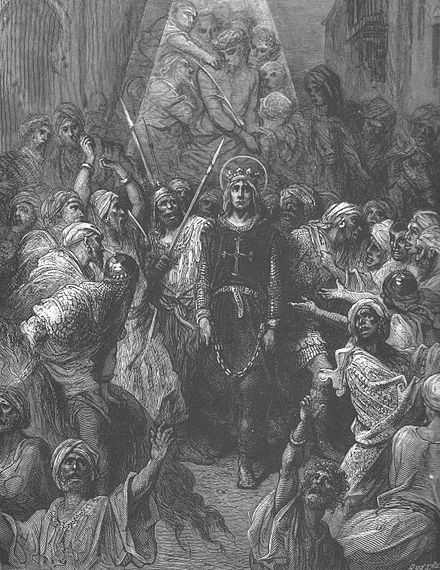
The kingdom of Sicily, consisting of Naples and southern Italy as well as the island, had been established by the Normans and later fell into the hands of the German imperial dynasty known as the Hohenstaufens. After Emperor Frederick II’s death it passed to his illegitimate son, Manfred. The papacy, determined to rid Italy of Hohenstaufen rule, bent all its energies to securing Manfred’s downfall. At length it offered the Sicilian crown to Charles of Anjou, a younger brother of King Louis IX of France (St. Louis). The intention was that the power of France be used to drive Manfred out of Italian kingdom. Charles of Anjou—dour, cruel, and ambitious—defeated Manfred in 1266 and established a new French dynasty on the throne of the kingdom.

The inhabitants of the realm, particularly those on the island of Sicily, had been accustomed to Hohenstaufen rule and resented Charles of Anjou. They looked on his French soldiers as an army of occupation. When, on Easter Monday, a French soldier molested a young married woman on her way to evening services in Palermo, he was struck down, and on all sides was raised the cry “Death to the French!” (Note in the melodramatic representation above, a knife-wielding figure topped by the Phrygian cap symbolizing Liberty.)

The incident resulted in a spontaneous uprising and a general massacre of Frenchmen, (some 13,000 dead) which spread swiftly throughout the island. When the French retaliated, the Sicilians offered the crown to Peter III of Aragon, Manfred’s son-in-law, who claimed the Hohenstaufen inheritance and led an expedition to Sicily.

There ensued a long, bloody, indecisive struggle known by the romantic name the “War of the Sicilian Vespers.” For twenty years Charles of Anjou and successors, backed by the French monarchy and the papacy, fought against Sicilians and Aragonese. In the end, southern Italy remained under Charles of Anjou’s heirs, who ruled it from Naples, while the island of Sicily passed under control of the kings of Aragon. The dispute between France and Aragon over southern Italy and Sicily persisted for generations and became an important in the politics of modern Europe.

The strife of the thirteenth century destroyed Sicilian prosperity. Once the wealthiest and best administered state in Italy, the kingdom of Sicily became pauperized and divided—a victim of international politics and of the ruthless struggle between papacy and Empire.

March 29

Home / Today in History / March 29

1930

Farewell Constantinople, Hello Istanbul

One of the great cities of the world is located just south of the Black Sea and reaches across the Bosphorus Strait from Europe to Asia. It was founded as a Greek city, a colony of Megara, named Byzantion. When the site was chosen as the location of the new capital of the recently-Christianized Roman Empire, it was dubbed New Rome but became better known as Constantinople. Since 1930 it has been called Istanbul.

When the Ottoman Turks blew open the walls of Constantinople and killed the last Roman Emperor in 1453, the once-magnificent city was a ghostly shell of its former self: underpopulated, poverty-stricken, with vast areas inside its walls returned to nature. Mehmet the Conqueror was determined to revive the city and make it his capital; he encouraged the Christian population to stay on, compelled Turkish settlers to immigrate, and began an infrastructure and building campaign that his successors would continue until the glory of the city was restored. For almost 500 years under the Turkish empire the name Constantinople was retained, but when that empire was toppled a change was made.

Mehmet Pasha, aka Ataturk, was the founder of a new, secular Turkish republic in 1923 and he meant to drag his nation into the 20th century. He crushed the power of the Islamic clergy, abolished the Caliphate, banned Arabic and replaced it with Roman letters, discouraged the wearing of the turban (the fedora was now the headgear of choice), and moved the capital from cosmopolitan Constantinople to the provincial city of Angora in the interior. Ataturk wished to emphasize Turkishness, not the multi-national Ottoman regime. As a symbol of this, Angora became Ankara and Constantinople was renamed Istanbul, probably from a bastardization of the Greek phrase. “to the City”.

In 1953, in honour of the 500th anniversary of the fall of the city, the Canadian pop group The Four Lads recorded “Istanbul (Not Constantinople)”, a humorous take on the name change written by Jimmy Kennedy and Nat Simon.  The lyrics proclaim:

Istanbul was Constantinople
Now it’s Istanbul, not Constantinople
Been a long time gone, Oh Constantinople
Now it’s Turkish delight on a moonlit night.

Every gal in Constantinople
Lives in Istanbul, not Constantinople
So if you’ve a date in Constantinople
She’ll be waiting in Istanbul.

Even old New York was once New Amsterdam;
Why they changed it I can’t say;
People just liked it better that way.

So, Take me back to Constantinople
No, you can’t go back to Constantinople
Been a long time gone, Oh Constantinople
Why did Constantinople get the works?
That’s nobody’s business but the Turks

Istanbul
Istanbul
Istanbul

Even old New York was once New Amsterdam
Why they changed it I can’t say
People just liked it better that way

Istanbul was Constantinople
Now it’s Istanbul, not Constantinople
Been a long time gone, Oh Constantinople
Why did Constantinople get the works?
That’s nobody’s business but the Turks

So, Take me back to Constantinople
No, you can’t go back to Constantinople
Been a long time gone, Oh Constantinople
Why did Constantinople get the works?
That’s nobody’s business but the Turks

March 28

th

The Feast of Pope Sixtus III

“May you live in interesting times” is supposed to be an ancient Chinese curse, part of a triplet of ill-wishes which includes “may you come to the attention of the authorities” and “may you achieve your desires.” Sixtus III (r. 432-40) lived in times that were full of interest and he played an important role in them.

Sixtus, one of 79 popes to be recognized as a saint, is probably best known for his building program of Roman churches and his attempts to repair the damage done to the city by the Visigoth sack of 410.  He refurbished the original St Peter’s basilica and the church of St John Lateran as well as dedicating new churches such as Santa Maria Maggiore and the basilica of Santa Sabina. The building of Santa Maria Maggiore reflects the intense devotion to the Virgin Mary which arose out of the Council of Ephesus which decided that Mary could be given the term “Theotokos” or “God Bearer.”

The mid-fifth century was a time of vigorous and rancorous theological debate. Originally a supporter of the British monk Pelagius, Sixtus eventually declared himself against the extreme free-will doctrines of Plagiarism and also waged ideological war against Nestorianism. Sixtus was succeeded by his deacon Leo, who became the first of only two popes to be called “the Great”.

March 27

Home / Today in History / March 27

1836

The Goliad Massacre

In October 1835 American settlers in the province of Texas rebelled against the Mexican government of General Antonio Lopez de Santa Anna. After a series of inconsequential battles, Santa Anna’s army began to rack up victories over the disorganized Texians, first at the Battle of the Alamo and then at Coleto. His policy was to follow up military successes with calculated atrocities, killing prisoners so as to deter any further flood of volunteers from the United States. A Mexican law passed in December 1835 declared that all armed foreigners taken in combat were to be treated as pirates and executed: no quarter was given at the Alamo and in March 1836, Santa Anna order the massacre of hundreds of American prisoners which had been gathered at Goliad.

Despite pleas for mercy from his junior officers, Santa Anna remained adamant. On Palm Sunday, 1836 nearly 500 prisoners were shot, bayoneted or bludgeoned to death. Some were able to escape and some were rescued due to the efforts of “The Angel of Goliad”, Franchita Alavez, the mistress of a Mexican officer. Rather than deterring American efforts, the massacre seems to have inspired the Texians to become more united and attract more support. In April a force of rebels encountered a larger body of Mexican troops at San Jacinto. With shouts of “Remember Goliad, Remember the Alamo!” the Texians defeated Santa Anna’s force and captured him the next day. In return for his freedom and a safe return to Mexico he acceded to the creation of an independent Republic of Texas.