June 27

1844

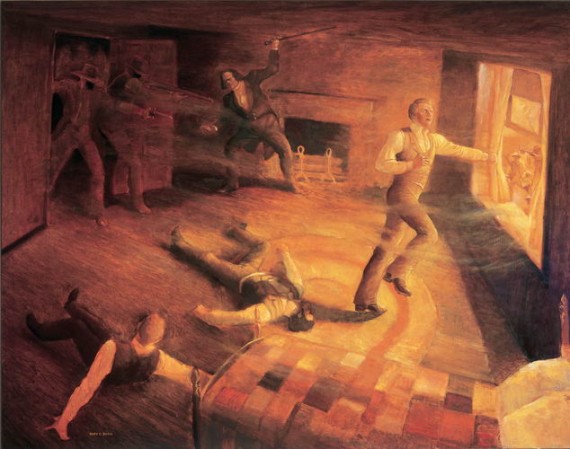
The assassination of Mormon prophet Joseph Smith

In 1820 Joseph Smith (1805-44) experienced the first of a series of visions that would lead to him becoming the founder of the Church of Jesus Christ of Latter-Day Saints. He claimed that during one of these visions an angel named Moroni revealed the location of a buried treasure containing a book of golden leaves and twin stones that would allow him to interpret the contents. He later recovered these books and dictated the translation which became The Book of Mormon. His remarkable religious claims led to him, and his growing number of followers, being forced to relocate a number of times. Many times they were met with violence and Smith himself was tarred and feathered in Ohio; on other occasions early Mormons were arrested and thrown in jail. By 1844 Smith had established his headquarters in the new city of Nauvoo where his teachings aroused opposition from both locals and long-time members of his own church. Smith ordered the destruction of a printing press run by his rivals and called out his own paramilitary force, the Nauvoo Legion, to put down resistance. On June 23, 1844 Joseph Smith and his brother Hirum were arrested and charged with treason. Smith reportedly said at the time: “I am going like a lamb to the slaughter; but I am calm as a summer’s morning. I have a conscience void of offence towards God, and towards all men. I shall die innocent, and it shall yet be said of me. ‘He was murdered in cold blood’”.

Four days later a mob, with faces blackened for disguise, attacked the jail. A near-contemporary account reads:

    Immediately there was a little rustling at the outer door of the jail, and a cry of surrender, and also a discharge of three or four firearms followed instantly. The doctor glanced an eye by the curtain of the window, and saw about a hundred armed men around the door. It is said that the guard elevated their firelocks, and boisterously threatening the mob discharged their fire-arms over their heads. The mob encircled the building, and some of them rushed by the guard up the flight of stairs, burst open the door, and began the work of death, while others fired in through the open windows.

    In the meantime Joseph, Hyrum, and Elder Taylor had their coats off. Joseph sprang to his coat for his six-shooter, Hyrum for his single barrel, Taylor for Markham’s large hickory cane, and Dr. Richards for Taylor’s cane. All sprang against the door, the balls whistled up the stairway, and in an instant one came through the door.

    Joseph Smith, John Taylor and Dr. Richards sprang to the left of the door, and tried to knock aside the guns of the ruffians.

    Hyrum was retreating back in front of the door and snapped his pistol, when a ball struck him in the left side of his nose, and he fell on his back on the floor saying, “I am a dead man!” As he fell on the floor another ball from the outside entered his left side, and passed through his body with such force that it completely broke to pieces the watch he wore in his vest pocket, and at the same instant another ball from the door grazed his breast, and entered his head by the throat; subsequently a fourth ball entered his left leg.

    A shower of balls was pouring through all parts of the room, many of which lodged in the ceiling just above the head of Hyrum.

    Joseph reached round the door casing, and discharged his six shooter into the passage, some barrels missing fire. Continual discharges of musketry came into the room. Elder Taylor continued parrying the guns until they had got them about half their length into the room, when he found that resistance was vain, and he attempted to jump out of the window, where a ball fired from within struck him on his left thigh, hitting the bone, and passing through to within half an inch of the other side. He fell on the window sill, when a ball fired from the outside struck his watch in his vest pocket, and threw him back into the room.

    After he fell into the room he was hit by two more balls, one of them injuring his left wrist considerably, and the other entering at the side of the bone just below the left knee. He rolled under the bed, which was at the right of the window in the south-east corner of the room.

    While he lay under the bed he was fired at several times from the stairway; one ball struck him on the left hip, which tore the flesh in a shocking manner, and large quantities of blood were scattered upon the wall and floor.

    When Hyrum fell, Joseph exclaimed, “Oh dear, brother Hyrum!” and opening the door a few inches he discharged his six shooter in the stairway (as stated before), two or three barrels of which missed fire.

    Joseph, seeing there was no safety in the room, and no doubt thinking that it would save the lives of his brethren in the room if he could get out, turned calmly from the door, dropped his pistol on the floor, and sprang into the window when two balls pierced him from the door, and one entered his right breast from without, and he fell outward into the hands of his murderers, exclaiming. “O Lord, my God!”

June 26

Home / Today in History / June 26

363 Death of Julian the Apostate

Flavius Claudius Julianus was born into the Roman imperial family in 331. The emperor Constantine and the sons of the dynasty that he founded were prone to fits of political paranoia that would regularly lead to some unfortunate relative or colleague being murdered. In this way Julian lost his father, half-brother, and a number of cousins but perhaps it was his youth that spared him in the purges.

Julian had been raised as a Christian but at the age of 20 he abandoned that faith and turned back to a variety of Neoplatonic paganism. Though he was closely watched by court officials for any possible treachery he was permitted to continue his philosophical enquiries. 

In 355 Emperor Constantius, the last of Constantine’s sons, decided that he needed a loyal Caesar (junior emperor) in the West and sent Julian to Gaul. There he distinguished himself as an honest administrator and successful military leader, winning battles against Germanic invaders along the Rhine. When Constantius, who was having trouble dealing with the Persians on the eastern border, ordered half of Julian’s troops to march to his aid in Mesopotamia, the legions rebelled. They had no interest in leaving their homes in Gaul and so proclaimed Julian their Augustus (chief emperor). The empire was spared a civil when Constantius died in 358 leaving Julian the sole emperor.

As a ruler Julian was an active reformer, trying to lessen the burden of the imperial administration while giving more power to the local civic officials. He laid restrictions on Christianity but attempted no bloody persecution and tried to revive the pagan sacrifices and oracles. The empire’s population was still largely non-Christian but Julian’s reign was too short to check the growing influence of Christianity. He was killed in 363, dying from a wound taken in battle against the Persians.

There was speculation at the time of his death that he had been murdered by one of his own troops but a much more interesting legend developed in Christian circles over the years. In this story, Julian was killed by the apparition of the martyr St Mercurius summoned to the deed by the prayers of St Basil. As the ghostly spear pierced the side of Julian, the emperor is reputed to have said, “Vicisti, o  Galilaee” –- “Thou has conquered, O Galilean!”

June 25

Home / Uncategorized / June 25

One of the joys of reading noir fiction is to come across the striking metaphors and similes that are a hallmark of the genre. Here are some from my favourite authors.

She smelled the way the Taj Mahal looks by moonlight. – Raymond Chandler, The Little Sister 

The only illumination came from one of those economy lightbulbs that looked like a radioactive pretzel. – Stuart MacBride, The Blood Road

From 30 feet away she looked like a lot of class. From 10 feet away she looked like something made up to be seen from 30 feet away. – Raymond Chandler, The High Window

The lawyer Thien, when Morath was ushered into his office by a junior member of the staff, turned out to be an ancient bag of bones held upright only by means of a stiff, iron-coloured suit. – Alan Furst, Kingdom of Shadows

“She died in a fire. I miss her like you… If I was underwater, I wouldn’t miss oxygen that much.” ― Dennis Lehane, Shutter Island

Looking at him I felt as if I had just met a powerful gorilla while at the same time being in possession of the world’s last banana. – Philip Kerr, The Lady from Zagreb

The minutes went by on tiptoe, with their fingers to their lips. – Raymond Chandler, The Lady in the Lake

Politicians were like talking dogs in a circus: the fact that they existed was uncommonly interesting, but no sane person would actually believe what they said. – Alan Furst, Dark Star

She had a long fur coat on over a very short skirt and sparkly top. Heels high enough to give Sherpa Tenzing a nosebleed. – Stuart MacBride, Now We Are Dead

A few locks of dry white hair clung to his scalp, like wild flowers fighting for life on a bare rock. – Raymond Chandler, The Big Sleep

“Remember, I’ve got no idea what this is all about,” said the girl when they were in the living room, a narrow room, where blue fought with red without ever compromising on purple. – Dashiell Hammett, “The Assistant Murderer”

 Hair like someone had run over Albert Einstein with a ride-on lawn mower. – Stuart MacBride, The Blood Road

A check girl in peach-bloom Chinese pajamas came over to take my hat and disapprove of my clothes. She had eyes like strange sins. – Raymond Chandler, The High Window

Torres finally smiled again, but it was a smile so vicious Bob could have smelled it with his eyes closed. – Dennis Lehane, The Drop

I called him from a phone booth. The voice that answered was fat. It wheezed softly, like the voice of a man who had just won a pie-eating contest. – Raymond Chandler, “Trouble Is My Business” 


June 24

1880

The first performance of O Canada

The Canadian national anthem O Canada was written in response to a commission by the Lieutenant-Governor of Québec and performed first on the feast day of John the Baptist, the province’s patron saint. The music was composed by Callixa Lavallée (1842-91) and the French lyrics by Sir Adolphe-Basile Routhier (1839-1920); an original set of English words was added in 1908 by Robert Stanley Weir. The Christian content of both official versions has of late come under attack by secularists, under the mistaken impression that Canada maintains an American-style separation of church and state. To understand the religious imagery of our national anthems, consider the full texts below.

First, the English translation of the French lyrics:

O Canada!

Land of our forefathers,

Thy brow is wreathed with a glorious garland of flowers.

As is thy arm ready to wield the sword,

So also is it ready to carry the cross.

Thy history is an epic

Of the most brilliant exploits.

Thy valour steeped in faith

Will protect our homes and our rights.

Will protect our homes and our rights.

Under the eye of God, near the giant river,

The Canadian grows hoping.

He was born of a proud race,

Blessed was his birthplace.

Heaven has noted his career

In this new world.

Always guided by its light,

He will keep the honour of his flag,

He will keep the honour of his flag.

From his patron, the precursor of the true God,

He wears the halo of fire on his brow.

Enemy of tyranny

But full of loyalty,

He wants to keep in harmony,

His proud freedom;

And by the effort of his genius,

Set on our ground the truth,

Set on our ground the truth.

Sacred love of the throne and the altar,

Fill our hearts with your immortal breath!

Among the foreign races,

Our guide is the law:

Let us know how to be a people of brothers,

Under the yoke of faith.

And repeat, like our fathers,

The slogan: “For Christ and King! “

The slogan: “For Christ and King!


The Original English version
O Canada!

Our home and native land!

True patriot love in all thy sons command.

With glowing hearts we see thee rise,

The True North strong and free!

From far and wide,

O Canada, we stand on guard for thee.

God keep our land glorious and free!

O Canada, we stand on guard for thee.

O Canada, we stand on guard for thee.


O Canada! Where pines and maples grow.

Great prairies spread and lordly rivers flow.

How dear to us thy broad domain,

From East to Western sea.

Thou land of hope for all who toil!

Thou True North, strong and free!

Chorus:

God keep our land glorious and free!

O Canada, we stand on guard for thee.

O Canada, we stand on guard for thee.

O Canada! Beneath thy shining skies


May stalwart sons, and gentle maidens rise,

To keep thee steadfast through the years

From East to Western sea.

Our own beloved native land!

Our True North, strong and free!

Chorus


Ruler supreme, who hearest humble prayer,

Hold our Dominion in thy loving care;

Help us to find, O God, in thee

A lasting, rich reward,

As waiting for the better Day,

We ever stand on guard.

Needless to say, the naked sexism of terms such as “sons” or “gentle maidens” caused the offenderati to clutch their pearls and reach for the smelling salts. Changes had to be made.

June 23

Home / Today in History / June 23

One of those bloody days.

1314 Battle of Bannockburn

Scots don’t win many battles against the English but they don’t let setbacks like Solway Moss or Culloden get them down. To this day they celebrate the victory of local hero Robert Bruce over the invading English led by the luckless Edward II. The loss led to the English eventually acknowledging Scottish independence.

1565 Dragut mortally wounded

The Great Siege of Malta pitted a massive army and navy of Turks against fortresses manned by the Knights of St John. One of the moments contributing to a Christian victory over the forces of Sultan Suleiman the Magnificent was the death of his admiral Dragut, “the Sword of Islam”, the greatest of all Mediterranean pirates, who was head of the expedition. Splinters from a cannon ball wounded Dragut who died after a week of suffering. His death split the Turkish command and weakened its leadership, leading to a humiliating defeat.

1611 Henry Hudson set adrift

One of the most plaintive works of art that I encountered as a child was the painting above, of explorer Henry Hudson and his little son John (in reality a teenager) in an open boat amidst the ice floes of the great bay named after him. On his fourth voyage to the New World, in search of a sea passage to Asia, his crew mutinied over plans to linger and put Hudson and loyal sailors into an open boat, while they sailed back to England. The castaways were never seen alive.

1942 First selection of Jews for Auschwitz gas chamber

The 1942 Swansee conference of Nazi officials had determined on a policy of extermination as a solution to the “Jewish problem”. A number of camps were built for the purpose of extracting useful slave labour from some prisoners and a speedy execution for others. On this date a train load of Jews deported from France arrived and selections were made on disembarking.

1985 Air India explosion

Indira Gandhi’s attack on a Sikh temple in Amritsar led to her assassination by her Sikh bodyguards and a rise in terrorism aimed at securing a separate “Khalistan”. Among Canadian Sikh immigrants were a number who chose to wage a violent campaign in their new home. Bombs were put on Air India jets flying out of Canada to Europe and Japan. Though the latter was rendered harmless at Narita airport, a device aboard Air India flight 182 exploded over the Atlantic killing 329 people.

June 22

Home / Today in History / June 22

War is cruel and men sometimes try to mitigate its brutality with “rules of warfare”. One controversial practice is that of retaliation for the other side’s violation of the norms of battle. In the American Civil War, the Union sometimes executed prisoners in response to Confederate guerrilla tactics. 

In 1864 Major James Wilson of the 3rd Missouri State Militia Cavalry and six of his men were captured and murdered by rebel irregulars. In retaliation, Union troops executed six prisoners from Missouri. Quaker Zadok Street wrote this letter to Abraham Lincoln to protest such acts.

Salem Ohio 9th of 11 Mo 1864
Esteemed & Honored Friend
Abraham Lincoln President

The shooting 6 Men in Missouri in retaliation for 6 Union Men murderd by Guerillas was the companion of my mind frequently day and night, And since then the shooting of others in Tennesse & Kentucky for similar retaliation is so inconsistent with the Gospel of Christ, and cannot be looked upon in favor by the Supreme Ruler of the Universe, and as no Nation can be blessed only whose God is the Lord, which thy various Proclamations wisely made from time to time fully declares in substance, I therefore respectfully but earnestly request Thee to seriously consider in thy retired moments when asking secretly for Divine aid to conduct the affairs of the Nation rightly, and ascertain if Thee should not prevent such acts by our Union officers, We do not know the private feelings or the hearts of those Men thus selected to be Shot, what injury may be done to them and their families we know not,

With thy enlarged and comprehensive view of Justice and right, argument is entirely unnecessary and refrain therefrom,

Allow me to say from the time of a few moments interview at thy House in Illinois prior to thy going to Washington after thy election, I have felt a very great desire for thy Administration to be one of Justice and honor under the peculiar trials in which Thee is placed I feel that a Divine interposition placed Thee in the Presidential Chair, and that Thee has been highly favored in thy movements,

Thy sincere Friend
Zadok Street

The quintessential Norm Macdonald joke

Home / Uncategorized / The quintessential Norm Macdonald joke

Norm Macdonald, the brilliant enigma, left this earthly plane too soon, dying in 2021 of cancer. In his honour let us chuckle at the wisdom and hilarity of this story.

A moth goes into a podiatrist’s office. 

The podiatrist says, “What’s the problem?” 

The moth says, “Where do I begin with my problems? Every day I go to work for Gregory Vassilievich, and all day long I toil. But what is my work? I am a bureaucrat, and so every day I joylessly move papers from one place to another and then back again. I no longer know what it is that I actually do, and I don’t even know if Gregory Vassilievich knows. He only knows that he has power over me, and this seems to bring him much happiness. And where is my happiness? It is when I awake in the morning and I do not know who I am. In that single moment I am happy. In that single moment, before the memory of who I am strikes me like a cane. And I take to the streets and walk, in a malaise, here and then there and then here again. And then it is time for work. Others stopped asking me what I do for a living long ago, for they know I will have no answer and will fix my empty eyes upon them, and they fear my melancholia might prove so deep as to be contagious. Sometimes, Doc, in the deepest dark of night, I awake in my bed and I turn to my right, and with horror I see some old lady lying on my arm. An old lady that I once loved, Doc, in whose flesh I once found splendor and now see only decay, an old lady who insults me by her very existence. 

“Once, Doc, when I was young, I flew into a spider web and was trapped. In my panic, I smashed my wings till the dust flew from them, but it did not free me and only alerted the spider. The spider moved toward me and I became still, and the spider stopped. I had heard many stories from my elders about spiders, about how they would sink their fangs into your cephalothorax and you would be paralyzed but aware as the spider slowly devoured you. So I remained as still as possible, but when the spider again began moving toward me, I smashed my wing again into my cage of silk, and this time it worked. I cut into the web and freed myself and flew skyward. I was free and filled with joy, but this joy soon turned to horror: I looked down and saw that in my escape I had taken with me a single strand of silk, and at the end of the strand was the spider, who was scrambling upward toward me. Was I to die high in the sky, where no spider should be? I flew this way, then that, and finally I freed myself from the strand and watched as it floated earthward with the spider. But days later a strange feeling descended upon my soul, Doc. I began to feel that my life was that single strand of silk, with a deadly spider racing up it and toward me. And I felt that I had already been bitten by his venomous fangs and that I was living in a state of paralysis, as life devoured me whole. 

“My daughter, Alexandria, fell to the cold of last winter. The cold took her, as it did many of us. And so my family mourned. And I placed on my countenance the look of grief, Doc, but it was a masquerade. I felt no grief for my dead daughter but only envy. And so I have one child now, a boy, whose name is Stephan Mikhailovitch Smokovnikov, and I tell you now, Doc, with great and deep shame, the terrible truth. I no longer love him. When I look into his eyes, all I see is the same cowardice that I see when I catch a glimpse of my own eyes in a mirror. It is this cowardice that keeps me living, Doc, that keeps me moving from place to place, saying hello and goodbye, eating though hunger has long eft me, walking without destination, and, at night, lying beside the strange old lady in this burlesque of a life I endure. If only the cowardice would abate for the time needed to reach over and pick up the cocked and loaded pistol that lies on my bedside table, then I might finally end this façade once and for all. But, alas, the cowardice takes no breaks; it is what defines me, it is what frames my life, it is what I am. And yet I cannot resign myself to my own life. Instead, despair is my constant companion as I walk here and then there, without dreams, without hope, and without love.” 

“Moth,” says the podiatrist, “your tale has moved me and it is clear you need help, but it is help I cannot provide. You must see a psychiatrist and tell him of your troubles. Why on earth did you come to my office?” 

The moth says, “Because the light was on.”

June 20

Home / Uncategorized / June 20

Why, it seems like only yesterday when the French government was dragging its heels on joining the American-led war on Saddam Hussein’s Iraq. Oh, how we mocked them for their pusillanimity (even we Canadians who also held back.) Despite the fact that the French are one of the most war-like countries in European history (anybody remember Charlemagne, Joan of Arc, Louis XIV, Napoleon I, and Napoleon III?) we focussed on their poor performance in World War II.

Here are some of the rude remarks which, in retrospect and considering the mess that was made of the 2003 intervention, now seem regrettable:

The French will only agree to go to war when we’ve proven we’ve found truffles in Iraq. – Dennis Miller 

They’ve taken their own precautions against al Qa’ida. To prepare for an attack, each Frenchman is urged to keep duct tape, a white flag, and a three-day supply of mistresses in the house. – Argus Hamilton 

What do you expect from a culture and a nation that exerted more of its national will fighting against Disney World and Big Macs than the Nazis? – Dennis Miller 

War without France would be like World War Il. – Unknown 

The last time the French asked for ‘more proof’ it came marching into Paris under a German flag. – David Letterman 

Going to war without France is like going deer hunting without your accordion. –  Norman Schwartzkopf 

We can stand here like the French, or we can do something about it. –  Marge Simpson 

It is important to remember that the French have always been there when they needed us. – Alan Kent

Somebody was telling me about the French Army rifle that was being advertised on eBay the other day the description was, “Never shot. Dropped once.” – Rep. Roy Blunt, MO


June 19

Home / Uncategorized / June 19

Dandified Cake Eaters Beware!

In 1923, a group of women in Washington, DC decided to form the Anti-Flirt Club, an organisation “composed of young women and girls who have been embarrassed by men in automobiles and on street corners”, its aim being to protect such ladies from any further discomfort. Its rules were simple:

  1. Don’t flirt: those who flirt in haste oft repent in leisure.
  2. Don’t accept rides from flirting motorists-they don’t all invite you in to save you a walk.
  3. Don’t use your eyes for ogling-they were made for worthier purposes.
  4. Don’t go out with men you don’t know-they may be married, and you may be in for a hair-pulling match.
  5. Don’t wink-a flutter of one eye may cause a tear in the other. 6. Don’t smile at flirtatious strangers save them for people you know.
  6. Don’t annex all the men you can get-by flirting with many you may lose out on the one.
  7. Don’t fall for the slick, dandified cake eater the unpolished gold of a real man is worth more than the gloss of a lounge lizard.
  8. Don’t let elderly men with an eye to a flirtation pat you on the shoulder and take a fatherly interest in you. Those are usually the kind who want to forget they are fathers.
  9. Don’t ignore the man you are sure of while you flirt with another. When you return to the first one you may find him gone.

June 18

Home / Uncategorized / June 18

286 Twin martyrs

MARCUS AND MARCELLIANUS were twin brothers of an illustrious family in Rome, who had been converted to the Faith in their youth and were honorably married. Diocletian ascending the imperial throne in 284, the heathens raised persecutions. These martyrs were thrown into prison, and condemned to be beheaded. Their friends obtained a respite of the execution for thirty days, that they might prevail on them to worship the false gods.

Tranquillinus and Martia, their afflicted heathen parents, in company with their sons’ own wives and their little babes, endeavored to move them by the most tender entreaties and tears. St. Sebastian, an officer of the emperor’s household, coming to Rome soon after their commitment, daily visited and encouraged them. The issue of the conferences was the happy conversion of the father, mother, and wives, also of Nicostratus, the public register, and soon after of Chromatius, the judge, who set the Saints at liberty, and, abdicating the magistracy, retired into the country. Marcus and Marcellianus were hid by a Christian officer of the household in his apartments in the palace; but they were betrayed by an apostate, and retaken. Fabian, who had succeeded Chromatius, condemned them to be bound to two pillars, with their feet nailed to the same. In this posture they remained a day and a night, and on the following day were stabbed with lances.

In 1902 their graves in the catacombs of Saint Balbina were rediscovered.