Advent does not begin with a fixed date because the period can begin anywhere from November 27 to December 3. Consequently there is no one common custom to kick off the season. In Honduras there is a masked dancer called the Warini or Christmas Herald who goes door to door accompanied by singers and drummers to announce the season. And in Twente in Holland long wooden horns, carved out of saplings are sounded over a well to produce a deep foghorn like tone. In Oldenzaal trumpeters blow in Advent from the four corners of a medieval tower. Moravian churches will make the occasion by the erection of their famous multi-pointed stars.
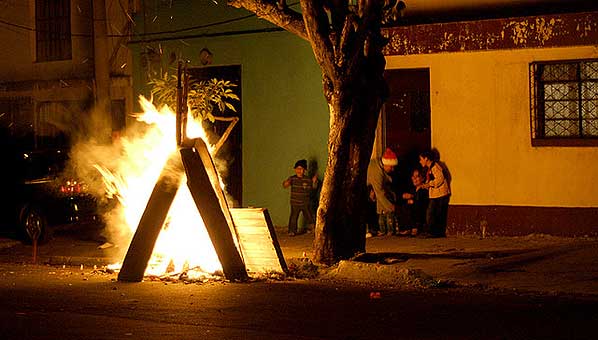
Almost everywhere there is the compulsion to clean the house. In fifteenth century Florence a religious revival led by the monk Savonarola resulted in the famous “Bonfire of the Vanities”, a public burning of luxuries that were deemed to keep the minds of believers off of God and salvation. A similar spectacle occurs every year at the beginning of the Christmas season in Guatemala. On December 7 (also the day to celebrate the Immaculate Conception of the Virgin Mary) Guatemalans haul out of their homes the things they think they don’t need anymore and set them on fire in a ceremony called “The Burning of the Evil” — with their homes thus purged of unnecessary encumbrances their souls can prepare for the coming of Christmas. In Trinidad and Tobago the house must be given a thorough cleaning and decorated; a portion of the Christmas budget always goes to buying something new for the house at this time of year. New curtains are hung, windows are washed, furniture is recovered, long-delayed repairs are made, a new piece of linoleum is laid and the paint brush is busy. In northern Europe Advent is also a time to tend to the graves of the family dead as well as sprucing up the house. In Moravian settlements in Labrador a common expression or question heard in December is “Is you ready yet?” This means basically, “Do you have your house thoroughly cleaned?”
For such a momentous occasion as the birth of the baby-god Jesus, one might think that the first Christians would be quick to celebrate the event. Christmas is the second-highest festival on the Christian calendar and the most widely-celebrated holy day in history, but the fact is that it was an after-thought to the early church. The first generations of believers concentrated on the death and resurrection of Jesus and lived in profound expectation of his imminent return. What need was there to make a fuss over his humble origins when he would soon return again in glory to judge the living and the dead and to usher in a new heaven and a new earth?
As the years went by, and Christ seemed to be tarrying, the circumstances of his birth attracted more interest. Pagan critics of the new religion, such as Celsus, made mock of the claims of a virgin birth and asserted that Jesus was the illegitimate product of an adulterous union. Certain 2nd-century Christians, influenced by Greek Gnosticism, were skeptical of the idea of a god dwelling in human flesh – this was a repellent notion to the philosophers; the very purpose of the soul was not to become trapped in a body but to escape its earthly prison of meat and bone. These criticisms prompted the second-century Church to emphasize the truth of the nativity stories told in the gospels of Matthew and Luke and even to add to them in pious fictions such as The Protoevangelium of James which invented details about the youth of Mary and introduced the character of Salome, a midwife, to the events in Bethlehem.
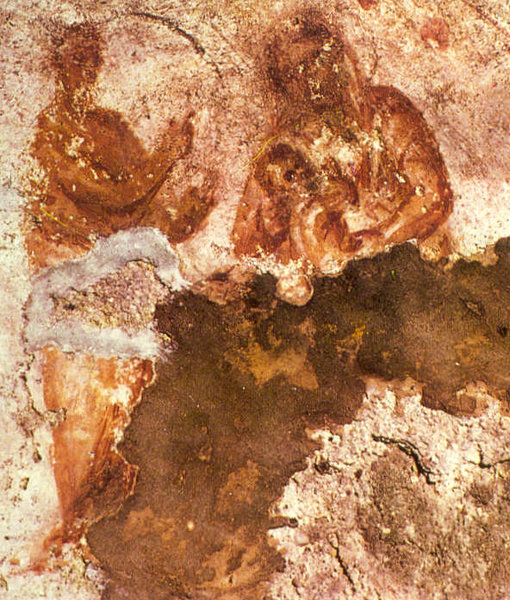
By the year 200 Christian writers had begun to speculate about when the birth of Jesus had taken place and numerous dates were bandied about. This does not mean that Christians were seeking to know the date of the birth of Jesus in order to celebrate it. The theologian Origen declared that only pagan rulers had their birthdays trumpeted and, indeed, King Herod Antipas had given birthdays a bad name in the Christian community when he had used the occasion of his to order the execution of John the Baptist. Despite such a view, believers were growing fonder of recounting the story of the birth of Jesus. In Rome, where Christians gathered to worship in the funeral caves outside the city, they decorated a wall with a picture of the Nativity scene. The catacomb of St Priscilla bears an image of three Magi advancing toward the seated Virgin and child while a man standing beside her (probably meant to represent an Old Testament prophet) points to the guiding star in the heavens. Second and third-century pseudo-gospels such as The Revelation of the Magi were particularly interested in the appearance of the wise men who, guided by this miraculous star, became the first Gentiles to worship the Christ Child.
With the accession of the emperor Constantine in 312, Christianity became a legal religion, free to marks its holy days publicly, and the celebration of the Nativity soon was celebrated joyfully. During the 300s and 400s Christmas grew in importance on the church calendar as music, drama and liturgy were added in spectacular fashion. And then it occurred to someone – we know not who or where – that Christmas deserved a period of preparation such as Easter had with Lent. By the 500s there seems to have been a formally recognized fast beginning in mid-November on St Martin’s Day, a custom starting first in the Frankish church and then spreading in the West; other restrictions include a ban on matrimony, feasting and games. In Rome itself the Advent period, as it was now known, named for the Latin “coming”, was shorter, less penitential and more joyful and by the high Middle Ages the contrary tendencies had merged – the season had become shortened to a four-week fast with Lenten-type behaviour required. These restrictions, however, were abolished in the twentieth century and the season is now one of reflection and spiritual preparation.
For liturgical churches of the West it marks the beginning of the Christian year. It is reckoned as a period of four Sundays beginning with the one closest to St Andrew’s Day on November 30. The faithful are to use this time to prepare themselves worthily to celebrate the anniversary of the Lord’s coming into the world as the incarnate God of love and also to make themselves ready for His final coming as judge, at death and at the end of the world. In church services, there are glorious hymns and lessons that point us to the prophecies and promises of coming redemption and the importance of heeding the injunction “prepare ye the way of the Lord.”
In these days when journalism is in so much disrepute and disrespect, it is useful to remember an earlier time when journalists might behave well. From Chambers’ Book of Days:
A remarkable instance was afforded, a few years ago, of the power of an English newspaper, and its appreciation by the commercial men of Europe. It is known to most readers at the present day, that the proprietors and editors of the daily papers make strenuous exertions to obtain the earliest possible information of events likely to interest the public, and take pride in insuring for this information all available accuracy and fulness; but it is not equally well known how large is the cost incurred by so doing. None but wealthy proprietors could venture so much, for an object, whose importance and interest may be limited to a single day’s issue of the paper.
In 1841, Mr. O’Reilly, the Times correspondent at Paris, received secret information of an enormous fraud that was said to be in course of perpetration on the continent. There were fourteen persons—English, French, and Italian—concerned, headed by a French baron, who possessed great talent, great knowledge of the continental world, and a most polished exterior. His plan was one by which European bankers would have been robbed of at least a million sterling; the conspirators having reaped about £10,000, when they were discovered. The grand coup was to have been this—to prepare a number of forged letters of credit, to present them simultaneously at the houses of all the chief bankers in Europe, and to divide the plunder at once. How Mr. O’Reilly obtained his information, is one of the secrets of newspaper management; but as he knew that the chief conspirator was a man who would not scruple to send a pistol-shot into any one who frustrated him, he wisely determined to date his letter to the Times from Brussels instead of Paris, to give a false scent. This precaution, it is believed, saved his life. The letter appeared in the Times on 26th May. It produced a profound sensation, for it revealed to the commercial world a conspiracy of startling magnitude.
One of the parties implicated, a partner in an English house at Florence, applied to the Times for the name of its informant; but the proprietors resolved to bear all the consequences. Hence the famous action, Bogle v. Lawson, brought against the printer of the Times for libel, the proprietors, of course, being the parties who bore the brunt of the matter. As the article appeared on 26th May, and as the trial did not come on till 16thAugust, there was ample time to collect evidence. The Times made immense exertions, and spent a large sum of money, in unravelling the conspiracy throughout. The verdict was virtually an acquittal, but under such circumstances that each party had to pay his own costs.
The signal service thus rendered to the commercial world, the undaunted manner in which the Times had carried through the whole matter from beginning to end, and the liberal way in which many thousands of pounds had been spent in so doing, attracted much public attention. A meeting was called, and a subscription commenced, to defray the cost of the trial, as a testimonial to the proprietors. This money was nobly declined in a few dignified and grateful words; and then the committee determined to perpetuate the memory of the transaction in another way. They had in their hands £2700, which had been subscribed by 38 public companies, 64 members of the city corporation, 58 London bankers, 120 London merchants and manufacturers, 116 county bankers and merchants, and 21 foreign bankers and merchants. In November, the committee made public their mode of appropriating this sum: namely, £1000 for a ‘Times Scholarship’ at Oxford, for boys in Christ’s Hospital; £1000 for a similar scholarship at Cambridge, for boys of the city of London School; and the remainder of the money for four tablets, to bear suitable inscriptions—one to be put up at the Royal Exchange, one at Christ’s Hospital, one at the City of London School, and one at the Times printing-office.
Ezra Weston Loomis Pound was born in 1885 in Idaho but grew up in Pennsylvania. As a university student he was insolent and lazy but he benefited from wide reading. He launched himself into the world as a poet and critic, finding patrons in the USA and London, making influential connections.
He was a pioneer and prophet of the Imagist mode, privileging the concrete object and minimalism. Pound was instrumental in helping the careers of T.s. Eliot, James Joyce, and Ernest Hemingway but he was also in talented in the art of making enemies.
Like many intellectuals of the 1920s he felt that the old world was in need of revolution and he fell under the spell of Italian-style fascism. Pound espoused an anti-capitalist economic vision of “social credit” which despised usury. This led the poet into a virulent anti-semitism which he never abandoned and which drew him closer, first to Benito Mussolini, and then to Adolf Hitler. He spent the years of World War II in Italy making pro-fascist broadcasts and inveighing agains the Jews.
After the war, Pound was arrested and tried for treason. Other who had done what he had (like Lord Haw-Haw) were executed but the literary world rallied round him and fought for his release. The US government compromised and had him declared insane and confined to a mental hospital. He was released in 1958 having been declared incurable and thus in no need of further treatment. He spent most of the rest of his life living in Italy, repenting of both his earlier poetry and his antisemitism.
Pound was clearly a major force in 20th century literature but much of his poetry was obscurantist rubbish. Nonetheless there are gems amid the dross, and I include two here: the beginning of the Norse-flavoured “The Seafarer” and his Li Po imitation, “The River-Merchant’s Wife”.
The Seafarer
May I for my own self song’s truth reckon,
Journey’s jargon, how I in harsh days
Hardship endured oft.
Bitter breast-cares have I abided,
Known on my keel many a care’s hold,
And dire sea-surge, and there I oft spent
Narrow nightwatch nigh the ship’s head
While she tossed close to cliffs. Coldly afflicted,
My feet were by frost benumbed.
The River-Merchant’s Wife: A Letter
While my hair was still cut straight across my forehead
I played about the front gate, pulling flowers.
You came by on bamboo stilts, playing horse,
You walked about my seat, playing with blue plums.
And we went on living in the village of Chōkan:
Two small people, without dislike or suspicion.
At fourteen I married My Lord you.
I never laughed, being bashful.
Lowering my head, I looked at the wall.
Called to, a thousand times, I never looked back.
At fifteen I stopped scowling,
I desired my dust to be mingled with yours
Forever and forever, and forever.
Why should I climb the look out?
At sixteen you departed
You went into far Ku-tō-en, by the river of swirling eddies,
And you have been gone five months.
The monkeys make sorrowful noise overhead.
You dragged your feet when you went out.
By the gate now, the moss is grown, the different mosses,
Too deep to clear them away!
The leaves fall early this autumn, in wind.
The paired butterflies are already yellow with August
Over the grass in the West garden;
They hurt me.
I grow older.
If you are coming down through the narrows of the river Kiang,
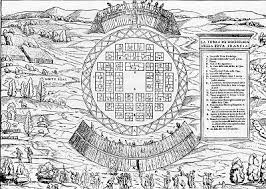
1535 – French explorer Jacques Cartier visits the Iroquois town of Hochelaga, a town of 1500 people living in 50 longhouses; “It was fine land with large fields covered with the corn of that country, which resembles Brazil millet, and is about as large or larger than a pea… They live on this as we do on wheat. And in the middle of these fields is situated and stands the village of Hochelaga, near and adjacent to a mountain, the slopes of which are fertile and are cultivated, and from the top of which one can see a long distance. We named this mountain Mount Royal. The village is circular and is completely enclosed by a wooden palisade in three tiers like a pyramid.” He visits the rapids at the head of navigation and calls them La Chine (China). Hochelaga will later become the French settlement of Ville Marie and then Montreal.
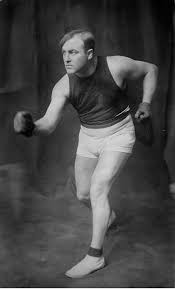
1906 – Canadian Tommy Burns (born Noah Brusso in Hanover, Ontario) KOs Jim Burns in 15 rounds for the World heavyweight boxing championship. Burns will lose the to the remarkable black American boxer Jack Johnson.
1926 – One of the quirky joys of Canadian football rules is the “rouge” or the single point gained when a punter kicks the ball through the end zone or an opposing player fields the ball in the end zone and fails to run it out. Bert Gibb of the Hamilton Tigers sets a record by kicking 9 singles in a football game against Montreal.
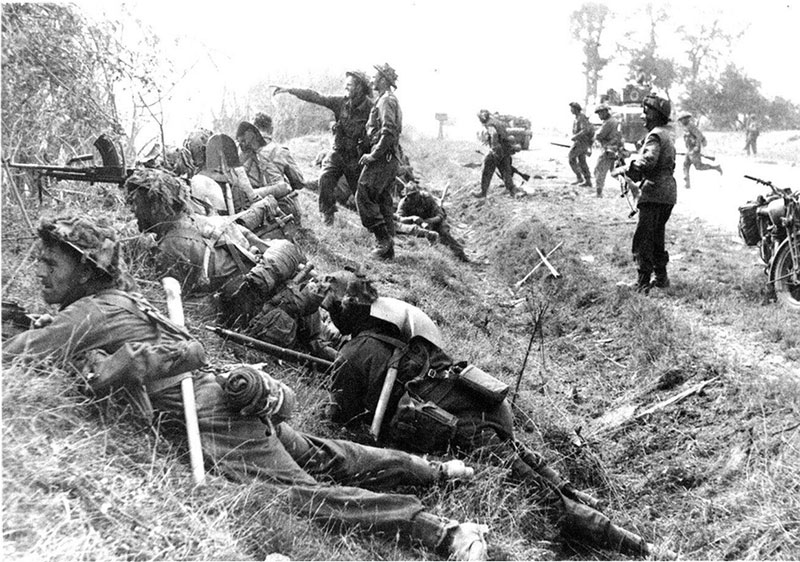
1944 – World War II – First Canadian Army begins the drive to clear the Scheldt estuary of Germany army resistance and open the port of Antwerp to shipping; bloody fighting ends with the Canadians victorious on November 8.
In 1689 James II, King of England and Scotland, was deprived of his throne in what came to be known as the Glorious or Bloodless Revolution. His desire to bring about religious toleration for Catholics (he was one) and his abuse of constitutional norms to do so united much of the political class who summoned James’s daughter Mary and her Dutch husband William to assume rule. William and Mary died childless and were succeed by James’s other daughter Anne. When she died in 1714, the English looked about for a Protestant heir and found one in George I who became the first of the Hanoverian line.
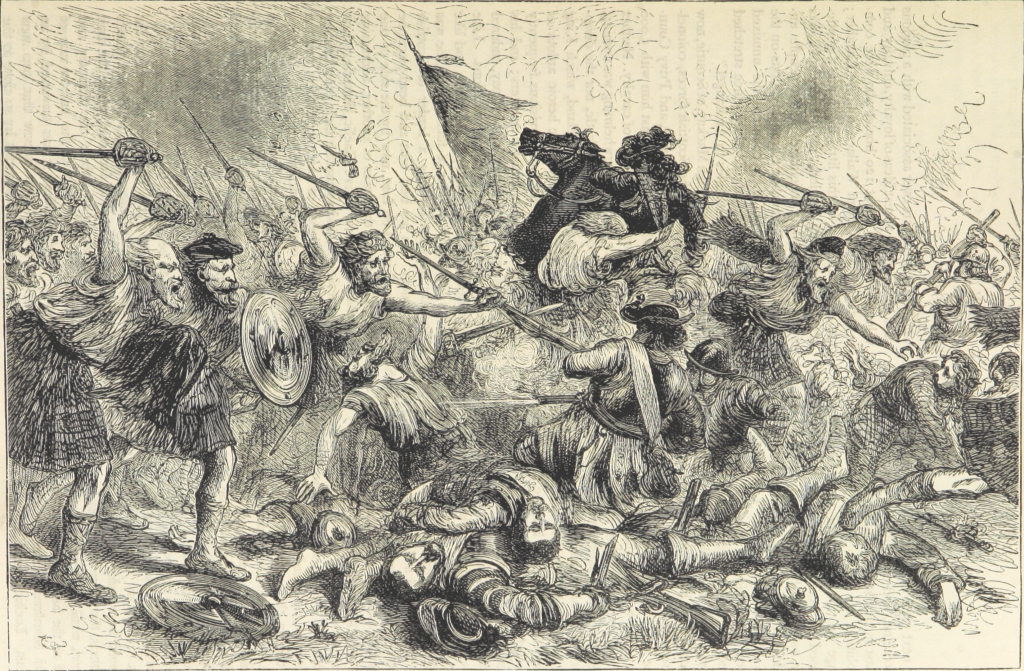
The descendants of James II were not willing to let the Stuart claim to the throne lapse. In 1715 James the Old Pretender launched an invasion of England with French help but was repelled. In 1745, his son (the grandson of James II) Charles Edward, known as the Young Pretender or Bonnie Prince Charlie landed in Scotland and found a small army of supporters to rally around him. His men (called Jacobites after the Latin translation of James) quickly took Edinburgh, forcing the British army to try and bring him to open battle.
This they did at Prestonpans, east of the capital. The redcoats outnumbered the Scots and were better armed but the Jacobites were made of sterner stuff than the ill-trained and inexperienced Englishmen. A sudden and savage Highland charge broke their opponents in less than fifteen minutes, killing hundreds and taking even more prisoners.
Charles Stuart’s success here led him and his generals to believe that such a charge could win them more battles but the Highlanders were massacred at Culloden when they faced disciplined troops and artillery fire.
On this date, churches of the Anglican communion celebrate the life of John Patteson (1827-71), the first Bishop of Melanesia. Patterson was the great-nephew of the poet Samuel Coleridge, educated at Oxford, and ordained a priest. He was a devoted student of languages and a country curate when he was recruited in 1854 to become a missionary in the Southern Pacific.
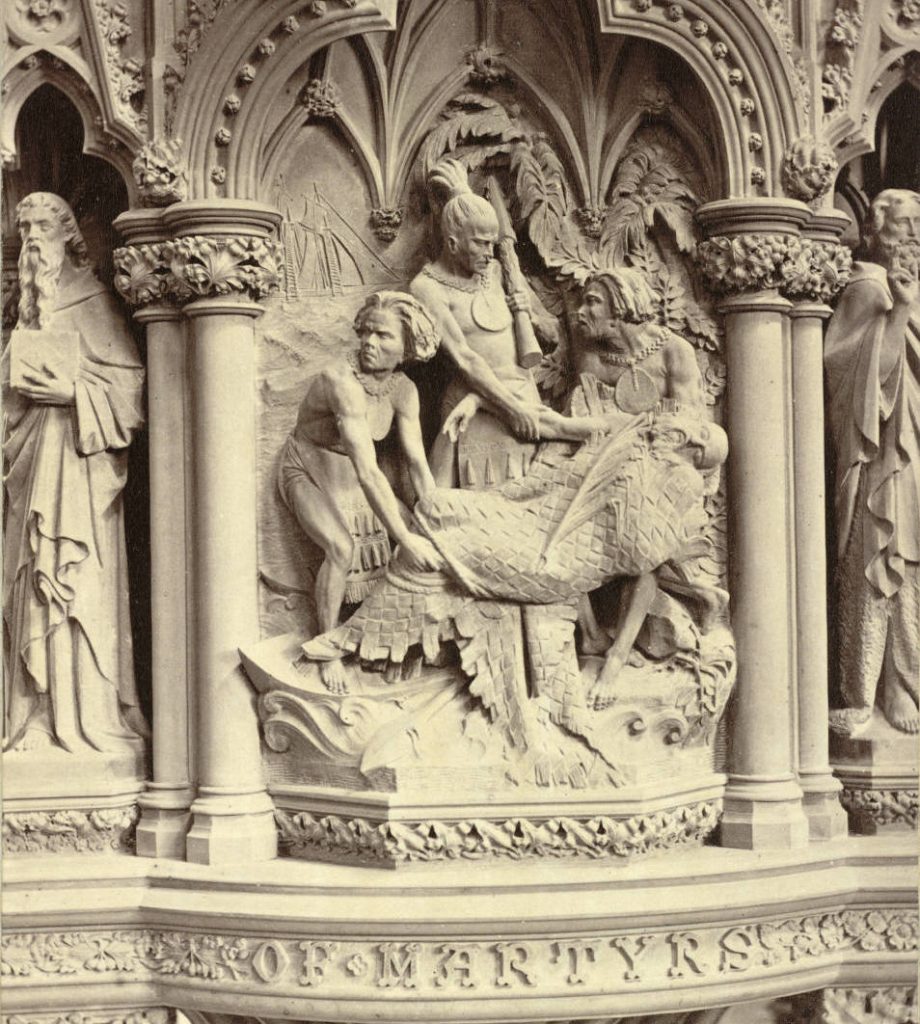
Based in New Zealand, Patteson sailed through the island chains of Melanesia trying to spread Christianity. To enable himself for this task he learned 23 native languages, wrote grammars for these tongues and translated parts of the Gospel. His job was made immeasurably harder by the presence in those areas of “blackbirders”, essentially kidnappers from British ships who would recruit islanders as indentured labourers and treat them as slaves on plantations. Patteson’s desire to offer a boarding-school education for native youth seemed to many of the locals as just another way of taking away their young men who would never return. Despite his opposition to this slave trade Patteson was attacked on more than one occasion. On this date in 1871 Patteson was killed on an island in the Solomons; his body was found floating at sea in a canoe with a palm leaf in his hand.
His death spurred a crack-down on black-birding and steps were taken to better protect islanders. Patteson is buried in Exeter Cathedral’s Martyrs’ Pulpit.
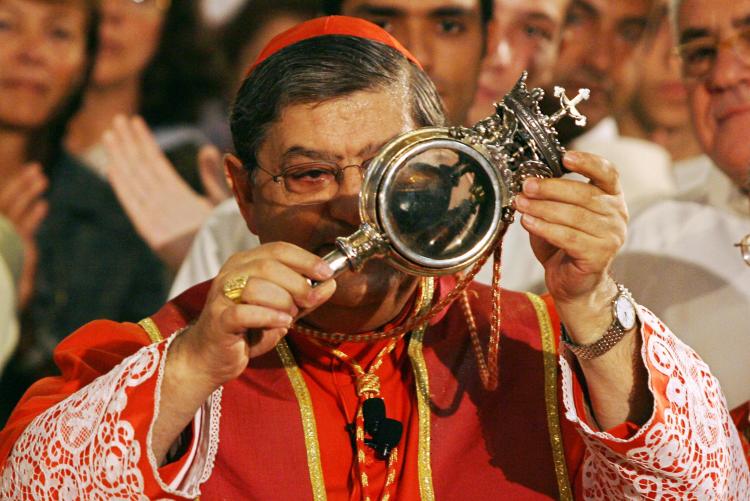
Should you happen to be in Naples on this date, or on December 16, or on the Saturday before the first Sunday in May, make it your business to drop in on the cathedral where you may be fortunate enough to see a miracle. At these times, the dried blood of St Januarius (or San Gennaro to the locals) will liquefy.
Januarius was the bishop of Naples during the time of the persecution of Christianity by the Emperor Diocletian at the beginning of the fourth century. In 304, he was thrown to the bears and then beheaded. His relics were preserved and it was noted in 1389 that when the ampoule containing his blood was brought near the reliquary containing his head, liquefaction occurred. This miracle came to occur regularly on his saint’s day (today), the anniversary of the translation of his relics, and on the festival of his patronage of Naples.
On March 21, 2015, the blood in the vial appeared to liquify during a visit by Pope Francis. This was taken as a sign of the saint’s favour of the pope. The blood did not liquify when Popes John Paul II and Benedict XVI visited nor when Naples elected a Communist mayor. Make of that what you will.
Januarius is the patron of Naples and blood banks and may be invoked against volcanic eruptions.
A celebration of that great and amiable man from Chambers’ Book of Days:
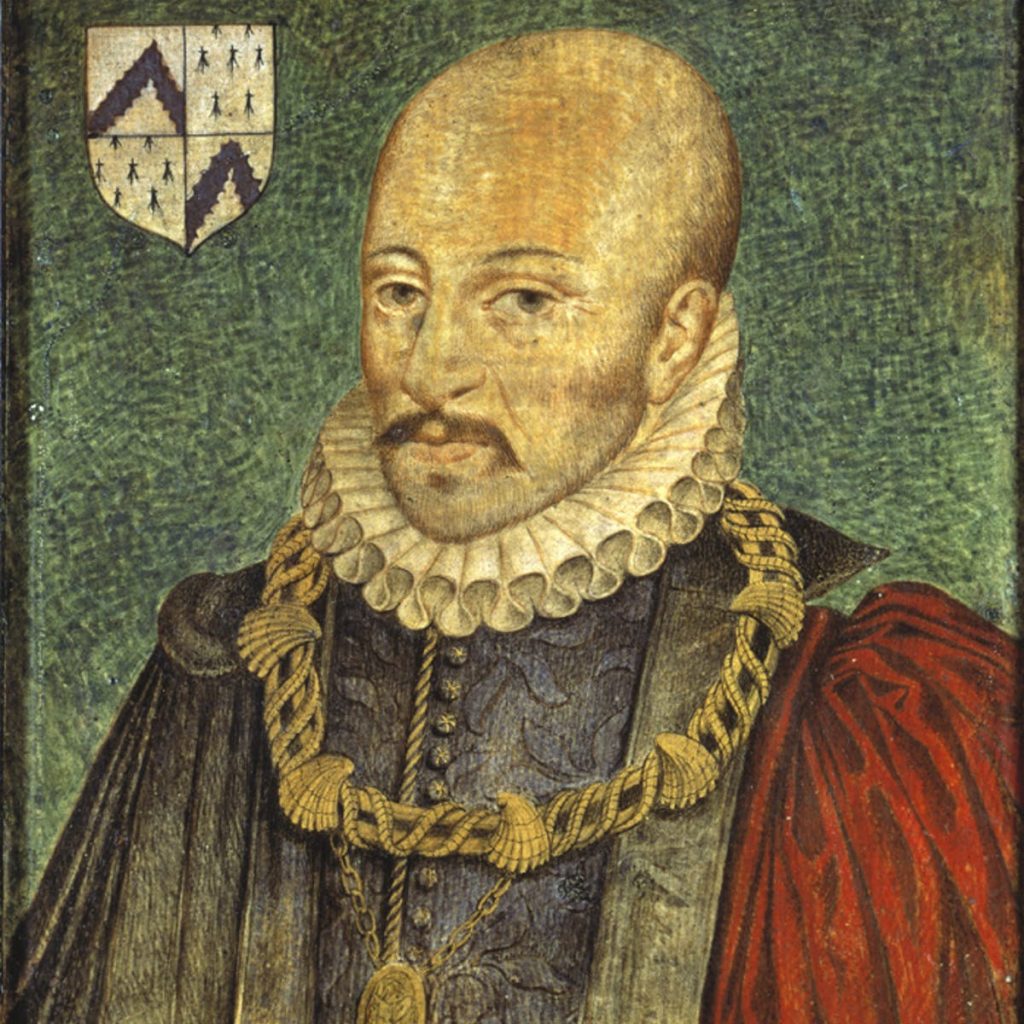
Montaigne was born in 1533, and died in 1592, his life of sixty years coinciding with one of the gloomiest eras in French history–a time of wide-spread and implacable dissensions, of civil war, massacre and murder.
The father of Montaigne was a baron of Perigord. Having found Latin a dreary and difficult study in his youth, he determined to make it an easy one for his son. He procured a tutor from Germany, ignorant of French, and gave orders that he should converse with the boy in nothing but Latin, and directed, moreover, that none of the household should address him otherwise than in that tongue. “They all became Latinised,”‘ says Montaigne; “and even the villagers in the neighbourhood learned words in that language, some of which took root in the country, and became of common use among the people.” Greek he was taught by similar artifice, feeling it a pastime rather than a task.
At the age of six, he was sent to the College of Guienne, then reputed the best in France, and, strange as it seems, his biographers relate, that at thirteen he had run through the prescribed course of studies, and completed his education. He next turned his attention to law, and at twenty-one was made conseiller, or judge, in the parliament of Bordeaux. He visited Paris, and was received at court, enjoyed the favour of Henri II, saw Mary Stuart, Queen of Scots, and entered fully into the delights and dissipations of gay society. At thirty-three he was married though had he been left free to his choice, he “would not have wedded with Wisdom herself had she been willing. But ’tis not much to the purpose,” he writes, “to resist custom, for the common usance of life will be so. Most of my actions are guided by example, not choice.” Of women, indeed, he seldom speaks save in terms of easy contempt, and for the hardships of married life he has frequent jeers.
In 1571, in his thirty-eighth year, the death of his father enabled Montaigne to retire from the practice of law, and to settle on the patrimonial estate. It was predicted he would soon exhaust his fortune, but, on the contrary, he proved a good economist, and turned his farms to excellent account. His good sense, his probity, and liberal soul, won for him the esteem of his province; and though the civil wars of the League converted every house into a fort, he kept his gates open, and the neighbouring gentry brought him their jewels and papers to hold in safe-keeping. He placed his library in a tower overlooking the entrance to his court-yard, and there spent his leisure in reading, meditation, and writing. On the central rafter he inscribed: I do not understand; I pause; I examine. He took to writing for want of something to do, and having nothing else to write about, he began to write about himself, jotting down what came into his head when not too lazy. He found paper a patient listener, and excused his egotism by the consideration, that if his grandchildren were of the same mind as himself, they would he glad to know what sort of man he was. “What should I give to listen to some one who could tell me the ways, the look, the bearing, the commonest words of my ancestors!” If the world should complain that he talked too much about himself, he would answer the world that it talked and thought of everything but itself.
A volume of these egotistic gossips he published at Bordeaux in 1580, and the book quickly passed into circulation. About this time he was attacked with [kidney] stone, a disease he had held in dread from childhood, and the pleasure of the remainder of his life was broken with paroxysms of severe pain. “When they suppose me to be most cast down,” he writes, “and spare me, I often try my strength, and start subjects of conversation quite foreign to my state. I can do everything by a sudden effort, but, oh! take away duration. I am tried severely, for I have suddenly passed from a very sweet and happy condition of life, to the most painful that can be imagined.”
Abhorring doctors and drugs, he sought diversion and relief in a journey through Germany, Switzerland, and Italy. At Rome he was kindly received by the pope and cardinals, and invested with the freedom of the city, an honour of which he was very proud. He kept a journal of this tour, which, after lying concealed in an old chest in his chateau for nearly two hundred years, was brought to light and published in 1774; and, as may be supposed, it contains a stock of curious and original information. While he was travelling, he was elected mayor of Bordeaux, an office for which he had no inclination, but Henry III insisted that he should accept it, and at the end of two years he was re-elected for the same period.
During a visit to Paris, he became acquainted with Mademoiselle de Gournay, a young lady who had conceived an ardent friendship for him through reading his Essays. She visited him, accompanied by her mother, and he reciprocated her attachment by treating her as his daughter. Meanwhile, his health grew worse, and feeling his end was drawing near, and sick of the intolerance and bloodshed which devastated France, he kept at home, correcting and retouching his writings. A quinsy [throat infection] terminated his life. He gathered his friends round his bedside, and bade them farewell. A priest said mass, and at the elevation of the host he raised himself in bed, and with hands clasped in prayer, expired. Mademoiselle de Gournay and her mother crossed half France, risking the perils of the roads, that they might condole with his widow and daughter.
It is superfluous to praise Montaigne’s Essays; they have long passed the ordeal of time into assured immortality. He was one of the earliest discoverers of the power and genius of the French language, and may he said to have been the inventor of that charming form of literature—the essay. At a time when authorship was stiff, solemn, and exhaustive, confined to Latin and the learned, he broke into the vernacular, and wrote for everybody with the ease and nonchalance of conversation. The Essays furnish a rambling auto-biography of their author, and not even Rousseau turned himself inside out with more completeness. He gives, with inimitable candour, an account of his likes and dislikes, his habits, foibles, and virtues. He pretends to most of the vices; and if there be any goodness in him, he says he got it by stealth. In his opinion, there is no man who has not deserved hanging five or six times, and he claims no exception in his own behalf. “Five or six as ridiculous stories,” he says, “may he told of me as of any man living.” This very frankness has caused some to question his sincerity, but his dissection of his own inconsistent self is too consistent with flesh and blood to be anything but natural.
Bit by bit the reader of the Essays grows familiar with Montaigne; and he must have a dull imagination indeed who fails to conceive a distinct picture of the thick-set, square-built, clumsy little man, so undersized that he did not like walking, because the mud of the streets bespattered him to the middle, and the rude crowd jostled and elbowed him. He disliked Protestantism, but his mind was wholly averse to bigotry and persecution. Gibbon, indeed, reckons Montaigne and Henri IV as the only two men of liberality in the France of the sixteenth century. Nothing more distinguishes Montaigne than his deep sense of the uncertainty and provisional character of human knowledge; and Mr. Emerson has well chosen him for a type of the sceptic. Montaigne’s device—a pair of scales evenly balanced, with the motto, Quo scais je? (What do I know?)—perfectly symbolises the man.
The only book we have which we certainly know was handled by Shakespeare, is a copy of Florio’s translation of Montaigne’s Essays. It contains the poet’s autograph, and was purchased. by the British Museum for one hundred and twenty guineas. A second copy of the same translation in the Museum has Ben Jonson’s name on the fly-leaf.