I am going to do a series on the Ten Greatest Canadians of the Twentieth Century, in no particular order. I may cheat a bit, as you will see. Since today is the birthday of one of those worthies, let us begin with him.
For many excellent reasons, Canada does not have a President. Our head of state is Queen Elizabeth II, and in her absence, a Governor-General who opens Parliament, hands out awards, and carries on all the ceremonial duties, while mere Prime Ministers and politicians do the grubby business of actually running the country. By universal accord, the greatest of our Governors-General was Georges Vanier, a splendid figure of a man with a heroic mustache, a chest full of medals, and a long record of service to his nation as a soldier and a diplomat. His wife Pauline was beautiful, pious and serene; together they helped refugees and founded the Vanier Institute of the Family. But perhaps their greatest gift to the world was the birth of their son Jean.
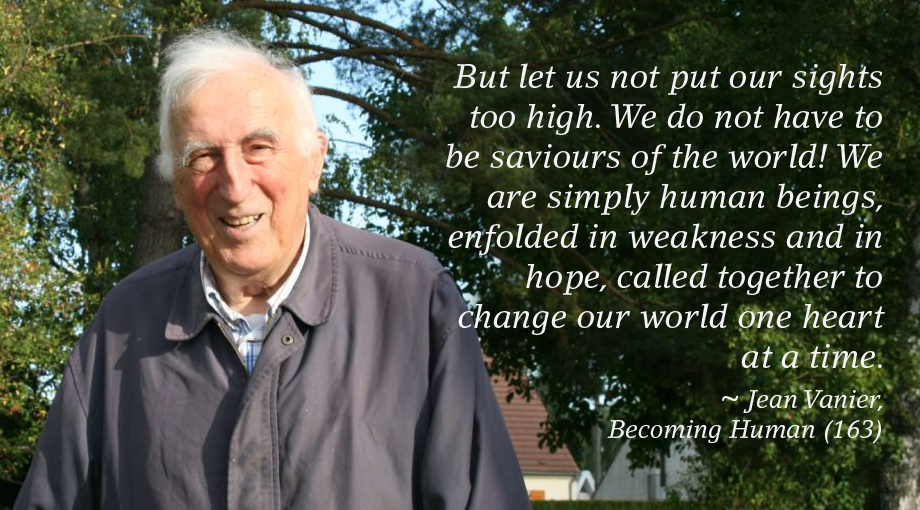
Jean Vanier served in the Royal Navy during the Second World War and was a career officer in peace time with the Royal Canadian Navy. He resigned his commission to become a philosophy professor at the University of Toronto, publishing works on Aristotle. When he was 36 years old, a friend showed him the horrible living conditions endured by people with mental disabilities. The result of this visit was a life-long dedication to serving the helpless and oppressed. He began a small community of the disabled and their helpers called L’Arche or The Ark, in a village in France, which blossomed into a world-wide movement with 147 homes in 35 countries. Vanier died recently at age 90, still a resident of his ‘’Arche community in Picardy.
It is a safe bet that before too long Vanier will be canonized as a saint of the Catholic Church, a fate that probably awaits his parents as well.
Well, all the above was written in 2019. Since then Vanier has been credibly accused of a tawdry sort of sexual misconduct. Under the guise of spiritual direction, Vanier seems to have manipulated a number of women, including nuns, into a sexual relationship. He was posthumously stripped of honours and schools once named after him were renamed. It is a safe bet his canonization will not take place any time soon.
“The evil that men do lives after them; The good is oft interred with their bones.” Future generations will have to weigh Vanier’s undoubted contributions against the harm he did to those 6 women.
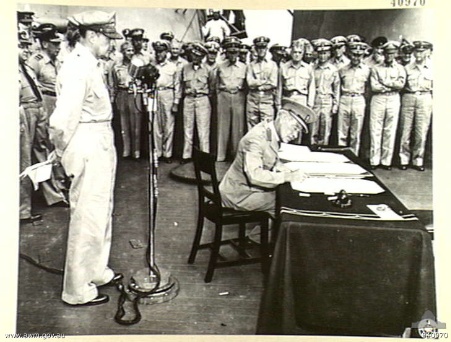
Pretty much everyone has seen the picture of American general Douglas MacArthur on the deck of the battleship Missouri signing the acceptance of the Japanese surrender which ended the Second World War in the Pacific. Less well-known is the fact that Canada also signed this document as one of the belligerents in the struggle against the Japanese empire.
Great Britain, in its own imperialistic way, assumed that it would sign on behalf of its Dominions but MacArthur chose to invite the Australians, who had played a significant part in battles against the Japanese, as well as Canada, New Zealand and two countries whose Asian colonies had been conquered, France and the Netherlands. The Australians were reportedly miffed at the Canadian invitation.
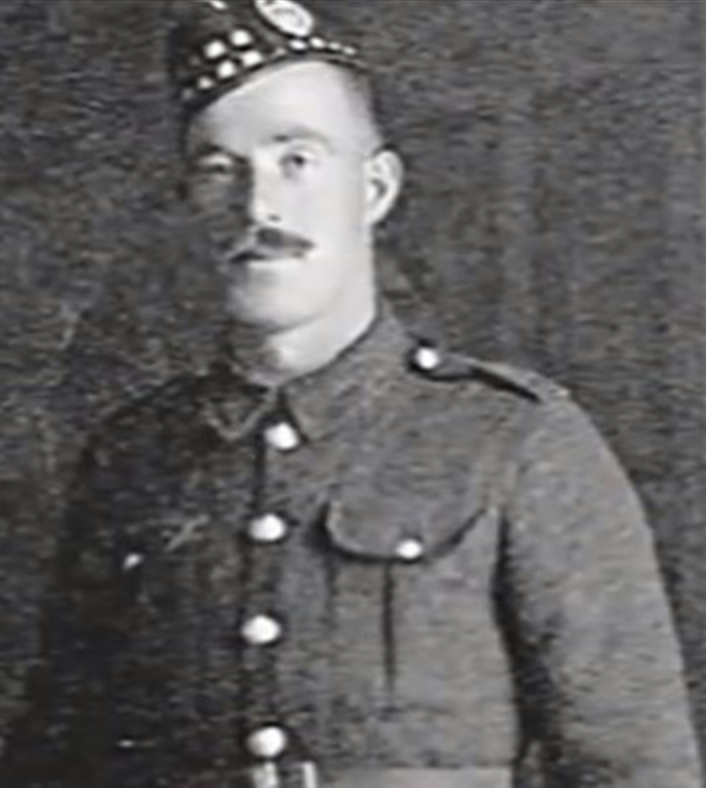
The Canadian signature was added by Colonel Lawrence Moore Cosgrove (pictured above) who accidentally signed on the wrong line, perhaps because he was blind in one eye from a wound suffered in World War I.
Cosgrove had been a war hero (DSO and the Croix de Guerre) and was supposedly the fellow on whose back John McRae wrote the poem “In Flanders Fields” in the trenches on the Western Front in 1917.
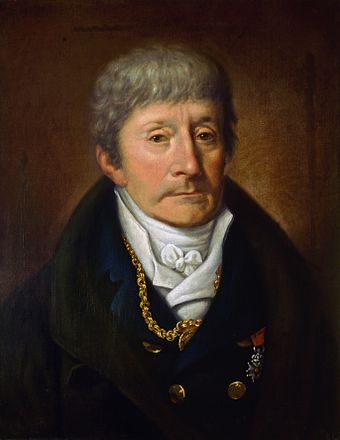
The 1984 movie Amadeus is a wonderful piece of cinema if you don’t care a fig for historical truth. It is sumptuously staged and brilliantly acted and, best of all, it is full of the wonderful music of Wolfgang Mozart, one of God’s kindest gifts to humanity. Unfortunately, its plot slanders the reputation of a very able and innovative composer and conductor, (and, apparently, a rather decent guy) Antonio Salieri (1750-1825).
Salieri was an Italian who spent most of his professional life serving the Austrian Habsburgs, especially the enlightened despot Joseph II, a noted musical aficionado. His operas were performed all over Europe; his influence on the genre was considerable. He was the imperial Kappelmeister and was the teacher of Beethoven, Liszt, and Schubert, yet the fictional musings of Alexander Pushkin and Peter Shaffer had made his life a metaphor for jealousy and mediocrity. In fact, Salieri and Mozart had no poisonous relationship and, if anything, Salieri was a supporter of his younger colleague. For a revisionist look that seeks to restore his personal and musical reputation, read Alexander Ross’s “Antonio Salieri’s Revenge”: https://www.newyorker.com/magazine/2019/06/03/antonio-salieris-revenge.
Oh, how true that is. I cannot watch historical dramas without getting upset at the anachronisms. I have no trouble with cheesy Hercules Unchained rubbish but something that purports to convey truth and does not, causes the veins in my temple to throb. Herewith the three worst “historical” films. Number Three on your program is Oliver Stone’s JFK. Stone took the paranoid fantasies of New Orleans district attorney Jim Garrison and turned it into an attack on the military-industrial complex. The fact that Garrison’s theories were laughed out of court mattered naught to Stone. Number Two is The Burning Times by Canada’s National Film Board under the direction of Starhawk, a witch. It claims that there was a Female Holocaust of 9,000,000 dead in the early-modern witchcraft craze. This was happily used by university Women’s Studies departments for years.
Number One, the worst historical film ever made, is King Arthur directed by Antoine Fuqua.
The lies start with the voiceover introduction: “By 300 AD, the Roman Empire extended from Arabia to Britain. But they wanted more. More land. More peoples loyal and subservient to Rome. But no people so important as the powerful Sarmatians to the east. Thousands died on that field. And when the smoke cleared on the fourth day, the only Sarmatian soldiers left alive were members of the decimated but legendary cavalry. The Romans, impressed by their bravery and horsemanship, spared their lives. In exchange, these warriors were incorporated into the Roman military. Better they had died that day.”
Rubbish in the first degree. By 300 the Roman empire was not expanding; it was barely holding on, rescued from collapse by soldier-emperor Diocletian who persecuted Christians intensely and who did not put Christian symbols on his soldiers’ shields as the opening scenes suggested.
“The powerful Sarmatians” were not all that powerful and were just about on their last legs as an independent people in the 300s AD; they certainly weren’t conquered by the Romans (they were absorbed by Slavs and other barbarian confederacies) or enlisted by the Romans as “knights”, an anachronistic term.
The film is set in Britain in the year 476 with Arthur (Clive Owen) leading a troop of Sarmatian cavalry in the Roman army. In fact, the last Roman military unit left the island in 410. And they ride with stirrups which were unknown at the time.
Arthur is a follower of Pelagius (a real historical character, a British heretic who proposed a theory of human free will at odds with the Christian doctrine of the need for divine grace). In the movie Pelagius’s notion of free will is meant to be some sort of democracy and he is murdered by the Church because of it. In fact Pelagius died c 420 unmolested by the Church, except in debate.
Pelagius’s murderer is the film’s villain, Bishop Germanius (clearly supposed to be Germanus of Auxerre, the opponent of Pelagius who died in 429 and who, of course, never laid a finger on the heretic much less killed him.) He reneges on the deal that would have allowed Arthur’s men to go home, forcing them to go on one last mission, to rescue a Roman official who lives north of Hadrian’s Wall and whose son might be the pope one day.
The Christian official whom the heroes are sent to save is, of course, a very bad man who tortures his slaves for asking for food. He tells them he speaks with the voice of God and that it is a sin to disobey him. The willingness of the film to tar the Church with any sort of evil reaches its low point when we see a monk wall himself up with pagans, eager to torture them into salvation and starve to death in the process. “It is God’s wish that these sinners be sacrificed. Only then can their souls be saved.”
All of this anti-Christian blather goes on before the battles with the invading Saxons who are shown to be racists as well as real mean guys (and invading north of the Wall instead of hundreds of miles south of it as in real life. There was nothing to steal up north.) Arthur teams up with British natives known as “Woads”, in real life the “Picts”. Woad is the plant that gives the blue dye the Picts adorned themselves with. Such an alliance is necessary because we learn that the Saxons have metal crossbows (not invented until 800 years later) but the Woads have trebuchets (likewise centuries out of place.) The most attractive of the Woads is Guinevere (Keira Knightley) who hurls her fragile frame clad in a well-tailored deer-skin bikini against the Saxons in a series of dazzling kung-fu moves unknown to history until the birth of Jet Li.
Sorry for the rant. It’s been 16 years since King Arthur and I’m still mad.
The London Daily Telegraph made the following report:
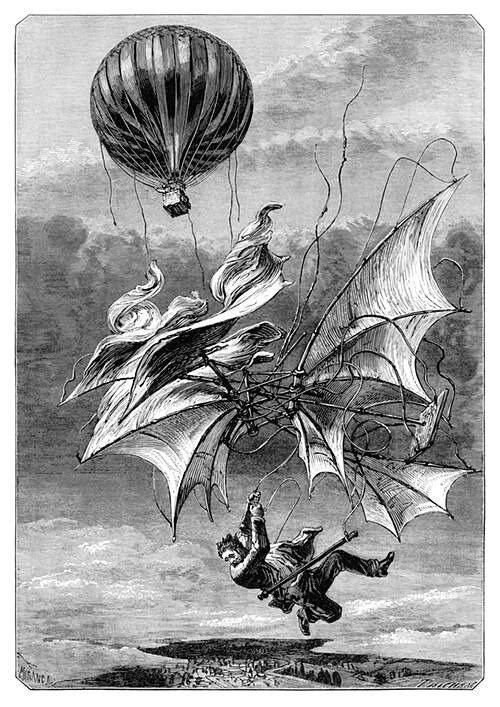
It was announced yesterday that, at 7.30 p.m., M. de Groof, the “Flying Man” would repeat at the Cremorne Gardens “his astounding performance of flying through the air a distance of 5,000 feet.” True to this announcement, the Flying Man did endeavour to repeat the exploit which he had accomplished in safety ten days before, and perished in the attempt.
M. de Groof was a Belgian, who had expended years in constructing for himself an apparatus with which he believed it possible to imitate the flight of a bird. The general outline of this apparatus was an immitation of a bat’s wings, the framework being made of cane, and the intervening membrane of stout waterproof silk. The wings were in all 37 feet long, with an average breadth of 4 feet, while the tail was 18 feet by 3. These wings were inserted into two hinged frames that were attached to a wooden stand upon which the aeronaut took his place. Here he had three levers which he worked by hand to give his machine propulsion or guidance as might be required; his theory being that having started from a given height, he could manage his descent so as to reach the earth by a sort of inclined swooping motion, without risk of concussion.
About a year ago M. de Groof made an attempt, of which our correspondent at the time telegraphed the particulars. to descend from a great neight on the Grande Place at Brussels. The effort was a failure, but l’Homme Volant as he was then called, escaped unhurt, though his network was afterwards torn in pieces by the crowd. On Monday, the 20th ultimo, however, M. de Groof repeated his experiment at Cremorne Gardens, with success. Mr. Baum, tho proprietor of the gardens, had, it seems, after making an engagement with him, felt some uneasiness as to the result, and at first refused to allow the trial to be made. The “Flying Man” protested the absolute feasibility of his scheme, and insisted on the contract being carried out; and this was done. The wings and stand were attached to a balloon guided by Mr. Simmons, who, after drifting over London towards Brandon, in Essex, released his companion at a considerable height—three or four hundred feet, it is said—and the flying apparatus was immediately set in motion. “For a time” it is stated, “it was a race between the aeronaut and the flyer, De Groof winning by two flelds’ lengths, and attaining the ground in perfect safety.”
How the accident occurred last night cannot be clearly ascertained. The apparatus, previous to the ascent, seemed in satisfactory order, and De Groof—though, according to custom, he took an affectionate farewell of his wife—appeared fully confident of making a successful ascent. About a quarter to 8 o’clock the balloon was cut loose, and rose slowly in the air, bearing with it the Flying Man and his gear. There was hardly a breath of air, a circumstance which might have been supposed to be favourable to the performance of an aeronautical feat of the kind. Be this as it may, however, when the balloon had attained a height of three or four hundred feet, the unfortunate performer seemed either to mistrust his own powers or the capability of his apparatus, for he was heard by the spectators below shouting to the man in the balloon to bring him nearer the earth. This request was complied with, and the balloon descended slowly towards Robert-street, which lies a quarter of a mile or so to the north of Cremorne Gardens. On approaching St. Luke’s Church, Mr. Simmons, the balloonist, was heard to say: “Yon must cut loose now, or you’ll come on the church roof.” The answer was, “Yes; let me drop into the churchyard,” and these were, no doubt, the last words De Groof uttered.
He cut the rope when about eighty feet from the ground, but, to the horror of the spectators, who must have numbered many thousand, the apparatus, instead of inflating with the pressure of the air, collapsed, and, turning round and round in its descent, fell with great violence in Robert-street, a yard or two from the kerbstone. Assistance to the unfortunate man was instantly forthcoming. Although still breathing, he was insensible; but the despatch with which he was extricated from the wreck of his apparatus and conveyed to Chelsea Infirmary proved in vain. He never recovered consciousness, and on his arrival at the hospital the surgeons pronounced him dead, Madame de Groof, who witnessed her husband’s fall, fainted at the sight, and a still more painful scene took place a short time later at the hospital, when she learned the whole sad truth.
The apparatus was carried off in shreds by the crowd before the police could secure it. From the hospital the body was removed to the dead-house, where it now awaits the inquest. It only remains to add that the balloon, on being freed from the weight of De Groof and his flying machine, soared away over the metropolis in a north-easterly direction; and, at dark, was seen at a great height above Victoria Park, where it was watched with much interest by large numbers of people, who were, of course, ignorant of the shocking tragedy in which it had played a part.
Evil always carries within itself the germ of its own subversion in that it leaves behind in human beings at least a sense of unease. Against stupidity we are defenseless.
Neither protests nor the use of force accomplish anything here; reasons fall on deaf ears; facts that contradict one’s prejudgment simply need not be believed – in such moments the stupid person even becomes critical – and when facts are irrefutable they are just pushed aside as inconsequential, as incidental. In all this the stupid person, in contrast to the malicious one, is utterly self-satisfied and. being easily irritated, becomes dangerous by going on the attack.
For that reason, greater caution is called for when dealing with a stupid person than with a malicious one. Never again will we try to persuade the stupid person with reasons, for it is senseless and dangerous.
Dietrich Bonhoeffer (1906 – 1945) “On Stupidity” – Letters and Papers from Prison
In 1879 Catholicism began spreading in Uganda when the White Fathers, a congregation of priests founded by Cardinal Lavigerie were peacefully received by King Mutesa of Uganda. The priests soon began preparing catechumens for baptism and before long a number of the young pages in the king’s court had become Catholics.
However, on the death of Mutesa, his son Mwanga, a corrupt man who ritually engaged in pedophilic practices with the younger pages, took the throne. When King Mwanga had a visiting Anglican Bishop murdered, his chief page, Joseph Mukasa, a Catholic who went to great length to protect the younger boys from the king’s lust, denounced the king’s actions and was beheaded on November 15, 1885.
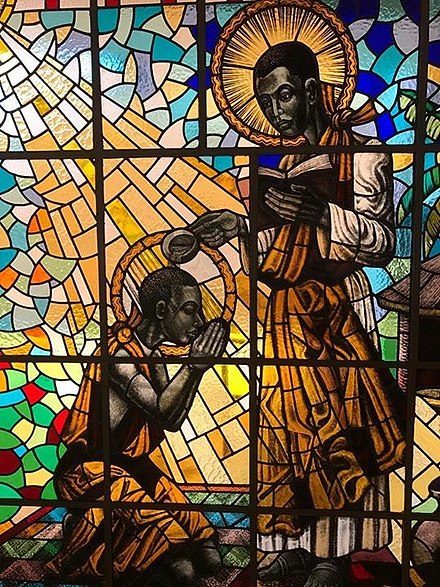
The 25 year old Charles Lwanga, a man wholly dedicated to the Christian instruction of the younger boys, became the chief page, and just as forcibly protected them from the kings advances. On the night of the martyrdom of Joseph Mukasa, realizing that their own lives were in danger, Lwanga and some of the other pages went to the White Fathers to receive baptism. Another 100 catechumens were baptized in the week following Joseph Mukasa’s death.
The following May, King Mwanga learned that one of the boys was learning catechism. He was furious and ordered all the pages to be questioned to separate the Christians from the others. The Christians, 15 in all, between the ages of 13 and 25, stepped forward. The King asked them if they were willing to keep their faith. They answered in unison, “Until death!”
They were bound together and taken on a two day walk to Namugongo where they were to be burned at the stake. On the way, Matthias Kalemba, one of the eldest boys, exclaimed, “God will rescue me. But you will not see how he does it, because he will take my soul and leave you only my body.” They executioners cut him to pieces and left him to die alone on the road. When they reached the site where they were to be burned, they were kept tied together for seven days while the executioners prepared the wood for the fire.
On June 3, 1886, the Feast of the Ascension, Charles Lwanga was separated from the others and burned at the stake. The executioners slowly burnt his feet until only the charred remained. Still alive, they promised him that they would let him go if he renounced his faith. He refused saying, “You are burning me, but it is as if you are pouring water over my body.” He then continued to pray silently as they set him on fire. Just before the flames reached his heart, he looked up and said in a loud voice, “Katonda! – My God!,” and died. His companions, some Catholic, some Anglican, were all burned together the same day all the while praying and singing hymns until they died.
According to an episode in season 4 of The Simpsons, Homer Jay Simpson was born on this date in 1956. His marriage to Marge Bouvier, his siring of three children and his employment at the Springfield Nuclear Power Plant are chronicled in the longest-running animated sitcom in television history.
Here are a few of Homer’s priceless observations:
“To alcohol! The cause of, and solution to, all of life’s problems.”
“Weaseling out of things is important to learn; it’s what separates us from the animals … except the weasel.”
“I saw this in a movie about a bus that had to SPEED around the city, keeping its SPEED over fifty, and if its SPEED dropped, the bus would explode! I think it was called The Bus That Couldn’t Slow Down.”
“Marge, it takes two to lie. One to lie and one to listen.”
“You tried your best and you failed miserably. The lesson is, never try.”
“Kids, just because I don’t care doesn’t mean I’m not listening.”
“I wish God were alive to see this.”
“I want to share something with you: The three little sentences that will get you through life. Number 1: Cover for me. Number 2: Oh, good idea, Boss! Number 3: It was like that when I got here.”
“Sleeping bags on the floor, a roaring fire. It’ll be just like the time they kicked me out of the sporting goods store.”
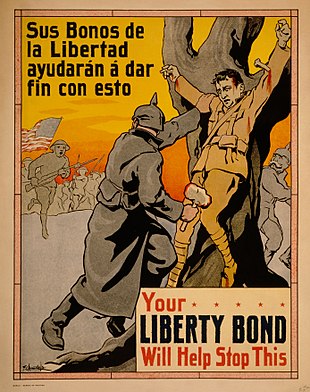
On May 10, 1915, in the tenth month of World War I, the Times of London published the first account of an Allied soldier crucified by the Germans. The article entitled “Torture of a Canadian Officer” said that its Paris correspondent had heard from front-line troops that they had recovered the body of a Canadian captain nailed to a wall by bayonets through his hands, feet, and throat, and riddled with bullets.
Questions were asked in the House of Commons about this incident and stories spread with different details — it wasn’t a captain, it was a sergeant; it wasn’t a single soldier, it was two, then three; the victim wasn’t Canadian, he was British, etc. Details were hard to pin down but the alleged incident was great fuel for anti-German propaganda, becoming the stuff of legend, posters, movies, and widespread public outrage.
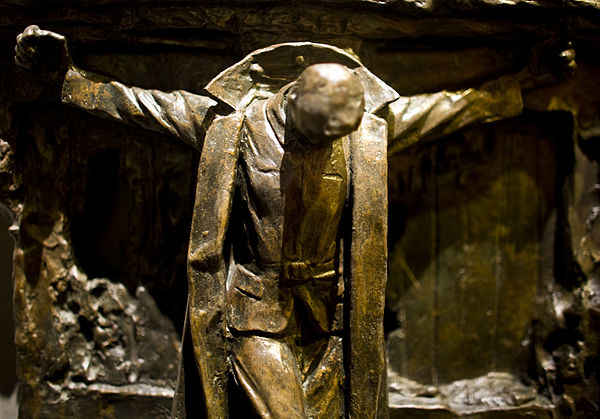
In 1918, the British war artist Francis Derwent Wood created a sculpture entitled “Canadian Golgotha” showing a Christ-like crucified soldier surrounded by mocking Germans, but before it could be exhibited after the war, the German government demanded documentary proof of the atrocity and the art was never shown until the 1990s.
Over the years, the story came to be doubted and put down to war-time rumour and exaggeration but the latest research suggests that the tale is true and that the victim was Sergeant Harry Band of the Central Ontario Regiment, who went missing in action in late April near Ypres.
This is the kind of book that is either going to inspire or infuriate you, but it should provoke valuable discussion and thought in either case. Johnson’s thesis is quite simple: the revolutionary thinkers whose ideas have shaped intellectual history over the past 250 years were, for the most part, lousy human beings. These were not just common or garden variety jerks, but personalities whose flaws were so manifest that they must call into question the value of the theories they generated.
This is an interesting proposition. Does it matter that Peter Sellers, the world’s greatest comedic actor, was a vile neurotic, that Marilyn Monroe was a goddess on screen but a drug-addled manipulator in everyday life, that Winston Churchill, who saved civilization during World War II, was also an alcoholic egomaniac? Probably not. But Johnson asks a deeper question: if a thinker cannot live out his own principles, can these ideas have any real merit? His book convinces us that there is a real connection between the rancid lives lived by intellectuals and the disasters their ideas produced.
For example, Jean-Jacques Rousseau is adored by educational theorists and his ideas are entrenched in the curricula of teachers’ colleges, despite the fact that he serially abandoned every one of his children. Karl Marx was bourgeois to the core and seems to have exploited the only working-class woman he ever knew: paying her starvation wages, impregnating her, and forcing her to abandon their child. Johnson lacerates the behaviour of these prominent figures but more importantly shows how their shabby personal values foreshadow the social harm their works engendered.