On the 5th of November 1800, it was settled by the privy-council, that in consequence of the Irish Union, the royal style and title should be changed on the 1st of January following—namely, from “George III, by the grace of God, of Great Britain, France, and Ireland, King, Defender of the Faith;” to “George III, by the grace of God, of the United Kingdom of Great Britain and Ireland, King, Defender of the Faith.” And thus the title of king of France, which had been borne by the monarchs of England for four hundred and thirty-two years—since the forty-third year of the reign of Edward III —was ultimately abandoned.
It was the Salic law [forbidding a female to inherit or pass on a claim to the French throne] which had excluded Edward from the inheritance of France; but Queen Elizabeth I claimed the title, nevertheless, asserting that if she could not be queen, she would be king of France. During the war between England and Spain, in the time of Queen Elizabeth, commissioners were appointed on both sides to discuss peace. The Spanish commissioners proposed that the negotiations should be carried on in the French tongue, observing sarcastically, that “the gentlemen of England could not be ignorant of the language of their fellow-subjects, their queen being queen of France as well as of England.” “Nay, in faith, gentlemen,” drily replied Dr. Dale, one of the English commissioners, “French is too vulgar for a business of this importance; we will therefore, if you please, rather treat in Hebrew, the language of Jerusalem, of which your master [Philip II] calls himself king, and in which you must, of course, be as well skilled as we are in French.”
Despite the abandonment of the claim to France the motto of the British monarch outside of Scotland (where the motto is different) is in French – “Dieu et mon droit” – as is the motto of the Order of the Garter – “Honi soit qui mal y pense”.
Our Lady of Kazan was a highly-venerated icon of the Russian Orthodox Church. It is said to have originated in Constantinople and was transported to Russia in the 12th century where it disappeared in 1438. It was miraculously rediscovered in Kazan after a vision in 1579. The city had been destroyed in a fire, after which a young girl had repeated dreams of the location of the icon. Despite scepticism of local church authorities it was found in the ruins of a house where it had been stored to protect it from the Tatar horde. Copies of the icon spread widely and churches were established in its honour. Prayers to this icon were credited for saving the country from invasion by Poles, Swedes and Napoleon.
In 1904 the icon was stolen and, though its gold frame was recovered, the icon itself was never seen again. The disasters of the 1905 Russian Revolution, the loss of the Russo-Japanese War, the Great War and the Communist takeover are attributed to its loss.
A splendid 16th-century copy was once owned by Pope John Paul II who returned it to the Russian Orthodox Church. It is now back in Kazan in the Cathedral of the Elevation of the Holy Cross on the site where it had been recovered.
Few saints have lived as brief, or unlikely, lives as the English St Rumald (aka Rumwold, Grumbald, or Rumbald). The son of an Anglo-Saxon princess and the king of Northumbria in the 7th century, he emerged from the womb proclaiming “I am a Christian! I am a Christian! I am a Christian!” He then made a full and explicit confession of his faith; desired to be forthwith baptized; appointed his own godfathers; and chose his own name. He next directed a certain large hollow stone to be fetched for his font; and when some of his father’s servants attempted to obey his orders, but found the stone far too heavy to be removed, the two priests, whom he had appointed his godfathers, went for it, and bore it to him with the greatest ease. He was baptized by Bishop Widerin, assisted by a priest named Eadwold, and immediately after the ceremony he walked to a certain well near Brackley, which still bears his name, and there preached for three successive days; after which he made his will, bequeathing his body after death to remain at Sutton for one year, at Brackley for two years, and at Buckingham ever after. This done, he instantly expired.
This remarkable infant was venerated by the pious believers of Buckinghamshire until the 16th century when the English Reformation put an end to such customs. At least four churches dedicated to tiny Rumald still exist. He is not to be confused with his contemporary St Rumbold of Mechelen, the English missionary martyred in Belgium.
Samuel Romilly was born in London in 1757 to descendants of French Protestants who had fled the persecutions of Louis XIV. He entered the legal profession in which he rose to renown and wealth. Romilly’s sympathies were always on the side of reform. During the 1780s he made the acquaintance of Jean-Jacques Rousseau and Denis Diderot and he had high hopes for the French Revolution but its increasing radicalism and violence ultimately dismayed him.
Romilly’s brilliance and oratorical skills won him the patronage of influential politicians and when he entered Parliament in 1808 he was made Solicitor General. He was a fierce opponent of the slave trade and a firm supporter of the attempts by William Wilberforce to abolish that institution but his main contribution as a reformer was to amend laws to which the death penalty was attached.
Since the sixteenth century England had passed legislating mandating execution not just for crimes of murder or treason but for far more trivial offences. By 1800 there were over 200 offences for which death was the mandatory sentence: theft of goods worth more than 12 pence, wrecking a fish pond, cutting down a young tree, keeping the company of gypsies, or impersonating a Chelsea Pensioner. Romilly’s efforts resulted in a gradual abolition of many of these statutes. (Britain’s last execution was in 1964 though the death penalty was abolished only in 1998.)
In October 1818 Romilly’s wife Anne died and a few days later, in a paroxysm of grief, he cut his own throat.
Zoila Augusta Emperatriz Chávarri del Castillo was born in 1922 to mixed-race Peruvian parents. She chose a career in singing South American folk music and after limited success in that field she was discovered by an American impresario who marketed her as an Incan princess with a phenomenal vocal range. Her stage name Yma Sumac became synonymous with exotic sounds and backdrops. She appeared in film, on Broadway, and in night clubs with extensive foreign tours to her credit.
Sumac’s vocal range may have been 6 octaves and she was revered for her vocal athleticism as much as for her interpretation and glamorous appeal. The clip below demonstrates her virtuosic novelty.
November 1 is All Saints’ Day or Hallowmas and the night preceding is thus All Hallows’ Eve or Hallowe’en. Together with November 2, All Souls’ Day, it constitutes Allhallowtide, a period to commemorate the Christian dead.
Halloween has become a secular festival dedicated to the distribution of unhealthy food to costumed children and to the indulgence by their elders in thoughts of the macabre. October television is dedicated to films about chainsaw homicide, haunted mansions, and the grisly dispatch of teenagers who violate the prime directive of sticking together when threatened by serial killers. October marketing focuses on novel ways to sell pumpkin-, witch-, skeleton- and zombie-related foodstuffs and clothing. Halloween has become the holiday on which more discretionary income is expended than any other save Christmas.
What this says about North American culture in the twenty-first century is uncertain. Is it a healthy interest in human mortality or a morbid fascination with the unholy and forbidden? Are we mocking evil or temporarily embracing it? Here are some thoughts on the subject:
I think if human beings had genuine courage, they would wear their costumes every day of the year, not just on Halloween. Wouldn’t life be more interesting that way? And now that I think about it, why the heck don’t they? Who made the rule that everybody has to dress like sheep 364 days of the year? Think of all the people you’d meet if they were in costume every day. People would be so much easier to talk to, like talking to dogs. – Douglas Coupland, The Gum Thief
It is as if French society were looking for a kind of civil religion capable of replacing Christian symbolism. At Halloween the dead are imitated and their ‘ghosts’ come back to frighten us and threaten us with death. On All Saints’ Day, in contrast, we affirm that the departed are alive and that we are promised to rejoin them in the City of God. – Hippolyte Simon, bishop of Clermont-Ferrand, Vers une France païenne? (Toward a Pagan France?)
Over time Halloween became an important night for customers, as well; for whereas children of the interwar years constructed their costumes from old clothes in the attic; for or closet and simply blackened their faces with burnt cork or soot, children in the more affluent 1950s and 1960s were more likely to buy Halloween masks and perhaps other articles of their costume from retail stores. By making Halloween consumer-oriented and infantile, civic and industrial promoters hoped to eliminate its anarchic features. – Nicholas Rogers, Halloween: From Pagan Ritual to Party Night
I would give nothing for that man’s religion whose very dog and cat are not the better for it. – Sir Rowland Hill
The Christian must be aware that he is moving towards a destination; and that the destination is not in this world. He must maintain a certain detachment from the things of this world; a chaste detachment; for where he is going cannot be here. Spectator and witness, perhaps actor in his turn, in some role for which he is or isn’t suited; bearing responsibilities to others in every single case. His suffering may be of more value than any achievement to which he may claim. He cannot vest his hopes in earthly things, knowing they will vanish. His finest possessions are not of this world, but from another: the phenomena of reciprocated love; of truth, goodness, and beauty apprehended, preciously kept in the purse of memory; of “news from a foreign country” received. This is all he will hold at the end of his journey, when his road through space and time lies behind him, and everything he once carried on his back has been used up, thrown or taken away, and even the old bag of his flesh is discarded. – David Warren, “Essays in Idleness”, 2014
Bishop Joseph Butler of Bristol in response to John Wesley’s conversion: “Enthusiasm, sir, is a horrid thing; a very horrid thing indeed.”
Whenever I think of the past, it brings back so many memories. – Steven Wright
What strange math. There is nothing like the tally of a life. All of our accomplishments, ridiculous. All of our striving, unnecessary. Our lives are unfinished and unfinishable. We do too much, never enough and are done before we’ve even started. We can only pause for a minute, clutching our to-do lists, at the precipice of another bounded day. The ache for more — the desire for life itself — is the hardest truth of all. – Kate Bowler, “One Thing I Don’t Plan to Do Before I Die Is Make a Bucket List”, New York Times, 2021
Politics was a blood sport in early-modern England. Men and women paid with their lives for choosing the losing side in a dynastic or religious quarrel. Their posthumous reputations often depended on how they behaved in their last moments when they faced their public execution. No one forgot the stubborn refusal of the Countess of Salisbury to cooperate with the headsman, the last words of Bishop Latimer as he was burned alive, or courage of Walter Raleigh dealing with his unjust fate, the victims of spineless James I.
Raleigh died nobly. The bishop who attended him, and the lords about him, were astonished to witness his serenity of demeanour. He observed calmly: “I have a long journey to go, therefore must take leave!” He fingered the axe with a smile, and called it “a sharp medicine, a sound cure for all disease”. He laid his head on the block with these words in conclusion:
‘So the heart be right, it is no matter which way the head lies.’
The following is Raleigh’s last poem, written the night before his death, and found in his Bible, in the Gate house, at Westminster:
Even such is time, which takes in trust Our youth, our joys, and all we have, And pays us nought but age and dust; Which in the dark and silent grave, When we have wandered all our ways, Shuts up the story of our days! And from which grave, and earth, and dust, The Lord shall raise me up, I trust.’
To celebrate the centenary of American independence, and to mark their own contribution to that effort, the French were determined to make the USA a splendid gift. The anniversary present would prove to be La Liberté éclairant le monde, the gigantic Statue of Liberty (more properly “Liberty Enlightening the World”).
Work began on Liberty years before the centenary but the difficulty of the task and financing problems meant that by 1876 only the statue’s arm bearing the torch could be sent to Philadelphia for the festivities. It was designed by Frédéric Auguste Bartholdi and built by Gustave Eiffel. Made of copper, it depicted the Roman goddess Libertas carrying a torch and a law tablet inscribed with “1776”; at her feet is a broken chain signifying freedom from oppression. The statue was shipped in pieces to New York where it was erected on an island platform in the harbour, towering 305′ above the ground.
On this date in 1886 President Grover Cleveland dedicated the statue after a grand ticker-tape parade (the first ever) through the streets of New York.
No American contribution to religion has evoked as much turmoil, tragedy, and violence as the Church of Latter Day Saints, popularly called Mormonism. Its origins lie in the Burned-over district of upstate New York but the crises it precipitated occurred across the USA all the way to the Great Salt Lake of Utah.
Following the 1830 publication of the Book of Mormon, Joseph Smith’s new revelations attracted a large number of converts as well as hostile attention from their Christian neighbours. Particularly provocative were the approval of polygamy and numerous theological novelties such as the appearance of Jesus Christ in the Americas.
Settlements of Mormons were established in Ohio and then Missouri where Smith prophesied the Second Coming and the founding of a new capital city. Alarm at the growth of a Mormon presence led to the establishment in 1836 of Caldwell County in the northwest of Missouri where they could come together in safety, but that hope proved illusory. Small-scale violence broke out, especially after Mormons expanded their presence into neighbouring counties. In 1838 these skirmishes broke out into what is known as the Mormon War.
In the summer of 1838 a Mormon preacher warned that his people would respond to any further attacks with violence. Sidney Rigdon’s “July 4th Oration” stated:
We take God and all the holy angels to witness this day, that we warn all men in the name of Jesus Christ, to come on us no more forever. For from this hour, we will bear it no more, our rights shall no more be trampled on with impunity. The man or the set of men, who attempts it, does it at the expense of their lives. And that mob that comes on us to disturb us; it shall be between us and them a war of extermination; for we will follow them till the last drop of their blood is spilled, or else they will have to exterminate us: for we will carry the seat of war to their own houses, and their own families, and one party or the other shall be utterly destroyed.—Remember it then all MEN.
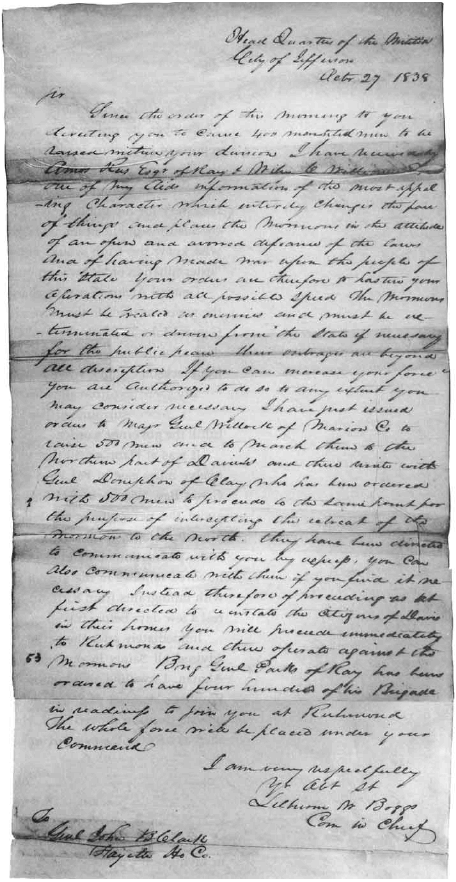
A Mormon militia encountered forces of the Missouri state troops at the Battle of Crooked River on October 24 and though casualties on both sides were light, all thought of conciliation was abandoned. On October 27 Missouri governor Lilburn Boggs issued Executive Order 44, known as the Extermination Order:
Headquarters of the Militia, City of Jefferson, Oct. 27, 1838.
Gen. John B. Clark:
Sir: Since the order of this morning to you, directing you to cause four hundred mounted men to be raised within your division, I have received by Amos Reese, Esq., of Ray county, and Wiley C. Williams, Esq., one of my aids [sic], information of the most appalling character, which entirely changes the face of things, and places the Mormons in the attitude of an open and avowed defiance of the laws, and of having made war upon the people of this state. Your orders are, therefore, to hasten your operation with all possible speed. The Mormons must be treated as enemies, and must be exterminated or driven from the state if necessary for the public peace—their outrages are beyond all description. If you can increase your force, you are authorized to do so to any extent you may consider necessary. I have just issued orders to Maj. Gen. Willock, of Marion county, to raise five hundred men, and to march them to the northern part of Daviess, and there unite with Gen. Doniphan, of Clay, who has been ordered with five hundred men to proceed to the same point for the purpose of intercepting the retreat of the Mormons to the north. They have been directed to communicate with you by express, you can also communicate with them if you find it necessary. Instead therefore of proceeding as at first directed to reinstate the citizens of Daviess in their homes, you will proceed immediately to Richmond and then operate against the Mormons. Brig. Gen. Parks of Ray, has been ordered to have four hundred of his brigade in readiness to join you at Richmond. The whole force will be placed under your command.
I am very respectfully, yr obt st [your obedient servant], L. W. Boggs, Commander-in-Chief.
This proclamation was swiftly followed by a massacre of 18 Mormon prisoners at Haun’s Mill, despoiling of Mormon settlers, and a decision by Joseph Smith to migrate out of Missouri. Further violence and hardship would ensue.