December 27

Home / Uncategorized / December 27

1814 The death of a prophetesss

When I was a young man, still in my teens, I visited London. The attractions included an English  girl I had met back in Saskatoon, Carnaby Street, the British Museum, and London newspapers. I was dazzled by the journalism, high and low. One advertisement in a tabloid caught my eye — it demanded that the Bishops open Joanna Southcott’s Box. It was implied that untold wisdom and cosmic secrets would be revealed and national calamities averted if they did. Who was Joanna Southcott? And what was in her box? Here is a near-contemporary account of the remarkable woman.

Joanna Southcott was born about the year 1750, of parents in very humble life. When about forty years old, she assumed the pretensions of a prophetess, and declared herself to be the woman mentioned in the twelfth chapter of the Book of Revelation. She asserted that, having received a divine appointment to be the mother of the Messiah, the visions revealed to St. John would speedily be fulfilled by her agency and that of the son, who was to be miraculously born of her. Although extremely illiterate, she scribbled much mystic and unintelligible nonsense as visions and prophecy, and for a time carried on a lucrative trade in the sale of seals, which were, under certain conditions, to secure the salvation of the purchasers. The imposture was strengthened by her becoming subject to a rather rare disorder, which gave her the appearance of pregnancy after she had passed her grand climacteric. The faith of her followers now rose to enthusiasm. They purchased, at a fashion-able upholsterer’s, a cradle of most expensive materials, and highly decorated, and made costly preparations to hail the birth of the miraculous babe with joyous acclamation.

The delusion spread rapidly and extensively, especially in the vicinity of London, and the number of converts is said to have amounted to upwards of one hundred thousand. Most of them were of the humbler order, and remarkable for their ignorance and credulity; but a few were of the more educated classes, among whom were two or three clergymen. One of the clergymen, on being reproved by his diocesan, offered to resign his living if ‘the holy Johanna,’ as he styled her, failed to appear on a certain day with the expected Messiah in her arms. About the close of 1814, however, the prophetess herself began to have misgivings, and in one of her lucid intervals, she declared that ‘if she had been deceived, she had herself been the sport of some spirit either good or evil.’

On the 27th of December in that year, death put an end to her expectations—but not to those of her disciples. They would not believe that she was really dead. Her body was kept unburied till the most active signs of decomposition appeared; it was also subjected to a post-mortem examination, and the cause of her peculiar appearance fully accounted for on medical principles. Still, numbers of her followers refused to believe she was dead; others flattered themselves that she would speedily rise again, and bound themselves by a vow not to shave their beards till her resurrection.

It is scarcely necessary to state, that most of them have passed to their graves unshorn. A few are still living, and within the last few years several families of her disciples were residing together near Chatham, in Kent, remarkable for the length of their beards, and the general singularity of their manners and appearance. Joanna Southcott was interred, under a fictitious name, in the burial-ground attached to the chapel in St. John’s Wood, London. A stone has since been erected to her memory, which, after reciting her age and other usual particulars, concludes with some lines, evidently the composition of a still unshaken believer, the fervor of whose faith far exceeds his inspiration as a poet.

In the twentieth century the sealed box she had left behind was, indeed, opened. She had specified that it was to be examined only in a time of national crisis and in the presence of 24 bishops of the Church of England. In 1927 one bishop was found who agreed to be present at the opening — it contained only a few odd papers, a lottery ticket, and a horse pistol. True believers insisted that this was not the genuine casket and that the Panacea Society continues to hold it in a secret location until a conclave of 24 bishops is assembled.
December 26

Home / Today in History / December 26

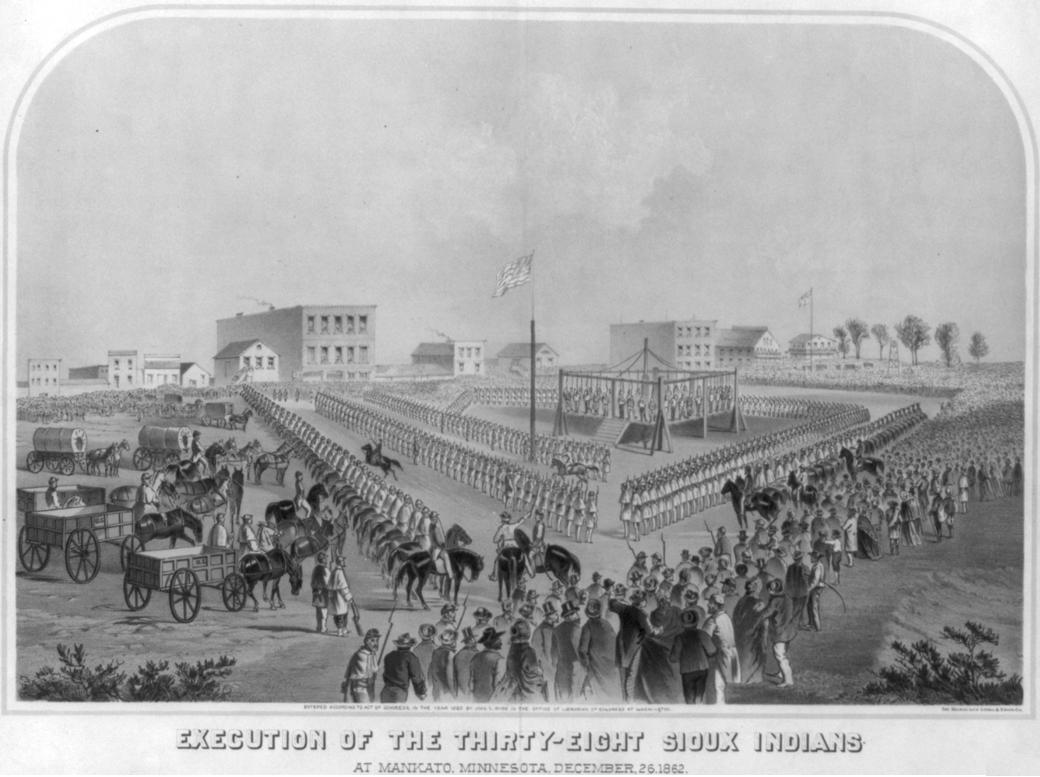
mankatomn38

1862

The largest mass execution in American history

In the summer of 1862, a number of Sioux tribes in Minnesota and the Dakota Territory rose up in a violent protest against their mistreatment by American government agents. Encroaching settlements had reduced their ability to hunt for food and promised supplies did not arrive, leaving the natives starving. On August 17, a hunting party of Sioux massacred 5 settlers, an act which encouraged a Dakota war council under Little Crow to sanction an all-out war which they hoped would drive the white man from their territory. Indian agencies were attacked, farm families were killed, detachments of troops were defeated and a number of towns were burnt to the ground. Trade on the Red River between Winnipeg and St Paul was halted and travel on the roads became too dangerous.

Because the United States was deeply involved in the Civil War, Washington was slow to send reinforcements to the area but when they arrived their numbers and firepower proved overwhelming. Bit by bit the tribes’ war-making capacity was reduced and though fighting would continue farther west, the majority of Sioux had surrendered by late September. Hundreds of their men were subjected to a far-too-speedy and ruthless trial; 303 were convicted of murder and rape and sentenced to death.

Henry Whipple, the Episcopal bishop in Minnesota, travelled to Washington to appeal for clemency but feeling among whites in the state was all for the execution of the Sioux. Politicians and generals warned that if mercy were granted, private vengeance might be the result. Abraham Lincoln personally helped whittle down the list to 38 who seemed most guilty. These men were executed at Mankato on a single gallows platform on December 26, 1862.

December 24

Home / Christmas / December 24

The feast of Saints Adam and Eve

Adam and Eve, the ancestors of the human race, were first honoured as saints in the churches of Eastern Christianity and during the Middle Ages their cult spread into the West. Though the Catholic church never officially recognized them with a feast day, popular veneration of Adam and Eve was widespread, particularly on December 24 when it was thought fitting that those responsible for the Fall of mankind be linked with the birth of the Saviour who came to redeem humanity.

Medieval dramas which told the story of Adam and Eve had as a stage prop a tree representing the Garden of Eden and the Tree of the Fruit of the Knowledge of Good and Evil. This tree was decorated with apples or round wafers representing the host of the Mass and it is this “Paradise Tree” which some historians see as a precursor to the modern Christmas tree. This link is evident when we note that as late as the nineteenth century some American and German Christmas trees had images of Adam and Eve and the Serpent underneath them. Godey’s magazine claimed “an orthodox Christmas-Tree will have the figures of our first parents at its foot, and the serpent twining itself. The apples were placed on the table on Christmas Eve to recall those through whose sin mankind first fell as well as the Virgin Mary, the new Eve.”

December 23

Home / Christmas / December 23

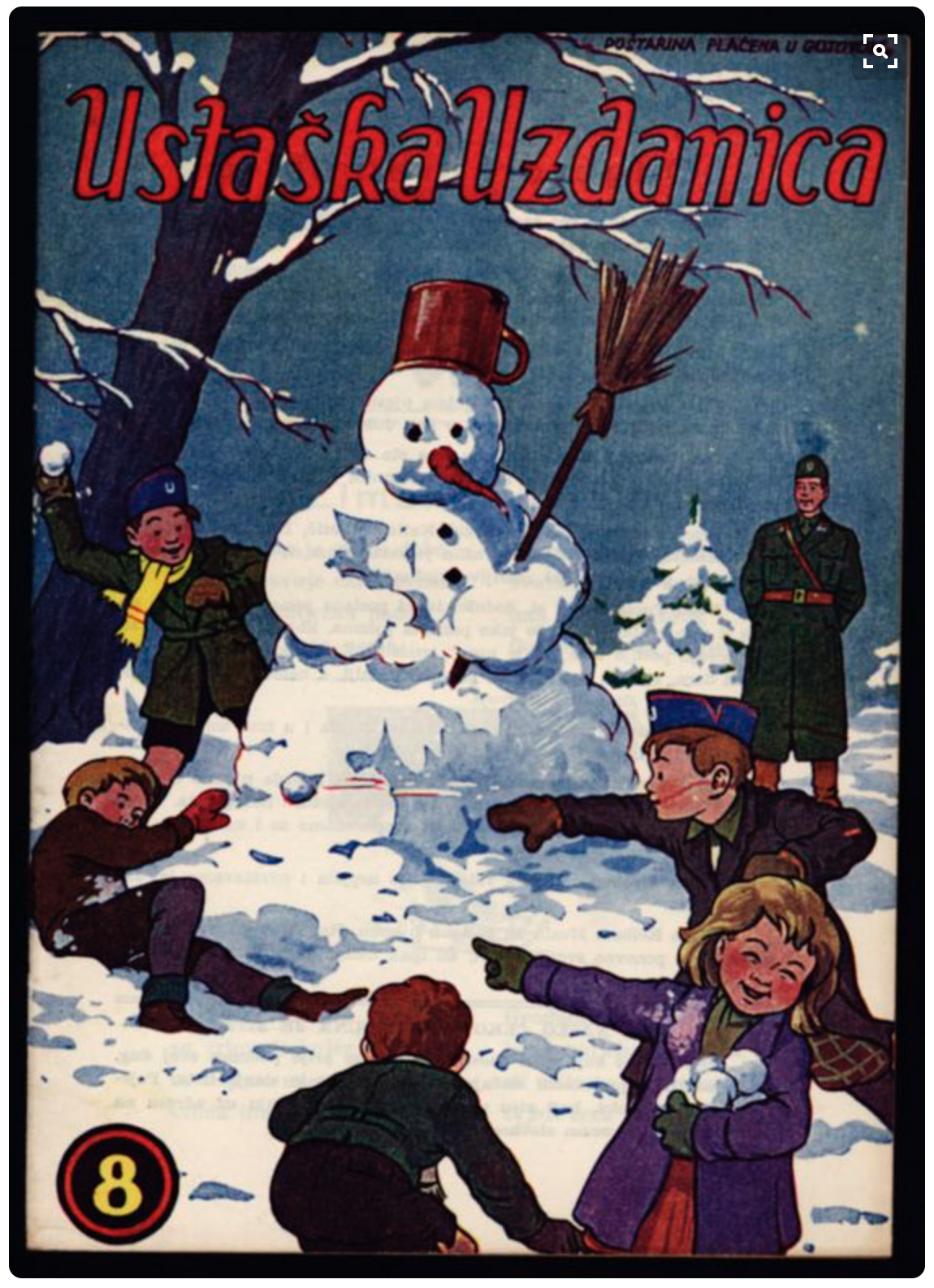
The last of our Christmas in wartime excursions presents four out-of-the-ordinary glimpses of the sacred season in the midst of bloodshed.

The first is the cover of the Ustase Youth magazine. The Ustase was a pro-Nazi Croatian movement, ultranationalist, ultra-Catholic, and fascist, which allied its region of Yugoslavia to the Germans during the Second World War. 

You are not going to see too many images of the New Year’s baby, Stalin, Chiang Kai-she, Uncle Sam, and John Bull in together in a single illustration in your lifetime. Therefore, enjoy this version from the Canadian Home Journal, December 1943 edition. 

“Christmas Greetings” come from this Finnish cavalryman at a time in the war when that nation was allied to Germany and thus was, on paper at least, at war with Canada and the United States. 

“Happy Norwegian Christmas” cry this little nissen elves as they fly the flag of Nazi-occupied Norway. Both the flag and overtly patriotic cards were banned by the Germans so this would have been an underground production.

December 22

Home / Uncategorized / December 22

Barring-out

A Christmas-time ritual and example of social inversion or “topsy-turvy”. In Britian school boys would bar the door and refuse the master entrance until ritual verses were exchanged and a holiday was granted. The usual pattern was for boys to gather weapons and provisions as Christmas drew near and then seize the school or, more often, a single classroom;  if they could hold out for a set period, usually three days, they were allowed an extension of the usual Christmas holidays or a relaxation of the normal rate of flogging. If the master broke in they were generally beaten severely or given extra tasks. 

The first mention of it comes in 1558 where it is treated as already having been an old custom. Charles Hode’s 1660 manual A New Discovery of the Old Art of Teaching Schools suggested a set of rules be drawn up whereby masters were given warning and formal demands agreed on by head boys.  The tradition in known in Scotland from 1580 and there are some seventeenth-century Irish examples.  The growing tendency to spell out student’s rights in school charters rendered it obsolete and by the nineteenth century it had virtually disappeared in England — the last recorded barrings out of the schoolmaster seems to have been in 1938 in Derbyshire and 1940 in Northumberland.

Outside of the British Isles the custom can also be seen amongst the Pennsylvania Dutch, in Belgium, Denmark, and Holland where St Thomas’s Day was a time to bar out the master until he treated them to a drink.

December 21

Home / Christmas / December 21

Wassail

The term wassail is derived from the Anglo-Saxon toast “waes hael”, or “good health” (the expected reply is “drinc-heil” or “drink well”). To wassail is to ceremonially drink someone’s health at Christmas, especially from a decorated bowl filled with a seasonal drink. The wassail bowl was traditionally filled with mulled ale or “lamb’s wool” and was adorned with ribbons. “Wassailers” often referred to those who went door-to-door at Christmas with a wassail bowl expecting a gratuity for a drink or those who expected the householder to fill the bowl at each stop.

The tradition of wassailing the apple trees or livestock is a vernerable one. In the seventeenth century the poet Robert Herrick noted: Wassail the trees, that they may bear/ You many a plum, and many a pear:/ For more or less fruits they will bring,/ As you do give them wassailing.

In order to ensure fertility for the coming year English farmers developed a number of variations on the wassail. In Devonshire, on Twelfth Night, men got out their weapons and went to the orchard. Selecting the oldest tree, they would form a circle and chant:  Here’s to thee, old apple tree/ Whence thou mayst bud and whence thou mayst blow/ And whence thou mayst bear apples enow:/ Hats full, caps full,/ Bushels, bushels, sacks full,/ And my pockets full too!/ Huzza! Huzza!

After drinking some cider the men would discharge their (unloaded) weapons at the tree and head home. Traditionally the women of the house were to deny the men entrance until they had guessed what sort of roast was being prepared for them. The man with the correct guess presided over the evening’s entertainment.  In other  parts of England fruit trees were wassailed by being sprinkled with cider, beaten with sticks and bidden in rhyme to bear well. In Cornwall the song was sung with a cider jug in one jug in one hand and a branch in the other. In south Hampshire they threatened the fruit tree: Apple tree, apple tree/ Bear good fruit,/ or down with your top/ And up with your root.

This threatening of the orchard is reminiscent of a custom in Romania. The farm husband and wife will go through the orchard at Christmas, she with her hands covered in dough and he with an axe. The man will go from one barren tree to another, each time threatening to cut it down. Each time, the wife will plead for the tree by saying:  “Oh no, I am sure that this tree will be as heavy with fruit next spring as my fingers are with dough this day.”

In the West Country it was also customary to wassail the oxen: on Twelfth Night men and women went into the stalls. They drank from the wassail bowl and took a cake from a basket decorated with greenery and placed it the ox’s horns. If the ox remained quite it was considered good luck. In Hereford, a cake was stuck on the horns of the ox while the oldest person present chanted: Here’s to thy pretty face , and to thy white horn,/ God send thy master a good crop of corn,/ Both wheat, rye and barley, of grains of all sort,/ And next year if we live we’ll drink to thee again. The rhyme was repeated in chorus, then the oldest threw a pint of cider in the beast’s face. If he tossed the cake forward it was a good sign.

In Sussex and Hertfordshire we also have mention of wassailing the bee-hives.

December 20

Home / Christmas / December 20

Beatings at Christmas

There are a number of different types of thrashings connected with the Christmas season in many countries over the centuries. The first is a threat of chastisement and is connected with the switches and rods carried by gift-bringers and their helpers. In the sixteenth-century Germany the Christmas bundle of presents included: “things that belong to teaching, obedience, chastisement and discipline, as A.B.C tablets, Bibles and handsome books, writing materials, paper, etc. and the Christ-rod”. The first book in the United States to include a picture of Santa Claus, the 1821 Children’s Friend, has the gift-giver state that he was happy to reward good girls and boys but “[W]here I found the children naughty,/In manners rude, in temper haughty,/ Thankless to parents, liars, swearers,/ Boxers, or cheats, or base tale-bearers, I left a long, black birchen rod,/ Such as the dread command of GodDirects a parent’s hand to use/ When virtue’s path his sons refuse. The threat of corporal punishment was inherent in the role played by such figures as Black Pete, Krampus, Cert or Père Fouettard (Father Switch) who accompany the gift-giver.

 On Childermas, December 28, which commemorates the Massacre of the Innocents by King Herod it was once customary in England to beat children. The explanation given in the seventeenth century was that that the memory of Herod’s crime “might stick the closer; and, in a moderate proportion, to act over the crueltie again in kind” but anthropologists have noted that ritual beatings are more likely descended from pagan rituals of good luck than punishment. An old German custom called “peppering” saw children beating their parents and servants beating their masters with sticks while asking in verse form for a treat. An equally venerable tradition in Normandy allowed children to give a thrashing to those who stayed too long in bed on December 28. In Wales on St Stephen’s Day, the practice was called “holming” or “holly-beating” — the last person to get out of bed was hit with holly sprigs and made to act as servant to the rest of the family. Sometimes the purpose of the holming was to draw blood. In parts of Scotland on New Year’s Eve boys beat each other with holly branches in the belief that for every drop of blood shed a year of life was saved for the victim. In Sweden it was once customary for the first-riser on Christmas Eve to give other family members small bundles of twigs which they would use to beat each other in the spirit of imparting vitality.

It is worth noting that fruit trees also came in for ritual beatings at Christmas. See tomorrow’s post on“Wassailing”.

December 19

Home / Christmas / December 19

The Atheist Critique

Not everyone likes Christmas. Aggressive atheists are particularly vexed by the season in which the claims of Christianity are most publicly on display and held in good repute. The most famous infidel of the late 19th century was Robert Ingersoll (1833-99) who lectured frequently on the virtues of unbelief. Here is his “Christmas Sermon” of December 19, 1891. His notion that Christmas was borrowed from pagan sun worship is no longer taken seriously by historians but it still lives on the internet.

The good part of Christmas is not always Christian — it is generally Pagan; that is to say, human, natural.

Christianity did not come with tidings of great joy, but with a message of eternal grief. It came with the threat of everlasting torture on its lips. It meant war on earth and perdition hereafter.

It taught some good things — the beauty of love and kindness in man. But as a torch-bearer, as a bringer of joy, it has been a failure. It has given infinite consequences to the acts of finite beings, crushing the soul with a responsibility too great for mortals to bear. It has filled the future with fear and flame, and made God the keeper of an eternal penitentiary, destined to be the home of nearly all the sons of men. Not satisfied with that, it has deprived God of the pardoning power.

And yet it may have done some good by borrowing from the Pagan world the old festival called Christmas.

Long before Christ was born the Sun-God triumphed over the powers of Darkness. About the time that we call Christmas the days begin perceptibly to lengthen. Our barbarian ancestors were worshipers of the sun, and they celebrated his victory over the hosts of night. Such a festival was natural and beautiful. The most natural of all religions is the worship of the sun. Christianity adopted this festival. It borrowed from the Pagans the best it has.

I believe in Christmas and in every day that has been set apart for joy. We in America have too much work and not enough play. We are too much like the English.

I think it was Heinrich Heine who said that he thought a blaspheming Frenchman was a more pleasing object to God than a praying Englishman. We take our joys too sadly. I am in favor of all the good free days — the more the better.

Christmas is a good day to forgive and forget — a good day to throw away prejudices and hatreds — a good day to fill your heart and your house, and the hearts and houses of others, with sunshine.

December 18

Home / Christmas / December 18

Christmas Baking

Baking has become an essential part of the celebration of Christmas for a number of reasons. Historically it relates to the midwinter veneration of grain and grain products in hopes that the next year’s harvest will be bountiful. We can see this in the eastern European custom of placing wheat and hay about the house, even under the table-cloth, on Christmas Eve and in the widespread practice of preparing a grain porridge, such as kutya or frumenty, at Christmastime. This notion carries over to baked goods, especially bread. In the nineteenth century German peasants believed there was particular power in bread baked at Christmas: thrown into a fire, it would quench the flames; given to cattle, it would keep them healthy. Similar beliefs attached to the oplatek wafer in Slavic Europe and Christmas cake in Flanders. As a result special breads and other baked goods became identified with Christmas in many countries: the German Christstollen which was said to represent the swaddling clothes of the baby Jesus; the Greek christopsomo which is often decorated with a cross; the medieval English mince pies which were made in the shape of a crib and adorned with a dough figure of the Holy Child; the Belgian cougnou or pain de Jesus in the shape of the baby Jesus; the Ukrainian kolach, which is sometimes stacked in threes as a reminder of the Trinity. Many cakes are baked in the shape of wreaths and circles to symbolize everlasting life.

 Christmas-tide is a feast and a feast means food and abundance. Christmas baking is therefore an expression of indulgence and the celebration of a full pantry after a year’s hard work. This is a time when the richest ingredients and most costly spices can be employed with a guilt-free conscience: the effort and expense lavished on Christmas baking is unmatched by food preparation at any other time of year. The weeks of Advent are scarcely time enough for the marshalling of resources — flour, fruit, nuts, butter, cream, chocolate, alcohol, sugar, etc., etc. — and the preparation of the cakes, cookies, breads and pies that are consumed in such quantities. It is little wonder than an Irish term for Christmas Eve is Oidhche na ceapairi, “Night of Cakes.” In Norway no less than seven kinds of cookies must be prepared.

Baking at Christmas is also a community activity. Most families will prepare at least some goodies together, as in the custom of the Stir-Up Sunday pudding, and on many occasions members of a whole village, church or other group will be involved. Eating Christmas baking is, of course, a communal activity as well, binding the family together in present enjoyment and often linking them to those who are dead or absent. The oplatek wafers of Poland are shared ritually with those around the table but some are reserved for those away from the home; in many countries families leave bread out for the spirits of those departed or for the Holy Family. Sharing with those less fortunate is often part of the Christmas tradition: either by setting a place for the unexpected visitor or by giving baked goods away — the “soul cakes” of England and the French pain calendeau are examples of charity foods.