December 22

Home / Today in History / December 22

screen-shot-2016-11-28-at-12-04-59-pm

1095 Birth of Roger II of Sicily

The Normans were a scurvy crew. Essentially Vikings with a haircut, they spread from the territory they had extorted from the King of France in 911 all across Europe, North Africa and the Middle East. They were banditti, mercenaries, and crusaders, eventually setting up kingdoms in England, Ireland, southern Italy and the Levant. The most glorious of these was the Kingdom of Sicily, wrested from the Muslims who had invaded the island in the 9th century. For a couple of glorious centuries the Normans ran a nation blending the best of Catholic, Byzantine, Jewish, Lombard and Muslim art, law, architecture and statecraft. Its capital at Palermo was the largest city in Europe and visitors today still marvel at churches such as the Cappella Palatina featured above.

300px-arabischer_maler_der_palastkapelle_in_palermo_002

The Capella was commissioned by the first king of Sicily, Roger II, whose birthday is today. His state was multi-relgious and tolerant and to his court came scholars, scientists and artists from around the Mediterranean. His armies and fleets warred against the Byzantine empire and against Arab powers, from whom he successfully conquered a section of the North African coastline. He died in 1154.

December 21

Home / Today in History / December 21

600px-sestertius_-_vespasiano_-_iudaea_capta-ric_0424

69 AD Vespasian becomes Roman Emperor

The Julio-Claudian family had ruled Rome since 31 BC and in that century only the dynastic founder Caesar Augustus was a success. His heir Tiberius started off well but became a corrupt and murderous tyrant. He was followed by Caligula, a corrupt and murderous madman. Next came Claudius, a well-meaning idiot poisoned by his wife to pave the succession of her son Nero. Nero’s crimes include the murder of his step-brother, mother, two wives and a host of Christians. In the year 68 the armies of Rome rebelled. Nero committed suicide, lamenting that Rome was losing a great poet in him, but no clear successor emerged. This brought about The Year of Four Emperors, as general after general claimed the imperial crown and was defeated by the next army leader. So hail and farewell to Vitellius, Otho, and Galba in short order. Surviving this round of civil wars was Titus Flāvius Caesar Vespasiānus Augustus, the founder of the Flavian dynasty.

Vespasian came from a new-money family with few influential connections. He rose slowly through political office but did better as a general, winning fame in the invasion of Britain and later in putting down the Jewish revolt in 68. The coin above reads “Judea Conquered”. Watching the civil war back in Rome, Vespasian believed that he should try his luck and he moved his army to seize the Egyptian grain supply which fed Rome while other armies of his supporters moved on the capital. On this date in 69 the Senate declared him Emperor.

Vespasian is known as a sane man and careful with money. His tax on urine (used in the tanning business) prompted the charge that an emperor should be above making money out of piss. His reply was pecunia non olet — money has no smell — and to this day urinals in France are called vespasiennes. Loot from Israel and the Jerusalem Temple helped him build the Colosseum, with the help of thousands of Jewish slaves who were killed in celebration of the arena’s opening.

When he was dying, aware that defunct Roman emperors were routinely deified, he cried, “Oh dear. I think I’m becoming a god.”

December 20

Home / Christmas / December 20

Trapped inside the doomed “cauldron” at Stalingrad, Wehrmacht pastor Kurt Reuber drew a charcoal picture of the Madonna and Child on the back of a map and labelled it “Life, Light and Love, Christmas in the Cauldron Fortress Stalingrad 1942”. He took it from bunker to bunker to cheer the troops at Christmas 1942. Reuber described the effect on displaying it:

When according to ancient custom I opened the Christmas door, the slatted door of our bunker, and the comrades went in, they stood as if entranced, devout and too moved to speak in front of the picture on the clay wall. …The entire celebration took place under the influence of the picture, and they thoughtfully read the words: light, life, love. …Whether commander or simple soldier, the Madonna was always an object of outward and inward contemplation.

The work was sent out on the last transport plane to leave the siege but the artist was left with the rest of the Sixth Army to fall captive to the Soviets. Reuber died in a Russian prisoner of war camp in 1944. The picture was suppressed by Nazi officials during the war but is now on display in Berlin’s Kaiser Wilhelm Memorial Church.


December 18

Home / Christmas / December 18

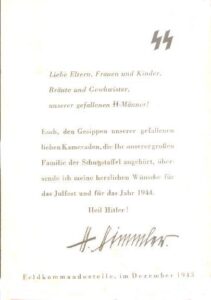
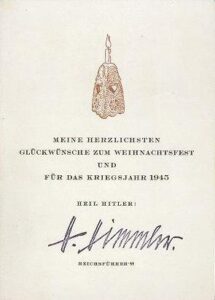
A couple of Christmas cards from the head of the SS, Heinrich Himmler. Note that in the 1943 card he refers to the holiday by its name “Julfest” but in the next year he uses the usual German name for Christmas “Weihnachten”. The graphic in the 1944 card is the “Julleuchter”, a candle holder with Nazi symbols, often made in concentration camps.

December 17

Home / Today in History / December 17
440px-mohamed_bouazizi

2011 Self-immolation  of Mohamed Bouazizi

What makes man want to die by setting himself on fire? In the case of  a particular Tunisian street vendor, it was a life of grinding poverty made worse by police harassment and extortion.

Mohamed Bouazizi was born in 1984 to a poor family in Sidi Bouzid in rural Tunisia. Unable to finish high school, he supported himself and his family by buying vegetables on credit and then selling him on the street from his wheel-barrow. On a number of occasions he had run-ins with the police who would confiscate his goods or demand bribe money, actions that threatened his very precarious livelihood. On the morning of December 17, 2010, Bouazizi was allegedly harassed by police who slapped him around and confiscated his produce and electronic scale. He attempted to protest to local officials who refused to hear him out. At this point he threatened to set fire to himself if his scale were not returned and when it was not, he purchased some gasoline. He returned to the square outside the governor’s offices, poured the gas over himself and set it alight. Onlookers tried to save him but the burns were so intense that he remained in a coma 18 days before he died of his injuries.

His actions prompted widespread protests in Tunisia, where disgust with corruption and autocracy had reached a boiling point. The ruler Ben Ali was forced to flee to Saudi Arabia and a wave of  popular discontent known as the Arab Spring broke over the Middle East and North Africa. Governments fell or were forced to make concessions to the people. Bouazizi was treated as a hero in the West; streets were named after him; human rights prizes were awarded posthumously and films celebrated his actions. Alas, the Arab Spring flourished only briefly and, before too long, tyranny and corruption were the norm again.

December 16

Home / Today in Church History / December 16
525

The Feast of St Adelaide of Burgundy (931-999).

Even princesses need patron saints.

The actual tangled lives of the royal families of medieval Europe are not far different from episodes in The Game of Thrones, though with fewer dragons. Adelaide was born into the ruling family of Burgundy and was married at age 15 to the head of a rival kingdom, Lothair II. When Lothair was poisoned, his murderous successor tried to make the royal widow marry his son but Adelaide refused and was thrown into prison. She managed to contact Otto, King of the Germans, who not only secured her release but married her. In 962 Otto was crowned Holy Roman Emperor and Adelaide became an empress. After Otto’s death she experienced difficulties with her daughter-in-law and was forced into seclusion on several occasions but spent much time in charity, founding monastic institutions and sponsoring attempts to Christianize pagan barbarians of the north.

Adelaide, because of her position and many adventures, is the patron saint of (in alphabetical order) abuse victims; brides; empresses; exiles; in-law problems; parenthood; parents of large families; princesses; prisoners; second marriages; step-parents; widows.

December 15

Home / Today in History / December 15
eichmann_adolf

1961

Adolf Eichmann verdict delivered

Otto Adolf Eichmann was born in Germany in 1906 but grew up in Austria where he attended the same high school that Adolf Hitler had attended 17 years before. He never graduated and worked in a series of undistinguished jobs until in 1932 he joined the Austrian branch of the Nazi Party and was assigned to the paramilitary Schützstaffel or SS. He returned to Germany in 1933 and was transferred to the SD, the Security Service; here he was sent to Berlin and worked for the Jewish Department, studying Zionist organizations and learning Yiddish and Hebrew.

By this time, the Nazis had achieved power and were using strong-arm methods to encourage the country’s Jewish population to emigrate; over half of Germany’s Jews would do so before 1939. As part of his duties Eichmann travelled to British-mandated Palestine (much of which is now Israel) to see if that territory would be suitable for the reception of those leaving Europe. He spoke with local Jewish authorities and expressed the fear that sending too many German Jews to Palestine would result in them forming an independent state.

When war began in 1939, Nazi policy shifted to the mass deportation of Jews to the east into territory Germany had conquered. Eichmann was placed in charge of the Central Office for Jewish Emigration, transporting of Czech, Austrian and German Jews into what had been Poland, a task which brought him into conflict with other Nazi officials who thought that the rail system could be put to better use or who wished to relocate ethnic Germans into that area. Some Jews were being forced into overcrowded and unsanitary ghettos while farther east tens of thousands of others were being murdered out of hand. After the 1942 Wannsee Conference in which Eichmann took part, it was decided to exterminate the Jewish population of Nazi-dominated Europe. This required massive construction of a constellation of death camps and coordination of the transport system. Eichmann seems to have had little influence on policy but played a key administrative role in facilitating the destruction of European Jewry.

With the defeat of Germany in 1945, things became dangerous for former SS officers but Eichmann remained safe under a series of false identities. In 1950, with the help of Catholic priests with Nazi sympathies, he obtained papers and transportation that allowed him to emigrate to Argentina under the name of Ricardo Klement. There his family joined him and he prospered in Buenos Aires as an employee of the local Mercedes-Benz firm. By 1957 the Israeli government began to be aware that Eichmann might be in Argentina, whose government was reluctant to extradite German war criminals. In 1960 a team of Israeli agents kidnapped Eichmann on his way home from work and flew him to Israel for trial.

Despite Eichmann’s argument that he was not morally responsible for the death of those in his charge and that he was merely following orders, he was found guilty of crimes against humanity, war crimes and membership in illegal organizations. He was hanged in 1942.

December 14

Home / Today in History / December 14

images-1

2012

The Sandy Hook massacre

On the morning of December 14, 2012 in Sandy Hook, Connecticut, Adam Lanza killed his mother, shooting her to death with a .22 rifle, one of the many guns she owned. He then drove to Sandy Hook Elementary School where he shot his way through the glass doors. In the next five minutes he fired 156 shots, killing 20 small children, none older than 7, six school staff and, finally, himself. Police were on the scene almost immediately but by the time they entered the building, the shooting had stopped. Two teachers survived their wounds.

Lanza was a mentally ill young man, probably schizophrenic as well as suffering from other disorders including a serious case of anorexia that may have affected his cognition. There were neither drugs nor alcohol in his system, and his brain was free of physical abnormality. He had briefly attended the school years before but no other link to the killings was found. He was obsessed with mass murder, downloading videos about the killings in Columbine, Norway and the Amish school in Pennsylvania. Lanza seems to have spent years compiling a spreadsheet listing around 500 mass murderers and the weapons they used.

The Sandy Hook School was demolished and a new one built; his house was deemed unsaleable because of the notoriety and was acquired by the city. Calls for gun control intensified after the shooting and unsuccessful lawsuits were launched against the gun’s manufacturer and merchandiser.

December 13

Home / Today in History / December 13
520px-nasa_apollo_17_lunar_roving_vehicle

1972 The last men on the moon

In 1957 the Soviet Union launched the world’s first artificial satellite, Sputnik I, and in 1961 sent the first man, Yuri Gagarin, into space. These developments spurred the United States into plans to further develop its missile capabilities and, in the words of President John Kennedy: “I believe that this nation should commit itself to achieving the goal, before this decade is out, of landing a man on the Moon and returning him safely to the Earth. No single space project in this period will be more impressive to mankind, or more important for the long-range exploration of space; and none will be so difficult or expensive to accomplish.”

The Space Race was on.

The American’s Vanguard, Mercury, Gemini and Apollo programs honed the American drive toward the moon while the Soviets pursued their Vostok, Voshkod and Soyuz plans. The Russians again were first to put a woman in space and to conduct activities outside of a space craft. Both sides suffered casualties in launch and voyage accidents; at least 14 astronauts and cosmonauts died in the race to the moon.

On July 21, 1969, after a three-day voyage, Apollo XI sent down its Lunar Excursion Module piloted by Neil Armstrong who became the first man on the moon. Five more successful flights were made before the attention of the Americans and Russians turned to orbiting platforms — space stations. The last men on the surface of the moon to date were Eugene Cernan and Harrison Schmitt of Apollo 17 in 1972.