December 2

boats_on_thethames

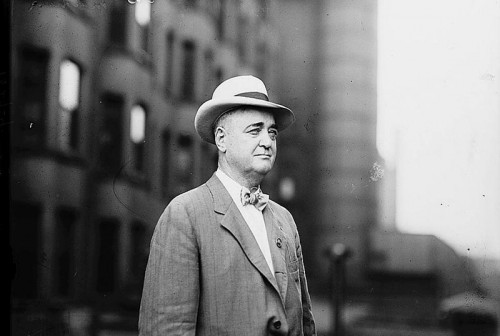
1697 Dedication of the new St Paul’s Cathedral.

There has been a cathedral church dedicated to St Paul in London ever since the 600s. As fire and the ravages of time brought these buildings down there was always a desire to see them rebuilt. The fourth cathedral to occupy the present spot was begun after fire destroyed the third version in 1087. This was a massive stone structure that was completed only in 1314, in the Gothic style. This meant flying buttresses supporting tall walls filled with stained glass windows, pointed arches, imaginative decoration and a towering spire, 490 feet high. In 1561, shortly after the beginning of Elizabeth’s reign and the restoration of Protestantism, a lightning strike destroyed the spire. The building remained a centre of London life where far more than religious services were carried on. Critics complained that people would use “the south alley for usury and popery, the north for sorcery, and the horse fair in the midst for all kinds of bargains, meetings, brawlings, murders, conspiracies, and the font for ordinary payments of money.” Little wonder that one of the cathedral’s paid staff was the “dog-whipper” whose job it was to control the noise of animals in the church.

In the seventeenth century John Donne was the Dean of the cathedral and preached there often (go here for a virtual reconstruction of his Gunpowder Day sermon of 1622: http://vpcp.chass.ncsu.edu ). After the Puritans won the English Civil War the building was used as a barracks and stable. Its final disgrace came in 1666 when the Great Fire of London destroyed the timber-arched edifice. A new structure was started under the supervision of Christopher Wren. The first stone was laid in 1675 and the building was declared open for use on this day in 1697 but it took another 14 years before it was completed.

Wren’s building was massive with a dome that dominated the eastern prospect of London before the rash of grotesque skyscrapers marred the view in the late twentieth century.
December 1

Home / Today in History / December 1

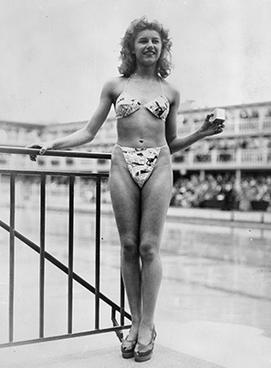
1927 Birth of the first bikini model

Micheline Bernardini was an 18-year-old nude dancer at a Paris nightclub when she was chosen by designer Louis Réard to showcase his two-piece bathing suit which he dubbed “bikini” after a recent atomic bomb test site. Réard had been unable to find a reputable runway model to display his suit so he cast an eye on one for whom wearing clothes  was an exciting novelty.

Pictured at a public swimming pool in July 1946, Mademoiselle Bernardini is holding a little box into which her entire costume could be packed.

Beard’s creation was by no means the first two-piece bathing suit but its extreme brevity, particularly on the buttocks, and the clever name choice caused a sensation and spawned a whole industry.

La Bernardini later moved to Australia where she worked at the Tivoli Theatre, Melbourne. She married an American soldier and moved to the United States.

November 30

Home / Christmas / November 30

General Lee and Santa Claus was a children’s book of 1867 written by Louise Clack. It is set in the post-Civil War American South where three little girls, Lutie, Birdie and Minnie (the latter still a hardened rebel because of the memory of her father who died in the Confederate army) wonder at the absence of Santa Claus during the war years. They write to General Robert E. Lee as “the goodest man who ever lived” to ask him “whether Santa Claus loves the little rebel children, for we think that he don’t; because he has not come to see us for four Christmas Eves.” General Lee favours them with the following reply: in fact Santa Claus does love the children of the South but in 1861 Lee himself stopped Santa from delivering any toys to the Confederacy. He said: “Santa Claus, take every one of the toys you have back as far as Baltimore, sell them, and with the money you get buy medicines, bandages, ointments and delicacies for our sick and wounded men; do it and do it quickly — it will be all right with the children.” And Santa did so for the duration of the war.

General Lee and Santa Claus is remarkable for its very early connection of American politics and Christmas and as a Southern counterpoint to the Civl War cartoons of Thomas Nast who had made Santa Claus into a firm supporter of the Union. Clack’s depiction of little rebel girls desolate at their desertion by Santa Claus shows how important a figure he had become in the imaginations of American children. The American Civil War did much to accelerate the reception of Christmas in the U.S.A. as a holiday representing homecoming and family

November 29

Home / Christmas / November 29

Italians were not enthusiasts of the Christmas card craze early in the 20th century but I do have two examples from their country as it participated in World War I.

The first is a rather harmless attempt to evoke seasonal jollity by pairing children and a piece of artillery.

The second is more heart-felt. It shows an Italian woman in chains, presumably a metaphor for those of Italian stock languishing under the rule of the Austro-Hungarian empire, and a charge by the famous feather-helmed Bersaglieri infantry. Above them an angel signals divine approval of the war effort and the caption reads “Christmas of glory”.

November 28

Home / Christmas / November 28
1859 Death of Washington Irving
Washington Irving, born in 1783 just after close of the American Revolution, was named after that conflict’s hero. Although trained as a lawyer Irving made a name for himself as the first great American writer. His 1809 mock historical Diedrich Knickerbocker’s History of New York from the Beginning of the World to the End of the Dutch Dynasty introduced Americans to Saint Nicholas as a Christmas gift-bringer, featuring the saint winging his way over treetops in a wagon, smoking a pipe and “laying his finger beside his nose” before flying off — all extremely influential images in the development of the figure of Santa Claus.
The Sketch Book of Geoffrey Crayon, Gent., (1819-20) contained “The Legend of Sleepy Hollow” and “Rip Van Winkle”, two beloved short stories, but also five sketches about Christmas at Bracebridge Manor in England. His account of the Squire of Bracebridge’s attempts to recreate an old-fashioned Christmas complete with feudal hospitality and a procession with a boar’s head fascinated both Americans and Englishmen and helped lead to a revival of interest in Christmas at a time when the holiday was under attack from public indifference and the Industrial Revolution.
Irving never married, remaining true to the memory of his 17-year-old sweetheart who died of tuberculosis.

November 27

Home / Christmas / November 27

One day away from Advent, our look at Christmas in wartime takes us to Nazi Germany. If Hitler’s National Socialists (and especially the SS) had had their way Christmas would have been replaced by a pagan Julfest with festivities on the winter solstice instead of December 25. However, Christmas was too firmly rooted in German culture to be attacked so directly. Instead the Nazi state tried a campaign of bait and switch, offering material and ceremonies that looked like Christmas but which were really subversive of its Christian essence.

This is mostly clearly in evidence in an Advent calendar sent out to German families to use in the run-up to Christmas Day. There were no stories of the baby Jesus; rather, a forest-born Golden Child was featured. No angels on the tree but swastika-shaped ornaments; St Nicholas was replaced by Knecht Ruprecht who was linked in the text to Nordic mythology.

Note the whirling sun which evokes the solstice and the swastika.

The caption says “Soon Ruprecht will enter the house and empty his sack for me. I gave his white horse hay which he likes.”

The 1943 edition of the Advent calendar shows German soldiers mourning at the grave of a fallen comrade surrounding by vignettes of Nazi conquests: burning villages in Russia, sinking merchantmen in the Atlantic, grapes from France, etc. The next year, the last Christmas of the war, this advent calendar kept the image of the soldiers but removed the wreath of victories celebrating territories the Germans had been driven out of.

November 26

Home / Uncategorized / November 26

1853 Birth of a pistolero

Who would have thought that one of America’s most iconic Western gunmen was born in Canada? Bartlomew William Barclay “Bat” Masterson first saw the light of day on this date in 1853 in the Eastern Townships of Quebec, an English-speaking area of that largely francophone province. His Irish immigrant family moved to the USA and settled in Kansas.

In his late teens Bat took up buffalo hunting and while search for a herd of bison in traditional Indian territory in 1874 took part in the famous Second Battle of Adobe Walls. He, other hunters, and a wagon train of settlers found themselves under siege at a trading post in the Texas panhandle when they were attacked by a party of Commanche, Cheyenne and Kiowa warriors, 700 strong. After 5 days they were rescued by cavalry and they abandoned the post to be burned by the vexed indigenes.

Masterston then scouted for the Army for a time, killed a man in a gunfight over a woman, and settled in Dodge City where he became a lawman. His handiness with a pistol led to many a posse, the capture of outlaws, and association with some of the legends of the West. Bat was friends with Buffalo Bill Cody, Wyatt Earp, Soapy Smitth, and Doc Holliday.

In the 1880s Masterton dabbled in journalism, gambling, and theater ownership; his taste in women ran to other men’s wives, circus performers, and dance-hall girls. In 1902 he moved to New York where his colourful turns of phrase, love of boxing, and exciting adventures in the West led to him becoming a journalist. He became friends with Theodore Roosevelt who always had a soft spot and a government patronage job for a manly man. Masterton was also a timekeeper for some high-stakes boxing matches. He died, diabetic and overweight in 1921 in New York.

Though not as great a subject of popular culture as Buffalo Bill or Wyatt Earp, the figure of Bat Masterton appears in a number of movies, but most notably in an eponymous  television series starring Gene Barry.

November 25

Home / Today in History / November 25

The Ukrainian Partisan Army was formed in the midst of World War II to fight for an independent nation. As such it was opposed to the Soviet Red Army, the Poles, and the Germans, though it occasionally collaborated with the Wehrmacht is combating Communist forces. The UPA was guilty of ethnic cleansing against Polish civilians and many of its members had earlier aided the Germans in rounding up Jews.

After end of the war, it continued to battle for years as an underground army against the USSR. These Christmas cards emphasize their religious allegiance to Orthodoxy in the face of godless Bolshevism. By 1953 military action and infiltration by the Soviet secret police had ended the UPA’s effectiveness and crushed hopes of an independent Ukraine.

November 24

Home / Today in Church History / November 24

1572 Death of John Knox

John Knox was a driving force in the Scottish Reformation which succeeded in replacing the Catholic Church in Scotland with a stern form of Calvinist piety.

Knox was born c. 1510 to a merchant’s family in Haddington, Scotland and by his early 20s had become a Catholic priest. He fell under the influence of Protestant reformer George Wishart and assisted him in his preaching campaign. Wishart was arrested and executed as a heretic in 1546 on the orders of Cardinal David Beaton. Shortly thereafter Beaton was assassinated and Knox joined the killers in their refuge in St Andrew’s Castle, becoming their chaplain. The Scottish Regent, Marie de Guise, mother of the child-queen Mary, called in the support of the French army to take the castle. Knox and other prisoners were condemned to be galley slaves but he was released in 1549 and went into exile in England. There he became a preacher at the court of Edward VI who was attracting Protestant thinkers and clergy from around Europe.

When in 1553 Edward VI was succeeded by his half-sister, the very Catholic Mary Tudor, Knox had to go into exile again. He fled to the Continent where he eventually took refuge in Geneva, then under the sway of John Calvin. By 1558 Knox and other Marian exiles had decided that it was legitimate for persecuted Christians to rise up against a religious oppressor. He put a special spin on his doctrine of resistance making it especially applicable to female rulers.

Knox had found himself persecuted by women in power – Marie de Guise in Scotland ruling on behalf of Mary Queen of Scots, Mary I (Blood Mary) in England, and Catherine de Medici in France. He proclaimed in his First Blast of the Trumpet Against the Monstrous Regiment of Women that philosophy, the Bible, and Nature itself testified against the reign of females. Unfortunately for Knox, the book appeared just as a Protestant queen, Elizabeth I, came to the English throne. Elizabeth was justifiably vexed at Knox who did not recant but only grudgingly admitted that occasionally God made an exception to the rule. His name was thereafter a dirty word at the English court and helped to discredit the hotter sort of Protestants in the eyes of the English government.

Back in Scotland Knox rejected the religious toleration proposed by Mary Queen of Scots and called for her overthrow. He was the intellectual foundation of the Reformation imposed by the Scottish nobility and its loudest voice until his death in 1572.

November 23

Home / Christmas / November 23

In today’s image a French soldier of World War I confronts the Hun with a piece of artillery. Its resemblance to the traditional Yule log-shaped Christmas dessert, gives us the caption “la buche de noël”.

The “75” on the cannon tells us this is the justly-famous “French 75”, a rapid-firing, highly-accurate weapon with a hydro-pneumatic recoil device.

So famous was the gun that a cocktail was named after it. To make a “French 75” mix 2 ounces of gin with a half-ounce of simple syrup and a half-ounce of lemon juice. Shake, pour over ice and add 5 ounces of champagne. Serve in a highball glass.