When legal threats by the Freedom From Religion Foundation forced the Minnesota town of Wadena to take down its traditional nativity scene in 2015, disappointed citizens responded by turning the township into an orgy of crèches. A local movement sprang up to replace the single banned nativity scene with hundreds of them in businesses, offices and private yards. The mayor, who had reluctantly yielded to the FFRF demand, put up eight displays in front of his own house
Author: gerryadmin
The wisdom of Homer Simpson
On April Fools’ Day, it seems appropriate to heed the words of the Sage of Springfield. Today’s lesson:
And how is education supposed to make me feel smarter? Besides, every time I learn something new, it pushes some old stuff out of my brain. Remember when I took that home winemaking course, and I forgot how to drive?
March 30
Spiritual Baptist/Shouter Liberation Day
The holiday in the Caribbean nation of Trinidad and Tobago commemorates the repeal on March 30, 1951, of the 1917 Shouter Prohibition Ordinance that prohibited the activities of the Shouter or Spiritual Baptist faith.
When West African slaves were imported to the American hemisphere, they often clung to many of their traditional religious practices. Sometimes these customs were kept alive in secret, and sometimes by grafting them on to Christian elements. In Catholic countries hybrid folk religions called candomble, orisha or santeria developed. In Protestant countries African ecstatic dancing, prophecy and reception of the Holy Spirit in extravagant ways resembled certain Methodist or Shaker devotions. The Spiritual Baptist sect arose on some British West Indian islands and included “catching” of the Spirit, sanctified shouting, elaborate costumes and wonderfully catchy music.
Colonial officials were worried about the potential for unrest in these services and banned them in 1917, saying: “It is not only the inconvenience caused by the noise which they make that has given rise to this legislation, but also the fact that from the information that has been received, the practices which are indulged in are not such as should be tolerated in a well-conducted community”.
The abolition of this act which allowed the sect, whose followers probably number in the hundreds of thousands, to flourish again, is celebrated on this day on Tobago.
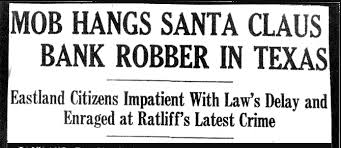
The Santa Claus Bank Robbery
On December 23, 1927 Santa Claus robbed the First National Bank in Cisco, Texas. Dressed as St. Nick, Marshall Ratliff and three undisguised companions looted the bank and took hostages but were greeted by police and heavily-armed townspeople when they emerged from the building. In the shoot-out that followed, two officers and a bandit were mortally wounded. Though Ratliff and his two remaining partners temporarily escaped after a series of car-jackings and hostage takings, they were forced to abandon the stolen money and were all rounded up within a week.
The erstwhile Santa, who killed again in a failed escape attempt, was eventually taken from his jail cell by an angry mob and lynched. A piece of the rope used in the impromptu hanging is on display in the Callahan County Courthouse in Baird, Texas.
Shoes and Christmas
Shoes have played a number of roles in Christmas observances around the world. The most common dates from the Middle Ages — the placing out of shoes on St. Nicholas Eve or Christmas Eve or Epiphany Eve so that the Gift-Bringer can fill them with treats or gifts. In many European countries it is essential that these shoes be freshly-polished if they are to be used in this way. These same shoes often hold grass or grain for the Gift-Bringer’s animals. A related use is to place one’s letter to Santa or other Gift-Bringer in a shoe so that he will know what to bring for a Christmas present.
In Greece, some people burn their old shoes during the Christmas season to prevent misfortunes in the coming year while others burn them to prevent the monstrous kallikantzaroi from coming down the chimney to torment the family. In Scandinavian countries it is believed that shoes placed side-by-side on Christmas Eve will prevent a family from quarrleing in the year to come.
Throwing shoes is also a means of Christmas divination. A girl who successfully throws her slipper into a tree or who throws her shoe at a door at midnight and finds that it points toward the door will receive a marriage proposal within the year.
The Salvation Army and Christmas
The Salvation Army, part church, part world-wide social service agency, has become identified with Christmas charity since its foundation in London in 1865 by General William Booth. The sounds of Army brass bands playing Christmas carols and the sight of street-corner kettles are an integral part of Christmas in many countries.
In 1891 Captain Joseph McFee of San Francisco set up the world’s first Salvation Army street kettle to collect donations for Christmas charities. It was such a success in raising money to provide a Christmas meal for the area’s poor people that within a few years kettles were a common site on the West Coast. In 1897 the idea spread to Boston; though some officers were reluctant to man the kettles lest they make a spectacle of themselves enough money was collected to feed thousands. In 1901 the Salvation Army set up the first mammoth sit-down dinners for the poor in New York’s Madison Square Garden, a custom that perisisted for decades. This kind of communal Christmas dinner is still offered to the homeless but around the world today the collections from street kettles also fund groceries, clothing and toys for poor families with their own homes, meals for and visits for shut-ins, services for the families of prisoners and the Christmas needs of inmates.
At one time the Army employed the homeless to dress as Santa Claus while they manned the kettles but the proliferation of street-corner and department-store Santas confused children so the practice was dropped. Nowadays many kettles are automated with a self-ringing bell, and a public address system broadcasting carols.
Royal Christmas Message
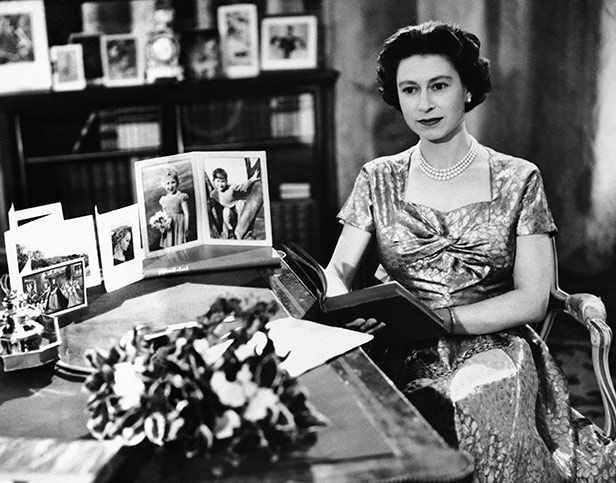
At 3 pm on every Christmas Day since 1932 the reigning British monarch has spoken to the people of the Empire and Commonwealth. The first to make a royal Christmas broadcast was George V, who had been asked by BBC General Manager John Reith for such a speech since 1923. Written by Rudyard Kipling, the speech was delivered from Sandringham Castle. Listening to it has become part of the traditional British Christmas afternoon activity.
The First Royal Christmas Broadcast
Through one of the marvels of modern science I am enabled this Christmas Day to speak to all my peoples throughout the Empire. I take it as a good omen that wireless should have reached its present perfection at a time when the Empire has been linked in closer union, for it offers us immense possibilities to make that union closer still.
It may be that our future will lay upon us more than one stern test. Our past will have taught us how to meet it unshaken. For the present the work to which we are all equally bound is to arrive at a reasoned tranquillity within our borders, to regain prosperity without self-seeking, and to carry with us those whom the burden of past years has disheartened or overborne.
My life’s aim has been to serve as I might towards those ends. Your loyalty, your confidence in me has been my abundant reward. I speak now from my home and from my heart to you all; to men and women so cut off by the snows, the desert, or the sea that only voices out of the air can reach them; to those cut off from fuller life by blindness, sickness, or infirmity, and to those who are celebrating this day with their children and their grandchildren—to all, to each, I wish a happy Christmas. God bless you.
Queen Elizabeth II made her first Christmas Broadcast on radio in 1952, and on television in 1957. Like her father George VI and grandfather George V, the Queen used to broadcast her message live but since 1960, the Christmas Message has always pre-recorded, and sent in advance to Commonwealth countries for broadcast at a suitable local time. The television programme incoporates material specially recorded for it during the preceding year. The speech is now also made available on the Internet.
March 22
1933
The Nazi dictatorship begins
After long years of campaigning against the democratic Weimar Republic in general and the German Communist Party (KPD) and Social Democratic Party (SPD) in particular, Hitler’s National Socialist German Worker’s Party (NSDAP or “Nazis) received the majority of seats in the March 1933 general election. The arson attack on the Reichstag (Parliament building) a few days before the vote had been attributed to Communist sympathizers and greatly aided Hitler’s victory.
Hitler used his electoral success to immediately put forward legislation that would effectively end democratic rule in Germany and transfer all power to the Chancellor and his cabinet. The “Reichstag Fire Decree” suspended civil liberties and provided cover for the outlawing of the KPD and the arrest of Communists. The Gesetz zur Behebung der Not von Volk und Reich (“Law to Remedy the Distress of People and Reich”) or “Enabling Act” passed on this day removed all effective power from the legislature and allowed direct rule by Hitler. The only party to oppose it was the Social Democratic Party, many of whose members soon found themselves on the run, unemployed, or in jail. Within a few months all political parties but the Nazis had been outlawed and the Thousand Year Reich well established.
Thermopylae
One of the my favourite poets is C.P. Cavafy, a gay Greek-Egyptian civil servant of the early 20th century. In this poem he honours the Spartan infantry who in 480 BC made a stand against an overwhelmingly superior Persian invasion force, before a treacherous local guide, Ephialtis, showed the enemy a way to attack the defenders from behind. Cavafy uses that example to praise all those who, in different ways, imitate the Spartans in their daily lives.
Honour to those who in the life they lead
define and guard a Thermopylae.
Never betraying what is right,
consistent and just in all they do
but showing pity also, and compassion;
generous when they are rich, and when they are poor,
still generous in small ways,
still helping as much as they can;
always speaking the truth,
yet without hating those who lie.
And even more honor is due to them
when they foresee (as many do foresee)
that in the end Ephialtis will make his appearance,
that the Medes will break through after all.
The Passions of Carol
There have been many variations on Charles Dickens’s A Christmas Carol: it has been set in London, in the American Midwest, in black ghettoes and modern television studios; Scrooge has been played by men, women, Muppets, puppets and cartoon ducks. Few versions, however, have stretched the genre as much as The Passions of Carol, a 1975 pornographic movie starring Merrie Holiday. Directed by Shaun Costello, the movie examines the change of heart Christmas brings to Carol Scrooge, a cruel editor of a skin magazine.