December 13

Home / Today in History / December 13
520px-nasa_apollo_17_lunar_roving_vehicle

1972 The last men on the moon

In 1957 the Soviet Union launched the world’s first artificial satellite, Sputnik I, and in 1961 sent the first man, Yuri Gagarin, into space. These developments spurred the United States into plans to further develop its missile capabilities and, in the words of President John Kennedy: “I believe that this nation should commit itself to achieving the goal, before this decade is out, of landing a man on the Moon and returning him safely to the Earth. No single space project in this period will be more impressive to mankind, or more important for the long-range exploration of space; and none will be so difficult or expensive to accomplish.”

The Space Race was on.

The American’s Vanguard, Mercury, Gemini and Apollo programs honed the American drive toward the moon while the Soviets pursued their Vostok, Voshkod and Soyuz plans. The Russians again were first to put a woman in space and to conduct activities outside of a space craft. Both sides suffered casualties in launch and voyage accidents; at least 14 astronauts and cosmonauts died in the race to the moon.

On July 21, 1969, after a three-day voyage, Apollo XI sent down its Lunar Excursion Module piloted by Neil Armstrong who became the first man on the moon. Five more successful flights were made before the attention of the Americans and Russians turned to orbiting platforms — space stations. The last men on the surface of the moon to date were Eugene Cernan and Harrison Schmitt of Apollo 17 in 1972.

December 12

Home / Today in History / December 12

votomatic

2000 Bush v. Gore is settled

What appears to outsiders to be a single election for the presidency of the United States is in a fact of a collection of over 50 state and district votes, each conducted with different rules and different forms of balloting. Nowhere was this more evident, or more controversial, than in the state of Florida during the 2000 election that pitted Republican George W. Bush against Democratic Albert Gore.

On election night, November 8, it appeared that Bush had prevailed and Gore made the customary telephone call of concession. Furious discussions among Democratic partisans reversed directions and Gore phoned a befuddled Bush to withdraw his concession. Gore had appeared to win the popular vote and some states, particularly Florida, might produce recounts in the balloting. A mandatory recount in that state confirmed a Bush victory but Gore’s people appealed in court.

The recount in Florida would be the subject of intense litigation with much of the uncertainty due to the nature of the voting machines Florida used, devices in which voters were to punch holes beside the candidates of their choice. But such machines often produced debatable results with the ‘chads’ often hanging from the holes. Scrutineers had to somehow divine the intention of the voter in such cases as

  • Hanging chads — attached to the ballot at only one corner.
  • Swinging chads — attached to the ballot at two corners.
  • Tri-chads — attached to the ballot at three corners.
  • Pregnant or dimpled chads — attached to the ballot at all four corners, but bearing an indentation indicating the voter may have intended to mark the ballot. (Sometimes “pregnant” is used to indicate a greater mark than “dimpled”.)

On this date in 2000 the Supreme Court 5-4 (the usual suspects in their respective places) ruled that no recount was necessary and that Bush had won Florida’s electoral votes, making him the President.

December 11

Home / Today in Church History / December 11

images

1792

Birth of Joseph Mohr, author of “Silent Night”.

Mohr was an Austrian priest. Ordained in 1815 his first parish was the Alpine village of Mariapfarr where he wrote a poem “Stille Nacht! Heilige Nacht!”. Transferred to the St Nicholas church in Oberndorf in 1817 he struck up a friendship with the organist Franz Gruber whom he asked in December 1818 to set “Stille Nacht” to music. Gruber obliged and the new work was premiered with guitar accompaniment at the midnight mass on Christmas Eve. Mohr spent the rest of his life as a parish priest in a number of Austrian villages, dying poor but well-loved.

The song would probably have only been performed on that single occasion and been forgotten had not a visiting musician seen the music in the church in 1825 and taken it away with him. It was played throughout Austria for the next few years, growing in popularity under the title “A Tyrolean Folk Carol”. The authorship of the piece remained a mystery until the 1854 by which time its lyricist was dead. The carol had been attributed to many different composers, including Haydn, Mozart and Beethoven but the director of the Royal Court Choir of Berlin, where “Silent Night” had become the favorite of King Friedrich Wilhelm IV of Prussia, researched the origins of the carol and succeeded in having its true creators credited for their work. The song has been translated into over 200 languages. Its English version was written in 1863 by American Episcopal priest John Freeman Young.

December 10

Home / Today in Church History / December 10

lutherbull

1520

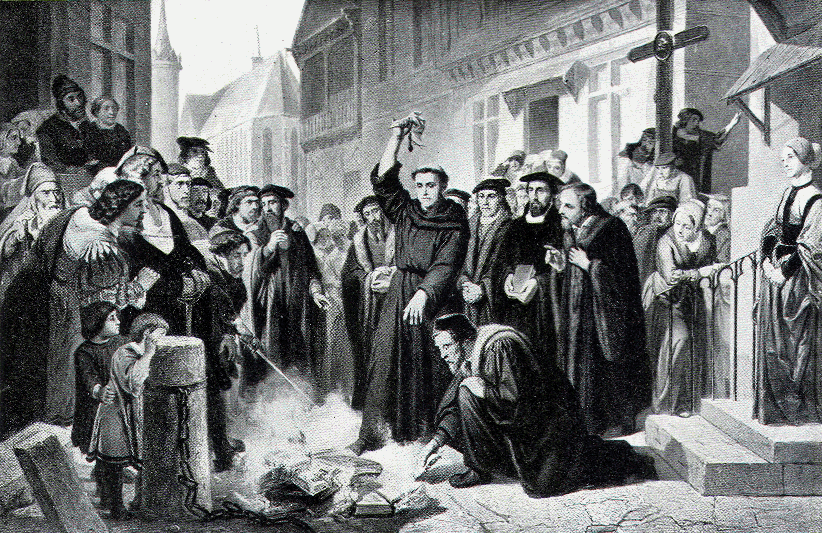
Luther burns Exsurge Domine.

In June 1520 Pope Leo X issued a bull against 41 errors promoted by the German Augustinian monk Martin Luther. Like most papal decrees of this sort it was known by the first few words of its Latin text, in this case “exsurge domine“, “Rise up, O Lord.” The inept Leo (born Giovanni di Lorenzo de’ Medici) proclaimed:

With the advice and consent of these our venerable brothers, with mature deliberation on each and every one of the above theses, and by the authority of almighty God, the blessed Apostles Peter and Paul, and our own authority, we condemn, reprobate, and reject completely each of these theses or errors as either heretical, scandalous, false, offensive to pious ears or seductive of simple minds, and against Catholic truth. By listing them, we decree and declare that all the faithful of both sexes must regard them as condemned, reprobated, and rejected . . . We restrain all in the virtue of holy obedience and under the penalty of an automatic major excommunication.

Because of Luther’s popularity in Germany it took some time before the bull was officially proclaimed there. Luther received notice of it only in October and denounced its writer as the Antichrist. He wrote two replies to it and on December 8, when the bull would have taken effect, he joined students and colleagues of the University of Wittenberg in burning it along with books of canon law and scholastic theology. This irremediable break with Rome on his part was followed by his excommunication early in 1521.


December 9

Home / Today in History / December 9

0135476

1956 Trans-Canada Airlines flight 810 crashes

Before there was Air Canada there was TCA, Trans-Canada Airlines. On this date in 1956 a TCA Canadair North Star (a four-engine propeller-driven craft) from Vancouver to Calgary ploughed into “the Fang”, a peak of Mount Slesse near Chilliwack, B.C. Shortly after takeoff the crew reported a fire in one engine and turned back toward Vancouver but the flight path they chose drove them into the mountain where all 62 people aboard died. Investigators blamed a faulty engine and ice on the wings.

The flight is still remembered as the one that took the lives of a number of CFL football stars returning from the East-West All-Star Game. Lost were Saskatchewan Roughrider stalwarts Mel Becket, Mario DeMarco, Ray Syrnyk and Gordon Sturtridge, and Winnipeg Blue Bomber Calvin Jones, the first black player to win the Outland Trophy as the top lineman in U.S. college football and who was the first African American on the cover of Sports Illustrated.

Scheduled to be on that flight, but missing it for various reasons, were defensive back and later Winnipeg (and even later Minnesota Viking) coach Bud Grant, and Edmonton Eskimo stars Jackie “Spaghetti Legs” Parker and Normie “the China Clipper” Kwong, later the lieutenant-governor of Alberta.

Today the Roughriders honour their lost with flags bearing their numbers above their Regina stadium. The families of Mel Becket and Mario DeMarco donated a commemorative trophy to recognize the Most Outstanding Offensive Lineman in the West.

December 8

Home / Today in History / December 8
sacre_louis2_france_02

877 Louis the Stammerer is crowned King of the West Franks

Louis the Stammerer was the son of Charles the Bald, the brother of Louis the Child, the father of Charles the Simple. In the Middle Ages before kings got publicity agents and all ended up with nicknames like “the Great” or “the Just”, royal labels were colourful and, presumably, accurate. Take, for example, Constantine V of the Byzantine Emperor who crapped in the baptismal font as a baby. He was henceforth dubbed “Copronymus” or “the Poop-Named”.

Let us take this opportunity, therefore, to salute those in history who ended up saddled with less-than-attractive sobriquets. Hats off to

Wilfred the Hairy of Barcelona,  Alfonso the Slobberer of Leon,   Arnulf the Unlucky of Flanders,  Harald Blue-Tooth of Norway

Charles the Fat, Holy Roman Emperor,   Sigurd the Slimy of Norway,    Sviatopolk the Accursed of Kiev,  Catherine the Sad of Bosnia

Gleb the Damned of Riazan,  Gothelo the Sluggard of Lorraine, Guy de Beauchamp the Black Cur of Arden,   Maria Isabel the Ugly of Aragon

What recent leader has had more ill nicknames than Margaret Thatcher? Attila the Hen, She Who Must be Obeyed, TBW (That Bloody Woman), the Great She-Elephant, the Iron Lady, the Iron Maiden, the la Passionara of Privilege, the Milk Snatcher.

Lately, Justin Trudeau has been termed the “Prime Minstrel” after his habit of blacking-up, also Mr Dress-Up, Prime Minister Zoolander, and (in China) Little Potato.

The View From Tokyo

Home / Today in History / The View From Tokyo

December 7 is the anniversary of the 1941 Japanese attack on Pearl Harbor as well as on British and American installations in Asia.  For the Japanese, across the International Date Line, it was December 8 as the English-language Tokyo paper above shows.

Here is the imperial rescript (decree) which is printed in that paper giving the Japanese reasons for war:

We, by grace of heaven, Emperor of Japan, seated on the Throne of a line unbroken for ages eternal, enjoin upon ye, Our loyal and brave subjects:

We hereby declare War on the United States of America and the British Empire. The men and officers of Our Army and Navy shall do their utmost in prosecuting the war. Our public servants of various departments shall perform faithfully and diligently their respective duties; the entire nation with a united will shall mobilize their total strength so that nothing will miscarry in the attainment of Our war aims.

To insure the stability of East Asia and to contribute to world peace is the far-sighted policy which was formulated by Our Great Illustrious Imperial Grandsire [Meiji emperor] and Our Great Imperial Sire succeeding Him, and which We lay constantly to heart. To cultivate friendship among nations and to enjoy prosperity in common with all nations, has always been the guiding principle of Our Empire’s foreign policy. It has been truly unavoidable and far from Our wishes that Our Empire has been brought to cross swords with America and Britain. More than four years have passed since China, failing to comprehend the true intentions of Our Empire, and recklessly courting trouble, disturbed the peace of East Asia and compelled Our Empire to take up arms. Although there has been reestablished the National Government of China, with which Japan had effected neighborly intercourse and cooperation, the regime which has survived in Chungking, relying upon American and British protection, still continues its fratricidal opposition. Eager for the realization of their inordinate ambition to dominate the Orient, both America and Britain, giving support to the Chungking regime, have aggravated the disturbances in East Asia. Moreover these two Powers, inducing other countries to follow suit, increased military preparations on all sides of Our Empire to challenge Us. They have obstructed by every means Our peaceful commerce and finally resorted to a direct severance of economic relations, menacing gravely the existence of Our Empire. Patiently have We waited and long have We endured, in the hope that Our government might retrieve the situation in peace. But Our adversaries, showing not the least spirit of conciliation, have unduly delayed a settlement; and in the meantime they have intensified the economic and political pressure to compel thereby Our Empire to submission. This trend of affairs, would, if left unchecked, not only nullify Our Empire’s efforts of many years for the sake of the stabilization of East Asia, but also endanger the very existence of Our nation. The situation being such as it is, Our Empire, for its existence and self-defense has no other recourse but to appeal to arms and to crush every obstacle in its path.

The hallowed spirits of Our Imperial Ancestors guarding Us from above, We rely upon the loyalty and courage of Our subjects in Our confident expectation that the task bequeathed by Our forefathers will be carried forward and that the sources of evil will be speedily eradicated and an enduring peace immutably established in East Asia, preserving thereby the glory of Our Empire.


December 6

Home / Today in History / December 6

1917 The Halifax Explosion

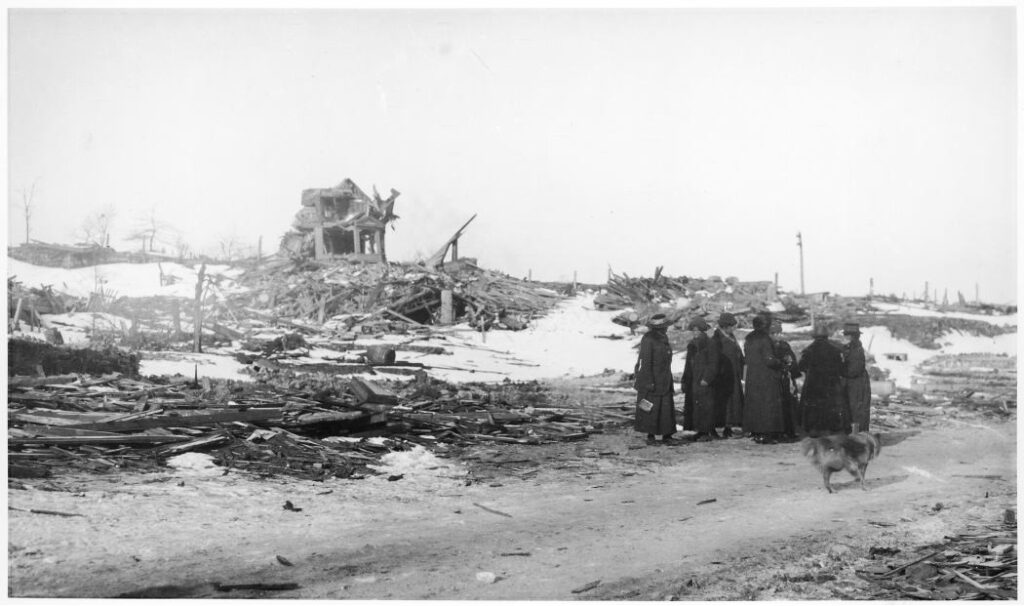
In the midst of World War I, Halifax harbour was an important shipping point for materiel headed to the Western Front. On December 6, 1917 two ships collided in that harbour, setting off the largest man-made explosion in history before the advent of the atomic bomb.

The two ships were the Norwegian merchant vessel Imo, en route to New York to pick up relief supplies for war-torn Belgium, and the other was the French ship Mont-Blanc, filled with tons of benzol, picric acid, TNT and gun cotton, set to join a convoy across the Atlantic. The Imo, steaming on the wrong side of the channel struck the Mont-Blanc, setting it ablaze. The French vessel’s crew abandoned ship leaving Mont-Blanc to drift closer to the populated shore. At 9:05 in the morning it exploded, destroying much of Halifax and damaging buildings 100 km away.

In her  Curse of the Narrows Laura MacDonald describes the effect of the explosion:

The air blast blew through the narrow streets, toppling buildings and crashing through windows, doors, walls, and chimneys until it slowed to 756 miles an hour, five miles below the speed of sound. The blast crushed internal organs, exploding lungs and eardrums of those standing closest to the ship, most of whom died instantly. It picked up others, only to thrash them against trees, walls, and lamp posts with enough force to kill them. Roofs and ceilings collapsed on top of their owners. Floors dropped into the basement and trapped families under timber, beams and furniture. This was particularly dangerous for those close to the harbour because a fireball, which was invisible in the daylight, shot out over a 1–4 mile area surrounding the Mont-Blanc. Richmond houses caught fire like so much kindling. In houses able to withstand the blast, windows stretched inward until the glass shattered around its weakest point, sending out a shower of arrow-shaped slivers that cut their way through curtains, wallpaper and walls. The glass spared no one. Some people were beheaded where they stood; others were saved by a falling bed or bookshelf. . . . Many others who had watched the fire seconds before awoke to find themselves unable to see.

The north end of the city was wiped out by the blast and subsequent tsunami. Nearly 2,000 people died, another 9,000 were maimed or blinded, and more than 25,000 were left homeless. An international rescue effort was put in place, one which is still recognized by Haligonians who every year send a giant Christmas tree to Boston to acknowledge the aid that city sent.

December 5

innocent_viii

1484 Pope Innocent VIII issues the witch-hunting bull Summis desiderantes.

Though using magic in harmful ways (maleficium) was illegal in most cultures, we cannot speak of a witch craze in Europe until the late fifteenth century when Dominican Inquisitors began to persuade the Church that witchcraft was a variety of heresy and thus worthy of extirpation. Two documents were instrumental in provoking a social concern with witchery that lasted over two centuries. One was Malleus Maleficarum or The Hammer of Witches by Sprenger and Kramer, two German Dominicans; the second was the papal decree of 1484 Summis desiderantes. The latter begins:

 It has recently come to our ears, not without great pain to us, that in some parts of upper Germany, as well as in the provinces, cities, territories, regions, and dioceses of Mainz, Cologne, Trier, Salzburg, and Bremen, many persons of both sexes, heedless of their own salvation and forsaking the catholic faith, give themselves over to devils male and female, and by their incantations, charms, and conjurings, and by other abominable superstitions and sortileges, offences, crimes, and misdeeds, ruin and cause to perish the offspring of women, the foal of animals, the products of the earth, the grapes of vines, and the fruits of trees, as well as men and women, cattle and flocks and herds and animals of every kind, vineyards also and orchards, meadows, pastures, harvests, grains and other fruits of the earth; that they afflict and torture with dire pains and anguish, both internal and external, these men, women, cattle, flocks, herds, and animals, and hinder men from begetting and women from conceiving, and prevent all consummation of marriage; that, moreover, they deny with sacrilegious lips the faith they received in holy baptism; and that, at the instigation of the enemy of mankind, they do not fear to commit and perpetrate many other abominable offences and crimes, at the risk of their own souls, to the insult of the divine majesty and to the pernicious example and scandal of multitudes.

Over the next 200 years the Church and local authorities in some parts of Europe, especially Germany, arrested thousands of suspected witches, executing probably about 50,000 of them. This was not a “Female Holocaust” with 9,000,000 victims as some, including the National Film Board of Canada, have laughably asserted but a set of panicked reactions to an age of upheaval and violence. The Church feared heresy, secular officials feared disorder and ordinary people feared supernatural harm. Where judicial torture was legal, bizarre confessions were the result; where torture was illegal, as in England or Ireland, witchcraft confessions were few. Despite its black reputation the Spanish Inquisition was among the first to call a halt to these trials, seeing in them only deluded ravings.

December 2

Home / Uncategorized / December 2

Advent does not begin with a fixed date because the period can begin anywhere from November 27 to December 3. Consequently there is no one common custom to kick off the season. In Honduras there is a masked dancer called the Warini or Christmas Herald who goes door to door accompanied by singers and drummers to announce the season. And in Twente in Holland long wooden horns, carved out of saplings are sounded over a well to produce a deep foghorn like tone. In Oldenzaal trumpeters blow in Advent from the four corners of a medieval tower. Moravian churches will make the occasion by the erection of their famous multi-pointed stars.

Almost everywhere there is the compulsion to clean the house.  In fifteenth century Florence a religious revival led by the monk Savonarola resulted in the famous “Bonfire of the Vanities”, a public burning of luxuries that were deemed to keep the minds of believers off of God and salvation. A similar spectacle occurs every year at the beginning of the Christmas season in Guatemala. On December 7 (also the day to celebrate the Immaculate Conception of the Virgin Mary) Guatemalans haul out of their homes the things they think they don’t need anymore and set them on fire in a ceremony called “The Burning of the Evil” — with their homes thus purged of unnecessary encumbrances their souls can prepare for the coming of Christmas. In Trinidad and Tobago the house must be given a thorough cleaning and decorated; a portion of the Christmas budget always goes to buying something new for the house at this time of year. New curtains are hung, windows are washed, furniture is recovered, long-delayed repairs are made, a new piece of linoleum is laid and the paint brush is busy. In northern Europe Advent is also a time to tend to the graves of the family dead as well as sprucing up the house. In Moravian settlements in Labrador a common expression or question heard in December is “Is you ready yet?” This means basically, “Do you have your house thoroughly cleaned?”