March 13

Home / Uncategorized / March 13

1954

The birth of Robin Duke

It is not often that I venture into the realm of popular culture on this blog but today provides me with an opportunity to salute the Canadian actress Robin Duke. She was a sorely underestimated contributor to that pinnacle of comedic genius known as SCTV and also starred in SNL and Schitt’s Creek.

I remember watching this skit in Saskatoon after I returned to Canada from years of studying in London. I had never heard of SCTV and my only experience of Canadian television humour came from watching the Wayne and Schuster Show where laughs were produced in a more sedate style. Molly Earl’s introduction of the “bingo drop can” convinced me my frozen nation could, if called upon, be suitably zany.

March 12

Home / Today in History / March 12

Pelley_wanted

1890

Birth of an American Fascist

William Dudley Pelley (1890-1965) was a fascinating mixture of spiritualist loon, aspiring dictator, talented writer, and fantasist. His short-lived Silver Legion was one of a number of fascist organizations that sprang up across the world in the 1930s in imitation of Benito Mussolini and Adolf Hitler.

Pelley rose to fame in the 1920s with his short stories, two of which won the coveted O. Henry Prize, and his journalistic skills. He spent time working with the Red Cross in Siberia during the Russian Civil War, where he developed a hatred of Communism and of Jews, who, he said, lay behind global Bolshevism. His way with words took him to Hollywood and a screenwriting career but he left in disillusion and anger with Jewish studio bosses.

In the 1930s he developed a new religion based on visions in which he claimed to have seen God the Father and Jesus and been given the power to levitate and see through walls. Many of his religious followers also became devotees of his new political movement, the Silver Legion, who wore silver shirts with a blue tie, in imitation of Mussolini’s Blackshirts, and Hitler’s Brownshirts. His group, he declared, would take part in the “the ultimate contest for existence between Aryan mankind and Jewry.” The party opposed Communism, Jews, involvement in foreign wars, and the Roosevelt administration. He claimed his Legion numbered 25,000 but when he ran for president in 1936 he received only 1,600 votes.

The government began to harass Pelley; he was placed under investigation by the House Committee on Un-American Activities and his property seized. When World War II broke out Pelley disbanded the Silver Shirts but continued to rail against Roosevelt. He was arrested and convicted of sedition, obstructing military recruiting and fomenting insurrection within the military. He was released from prison in 1950 whereupon his interests turned to UFOs and a new religion called Soulcraft. His writings live on in neo-Nazi websites.

March 11

Home / Today in History / March 11

1619 The Witches of Belvoir

On the 11th of March 1619, two women named Margaret and Philippa Flower, were burnt at Lincoln for the alleged crime of witchcraft. With their mother, Joan Flower, they had been confidential servants of the Earl and Countess of Rutland, at Belvoir Castle. Dissatisfaction with their employers seems to have gradually seduced these three women into the practice of hidden arts in order to obtain revenge. According to their own confession, they had entered into communion with familiar spirits, by which they were assisted in their wicked designs. 

Joan Flower, the mother, had hers in the bodily form of a cat, which she called Rutterkin. They used to get the hair of a member of the family and burn it: they would steal one of his gloves and plunge it in boiling water, or rub it on the back of Rutterkin, in order to effect bodily harm to its owner. They would also use frightful imprecations of wrath and malice towards the objects of their hatred. In these ways they were believed to have accomplished the death of Lord Ross, the Earl of Rutland’s son, besides inflicting frightful sicknesses upon other members of the family.

It was long before the earl and countess, who were an amiable couple, suspected any harm in these servants, although we are told that for some years there was a manifest change in the countenance of the mother, a diabolic expression being assumed. At length, at Christmas, 1618, the noble pair became convinced that they were the victims of a hellish plot, and the three women were apprehended, taken to Lincoln jail, and examined. The mother loudly protested innocence, and, calling for bread and butter, wished it might choke her if she were guilty of the offences laid to her charge. Immediately, taking a piece into her mouth, she fell down dead, probably, as we may allowably conjecture, overpowered by consciousness of the contrariety between these protestations and the guilty design which she had entertained in her mind.

Margaret Flower, on being examined, acknowledged that she had stolen the glove of the young heir of the family, and given it to her mother, who stroked Rutterkin with it, dipped it in hot water, and pricked it: whereupon Lord Ross fell ill and suffered extremely. In order to prevent Lord and Lady Rutland from having any more children, they had taken some feathers from their bed, and a pair of gloves, which they boiled in water, mingled with a little blood. In all these particulars, Philippa corroborated her sister. Both women admitted that they had familiar spirits, which came and sucked them at various parts of their bodies: and they also described visions of devils in various forms which they had had from time to time.

The examinations of these wretched women were taken by magistrates of rank and credit, and when the judges came to Lincoln the two surviving Flowers were duly tried, and on their own confessions condemned to death by the Chief Justice of the Common Pleas, Sir Henry Hobbert.

The above account from Chambers’ Book of Days omits several interesting points: the death of another of the earl’s children, the possible escape from the gallows of one of the accused, and the recent suggestion that the boys were poisoned to leave the earl without a male heir, allowing the poisoner to inherit the estate by marrying one of the earl’s daughters.

March 10

th

1528

Martyrdom of an Anabaptist theologian

Balthasar Hubmaier (1480-1528) was born in Augsburg and was educated at the universities of Freiburg and Ingolstadt. At the latter he was awarded his doctorate and was taught by Johann Eck, who was to become Luther’s first great adversary. As a Catholic priest he won fame as a preacher and became vice-rector of the university. He seems to have fallen under the influence of Erasmian humanism and then into a sort of Protestantism.  In 1523 he met with Huldreich Zwingli in Zürich which deepened his new faith but they came to differ on the vexed question of infant baptism. The next year he married and was forced to flee his Waldshut church when this came to the attention of the authorities.

The year 1525 saw momentous events in the religious history of Europe. It was the year of the great German Peasant Rebellion when dozens of armed uprisings occurred against the establish order, many of them espousing radical anti-Catholic ideas. At the same time, Zürich, which had declared itself a city adhering to the reformed faith, began to harden its heart against dissidents. Hubmaier, who was fleeing the violence, was arrested by Zwingli and under torture reluctantly recanted his stand on baptism. For Hubmaier, the test of any doctrine was whether it could be defended in Scripture and he continued to preach this after he left Switzerland for Moravia. In 1528 he was arrested and imprisoned in Vienna where again he underwent torture. This time he did not recant and was burnt at the stake for heresy. His wife was executed by drowning, an ironic punishment to those who underwent immersion rebaptism.

Today Anabaptism appears a harmless and valuable piece in the mosaic of contemporary Christianity but in the sixteenth century it was viewed with abhorrence. Not only was it tainted by the violence of some of its adherents in the 1525 rebellions and the 1535 seizure of Münster, its redefinition of true religion, its rejection of tradition and its unwillingness to fight against Turks provoked harshness by Protestants and Catholics alike.

March 9

Home / Today in History / March 9

khyber

1925

Pink’s War

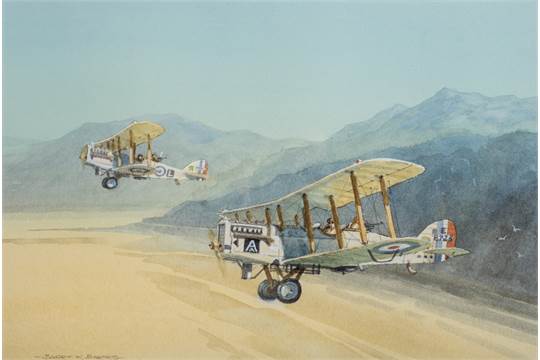
“First, plan your retreat.  All expeditions into tribal lands end in retreat.”  The obdurate and indomitable nature of the tribes of the Northwest Frontier of India is legendary. Warlike, fiercely independent, and clannish, they have bedevilled every attempt to curb their raids and blood feuds. For over a century they repelled the British Army, just as today they are a challenge to the Pakistani government.

In 1925, the Mahsud tribe of southern Waziristan was holding out against the British Raj and continuing to attack army outposts. The Royal Air Force, determined to succeed where the Army had failed, conducted its first independent action in strikes on Mahsud villages. Under Wing Commander Richard Pink, flying Bristol fighters and deHavilland DH9A light bombers, the RAF first leafleted the mountain strongholds to warn of impending attacks so that there would be no civilian casualties and then proceeded, day and night, to strafe, bomb (over 250 tons of ordinance) and harass the territory for weeks until the tribesmen finally agreed to a treaty.

540x360

March 8

220px-Manuel_Gómez-Moreno_González._San_Juan_de_Dios_salvando_a_los_enfermos_de_incendio_del_Hospital_Real_(1880)

St John of God’s Day

Born João Duarte Cidade in Portugal in 1495, John was abducted from his parents at age 8 and ended up as a child shepherd in Spain. On reaching adulthood John joined the Spanish army and for 20 years fought in various campaigns against the French and the Turks. In his 40s he left the army and wandered about searching for a purpose in life. He tried giving himself as a martyr in North Africa and selling books in Gibraltar. He began to experience religious visions — in one of these the figure of Jesus called him “John of God” — and then suffered a mental breakdown which necessitated his being locked in a hospital for the insane where he underwent the traditional treatment: flogging and starvation. There was visited by John of Avila, a priest who was himself later canonized, who urged him to turn his suffering into caring for others.

On his release John began a ministry to the poor and the sick, caring for them in his house and begging for food and medicines. He attracted followers who were inspired by his example and, after his death from an illness contracted after rescuing a man from drowning, these disciples were recognized as the order of the Brothers Hospitallers of St John of God. This order continues his work today around the world.

John is the patron saint of hospitals, the sick, the dying, heart patients, publishers, printers, nurses, firefighters, alcoholics, and booksellers.

March 7

321

Constantine makes Sunday the official day of rest

For a long time early Christianity debated the proper day for the Sabbath: Saturday, to follow the Jewish tradition; or Sunday, the day of the Resurrection. Standardization only occurred in the 4th century when the faith became legally recognized and the royal family of the Roman empire converted.

On March 7, 321 the emperor Constantine decreed that Sunday would be the universal day of rest throughout the Roman world:

On the venerable Day of the Sun let the magistrates and people residing in cities rest, and let all workshops be closed. In the country, however, persons engaged in agriculture may freely and lawfully continue their pursuits; because it often happens that another day is not so suitable for grain-sowing or vine-planting; lest by neglecting the proper moment for such operations the bounty of heaven should be lost.

Some claim that Constantine’s move was not directed so much by his new-found Christianity but by his long-standing devotion to the imperial sun-god cult of Sol Invictus. Coins bearing this image continued to be minted until 325.

This law was not immediately obeyed. The fact that the Council of Laodicea in 363 had to prohibit the Saturday Sabbath and demand Sunday rest meant that there was still the desire in some Christian communities to cling to the Jewish practice.

March 6

Home / Today in History / March 6

An interesting day in history.

1836 Fall of the Alamo

FalloftheAlamo

After a 13-day siege Mexican troops under General Santa Ana pour into the Alamo fort and massacre the defenders. The painting above shows the death of Davy Crockett.

1857 The Dred Scott decision

Dred Scott, a black slave, had been taken by his master to a non-slave state and sued for his freedom. The Supreme Court ruled against him, saying that “a negro, whose ancestors were imported into [the U.S.], and sold as slaves”, whether enslaved or free, could not be an American citizen and therefore had no standing to sue in federal court. Moreover, the court said the federal government could not regulate slavery in territories acquired after the creation of the U.S.  This ruling inflamed anti-slavery passions and contributed to the outbreak of the Civil War in 1861.

1912 First use of airships in war

Italian forces in two dirigibles drop bombs on Turkish troops in what is now Libya.

FDNY_responds_to_Weatherman_townhouse_explosion

1970 A Weather Underground bomb explodes

Left-wing terrorist groups emerged out of the anti-war and civil rights movements of the 1960s. One of these was the Weathermen, (later the Weather Underground) whose name derived from the Bob Dylan song “Subterranean Homesick Blues” containing the line “You don’t need a weatherman to know which way the wind blows.” The group incited riots, declared war on the USA, and bombed the Pentagon, Capitol Building and State Department. On this date three terrorists, all white graduate students, died when one of their own bombs exploded in their Greenwich Village safe house.

f8b55d28ca77ff766744d9818d7f3dbb

1984 British miners’ strike begins

Until this strike the British miners had been among the best-paid and most militant of the UK’s labour unions. For years, the the National Union of Miners had successfully resisted government plans to make the coal industry more efficient and reduce subsidies; their strike in 1974 had brought down Edward Heath’s Conservative government. In 1984, without calling a national ballot, NUM president Arthur Scargill led the miners out again, but this time Margaret Thatcher’s government was prepared. Coal stockpiles at power plants were enormous, and police strategies were devised to counter the union tactic of flying pickets. After a year of bitter conflict, the union conceded defeat.

March 5

Home / Uncategorized / March 5

Joining the line waiting to enter the gates of Hell on March 5, 1953 was Joseph Vissarionovich Djugashvilli, aka Cato, aka Koba, aka Stalin, Georgian revolutionary and Soviet dictator.

Born in 1879 to a peasant family who hoped that he would become an Orthodox priest, Stalin rebelled and became fascinated with Marxism. He rose from being a low-ranking thug and bank robber for the socialist cause to becoming editor of Pravda, the Communist Party newspaper, and discipline of V.I. Lenin, head of the Bolshevik faction. Exiled to Siberia in 1913-17, he was released to join in the political turmoil that followed the overthrow of the Czar and the establishment of the first provisional Russian democracy. During the revolutionary wars provoked by the Bolshevik overthrow of parliament, Stalin served as a bureaucrat, a role at which he excelled. By 1922 and the establishment of the Soviet Union he was Party Secretary, an unglamorous but powerful post that enabled him to sit on all committees and influence the rise or fall of party members.

On Lenin’s death in 1924 a struggle for the top jobs broke out. Stalin’s rivals were all much better-known and few thought him a candidate for supreme leadership, particularly as Lenin in his last days had grown disenchanted with him. He succeeded, however, in out-maneuvering Leon Trotsky, founder of the Red Army by allying with Grigory Zinoviev, head of the Comintern, Politburo member Lev Kamenev and intellectual Nikolai Bukharin. Stalin then turned on his erstwhile friends and by 1927 was in command of the USSR.

His policies of rapid industrialization and collectivization of agriculture were brutally set in place.The former had some success but the latter was disastrous and resulted in millions dying of starvation. Millions more were sent to the Gulag slave labour camps and tens of thousands of generals, scientists, technical experts, and party officials were murdered in the political purges of the 1930s.

Stalin’s 1939 non-aggression pact with Hitler led to the Second World War. The reward for the USSR was the green light to occupy the Baltic republics and eastern Poland but Stalin was caught by surprise in 1941 when German forces launched Operation Barbarossa. Russian heroism mixed with a disregard for human life would eventually win the war on the Eastern Front but at an enormous cost. 158,000 Russian troops shot by their own side not to mention those killed in service in the punishment brigades from which only a survivable wound could free one. After victory in 1945, 3,000,000 liberated Russian prisoners were sent to the GULAG for the crime of having surrendered. Half of the returning officers were shot out of hand; only 20% ever returned home. Among the victimized were many of the most prominent Russian military heroes whose crime was outshining Stalin. 

Stalin was never in good health but it was considered dangerous to suggest this to him. In 1952 a number of Jewish doctors were accused of planning to poison him and other leaders. Robert Tucker’s biography Stalin in Power: The Russian Revolution from Above, 1928-1941 has this to say about Stalin and Jews:

His Russian nationalism had an exclusionary aspect: it was anti-Semitic. In the mid-1920s he made covert use of anti-Semitism in the fight against a Left opposition whose major figures, Trotsky and afterward Zinoviev and Kamenev, were Jews (their original surnames were Bronstein, Radomylsky, and Rosenfeld, respectively). He encouraged the baiting of the opposition leaders as Jews in meetings held in factory party cells. He was identifying his faction as the party’s Russian faction, and the Trotskyists as the Jewish one. That Jews, no matter how culturally Russified, could not be authentically Russian seems to have become an article of belief with him.
 

On March 1, 1953 he suffered a stroke and lingered until expiring on March 5. (The dark comedy The Death of Stalin (2017) gives us a glimpse into his last days and the sordid crew jockeying to succeed him.) His embalmed body was put on display beside Lenin’s outside the Kremlin.

The historian Robert Conquest sums up the 70 years of Bolshevism this way: “There was an old bastard named Lenin/ Who did two or three million men in./ That’s a lot to have done in,/ But where he did one in/ That old bastard Stalin did ten in.”


March 4

Home / Today in History / March 4

conf0206-1-150dpi1861

Adoption of the official flag of the Confederate States of America

If one were to identify this flag as that of the Confederacy, you would be wrong.

Confederate_Rebel_Flag.svg

What you see above is a version of the Confederate battle flag, based on that of Lee’s Army of Northern Virginia. The Confederacy itself used this below as its official flag, chosen on this date in 1861:

Flag_of_the_Confederate_States_of_America_(1861-1863).svg

The flag was known as the “Stars and Bars” and was widely disliked because of its resemblance to the flag of the Union, the “Stars and Stripes”. So, in 1863 the CSA chose the “Stainless Banner” incorporating the battle flag in the canton:

Unknown

Many liked this design because it was mostly white and the rebels were, after all, fighting for white supremacy, but in battle that was a drawback as it resembled a flag of truce or surrender. Thus, on this date in 1865, the third and last flag of the Confederate States, the “Bloodstained Banner” was chosen:

Flag_of_the_Confederate_States_of_America_(1865).svg