October 2

Home / Uncategorized / October 2

1528 The Obedience of a Christian Man

One of the greatest challenges that early Protestant reformers faced in persuading secular rulers of the value of the new religion was to assure kings that, despite their religious disobedience, they were perfectly harmless citizens. This was not always easy, given the way dissidents had claimed spiritual sanction for their violence in the German Peasant Rebellion.

Martin Luther wished to disassociate the evangelical cause from imputations of lawlessness and rebellion and return to the ideas held by the early Christians: obey superiors in all lawful commands but when ordered to perform any act against the will of God, refuse and suffer the legal consequences without murmur or complaint. Luther’s wish to deny the Catholic Church any coercive power tended to elevate the powers of the secular ruler; indeed Luther said that no one had spoken so highly of the magistracy since the days of the apostles as he had. The lot of Christians would ever be suffering and the cross; redress of oppression was to be sought only through prayer.

The early English reformers backed Luther on this point. William Tyndale, in his Obedience of a Christian Man, cited St. Paul’s words Romans 13 on obedience to the higher powers, castigated those who might suggest resistance and said that evil rulers were wholesome medicine, sent by God to chastise his people. In one remarkable passage he praises tyranny in comparison to the rule of a weak king:

It is better to pay the tenth than lose all. It is better to suffer one tyrant than many, and to suffer wrong of one man than of every man. Yea, and it is a better thing to have a tyrant unto thy king than a shadow; a passive king that doth nought himself, but suffereth others to do with him what they wi!, and to lead him whither they list. For a tyrant, though he do wrong unto the good, yet he punisheth the evil, and maketh all men obey, neither suffre any man to poll but himself only. A king that is soft as silk, and effeminate that is to say, turned into the nature of a woman,—what with his own lusts, which are the longing of a woman with child, so that he cannot resist them, and what with the wily tyranny of them that rule him, —shall be more grievous unto the realm than a right tyrant. Read the chronicles and thou shalt find it ever so. 

Kings, added Tyndale, were above the law; they might do right or wrong as they willed and were accountable to no one but God.

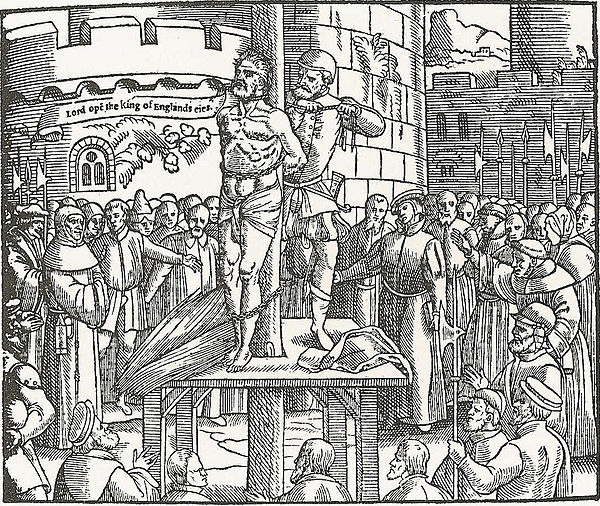
But, woe to poor obedient Tyndale. Despite fleeing religious persecution in England for his translation of the Latin Bible into the vernacular, he was arrested and burnt at the stake in 1536. His last words were “Lord, open the King of England’s eyes.”


October 1

Home / Uncategorized / October 1

1947 Sarah Binks is born

Paul Hiebert (1892-1987) was a University of Manitoba chemist who revealed a sly humour and a talent for exquisitely awful verse in publishing Sarah Binks, a faux biography of the “Sweet Songstress of Saskatchewan”. Born in Russia to a Mennonite family who migrated to Canada, Hiebert took degrees in philosophy and Gothic and Teutonic philology before doing a Ph.D. in chemistry and launching an academic career. 

Hiebert imagined Willows, a Saskatchewan village of the early 20th century:

Half way between Oak Bluff and Quagmire in Saskatchewan lies the little town of North Willows. Its public buildings are unpretentious but pure in architectural style. A post office, two general stores, Charley Wong’s restaurant and billiard parlour, two United churches, the Commercial House (Lib.), the Clarendon Hotel (Cons.), a drug store, a consolidated school, and eighteen filling stations, make up the east side of Railroad Avenue, its chief commercial street. On the west side Railway Avenue is taken up by the depot, the lumber yard and four elevators. At right angles to Railway Avenue runs Post Office Street, so called because the post office was on this street before the last provincial election.

From Willows came Sarah Binks, spinster poetess whose hymns to the rural charms of her province live on in immortal ditties such as “Song to the Cow”, “Goose” and “Up from the Magma and Back Again”. These stanzas won her the much-coveted Wheat Pool Medal but, alas, the accompanying prize was a horse thermometer. In a tragic mishap while taking her own temperature, she bit down hard on a Scotch mint, cracking the thermometer and swallowing a fatal dose of mercury.

She was hailed at the unveiling of her monument with this tribute by the Honourable A.E. Windheaver:

“Despond not! I give you the words of your own great poetess, than whom there is no greater in this great Province of which I have the honour to be Minister of Grasshopper Control and Foreign Affairs. Despond not! Come drought, come rust, come high tariff and high freight rates and high cost of binder twine, I still say to you, as I have already said to the electors of Quagmire and Pelvis, that a Province that can produce a poet like your Sarah Binks under the type of government we have been having during the last four years, full of graft and maladministration and wasting the taxpayers’ money, and what about the roads, I want to say, that a Province that can produce such a poet may be down but it’s never out.”

September 30

Home / Today in History / September 30

1520 Accession of Suleiman the Magnificent

The longest-serving and probably greatest of the Ottoman emperors was Suleiman, known in the West as “the Magnificent” and to the Turks as “the Lawgiver”. Born in 1494 to Sultan Selim the Grim, he followed his father’s policy of aggressive expansion of his empire and Sunni Islam.

In 1521 Suleiman struck into Serbia and captured Belgrade. The next year he took the important fortress of Rhodes from which the Knights of St John had bedevilled Islamic shipping in the eastern Mediterranean. In 1526 he smashed the Hungarians at Mohács and killed their king, but in 1527 he received a setback in his war on Christian Europe — his forces were turned back after an unsuccessful siege of Vienna. Fortunes in the battle between the Ottoman Empire and the Habsburg Holy Roman Empire would ebb and flow for centuries.

Next to face Suleiman’s armies were the Persians, recently made subject to the Shi’ite Safavid dynasty. A series of wars for the next three decades would advance the Turkish realm deeper into western Asia. 

At sea Ottoman navies battled the Portuguese in the Red Sea and Indian Ocean as far away as what is now Indonesia. In the Mediterranean Turkish fleets and their allies in the pirate states of North Africa had success against the ships of the Italian city states and Spain — a cynical alliance (is there any other kind?) with the French made that task easier.

In Turkey Suleiman was best known for codifying non-Sharia Islamic law and for sponsoring a flowering of arts and architecture. He himself was a poet of note.

Unlike previous Ottoman sultans, Suleiman married one of his concubines, a blonde Ukrainian beauty, daughter of an Orthodox priest, captured in a slaving raid and sold to the palace. Though their love affair was of epic proportions it did the empire no good. Under Roxelane’s influence, Suleiman killed two of his abler sons by other women in order to make her child, Selim, his heir. On his death in 1566 the apex of Ottoman grandeur had been reached, never again to be surpassed.

September 29

Home / Today in History / September 29

1902 Death of William Topaz McGonagall

Lovers of excruciatingly bad poetry have long honoured the shade of Irish-born Scottish poet William McGonagall, a weaver turned compulsive rhymester who to his dying day fancied himself among the greatest of his calling.

And, indeed, poetry was a calling. In 1877, when McGonagall was unemployed and in his 50s, he had a vision: I seemed to feel as it were a strange kind of feeling stealing over me, and remained so for about five minutes. A flame, as Lord Byron has said, seemed to kindle up my entire frame, along with a strong desire to write poetry; and I felt so happy, so happy, that I was inclined to dance, then I began to pace backwards and forwards in the room, trying to shake off all thought of writing poetry; but the more I tried, the more strong the sensation became. It was so strong, I imagined that a pen was in my right hand, and a voice crying, “Write! Write!

For the next 25 years McGonagall proclaimed his creations on street-corners, in pubs, and in a circus where he was content, for fifteen shillings a night, to be pelted with refuse while he recited.  He died penniless and was buried in an unmarked Edinburgh grave but his memory lives on as long as poems like the one appended below, “The Death and Burial of Lord Tennyson”, are still treasured. His works are in print and, for their soporific qualities, make splendid bed-time reading.

Alas! England now mourns for her poet that's gone-
The late and the good Lord Tennyson.
I hope his soul has fled to heaven above,
Where there is everlasting joy and love.

He was a man that didn't care for company,
Because company interfered with his study,
And confused the bright ideas in his brain,
And for that reason from company he liked to abstain.

He has written some fine pieces of poetry in his time,
Especially the May Queen, which is really sublime;
Also the gallant charge of the Light Brigade-
A most heroic poem, and beautifully made.

He believed in the Bible, also in Shakspeare,
Which he advised young men to read without any fear;
And by following the advice of both works therein,
They would seldom or never commit any sin.

Lord Tennyson's works are full of the scenery of his boyhood,
And during his life all his actions were good;
And Lincolnshire was closely associated with his history,
And he has done what Wordsworth did for the Lake Country.

His remains now rest in Westminster Abbey,
And his funeral was very impressive to see;
It was a very touching sight, I must confess,
Every class, from the Queen, paying a tribute to the poet's greatness.

The pall-bearers on the right of the coffin were Mr W. E. H. Lecky,
And Professor Butler, Master of Trinity, and the Earl of Rosebery;
And on the left were Mr J. A. Froude and the Marquis of Salisbury,
Also Lord Selborne, which was an imposing sight to see.


September 28

Home / Today in History / September 28

The birthdays of screen sirens

1919 Doris Singleton

Singleton was a vocalist and radio star before getting the role she is best remembered for, playing Lucille Ball’s nemesis Carolyn Appleby on Love Lucy. 

1934 Brigitte Bardot

It is difficult to believe that Mademoiselle Bardot, who is still the epitome of the French “sex kitten”, was born the same year as Bonnie and Clyde were gunned down and the Dionne quintuplets dazzled the media. Bardot made 47 films before retiring in 1973 and becoming, first, an animal rights activist and then a critic of Muslim immigration.

1952 Sylvia Kristel


The Dutch model achieved soft-porn film immortality by starring in 1974’s Emmanuelle, Emmanuelle 2, Emmanuelle 3, Emmanuelle 4, Emmanuelle 7, Private Lessons, and Lady Chatterley’s Lover. She did not have a happy life, was addicted to cocaine, and died of throat cancer in 2021.

1967 Mira Sorvino

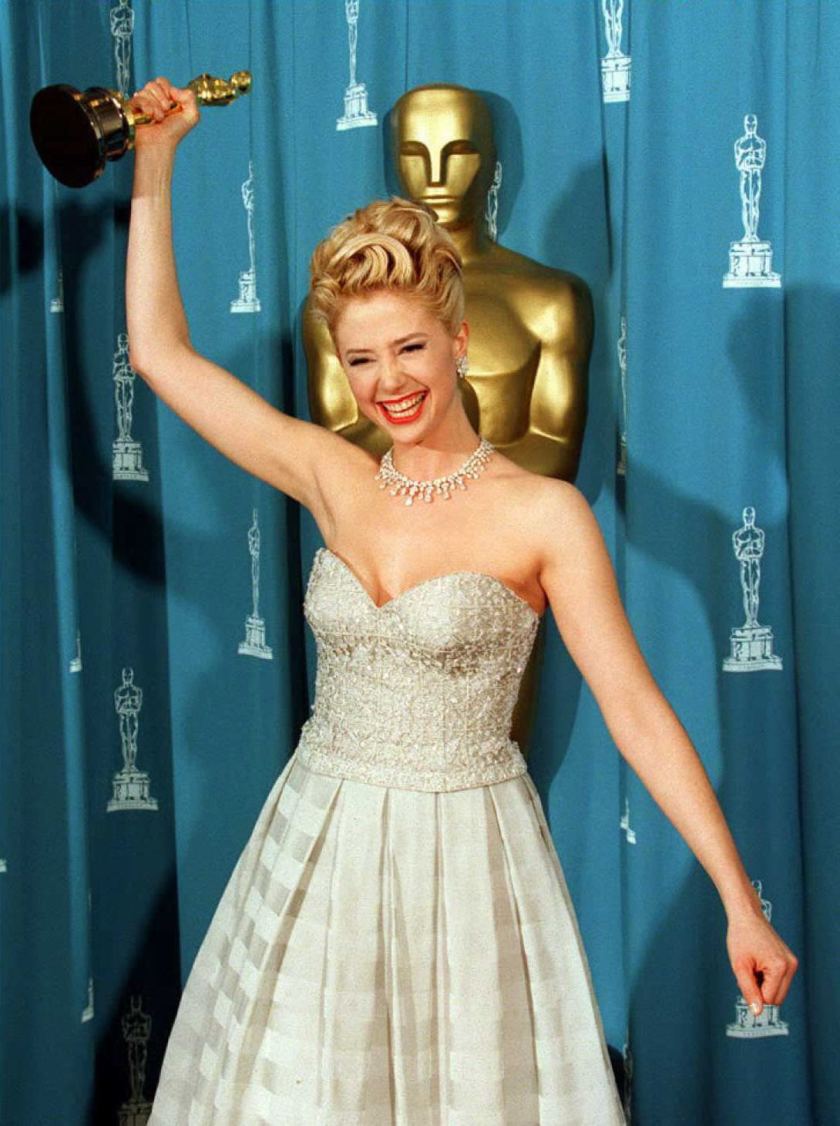
Academy Awards for supporting actors and actresses go to the strangest people — Walter Brennan won three of them. Mira Sorvino was tabbed for the prize in 1995 for her role as a prostitute in Woody Allen’s The Mighty Aphrodite. She has also been honoured by entomologists: an excretion of the sunburst diving beetle has been named  “mirasorvone”.

September 27

Home / Today in Church History / September 27

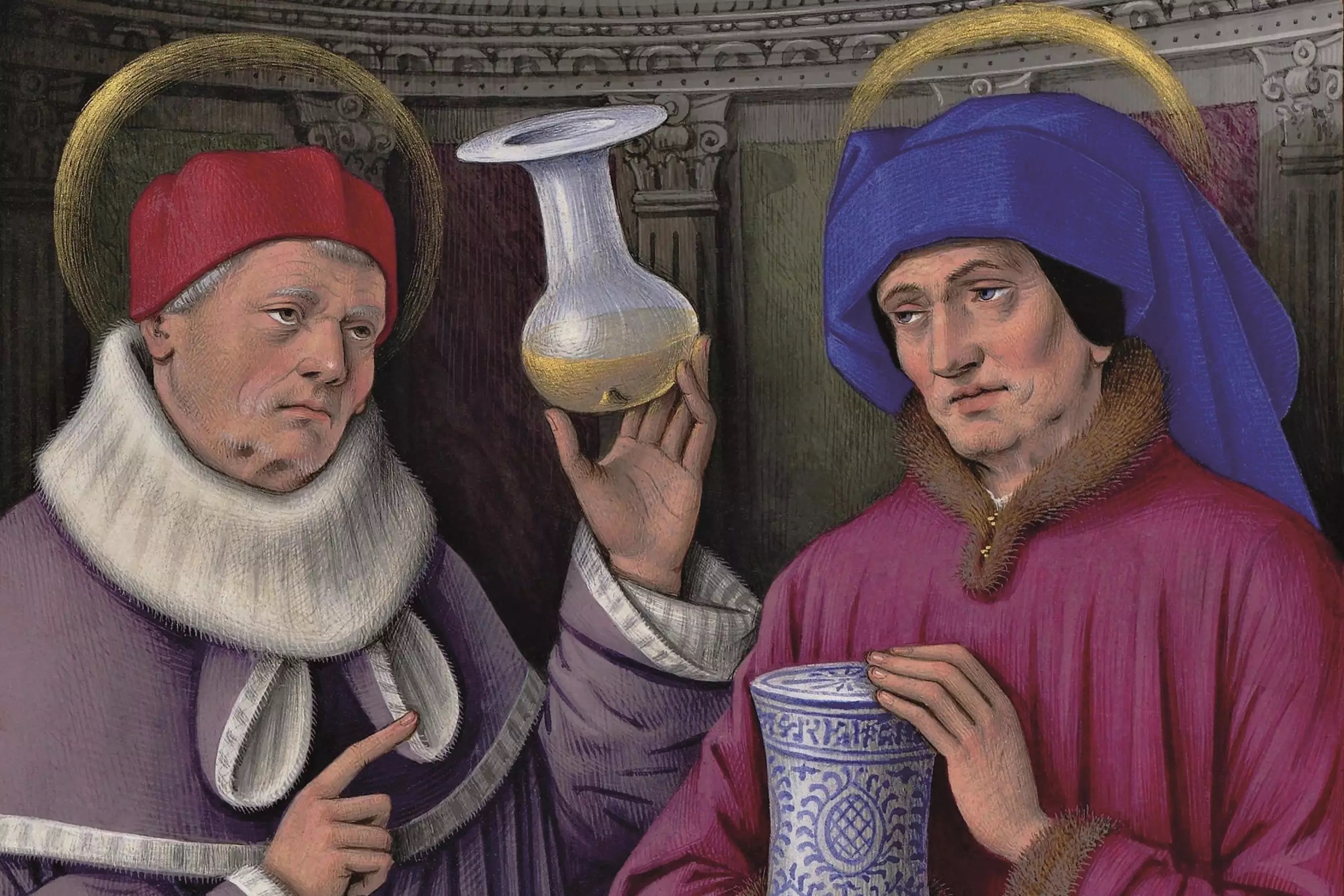
Saints Damian and Cosmas

Damian and Cosmas,  according to legend, were two third-century Syrian brothers (perhaps twins) who trained as physicians before their conversion to Christianity. They were known for their generosity and refusal to accept payment for their medical aid. In one particularly miraculous bit of healing, they grafted the leg of a dead black Ethiopian on to the body of a white patient who had lost his limb to cancer — an act which proved immensely popular with medieval and Renaissance artists (though the paintings disagree as to whether it was the right or left leg which was attached.) They were arrested during one of Diocletian’s persecutions and martyred.

Their legend spread widely very quickly with churches dedicated to them as early as the fourth century. The relics of Damian and Cosmas were removed from Syria to Constantinople by the emperor Justinian in the 500s and he ordered an elaborate tomb built for them in gratitude for a healing produced by their intercession. Their bones seem to have divided and multiplied, as a number of churches claim their twin skulls. Pilgrims may visit these heads in Madrid, Munich, and Venice.

They are the patron saints of surgeons, physicians, twins, dentists, barbers, pharmacists, veterinarians, orphanages, day-care centres, and confectioners. They are protectors of children and may be invoked by those suffering from hernias and the plague.

September 26

Home / Today in History / September 26

1983, The world is saved.

From The Spectator: In the early morning of September 26 1983, Stanislav Petrov of the Soviet Union’s Air Defense Force was on duty, monitoring his country’s satellite system, when the siren sounded. His computer indicated that the US had just launched five nuclear-armed intercontinental ballistic missiles, and protocol required him to notify superiors immediately. Soviet strategy was to ‘launch on warning’, and many in Moscow believed Ronald Reagan was planning a first strike. But Petrov had a gut feeling this was a false alarm. Five missiles seemed too few, and the system itself was new. He did not inform superiors and within a few minutes it became clear that he had been right. Much of the world could have been destroyed within an hour if Petrov had followed protocol.

He says he was the only officer in his team who had received a civilian education. “My colleagues were all professional soldiers, they were taught to give and obey orders.” So, he believes, if somebody else had been on shift, the alarm would have been raised.

A few days later Mr Petrov received an official reprimand for what happened that night. Not for what he did, but for mistakes in the logbook.

He kept silent for 10 years. “I thought it was shameful for the Soviet army that our system failed in this way.” But, after the collapse of the Soviet Union, the story did get into the press. Mr Petrov received several international awards.

He does not think of himself as a hero. “That was my job”, he said. “But they were lucky it was me on shift that night.”

September 25

Home / Today in History / September 25

1808 The Death of a Classicist

Richard Porson was born on Christmas Day in 1759 to a working-class English family but his brilliance and remarkable memory attracted sponsors who paid for his education at Eton and Cambridge. He soon developed a reputation as a keen scholar of the classics, publishing editions of Aeschylus, Xenophon and Aristophanes. Porson lost his teaching position at Cambridge because he was not in holy orders but his supporters pooled together enough money to give him a comfortable annuity. In 1792 he became Regius Professor of Greek at Cambridge, a position with few duties and less remuneration but in 1806 he was made librarian of the London Institution which came with a handsome salary.

Porson was an engaging conversationalist, though his excessive drinking and lack of personal hygiene were often remarked on. In 1808 he died of a stroke. Chambers has an anecdote to illustrate Porson’s unconventional behaviour:

The circumstances connected with Porson’s marriage are rather curious. He was very intimate with Mr. Perry, the editor of the Morning Chronicle, for whom his sister, Mrs. Lunan, a widow, kept house. One night the professor was seated in his favourite haunt, the Cider Cellars in Maiden Lane, smoking a pipe with a friend, when he suddenly turned to the latter and said: ‘Friend George, do you not think the widow Lunan an agreeable sort of personage, as times go?’ The party addressed replied that she might be so.

‘In that case,’ replied Porson, ‘you must meet me at St. Martin’s-in-the-Fields at eight o’clock to-morrow morning,’ and thereupon withdrew after having called for and paid his reckoning. His friend was somewhat puzzled, but knowing that Porson generally meant what he said, resolved to obey the summons, and accordingly next morning presented himself at the appointed hour at the church, where he found Porson, with Mrs. Lunan and a female friend, and a parson in full canonicals for the solemnisation of matrimony. The service was quickly got through, and thereupon the party quitted the sacred building, the bride and bridegroom going each different ways with their respective friends.

The oddity of the affair did not end here. Porson had proposed to Mrs. Lunan some time before, but had insisted on her keeping it a secret from her brother; and now that the ceremony was completed, seemed as determined as ever that nothing should be said of the marriage, having apparently also made no preparations for taking his bride home. His friend, who had acted as groomsman, then insisted that Mr. Perry should be informed of the occurrence; and Porson, after some opposition, consenting, the two walked together to the residence of the worthy editor, in Lancaster Court, where, after some explanation, an arrangement was effected, including the preparation of a wedding-dinner, and the securing of apartments for the newly-married couple.

After dinner, Porson, instead of remaining to enjoy the society of his bride, sallied forth to the house of a friend, and after remaining there till a late hour, proceeded to the Cider Cellars, where he sat till eight o’clock next morning! Not-withstanding what may well be called this most unprecedented treatment of a wife on her wedding-day, it is said that during the year and a half that the marriage subsisted, Porson acted the part of a kind and attentive husband, and had his wife lived, there is great reason to believe that she might have weaned him in time from his objectionable habits.

September 24

Home / Today in History / September 24

1893 Birth of blues legend

Lemon Henry “Blind Boy” Jefferson was born to a family of Texas sharecroppers. Visually impaired since birth, he became a street musician, playing gospel music and dance tunes, developing a unique vocal and guitar style. In the 1920s his talents were discovered and recording contracts made him a rich man. Hits like “See That My Grave is Kept Clean” and “Matchbox Blues” sold well and inspired later musicians such as the Beatles. Jefferson died in 1929 in mysterious circumstances, either in a blizzard, in a street robbery, or of a heart attack. He was indicted into the inaugural class of the Blues Hall of Fame.

Here Jefferson sings “Black Cat Moan”:

Let us also salute those other blues musicians with snappy nicknames: Lightning Hopkins, Blind Boy Grunt, Cripple Clarence Lofton, Muddy Waters, Peg Leg Sam, Washboard Sam, Backwards Sam Firk, Ironing Board Sam, Magic Sam, Watermelon Slim, Eddie “Cleanhead” Vinson, Howlin’ Wolf, Cow-Cow  Davenport, Taj Mahal, and the immortal Johnny “Big Moose” Walker.

September 23

Home / Uncategorized / September 23

The Battle of Plataea (cont’d)

Two tales from the 479 BC Battle of Plataea remain to be told.

The first concerns Aristodemus, a Spartan infantryman who had been part of the 300-hoplite force that guarded the pass at Thermopylae against the full force of the Persian invasion in 480 BC. He and a companion, Eurytus, had been stricken with an eye disease which nearly blinded them and been sent away from the fighting by King Leonidas. Eurytus, feeling guilty, turned back to join his unit and had perished when the Spartans and their allies were wiped out. Aristodemus, on his return to Sparta, was treated with contempt for not having done the same. Herodotus recounts that “no man would give him a light for his fire or speak to him; he was called Aristodemus the Coward.” The same treatment was meted out to another soldier, Pantites, who had been dispatched from Thermopylae with a message — he was so soundly abused that he committed suicide.

When Spartan troops encountered the Persians again at Plataea the following year, Aristodemus was determined to wipe out his shame. He fought with suicidal frenzy and died. After the battle Herodotus said there was discussion about who had fought most bravely:

According to my judgment, he that bore himself by far the best was Aristodemus, who had been reviled and dishonoured for being the only man of the three hundred that came alive from Thermopylae;​ and the next after him in valour were Posidonius and Philocyon and Amompharetus. Nevertheless when there was talk, and question who had borne himself  most bravely, those Spartans that were there judged that Aristodemus had achieved great feats because by reason of the reproach under which he lay he plainly wished to die, and so pressed forward in frenzy from his post, whereas Posidonius had borne himself well with no desire to die, and must in so far be held the better man. This they may have said of mere jealousy; but all the aforesaid who were slain in that fight received honour, save only Aristodemus; he, because he desired death by reason of the reproach afore-mentioned, received none.

The second story concerns this pillar which is erected in the heart of the Old City in Istanbul:

After their victory, the Greeks gathered metal from the spoils from the battle — swords, spear-heads, shields, chariot-fittings, etc. – and ordered a bronze column to made of three twisting serpents. This was erected at Delphi where it held a gold sacrificial cauldron, as a tribute to the gods. There it stood for over 700 years until the emperor Constantine had it removed in 324 to adorn the chariot race stadium in his new capital of Constantinople. The snake heads disappeared over time (though part of one can be seen in the nearby archaeological museum) but visitors in the 21st century can gaze upon the column and see relics of the climactic battle of the Persian wars 2500 years.