Snake Gods for Santa

Home / Christmas / Snake Gods for Santa

Yesterday I wrote about the time that Brazil tried to replace Santa Claus with a home-grown gift-bringer named Vovo Indio. Today, you will learn about a similar attempt in Mexico.

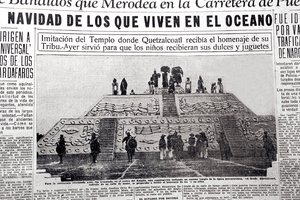
 About the same time as Brazil’s  experiment, Mexico too was in a revolutionary mood, anxious to cast off old ways. In a similar ill-starred move, to boost nationalism and assert Mexican independence of American and Spanish cultural figures, the Minister of Education proposed replacing Santa Claus and the Three Kings with a pre-Columbian pagan deity. Children were urged to direct their Christmas hopes to the Aztec god Quetzalcóatl; merchants used the god in advertising – G.E. ran an ad boasting that whether it came from the Magi, Santa or Quetzalcóatl, there could be no gift like a General Electric refrigerator –and on 23 December 1930 the government constructed a replica of an Aztec temple in the national stadium where the Plumed Serpent himself delivered presents to a crowd of children, watched by an approving President Pascual Ortiz Rubio. Like Vovo Indio, Quetzalcóatl proved to have no popular appeal. Critics pointed out to the ruling regime that an Aztec god, half-bird, half-snake,  was as foreign to contemporary Mexican culture as Santa Claus or the Reyes Magos.

Vovo Indio

Home / Christmas / Vovo Indio

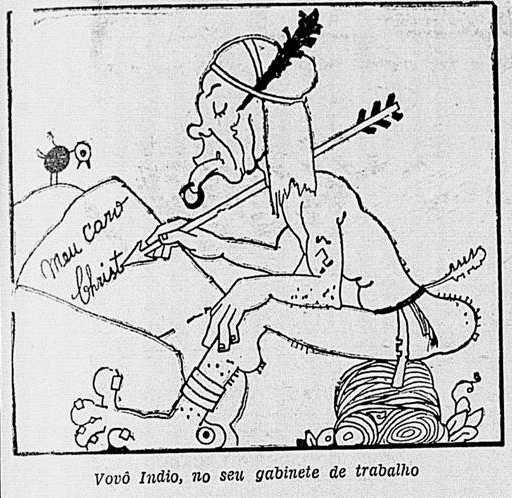
Sometimes defenders of local culture have attempted to introduce well-meaning synthetic replacements for Santa Claus, with humorous and short-lived results. In the 1930s the Brazilian government, rocked by the impact of the Great Depression and impressed by the seeming success of Mussolini’s Italian fascism, turned inward and instituted policies that emphasized national self-sufficiency. Foreign goods and foreign ideas were rejected and replaced with local production and ideology. This encouraged an abortive move to replace Papai Noel, the local version of Santa, with Vovo Indio, or “Grandfather Indian”, meant to be an alternative to Euro-American gift-bringers and thus inflate Brazilian patriotic sentiments. Instead of a fat, fur-clad saint from the chilly north, Vovo Indio was the child of a black slave and an aboriginal mother, raised by a white family, and wearing only a feather head-dress and loin-cloth. Despite political backing by the President and fascist ultra-nationalists, Vovo Indio never caught on with the children of Brazil (in fact, he was perceived as rather frightening) and he soon returned to the jungle.

December 9

Home / Christmas / December 9

In ancient Rome, ivy, Hedra helix, was a symbol of wine and merriment but was adopted by Christians as a sign of the human weakness that needs to cling to divine strength. In England it was frequently used as a greenery with which to decorate churches at Christmas, particularly in company with holly, with whom it is celebrated in song. In Scotland it was useful in divination. Young women would pluck an ivy life, hold it to their hearts and say: “Ivy, Ivy, I love you;/ In my bosom I put you,/ The first young man who speaks to me/ My future husband shall be.”

The plant, when hung in milksheds, was said to prevent souring and was also a preventative for baldness and corns. Its other medicinal uses can be read in this early-modern account:

The juice of the berries or leaves snuffed up into the nose, purges the head and brain of thin rheum that makes defluxions into the eyes and nose, and curing the ulcers and stench therein; the same dropped into the ears helps the old and running sores of them; those that are troubled with the spleen shall find much ease by continual drinking out of a cup made of Ivy, so as the drink may stand some small time therein before it be drank.

And as for ivy’s Christmas companion, holly, an English legend proclaims: “Whosoever against holly doth cry,/ In a rope shall be hung full high.” For, when the oak and ash trees babbled to the wind, and betrayed the Saviour’s hiding-place, the holly, the ivy, and the pine kept the secret hidden in their silent hearts; and for this good deed they stand green and living under winter’s icy breath, while their companions shiver naked in the blast. Not till the risen sun has danced on Easter morn shall the oak adorn a Christian household and prove itself forgiven. 

December 8

Home / Christmas / December 8

Two sorts of divination, or telling the future, were popular at Christmas: predicting the weather and discerning one’s intended spouse.

 One way of determining the weather in the year to come was based on the day of the week on which Christmas fell. Should it fall on a Sunday it meant a year of peace and good weather, a good year for sheep and beans, and the speedy capture of thieves.  Christmas Day on Monday produces a stormy and windy year; the sick will survive, although many beasts will die, and thieves be taken. Bad luck when Christmas Day falls on a Tuesday: women, sheep, lords, kings and thieves will die, yet the sick will recover. Wednesday presages a harsh winter with danger to the young and sailors. Thursday gives mixed predictions, but when when Christmas falls on a Friday, “you may sow in ashes”: i.e., crops will be so good they will spring up anywhere. Saturday’s indications are dire: “What woman that day of childe travaille / They shall bothe be in gret peraile”. Another means of weather prediction was to assign the Twelve Days of Christmas to a particular month; whatever the conditions on that day would prevail in the corresponding month. In New Zealand the Maoris say that if the pohutukawa flowers before Christmas, it will be a long hot summer; if it doesn’t, then a sultry, wet Christmas season is in store. A Scottish proverb that a “black Christmas makes a fat kirkyard” means that a snowless Christmas will result in may people dying in the coming year — a common saying all across Europe. The Romanian proverbs: “Christmas in mud, Easter in snow”; “Green Christmas brings white Easter” are similarly widespread. German farmers say: “If the crow is standing in clover at Christmas, she’ll be sitting in snow at Easter.”  A windy Christmas, however, and a calm Candlemas are signs of a good year.

There are countless ways for a young woman to determine the identity or character of her future husband. The girl might tap on the henhouse door on Christmas Eve: if a hen cackles her marital prospects are bad; cock crows are good. She might place her name and those of her friends on the bands of the ashen faggot; the first to burn through will be the first to marry. In Germany it was the custom to form a circle of girls and trust in the powers of a blinfolded goose —  the first to be touched by the bird will be the tnext to be wed. In Denmark young women could induce dreams of their future mates by reciting just before bedtime on St Lucia’s Eve:

Sweet St. Lucy, let me know

Whose cloth I shall lay,

Whose bed I shall make,

Whose child I shall bear,

Whose darling I shall be,

Whose arms I shall lie in.

December 7

Home / Christmas / December 7

On December 7/8, 1941, the Japanese Empire launched attacks on British, American and Dutch holdings in Asia, opening the Pacific sphere of the Second World War. During the next four Christmas seasons, anti-Japanese images could be found on cards and in other print publications. On both sides the war prompted racist tropes and metaphors. Hideki Tojo, the war minister, became the face of the Japanese enemy.

V-mail letters allowed troops in the field to provide their own pictures on communications with their loved ones back home at Christmas. 


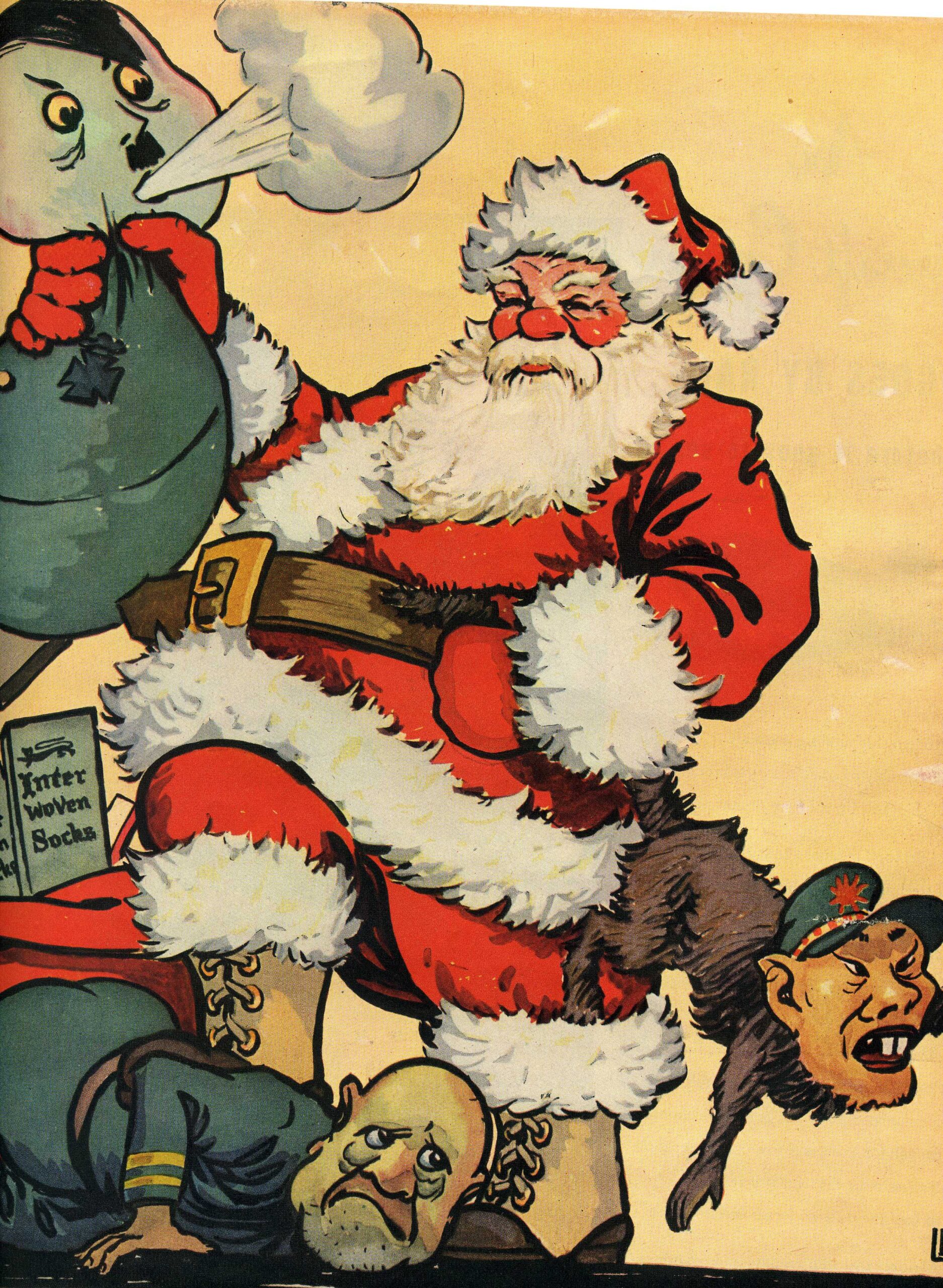
In this ad for socks, Santa Claus tames the Axis powers.

This mock message from Japan urges war industry workers to slack off. The dagger here and in the first V-mail above symbolize the American view that the was was necessary to punish Japan for its treacherous attacks in December, 1941.


December 6

440px-icon_c_1500_st_nicholas

The Feast of St Nicholas

At one time, Nicholas was, aside from the Virgin Mary, the most powerful of saints, prayed to for aid by Christians of all sorts and the patron of hundreds of churches from Iceland to Turkey. After the Protestant Reformation he fell on hard times; in the twentieth century he fell even lower at the hands of Pope Paul VI. But thanks to a love of Christmas his reputation is arising once more.

Legend says that Nicholas was born into a rich family living in what is now Turkey in the days of the late Roman empire. He became a priest and then a bishop of Myra in southern Asia Minor. Nicholas is said to have been at the 325 Council of Nicaea, which was held to determine whether Christ was truly divine, and where he supposedly struck Arius, the arch-heretic, a blow to the head. He developed a reputation for charity and miracle working which, after his death, led him to be venerated all across Europe. In one incident he was able to fly and rescue a sinking boat, leading him to be the patron saint of sailors; in another he resurrected three young scholars who had been pickled in a cask by a cannibal innkeeper, making him the patron saint of students, barrel makers and pickle makers; in another he dropped off gifts of money secretly at night to a poor family, saving the daughters from lives of prostitution, thus becoming the patron of maidens, marriage and a magical gift bringer to children.

By the year 1200 stories had spread of his giving gifts to children on the eve of his feast day, December 6. For 300 years he came by night on his white horse and left treats in the shoes of good children (and threatening bad or lazy kids with a good beating.) In the 1500s the cult of saints was abolished in Protestant lands and Nicholas was replaced in much of Europe as Christmas Gift-bringer by the Christ Child. However his legend was taken to North America by Dutch settlers where tales of good Sinterklaas lingered in the public imagination. Early in the 1800s New York poets, writers and illustrators reimagined him as “Santa Claus”, the figure who took the world of Christmas giving by storm, becoming a global superstar in the twentieth century.

Lately, however, Santa Claus has been subject to a campaign of resistance in those countries where he displaced traditional gift givers. In Spain, supporters of the Three Kings want the Magi returned to centre stage while in Germany, Austria, and the Netherlands, societies for the restoration of the legend of St Nicholas have placed the old fellow back in the hearts of children.

December 5

Home / Christmas / December 5

St Nicholas Eve

I have hundreds of German and Austro-Hungarian Christmas cards from World War I but this is the sole example I have of one that employs St Nicholas. Though the saint was a popular gift-bringer in German-speaking Catholic territories, he seems to have had no place on such cards. It is the Christ Child (Christkindl) or a Santa Claus (der Weihnachtsmann) figure who appears as the bearer of supernatural bounty.

Accompanying St Nicholas is Krampus, a beloved figure in Austria and some neighbouring areas. Krampus is portrayed as a demon who will threaten kids with chains, switches, or a pack into which he will throw bad children. Between the two is the Christmas angel. In Hungarian and German is the wish “Merry Christmas”

December 4

Home / Today in History / December 4

On this day in 1829 British imperialists, intent on maximizing their looting of the subcontinent and of grinding the face of the Indian natives further into the dust, abolished suttee, the Hindu practice whereby a widow is burnt alive on the funeral pyre of her husband. Not content with this brutal imposition of Western values on a rich and ancient culture, the British forced yet more of their middle-class Christian morality on helpless Asian populations: they would go on to wipe out Thugee (ritual murder in service of the goddess Kali which claimed 40,000 victims a year), human sacrifice, infanticide, piracy, head-hunting, foot-binding and slavery. Fortunately for cultural relativists everywhere, the British were eventually driven out of India and suttee has been revived.

On this day in 1974 the doddering existentialist Jean Paul Sartre visited the German anarchist Andreas Baader in prison. In his account of the meeting, Sartre mentions little of what he said to the jailed terrorist, but he might well have chosen to comfort him with this quote from his 1943 masterwork Being and Nothingness: “Man can will nothing unless he has first understood that he must count no one but himself; that he is alone, abandoned on earth in the midst of his infinite responsibilities, without help, with no other aim than the one he sets himself, with no other destiny than the one he forges for himself on this earth.” No doubt buoyed up by this encouraging message, Baader would go on to kill himself in his cell.

On this day in 1977 Jean-Bedel Bokassa, ruler of the Central African Empire, crowned himself. This former army sergeant and practicing cannibal was the darling of the government of France which paid $20,000,000 for the day’s festivities, which were modeled on the coronation of that other jewel in the crown of French democracy, Napoleon Bonaparte.

December 3

Home / Today in History / December 3
bayezid-selim

The birth of Bayezid II

In 1453, Mehmet the Conqueror took Constantinople for the Ottoman Turks, thus ending the Christian Roman Empire. Mehmet spent the rest of his life consolidating his gains by expanding into Europe and turning Constantinople into a glorious new capital for his regime. At the early age of forty-nine he died very suddenly; suspicions fell on a poisoner acting for his oldest son Bayezid, born on this day in 1447.

Bayezid claimed the throne but had to deal with the opposition of his brother Çem (or Jem). It was customary for a new sultan to murder all of his brothers and half-brothers so Çem fled to the Knights of St John, fierce enemies of the Turks; the Knights sent Çem to the pope who accepted a bribe from Bayezid to keep him locked up and not interfering in his rule.

Bayezid had a successful reign, warring against the Persians on his eastern border, mopping up more Christian territory, and taking advantage of the Spanish expulsion of their Jewish population. Bayezid sent Turkish ships to Spain to take on Jews wishing to migrate to Ottoman territory, laughing at the folly of Ferdinand and Isabella. “You venture to call Ferdinand a wise ruler,” he said to his courtiers, “he who has impoverished his own country and enriched mine!” Ironically, the pope held the same opinion and welcomed Jewish refugees into his Italian holdings.

Ottoman politics were often a blood sport. Late in life, Bayezid faced revolts by two of his sons. He defeated the rebellion of Ahmet but was deposed in 1512 by his son Selim (later known to history as “the Grim”). He died very shortly thereafter and is buried in Istanbul.

December 2

boats_on_thethames

1697 Dedication of the new St Paul’s Cathedral.

There has been a cathedral church dedicated to St Paul in London ever since the 600s. As fire and the ravages of time brought these buildings down there was always a desire to see them rebuilt. The fourth cathedral to occupy the present spot was begun after fire destroyed the third version in 1087. This was a massive stone structure that was completed only in 1314, in the Gothic style. This meant flying buttresses supporting tall walls filled with stained glass windows, pointed arches, imaginative decoration and a towering spire, 490 feet high. In 1561, shortly after the beginning of Elizabeth’s reign and the restoration of Protestantism, a lightning strike destroyed the spire. The building remained a centre of London life where far more than religious services were carried on. Critics complained that people would use “the south alley for usury and popery, the north for sorcery, and the horse fair in the midst for all kinds of bargains, meetings, brawlings, murders, conspiracies, and the font for ordinary payments of money.” Little wonder that one of the cathedral’s paid staff was the “dog-whipper” whose job it was to control the noise of animals in the church.

In the seventeenth century John Donne was the Dean of the cathedral and preached there often (go here for a virtual reconstruction of his Gunpowder Day sermon of 1622: http://vpcp.chass.ncsu.edu ). After the Puritans won the English Civil War the building was used as a barracks and stable. Its final disgrace came in 1666 when the Great Fire of London destroyed the timber-arched edifice. A new structure was started under the supervision of Christopher Wren. The first stone was laid in 1675 and the building was declared open for use on this day in 1697 but it took another 14 years before it was completed.

Wren’s building was massive with a dome that dominated the eastern prospect of London before the rash of grotesque skyscrapers marred the view in the late twentieth century.