1715 The death of Louis XIV
I did my master’s thesis in History on a book of political philosophy commissioned for the son of Louis XIV. I find that I am much less generous to the memory of the man than the English author of this 19th-century assessment.
Louis XIV had reigned over France for seventy-two years. He had been allowed to assume power beyond his predecessors; he had been idolised to a degree unknown to any other European sovereign. His wars, though latterly unfortunate, had greatly contributed to raise him in the eyes of his subjects. He had enlarged his dominions, and planted a grandson on the throne of Spain. As specially Le Grand Monarque amongst all contemporary sovereigns, he was viewed even by neighbouring nations as a being somewhat superior to common humanity. It becomes curious to see how such a demi-god could die.
Up to the 23rd of August 1715, Louis was able to attend council and transact business; for two days more, he could listen to music and converse with his courtiers. About seven in the evening of the 25th, the musicians came as usual to entertain him; but he felt himself too unwell to receive them, and his medical advisers were called instead. It was seen that his hour was approaching, and the last offices of religion were that night administered to him.
Next day, after mass, he called to his bedside the cardinals De Rohan and De Billi, in presence of Madame de Maintenon (his wife), the Father Tellier, the chancellor, and other officers, and said to them ‘I die in the faith and submission of the church. I am not instructed in the matters which trouble her, but have followed your counsels, and uniformly done what you desired. If I have done amiss, you will be answerable before God, who is now my witness.’ The two cardinals made no other answer than by eulogiums on his conduct: he was destined to be flattered to the last moment of his life.
Immediately after, the king said: ‘I again take God to witness that I have never borne hatred to the Cardinal de Noailles; I have always been distressed by what I have done against him; but it was what they told me I ought to do.’ Thereupon, Blouin, Fagon, and Mareschal asked in elevated tones: ‘Will they not allow the king to see his archbishop, to mark the reconciliation? The king, who understood them, declared that, far from having any objection, he desired it, and ordered the chancellor to make the archbishop come to him— ‘If these gentlemen,’ he said, looking to the two cardinals, ‘do not find it inconvenient.’ It was a critical moment for them.
To leave the conqueror of heresy to die in the arms of a heretic was a great scandal in their eyes. They withdrew into the recess of a window to deliberate with the confessor, the chancellor, and Madame de Maintenon. Tellier and Billi judged the interview too dangerous, and induced Madame de Maintenon to think so likewise; Rohan and the chancellor, having the future in view, neither opposed nor approved; all, once more approaching the bed, renewed their praises of the delicacy of the royal conscience, and told him that such a step could not but subject the good cause to the triumph of its enemies—nevertheless, they were willing to see the archbishop come, if he would give the king his promise to accept the constitution. The timid prince submitted to their advice, and the chancellor wrote in consequence to the archbishop. Noailles felt keenly this last stroke of his enemies, answered with respect, but did not accept the conditions, and could not see the king. From that time he was nothing but an ingrate and a rebel, and they spoke of him no more, in order that the king might die in peace.
The same morning, the king had the infant Dauphin (his great-grandchild, subsequently Louis XV) brought to him by the Duchess de Ventadour, and addressed him in these words: ‘My child, you will soon be the sovereign of a great kingdom: what I most strongly recommend to you, is that you never forget your obligations to God; remember you owe Him all that you are. Endeavour to preserve peace with your neighbours. I have loved war too much. Do not imitate me in that, nor in my too great expenditure. Take counsel in all things; seek to know the best, that you may follow it. Relieve your people as much as you can, and do for them that which I have had the misfortune not to be able to do for them myself. Do not forget the great obligations you are under to Madame de Ventadour. For me, madam,’ turning to her, ‘I am sorry not to be in a condition more emphatically to mark my gratitude to you.’ He ended by saying to the Dauphin: ‘My dear child, I give you my blessing with all my heart;’ and he then embraced him twice with the greatest marks of tenderness.
The Duchess de Ventadour, seeing the king so moved, took away the Dauphin. The king then received, in succession, the princes and princesses of the blood, and spoke to them all, but separately to the Duc d’Orleans and the legitimate children, whom he had made come first. He rewarded all his domestics for the services they had rendered him, and recommended them to show the same attachment to the Dauphin.
After dinner, the king addressed those about him. ‘ Gentlemen, I ask your pardon for the bad example I have given you. I would wish to show my sense of the manner in which you have always served me, my sense of your invariable attachment and fidelity. I am extremely vexed not to have been able to do for you all I wished to do. I ask you for my great-grandson the same attachment and fidelity you have shewn to me. I hope you will all stand unitedly round him, and that, if any one breaks away, you will aid in bringing him back. I feel that I am giving way too much, and making you give way too—pray, pardon me. Adieu, gentlemen; I reckon upon your occasionally remembering me.’
On Tuesday the 27th, when the king had no one beside him but Madame de Maintenon and the chancellor, he caused to be brought to him two caskets, from which he directed numerous papers to be taken out and burned, and gave orders to the chancellor regarding the remainder. Subsequently to this, he ordered his confessor to be called, and after speaking to him in a low voice, made the Count of Ponchartrain approach, and instructed him to carry out his commands relative to conveying his heart to the Jesuits’ convent, and depositing it there opposite that of his father, Louis XIII.
With the same composure, Louis caused the plan of the castle of Vincennes to be taken from a casket, and sent to the grand marshal of the household, to enable him to make preparations for the residence of the court, and conducting thither the young king—such were the words used. He employed also occasionally the expression, In the time that I was king; and then, addressing himself to Madame de Maintenon, said: ‘I have always heard that it is a difficult thing to die; I am now on the verge of this predicament, and I do not find the process of dissolution so painful a one.’ Madame de Maintenon replied, that such a moment was terrible when we still cherished an attachment to the world and had restitutions to make. ‘As an individual,’ rejoined the king, ‘I owe restitution to no one; and as regards what I owe the kingdom, I trust in the mercy of God. I have duly confessed myself; my confessor declares that I have a great reliance in God; I have it with all my heart.’
How indubitable a security was Father Tellier for the conscience of a king! The following day (Wednesday) Louis, as he was conversing with his confessor, beheld in the glass two of his servants who were weeping at the foot of his bed. ‘Why do you weep,’ said he, ‘did you think I was immortal? My age should have prepared you for my death.’ Then looking to Madame de Maintenon, ‘What consoles me in quitting you, is the hope that we shall soon be reunited in eternity!’ She made no reply to this farewell, which did not appear at all agreeable to her. ‘Bolduc, the first apothecary, assured me,’ says Duclos, ‘that Madame de Maintenon said, as she left the room: “See the appointment which he makes with me! this man has never loved any one but himself.” Such an expression, the authenticity of which I would not guarantee, as the principal domestics bore her no good-will, is more suitable to the widow of Scarron [her first husband] than to a queen.’ However this may be, Madame de Maintenon departed immediately for Saint-Cyr, with the intention of remaining there.
A Marseille empiric, named Lebrun, made his appearance with an elixir, which he announced as a remedy for the gangrene which was advancing so rapidly in the king’s leg. The physicians, having abandoned all hope, allowed the king to take a few drops of this liquid, which seemed to revive him, but he speedily relapsed; a second dose was presented, his attendants telling him at the same time that it was to recall him to life. ‘To life or to death,’ said the king, taking the glass, ‘whatever pleases God.’ He then asked his confessor for a general absolution.
Since the king had taken to his bed, the court had gathered in a marked manner around the Duke of Orleans [the future regent]; but the king having apparently rallied on Thursday, this favourable symptom was so exaggerated, that the duke found himself alone.
The king having noticed the absence of Madame de Maintenon, exhibited some chagrin, and asked for her several times. She returned speedily, and said that she had gone to unite her prayers with those of her daughters, the virgins of Saint-Cyr. Throughout the following day, the 30th, she remained beside the king till the evening, and then seeing his faculties becoming confused, she went to her own room, divided her furniture among her servants, and returned to Saint-Cyr, from which she no more emerged.
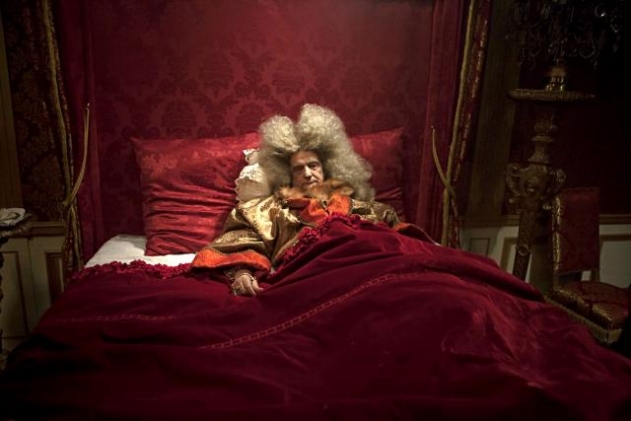
From this time, Louis had but slight intervals of consciousness, and thus was spent Saturday the 31st. About eleven o’clock at night, the curé, the Cardinal de Rohan, and the ecclesiastics of the palace came to repeat the prayers appointed for those in the agonies of death. The ceremony recalled the dying monarch to himself; he uttered the responses to the prayers with a loud voice, and still recognising the Cardinal de Rohan, said to him: ‘These are the last benefits of the church.’ Several times he repeated: ‘My God, come to my aid; haste to succour me’, and thereupon fell into an agony, which terminated in death on Sunday the 1st September, at eight o’clock in the morning.
‘Although,’ remarks Voltaire, ‘the life and death of Louis XIV were glorious, he was not so deeply regretted as he deserved. The love of novelty, the approach of a minority in which each one anticipated to make his fortune, the constitution dispute which soured men’s minds, all made the intelligence of his death be received with a feeling which went further than indifference. We have seen the same people, which, in 1686, had besought from Heaven with tears the recovery of its sick king, follow his funeral procession with very different demonstrations . . . . Notwithstanding his being blamed for littleness, for severities in his zeal against Jansenism, an overweening degree of arrogance in success towards foreigners, a weakness in female relationships, too much rigour in personal matters, wars lightly entered upon, the Palatinate given over to the flames, and the persecution of the adherents of the reformed doctrines, still his great qualities and actions, when placed in the balance, outweigh his defects. Time, which ripens the opinions of men, has set its seal on his reputation; and in despite of all that has been written against him, his name will never be pronounced without respect, and without conjuring up the idea of an epoch memorable through all ages. If we regard this prince in his private life, we see him, it is true, too full of his exalted position, but withal affable, refusing to his mother any share in the government, but fulfilling towards her all the duties of a son, and observing towards his wife all the externals of good-breeding; a good father, a good master, always decorous in public, hard-working in council, exact in business, just in thought, eloquent in speech, and amiable with dignity.’