June 28

Home / Today in History / June 28

1914

A dreadful moment

It’s one of those great turning points in history. A young terrorist, disappointed at missing his target earlier in the day, is astonished to see the man appear, being driven slowly toward him again in an open car. He steps forward, aims at the middle-aged couple in the back seat and fires his pistol …

Had Gavrilo Princip missed; had the driver taken the correct route; had the Archduke not insisted on seeing the victims wounded in the previous attack, would Austria and Serbia have fought anyway? Would World War I still have broken out? Would 20,000,000 have died? Would my great-uncle Bill still have suffered shell-shock on the Western Front and wandered away to be lost forever to his family?

The slow collapse of the Turkish Empire meant that it was withdrawing from parts of southeastern Europe it had ruled for centuries, leaving a political vacuum that both the Kingdom of the Serbs and the Austro-Hungarian Empire wished to fill. A particularly contentious area was Bosnia, with its mixed population of Orthodox Serbs, Muslims and Catholic Croats. It was ruled by Austria but coveted by Serbia who wished to build a pan-Slavic state in the region. A teen-age Bosnian Serb, Gavrilo Princip, wished to see his nation join Serbia and associated himself with the Black Hand, a terrorist group linked to the Serbian secret police. When the Black Hand learned that the heir to the Austrian throne, Archduke Ferdinand, would be visiting Sarajevo they saw an excellent opportunity to create an outrage that would lead to a war of liberation. They trained and supplied Princip and five others for a murderous attack on the royal procession.

However, on the day, things did not work out as planned. The first two would-be killers, armed with pistols and bombs, froze as the Archduke and his wife Sophie drove by. Farther on, the third threw his bomb but it bounced off the royal car and exploded on the street injuring 16 people. The bomber atttempted to commit suicide by swallowing a cyanide pill but it was old and had lost its potency – he then leapt into the river but discovered it was only knee-deep. He was arrested and beaten up by the crowd as the motorcade proceeded on. The Archduke reached the safety of the town hall but then insisted on being taken to the hospital to visit those wounded by the bomb. The route — which was the wrong one — took the car to the spot where Princip was standing. He took out his Belgian semi-automatic FN .38 and fired the shots that would start World War I.

Princip was too young to be executed so he was imprisoned and died of tuberculosis in 1918. Three of his co-conspirators were executed and a dozen others involved in the plot were imprisoned. But what of the Serbian masterminds of the plot who were safe inside their borders? In 1916 when secret talks were carried out between Austria and Serbia about a possible peace, the Austrians demanded an end to such plots and the Serbian Regent, who was himself concerned about the power wielded by his military and intelligence agencies, obliged by arresting those who had planned the assassination. Three of his officers were executed on trumped-up charges and others thrown in jail.

Despite the horrific results of Princip’s actions, the killer is still a hero in Serbia. In 2015 that country’s president attended the unveiling of a statue in Belgrade to the terrorist and proclaimed: “Princip was a hero, a symbol of liberation ideas, tyrant-murderer, idea-holder of liberation from slavery, which spanned through Europe”.

June 26

Home / Today in History / June 26

1522

Suleiman the Magnificent attacks the Knights of St John on Rhodes

With the fall of Acre in 1291 the orders of crusading monks, the Knights of St John, the Templars and the Teutonic Knights, would be based in the Holy Land no more. The Teutonic Knights would concentrate on crusading against pagans in northern Europe, the Templars would be destroyed by the papacy and the King of France, and the Knights of St John (aka the Hospitallers) moved temporarily to Cyprus.  In 1309 the Knights of St John seized territory from their fellow (albeit Byzantine Orthodox) Christians — the island of Rhodes just off the coast of what is now Turkey and the port of Halicarnassus (now the resort town of Bodrum) on the nearby mainland.  The Knights built powerful fortifications in both sites (sadly the ruins of the Mausoleum of Halicarnassus, one of the Seven Wonders of the Ancient World, were dismantled and used in building towers) and from there they fought against Islamic armies and navies, making themselves a considerable thorn in the side of the powerful Turkish sultanates in the eastern Mediterranean. As such they became the target of Muslim attempts to drive them away. In 1444 the Mameluke Sultan of Egypt mounted an expedition against them. The siege lasted 40 days but with the help of a Burgundian fleet, the Mamelukes were defeated. Mehmet the Conqueror, the Ottoman Turk who took Constantinople in 1453 and destroyed the Byzantine Empire, was determined to take Rhodes but his attempt in 1480 failed.

On June 26, 1522 the newly-crowned Ottoman emperor, Suleiman the Magnificent, arrived off the coast of Rhodes with 400 ships and an army of 100,000 men to attack the 7,000 men defending Rhodes under the Grand-Master, Philippe Villiers de l’Isle-Adam. Over the course of months a steady artillery bombardment and a series of underground mine explosions opened gaps in the walls. On December 22, both sides agreed to an honourable surrender. The Knights would leave Rhodes with their weapons and wealth and as many civilians as wished to accompany them. The Turks promised those Christians who stayed that they could keep their churches and pay no taxes for five years.

The fall of Rhodes tightened the Turkish hold on the Levantine coast but the Knights of St John would resume their war against them after they accepted a new base of operations on the island of Malta, donated by its overlord, the king of Spain. The annual rent for this island would be a single falcon payable on All Saints’ Day.

June 22

Home / Today in History / June 22

1941

Operation Barbarossa

Invading the Russian heartland from the west seems to be a bad idea. The Teutonic Knights tried it and lost the Battle of the Ice in 1242; the Swedes tried it and were thrashed at Poltava in 1709; Napoleon tried it and never recovered from the retreat from Moscow in 1812; and Hitler tried it in 1941 with Operation Barbarossa, the largest military action in world history. The result: close but no cigar.

Adolf Hitler’s political testament My Struggle, written in the 1920s, made his intentions clear. The future of Germany lay in expanding into eastern Europe, cleansing it of its Slavic population, and making living space for a racially-pure Aryan race. We completely break our past colonial and trade policy and deliberately turn to acquiring new lands in Europe. We can only consider Russia and its neighboring countries. After Hitler’s election in 1933, the relations between Germany and the USSR were hostile; the Spanish Civil War was a proxy conflict with both nations pouring arms and men into the opposing sides. Stalin watched in alarm as Hitler swallowed up Austria and Czechoslovakia and turned his eyes on Poland but could not bring himself to ally with other German foes such as Britain and France.

The world was astonished, therefore, to learn that in August 1939, these antagonists had signed the Molotov-Ribbentrop Pact, which set out a 10-year peace treaty (and which, in secret clauses, vowed cooperation in an invasion of Poland). Scarcely more than a week later, Germany invaded Poland and soon after, Soviet forces occupied the east of the country and would go on to extinguish the independence of Latvia, Lithuania, and Estonia.

The German Reich and the Soviet Union now shared a long common border. No one expected their peace to last the full 10 years but, despite numerous warnings from spies and western powers, Stalin was taken by surprise when, less than two years after the pact, millions of German troops swarmed into the Soviet Union in Operation Barbarossa, named for a medieval Holy Roman Emperor. Joined with allies from Finland, Slovakia, Italy, Hungary and Romania, German divisions pressed deep into the USSR, taking millions of Red Army soldiers prisoner. But despite overrunning vast Russian territory and sweeping aside a number of armies, the German did not achieve their goals: the front stalled in front of Leningrad and Moscow as winter set in. A desperate gamble had failed.

June 20

Home / Today in History / June 20

1909

Birth of a romantic legend

Though this daily blog charts history’s more momentous events — battles, treaties, catastrophes, and atrocities — there can still be time to celebrate one who, in the words of Dr Johnson’s praise of David Garrick, added to the “the public stock of harmless pleasure”.

Errol Flynn was born in Tasmania and educated in Australia and England. Expelled from school for having sex with the laundry lady and fired from his first job for theft, he gave early signs of a life spent in ignoring conventional morality.  By the age of 24 he had been bitten by the acting bug and started appearing on stage in Britain and in lightweight films. Though dramatic depth was never his strongpoint, his easygoing charm and swashbuckling manner soon saw him starring in roles that featured his lithe form and skill with a blade, such as Captain Blood, The Adventures of Robin Hood and The Charge of the Light Brigade. He was equally at home twirling a six-gun in Dodge City, They Died With Their Boots On, Santa Fe Trail and Virginia City.

Flynn could not resist the bottle or women, especially young (very young) women and scandal dogged his career. He died dissolute and puffy at the age of 50 but will always be remembered for his way with romantic lines that no present-day actor could get away with. Heed the following.

From The Adventures of Don Juan

Don Juan: I have loved you since the beginning of time.

Catherine: But you only met me yesterday…

Don Juan: Why, that was when time began!

Or

Catherine: But you’ve made love to so many women.

Don JuanCatherine, an artist may paint a thousand canvasses before achieving one work of art, would you deny a lover the same practice?


June 18

Home / Today in History / June 18


1815

The Battle of Waterloo

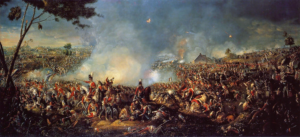
For twenty years, Napoleon Bonaparte, a minor Corsican noble who had made himself Emperor of the French, had troubled Europe with his armies and insane ambitions. Millions had died in the battles that raged from the Caribbean to the ruins of Moscow, but in 1814 Napoleon had found himself facing a great coalition that had brought him to admit defeat. Instead of taking him behind the woodshed and shooting him, thus ridding the world of such a pest, the crowned heads of Europe decided that it would not do to execute someone who had worn an emperor’s crown, an act that might give the lower orders dangerous ideas. So, a ridiculous fiction was devised, whereby Napoleon would continue his life as a ruler, but his domain would be restricted to the tiny island of Elba, off the west coast of Italy. He was given the freedom of his territory but a British squadron patrolled the island’s shores to prevent his escaping.

But escape he did. A small boat took him to France where the armies that had been sent to arrest him fell under his spell and reinstated him in imperial splendour in Paris. Poor Louis XVIII, whose Bourbon dynasty had been restored, fled quickly to England. For 100 days Napoleon ruled again and gathered a force to smash the coalition, marching north into Belgium to encounter a British army stationed there, before it could be joined by a Prussian contingent.

The leader of the British was Arthur Wellesley, the Duke of Wellington, who had a splendid career fighting in India and driving the French out of Portugal and Spain. Napoleon derided him as a “sepoy general” but he had beaten every French marshal that Bonaparte had sent against him. The two sides met at Waterloo, south of Brussels, and fought a bloody battle all day. Napoleon’s artillery hammered the British across a valley and senseless cavalry charges by both sides proved that mounted units were the best-looking but stupidest troops on the field. When, in the evening, German reinforcements arrived and the massed fire of British rifles drove back uphill charges by Napoleon’s elite Imperial Guard, the battle was lost. Shouts of “La Garde recule. Sauve qui peut!” (“The Guard retreats. Save yourself if you can!”) prompted a retreat. Napoleon abdicated his throne and surrendered to the British on July 15, 1815.

June 15

Home / Today in History / June 15

1859

The Pig War between Canada and the USA

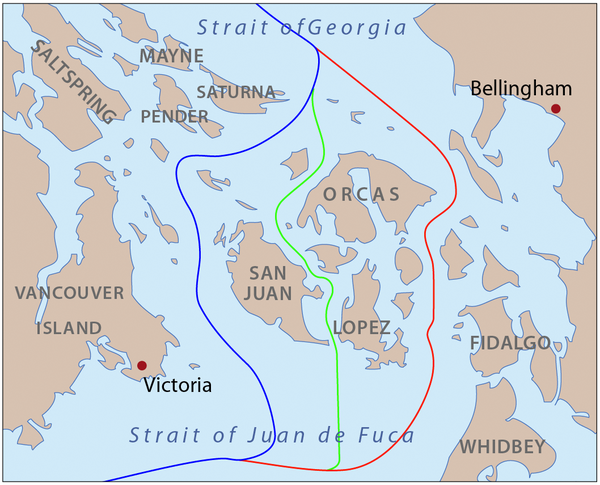
The Oregon Treaty of 1846 had settled the boundary between British North America (later to be Canada) and the United States from the prairies to the Pacific along the 49th parallel. Things got a bit tricky however in the waters between the mainland and Vancouver Island — the Island, occupied by the British, dips below the parallel. Unfortunately, ambiguity in the language of the treaty resulted in rival claims to the San Juan Islands. An online article by Tod Matthews takes up the story:

Before the Pig War, the British were determined to resist the tide of American migration sweeping across the Rocky Mountains. They argued that the Americans were trespassing on land guaranteed to Britain by earlier treaties and explorations and through trading activities of the long-established Hudson’s Bay Company. Americans considered the British presence an affront to their “manifest destiny to overspread the continent” and rejected the idea that the land west of the Rockies should remain under foreign influence. The Oregon Treaty of 1846 gave the United States undisputed possession of the Pacific Northwest south of the 49th parallel, extending the boundary “to the middle of the channel which separates the continent from Vancouver’s Island; and thence southerly through the middle of the said channel, and of Fuca’s straits to the Pacific Ocean.” However, the treaty created additional problems because its wording left unclear who owned San Juan Island. The difficulty arose over that portion of the boundary described as the “middle of the channel” separating British-owned Vancouver Island from the mainland. Actually, there were two channels: Haro Strait (nearest Vancouver Island) and Rosario Strait (nearer the mainland). San Juan Island lay between the two. Britain insisted that the boundary ran through Rosario Strait; the Americans claimed it lay through Haro Strait. Thus, both sides considered San Juan theirs for settlement.

By 1859, there were about 25 American settlers on San Juan Island. They were settled on redemption claims which they expected the U.S. Government to recognize as valid but which the British considered illegal. Neither side recognized the authority of the other. Amazingly, this conflict occurred on an island only 20 miles long and seven miles wide, covering 55 square miles

When American settler Lyman Cutlar shot and killed the Hudson’s Bay Company’s marauding pig, the feud between nation’s came to blows. British authorities threatened to arrest him. American citizens requested military protection. Brig. Gen. William S. Harney, the commander of the Department of Oregon and anti-British to boot, responded by sending a company of the 9th U.S. Infantry under Capt. George E. Pickett to San Juan. James Douglas, governor of the Crown Colony of British Columbia, was angered at the presence of American soldiers on San Juan. He had three British warships under Capt. Geoffrey Hornby sent to dislodge Pickett but with instructions to avoid an armed clash if possible. By August 1861, five British warships mounting 167 guns and carrying 2,140 troops opposed 461 Americans, protected by an earthen redoubt and 14 cannons. When word of the crisis reached Washington, officials there were shocked that the simple action of an irate farmer had grown into an explosive international incident. San Juan Island remained under joint military occupation for the next 12 years. In 1871, when Great Britain and the United States signed the Treaty of Washington, the San Juan question was referred to Kaiser Wilhelm I of Germany for settlement. On October 21, 1872, the emperor ruled in favor of the United States, establishing the boundary line through Haro Strait. Thus San Juan became an American possession and the final boundary between Canada and the United States was set. On November 25, 1872, the Royal Marines withdrew from English Camp. By July 1874 the last of the U.S. troops had left American Camp. Peace had finally come to the 49th parallel.

June 7

1900

“Smash! Smash! For Jesus’ sake, smash!”: Carrie Nation attacks her first saloon

Carrie Nation (1846-1911) was an American teacher and member of the Women’s Christian Temperance Union who vociferously opposed the sale of alcohol. In 1900, in her home of Medicine Lodge, Kansas, she received a message from God:

The next morning I was awakened by a voice which seemed to me speaking in my heart, these words, “GO TO KIOWA,” and my hands were lifted and thrown down and the words, “I’LL STAND BY YOU.” The words, “Go to Kiowa,” were spoken in a murmuring, musical tone, low and soft, but “I’ll stand by you,” was very clear, positive and emphatic. I was impressed with a great inspiration, the interpretation was very plain, it was this: “Take something in your hands, and throw at these places in Kiowa and smash them.”

Taking this message to heart, she went to Dobson’s Saloon in Kiowa and greeted the patrons with the words “Men, I have come to save you from a drunkard’s fate”. She then proceeded to smash the bar and its bottles of the demon rum with rocks she had picked up and a sledge hammer. Other saloons in the area received similar treatment at the hands of this fiery Amazon — she was over six feet tall and weighed 250 pounds. Her husband jocularly suggested that she use a hatchet during her next attack and this became her trademark; she called her assaults “hatchetations”. She and her followers from the WCTU or the Anti-Saloon League attacked bars across the United States, resulting in a series of arrests and fines which did not deter her. She died in 1911, a national celebrity and eight years later the United States adopted Prohibition.

May 29

1453

The Fall of Constantinople

On May 29, 1453, the troops of the Turkish Sultan Mehmet II broke through the defences of Constantinople and completed the conquest of the city. Michael Paleologus, the last ruler of the Roman Empire died fighting before the city was comprehensively sacked and its inhabitants sold into slavery. The great Church of Holy Wisdom, Hagia Sophia, was immediately turned into a mosque. The most sacred relic of eastern Christians, the Hodegetria, a portrait of Mary and the baby Jesus supposedly painted by Luke the Evangelist, was chopped into bits for the gold in its frame.

By that time, Constantinople, once the grandest city on the planet, was only a hollow shell of its former self and the Roman Empire, of which it had been its capital, was reduced to a few scattered holdings. But the capture of the city had enormous political and symbolic importance. Both the Turks and the Russians claimed to be the heirs of Byzantium. Mehmet styled himself the Kayser-i-Rum, “Roman Emperor” and decreed that his next conquest would be Rome itself. The ruler of Muscovy, Ivan III, married a Byzantine princess and declared that he was the successor of Orthodox supremacy, appropriating the title of Czar, or “Caesar”. The flood of exiles from the city who found refuge in Italy brought with them manuscripts and a knowledge of Greek that helped fuel a second stage in the Renaissance. Turkish expansion brought with it a strangling of the trade between Asia and Europe, encouraging Europeans to embark on direct voyages to the East rather than relying on Islamic middle men; the expeditions of Columbus and Vasco da Gama are results of the fall of Constantinople.

Today, visitors to Constantinople, called “Istanbul” by the Turks, can visit a tiny enclave in the Fener district by the Golden Horn and see the compound of the Patriarch of Constantinople, the last remaining official of the Roman Empire.

May 21

1660

Battle of the Long Sault

The continued existence of the colony of New France was always more than a little perilous. At risk from European powers when the home country went to war with the Dutch or the British, and under the constant threat of native resistance, particularly from the savage Iroquois Confederacy, the colonists lived in a state of perpetual tension.

Dollard des Ormeaux was a young man with some military experience before migrating to New France where he settled in Ville-Marie, what is now Montreal. Learning that an Iroquois force assembling on the Ottawa River was intent on raiding French settlements on the St Laurence, Dollard proposed taking a party inland and ambushing the hostile natives. With the agreement of the town’s leadership, Dollard gathered 17 settler volunteers and 4 Huron for the guerrilla task. In early May they reached the Ottawa and established themselves in an old Algonquian fort at the Long Sault, where they were joined by another 40 Huron warriors.

The Iroquois force they meant to ambush was far larger than anticipated, numbering perhaps 700, and Dollard and his men soon found themselves besieged. They held off the Iroquois for five days, despite the defection of many of the Huron. The crucial moment came when Dollard lit a barrel of explosives which he meant to hurl into the enemy ranks but at that moment he was shot and the gunpowder fell back into the fort, killing many of its defenders in the explosion. The Iroquois soon overran the palisades and found only 5 Frenchmen alive; 4 soon died and the other was taken prisoner along with a few Huron to be tortured to death and cannibalized.

The fact that the Iroquois, at this point, returned home and did not attack the settlements has led to Dollard and his men being treated as the saviours of New France. Recent historians have tried to downplay the heroic aspect, suggesting that Dollard was really intent on stealing furs, and that the Iroquois would not have gone on to imperil New France anyway. The debate continues.

May 19

A Big Day in Tudor History

1499

Heir to the Tudor dynasty of England, Prince Arthur, weds by proxy Spanish princess Katharine of Aragon, daughter of Ferdinand and Isabella. Katharine is 13 and Arthur is 12; they will not meet until over two years later. They were married on November 14, 1501 but they may not have consummated the marriage — a matter of enormous consequence as Arthur died in April 1502 and Katharine was left a widow. Her claim to be a virgin sped the papal dispensation that allowed her to marry Henry VIII, Arthur’s brother, in 1509.

1536

Henry VIII divorced his wife Katharine of Aragon in order to marry his pregnant mistress Anne Boleyn. Unfortunately for Anne, she could not produce a male heir, giving birth only to a daughter Elizabeth, and suffering three miscarriages. Henry then decided to replace her with Jane Seymour and charged Anne with incest and adultery; she was beheaded on this date.

1568

Elizabeth, daughter of Henry VIII, was not the only claimant to the English throne. In the person of Mary, Queen of Scots, she faced another woman of Tudor blood, untouched by the accusations of bastardy which haunted Elizabeth, and supported by the princes of Catholic Europe. On this day, Elizabeth orders the arrest of Mary who had abdicated the Scottish throne and fled over the English border from rebellious nobles.