August 13

Home / Today in History / August 13

1961

Construction of the Berlin Wall

At the end of World War II, the the map of the defeated Germany was considerably altered. Parts of the nation were lopped off and given to neighbouring countries while the remaining territory was divided into four, each ruled by one of the occupying powers. There were sectors for the French, British, Americans, and USSR; the old capital Berlin, now deep in the Soviet sector, was similarly divided. In 1948 Stalin tried to drive the Western powers out of Berlin by blockading the city but the Berlin Airlift thwarted that.

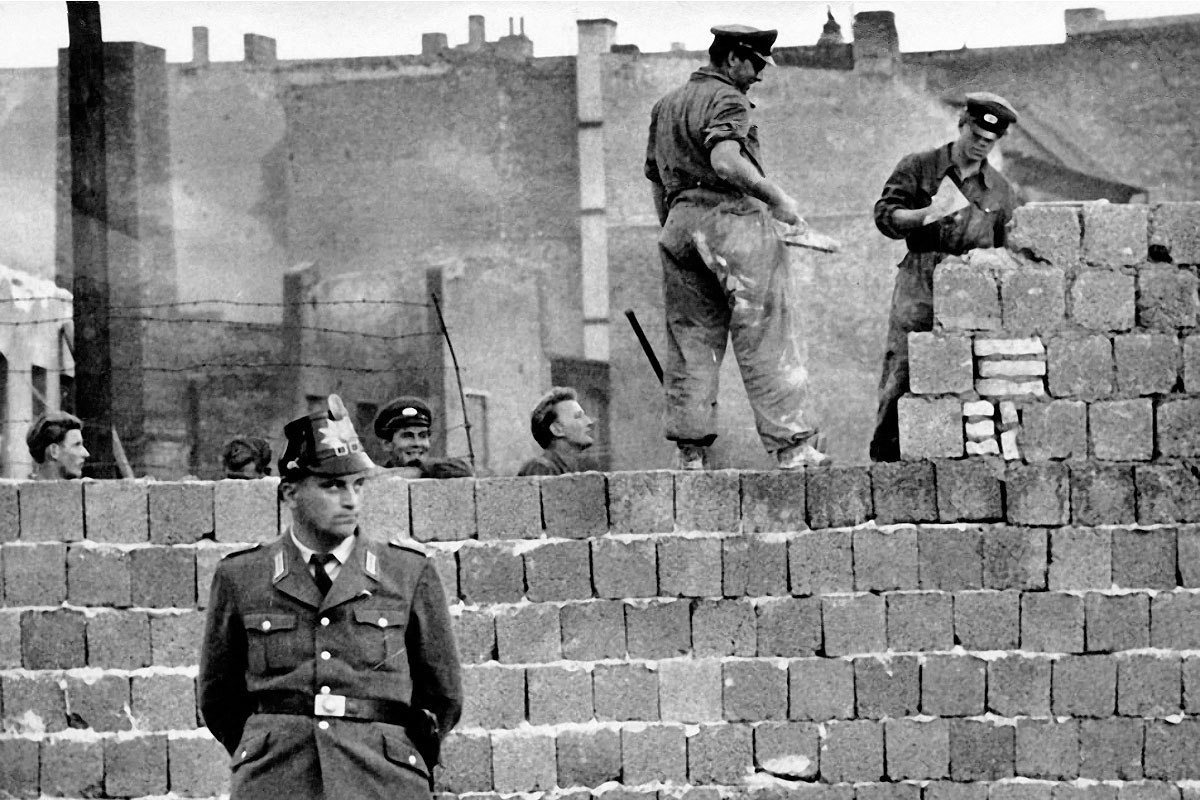
Western Germany, or the German Federal Republic, emerged out of the French, British, and American sectors, democratic with a market economy; in the East, the German Democratic Republic, was a Soviet puppet state with a communist command economy. The prosperity gap that increasingly separated the two to the benefit of the westerners and political freedoms led to a desire on the part of GDR residents to migrate west. Before 1961, 3.5 million Germans had done so, perhaps as much of 20% of the population. Particularly irksome to the eastern government was the loss of young, educated Germans to a brain drain, with the relaxed border in Berlin as the faucet. Consequently at the urging of their Soviet masters, the populace of the city awoke on the morning of August 13, 1961 to the construction of the Antifaschistischer Schutzwall, the Anti-Fascist Protection Rampart,  a barrier separating East and West Berlin, supposedly designed to keep the nasty capitalists out of the East German paradise. Hundreds of refugees fled over the makeshift border while it was being erected but it soon enclosed West Berlin in a ring of concrete, barbed wire, mines, dog patrols, and a no-man’s land death strip.

The Wall, which was eventually pierced in 1989, may have been of economic benefit to the GDR (ending the black market and enabling tighter control) but it was an enormous spiritual black eye to the communist project. If you had to make a prison of your own country, how could you proclaim the benefits of a Marxist society? Both Presidents Kennedy and Reagan scored propaganda coups by coming to the Wall and demanding its removal.

August 11

Home / Today in History / August 11

1965

The Watts Riots

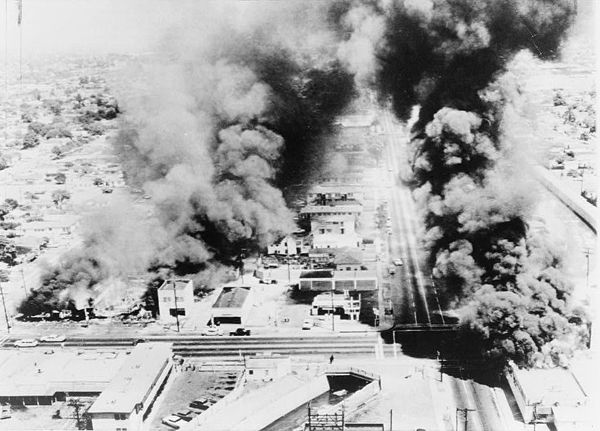
A post-war migration of southern African Americans to the Los Angeles area created urban tensions as restrictive housing laws created largely black sections of the eastern and southern parts of the city. These shady real estate practices and perceived racial bias by the Los Angeles Police Department created resentment in areas such as Watts and Compton. On August 11, 1965 a routine evening traffic stop resulted in six days of rioting that caused deaths, enormous damage, and the summoning of the armed forces to subdue the unrest.

Marquette Frye was arrested for drunkenly driving his mother’s 1955 Buick, but a scuffle broke out when bystanders and Frye’s family protested his treatment. In addition to taking Marquette into custody, his mother and brother were also arrested. Guns were drawn, back-up was summoned, crowds gathered, and bottles were thrown. Despite attempts by community leaders to calm the situation, rumours spread about police brutality, and rioters took to the streets, vandalizing buildings and menacing white passersby. After two days of disturbances, the California National Guard put 2,300 reservists on to the streets to join 1,600 police, all to little avail. Arson was widespread, mobs enforced-no-go areas, and police were attacked; it was estimated that 30,000 inhabitants participated in the riots. The LAPD responded with mass arrests and ordered a curfew; bit by bit they took back the neigbourhoods and by August 16 peace had been restored.

The toll was high: 34 deaths, 1,038 injured, 3,438 arrested; hundreds of buildings and businesses over a 50-square-mile area were burnt or looted. A commission determined that a number of racial inequities in employment, housing and education were to blame. This was not to be the last major race riot in the 1960s.

August 10

Home / Today in History / August 10

1680

The Pueblo Revolt

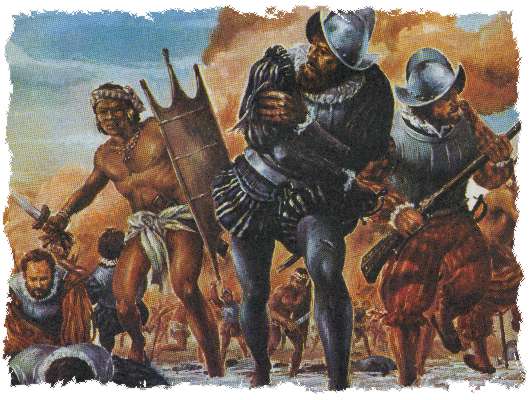
Beginning in the mid-16th century, Spanish troops and settlers penetrated into the territory of the Pueblo in what is now New Mexico. Though royal Spanish law was remarkably tolerant for the time, its enforcement in distant parts of the empire was weak, leading to the enslavement and forced conversion of natives. Franciscan missionaries evangelized the Pueblo and won many to at least a superficial attachment to Christianity but most natives continued various aspects of their traditional spirituality including psychoactive drugs and kachina dances. Drought conditions and raids by the Apache added to the resentment against the Spanish occupiers and prompted a number of local unsuccessful revolts.

In 1680 a Pueblo leader named Popé (or Po’pay) engineered a conspiracy against the Spanish settlers and their missionaries. The notoriously fragmented natives had no tradition of political unity, but such was their hatred of their suppression that they listened to Popé’s blandishments, which promised an end to the drought and a return to prosperity if the foreigners were expelled and the Pueblo returned to the worship of their old gods. On August 10 they rose up en masse and began murdering hundreds of priests and colonists. Columns of frightened Spanish retreated from the territory into the safety of Texas, leaving the Pueblo once again in charge of their destiny. Popé travelled through the land, urging the destruction of all Spanish churches, and buildings, and discouraging the agriculture that the newcomers had brought: the cultivation of fruit trees, wheat and barley, and raising livestock such as cattle and sheep.

For twelve years the Pueblo maintained their independence but the droughts did not end with the return of the old gods, nor did Apache raids cease. When a new Spanish governor invaded again, he promised clemency for the rebels and distributed food; a peace was agreed upon. There would be further outbreaks of violence but, in general conditions, were better and Spanish oppression diminished after the revolt.

August 5

Home / Today in History / August 5

1944

The Night of 100 Suicides

Japanese prisoners of war were, relatively speaking, a rare phenomenon in World War II. Schooled in the ethos of the bushido warrior code, Japanese soldiers much preferred death to dishonour and would almost always fight to the last man or commit suicide rather than surrender.

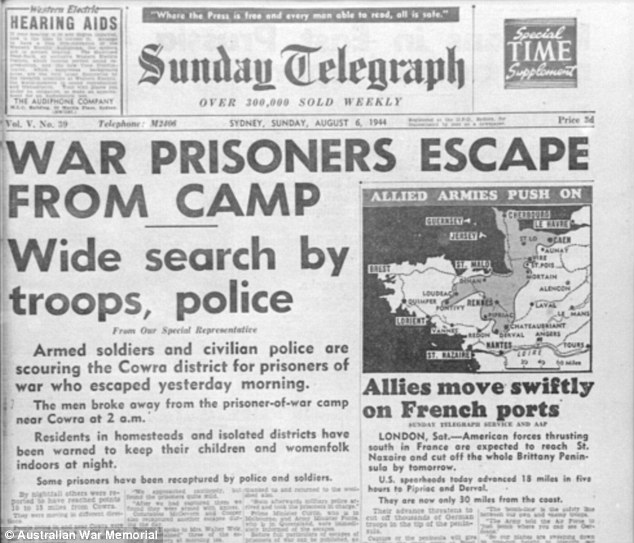
In Cowra POW Camp in New South Wales, Australia, 4,000 enemy soldiers and interned civilians were held: Japanese, principally from captured merchant ships, Koreans, political prisoners from the Dutch East Indies, and Italians, captured in the North African campaign. The latter were the happiest of the captives, often allowed out into the community on their own or in work details, many of them making friends (and lovers) among the local population. The Japanese, however, were troublesome and resentful. Unlike the Italians, they were not trusted outside the camp, but otherwise were well treated according to Geneva Convention rules, quite unlike the barbarous conditions faced by Australians captured by the Japanese.

About 2 in the morning of 5 August 1944, a bugle sounded, and over a thousand Japanese erupted from their barracks, armed with makeshift weapons, and attempted a mass escape, the largest ever tried during the war.  Shouting “Banzai” they threw themselves at the barbed wire fences. With blankets, baseball gloves and bare bodies, they neutralized the wire and assaulted the few guards in human wave attacks. Inside the barracks, a dozen prisoners had hanged themselves while others set fire to the compound. At the cost of hundreds of lives they overwhelmed their captors and escaped into the night. They scrupulously observed their commanders’ instructions to harm no civilians but they resisted any attempt at recapture. It took four days to round up the escapees, though more were killed in the process and more committed suicide. In the end, the casualty list read four Australian dead, 231 Japanese killed, and 108 wounded.

A military court of inquiry determined

  • that conditions at the camp were fully in accordance with the International Convention;
  • that no complaints regarding treatment had been made by or on behalf of the Japanese prior to the incident, which appeared to have been a premeditated and concerted plan of the prisoners;
  • that the actions of the Australian garrison in resisting the attack averted greater loss of life, and that firing ceased as soon as control was assured; and
  • that many of the dead had died by suicide or by the hand of other prisoners, and that many of the wounded had suffered self-inflicted wounds.

A survivor explained the motivation for the events: “the soldiers has been brainwashed to believe that only a shameful coward with no right to exist would ever surrender in wartime. Even their families often couldn’t accept defeated troops returning home, and they were often treated like fearful ghosts and driven away.” Today Cowra has become a place of pilgrimage and friendship for the Japanese people, and is the location of the only Japanese War Cemetery in Australia, containing the graves of those Japanese killed in the breakout.

August 3

Home / Today in History / August 3

1914

Germany invades France

After a month of posturing and threats following the assassination of the heir to the Austrian throne, the powers of Europe finally take up arms; with the German invasion of France the Great War, the First World War begins.

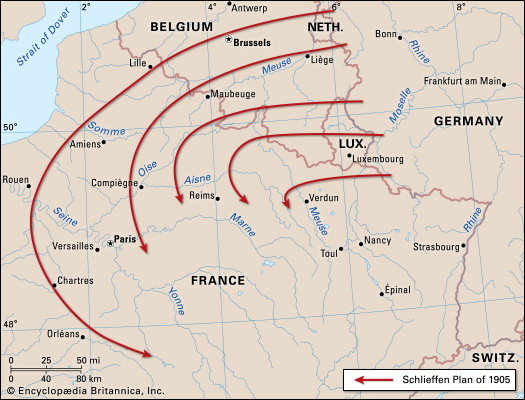
The German General Staff had long planned their strategy for the conquest of France. Knowing that they faced enemies on two fronts — the French Republic to the west, the Russian Empire to the east — they counted on a quick strike to knock one of their enemies out of the war before turning to confront the other. Since France was more highly industrialized and mechanized, they could mobilize their armies more quickly than the Russians, so the Germans made the French their first target. According to the Schlieffen Plan, proposed in 1905 by Field Marshal Alfred von Schlieffen, the Chief of the Imperial Army German General Staff, the German army would concentrate its forces on the Western Front and avoid French fortifications by invading through neutral Belgium and Luxembourg, a gross violation of international law and a treaty to which Germany was a signatory.

On August 3, seven German field armies, comprising 80% of the empire’s armed forces, began to move, sweeping through Belgium and Luxembourg, hoping to smash the French armies on the border and encircle Paris. At first they were successful, taking the great fortress of Liege and capturing Brussels. The French, meanwhile, were concentrating on a thrust east into Alsace, held by the Germans since the Franco-Prussian War of 1870 but considered by the French to be theirs. By late August German forces had entered France, coming to within 43 miles of Paris, where they were stalled by stiffening French resistance and the arrival of the British Expeditionary Force. The Schlieffen Plan had failed; the result was a stalemate and four years of hideous, near-static trench warfare.

August 1

Home / Today in History / August 1

1944

The Warsaw Uprising Begins

When Nazi armies collaborated with the Soviet Red Army in overrunning Poland in the autumn of 1939, the occupying forces set out to eradicate Polish identity. Both the Germans and Russians took special care to imprison and murder the country’s intellectual, artistic, political and military leaders. The Nazis aimed to rid the country of its Slavic population and replace it with German colonists; the USSR aimed to Sovietize the Poles; both wished to erase Poland from the map.

Patriotic Poles, however, continued to resist; some inside the country in partisan units devoted to sabotage; some outside the country in the armies of the Allies. Polish fliers participated in the Battle of Britain; Polish soldiers battled the Germans in Italy and on D-Day in France. Unfortunately there was no political union, no single government-in-exile that could speak for Poland — a pro-western group was based in London and a pro-Soviet group operated from Moscow. When Poles exposed the Soviet perpetrators of the 1940 Katyn massacre of Polish officers, the USSR curtailed cooperation with the western group. This was to prove fatal in 1944.

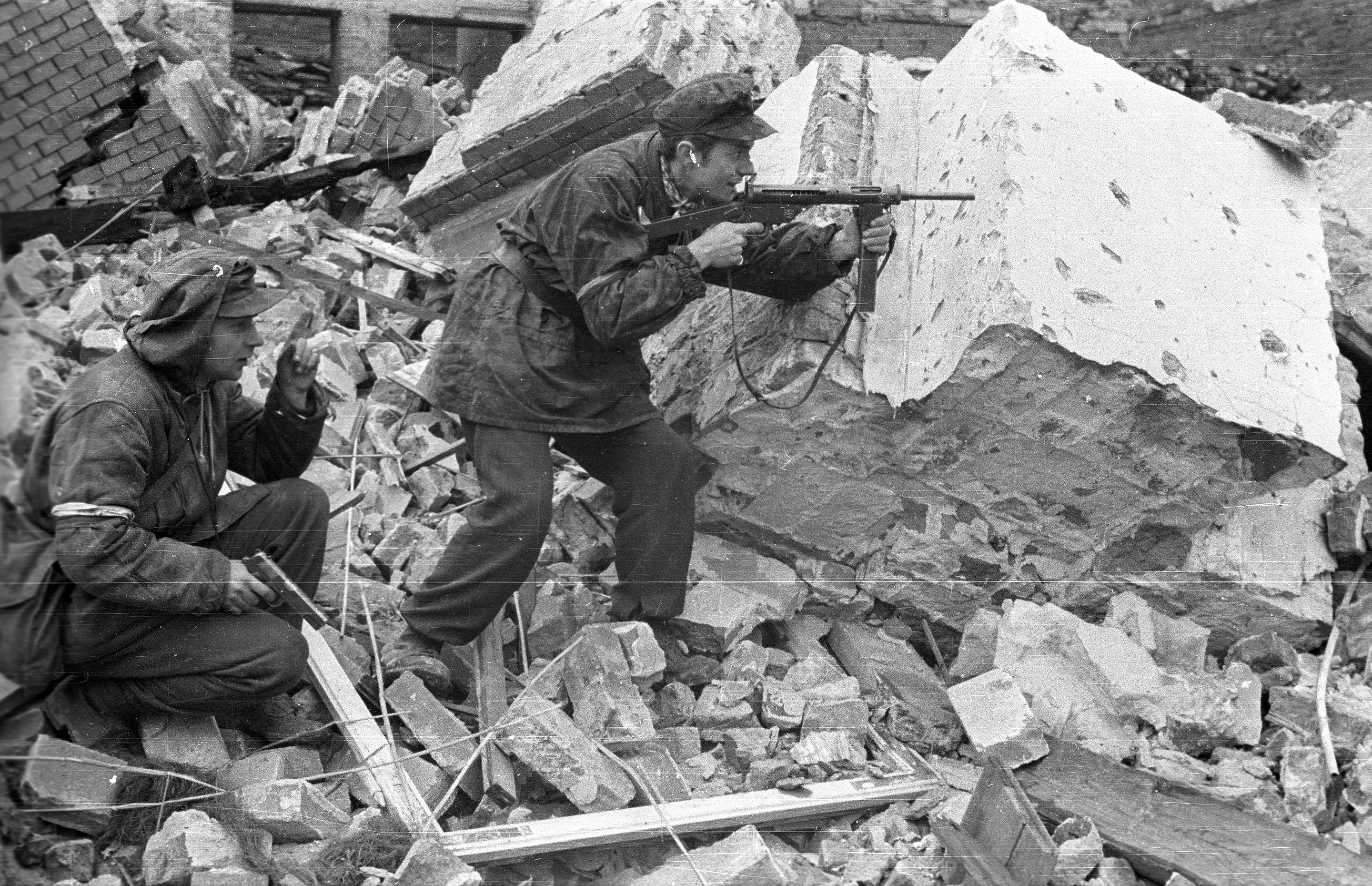
For years the Polish Home Army and other partisan groups had been harassing German forces and arming for a general uprising. Some of these units had assisted Polish Jews in their doomed battle for the Warsaw Ghetto and all looked forward to the advance of Allied armies. By the summer of 1944 it was apparent that the Red Army would be the first to liberate Poland and it was decided that a mass rebellion would begin on August 1. The plan was to take control of Warsaw and then link up with advancing Russian forces to drive the Germans out of the rest of the country.

On August 1 tens of thousands of Poles attacked German bunkers and fortifications in Warsaw. For four days they scored successes, occupying much of the centre of the capital, liberating a concentration camp and causing Germans to withdraw. However, the Red Army halted its advance and refused to come to the aid of the Poles; Stalin refused British and American airforces permission to drop supplies. When the western Allies flew over Poland anyway, Stalin refused permission for them to land in territory under Red control, thus limiting the capacity and effectiveness of the airdrops. The Germans, on the other hand, were able to rush reinforcements into the city. After a while stalemate, turned to siege, civilians and partisans began to starve and German troops carried out massacres of inhabitants in order to break the will of the resistance. Fighting continued until early October by which time much of the city was in flames, Home Army troops had surrendered and the civilians were forced out of Warsaw, 85% of which had been destroyed in the fighting or in the aftermath by vengeful German troops.

July 30

Home / Today in History / July 30

1975

The Disappearance of Jimmy Hoffa

James Riddle Hoffa (1913-75) was a working-class kid who got into the union-organizing business while working in a grocery store. By the time he was in his 20s he was working for the International Brotherhood of Teamsters, a union of truckers and warehouse workers. As Hoffa rose through its ranks, he helped the Teamsters organize on a national basis and become one of the most powerful unions in America, able to disrupt the country’s transport of goods with strikes and boycotts. In order to do so, Hoffa and the Teamsters developed links with organized crime, which wanted to get its hands  on the pension fund. He became union vice-president in 1952 and president in 1958, a position he held until 1971.

The corruption of the Teamsters was well-known to authorities in the government and labour circles. The union was expelled from the AFL-CIO, the umbrella organization for organized labour, and Attorney-General Robert Kennedy went after Hoffa and the Teamsters with a vengeance. He was convicted in 1964 of jury-tampering and fraud and served time in prison from 1967-71, though it was widely-believed he continued to control the union through stooges. He was released by President Nixon (some say in return for an exchange of money and guarantee of union support) but only on the condition that he refrain from Teamster activity until 1980.

Hoffa’s attempts to regain control of the Teamsters was resisted from many inside the union and may have disrupted plans by organized crime to work closely with those now in charge of the union. On the afternoon of July 30, 1975 he was scheduled to meet  Anthony Giacalone and Anthony Provenzano, two Mafia bosses, at a restaurant in Detroit but he was never seen again. Though his body has never been recovered (its position was said to be under various highways, in various fields or beneath Giants Stadium in New Jersey) the consensus is that he was murdered very soon after his disappearance. Hoffa’s son James has been president of the Teamsters since 1999.

July 29

Home / Today in History / July 29

1981

Charles and Diana wed

A great wedding and a terrible marriage. On this day in 1981, Lady Diana Spencer and His Royal Highness Prince Charles Philip Arthur George, Prince of Wales, KG, KT, GCB, OM, AK, CC, QSO, PC, ADC, Earl of Chester, Duke of Cornwall, Duke of Rothesay, Earl of Carrick, Baron of Renfrew, Lord of the Isles and Prince and Great Steward of Scotland, Field Marshal, Admiral of the Fleet in the Royal Navy, Marshal of the Royal Air Force and Colonel in the Papua New Guinea Defence Force, (MA Cantab), were wed at St Paul’s Cathedral in London in a ceremony watched by 3,000 in the church, 750,000,000 on television around the world. Among the guests were most of the crowned heads of the planet, including the dispossessed claimants to monarchies that had ceased to exist, such as Greece, Romania, Bulgaria and Yugoslavia.

As heir to the throne it was essential that Charles should wed. Though he had had numerous girl friends and mistresses before his proposal to Lady Diana, none of these women were considered suitable marriage partners or a future Queen — soft porn actresses, wives of his friends, and Catholic princesses all fell short of the required standard. It does not appear that he was much in love with his intended spouse but she was young, beautiful, of noble birth, and a virgin: four qualities rarely found in the same woman in England at the time. They became engaged in February 1981 and plans for a sumptuous ceremony were set in motion immediately.

The bride wore a gown of ivory silk taffeta, decorated with lace, hand embroidery, sequins, and 10,000 pearls with a 25-foot train of ivory taffeta and antique lace. The dress had to be altered considerably as Diana had suffered a weight loss due to bulimia. (One critic called the outfit “too much dress, too little princess.”) Charles wore the uniform of a naval commander, festooned with the decorations of the Orders of the Garter, Thistle, and the Bath. Three choirs, three orchestras and a brass ensemble provided the music; the Archbishop of Canterbury, the Dean of St Paul’s, a Catholic cardinal and sundry Protestant clerics conducted the service.

The marriage soon fell apart. Charles insisted on the royal prerogative of keeping a mistress and Diana took to preying on other women’s husbands.

July 26

Home / Today in History / July 26

1936

Dedication of the Vimy Memorial

After World War I Canadians were anxious to remember their deeds and their dead in monumental form; all across the country hundreds upon hundreds of local statues, cairns, and cenotaphs were erected. The government also planned to memorialize battle sites in Europe with a series of identical monuments in Belgium and France and held a competition for designs. When over 160 proposals were submitted in 1921, what emerged was overwhelming support for a single spectacular construction based on a design by architect Walter Allward, on Vimy Ridge where Canadian troops had won a bloody victory in 1917. France agreed to donate land to Canada in perpetuity for such a memorial, provided Canada was responsible for its upkeep.

The monument was years in the making, partly because of the difficulty in finding and transporting exactly the right stone. The original plan called for marble but this was deemed to be too susceptible to erosion in the climate of northern France and builders chose instead a type of limestone found in Croatia — it had been used in Diocletian’s palace at Split built 1,650 years earlier and was still in fine shape. 6,000 tonnes of the stone had to be quarried and moved to Vimy while 11,000 tonnes of concrete and hundreds of tonnes of steel were being employed on the foundation.

An enormous pilgrimage of veterans was planned for the official dedication in 1936. Politicians, military units, bands, and clergy were in abundance, presided over by King Edward VIII,  performing one of his few official duties before his abdication.

During World War II, the site was in German-occupied France and rumours spread that the Nazis would desecrate the memorial. In order to dispel such stories the German government published pictures of Adolf Hitler triumphantly visiting the monument and showing that it was still being preserved.

July 25

Home / Today in History / July 25

1814

Battle of Lundy’s Lane

At Queenston Heights and Lundy’s Lane,
Our brave fathers, side by side,
For freedom, homes and loved ones dear,
Firmly stood and nobly died;
And those dear rights which they maintained,
We swear to yield them never!
Our watchword evermore shall be
“The Maple Leaf forever!”

Those pesky Americans keep trying to invade Canada and keep failing. Yankee intruders were forced to retreat from Montreal and Quebec during their ill-advised War of Independence and in the aftermath of their Civil War the Fenians were repelled from New Brunswick, Ontario, Quebec and Manitoba. The only American defeats we actually sing about, however, are those drubbings we dealt them in the War of 1812, at Queenston Heights and Lundy’s Lane.

Lundy’s Lane was along a commanding piece of ground in the Niagara peninsula and there British and Canadian troops were attacked by an American force led by Generals Jacob Brown and Winfield Scott who had been successfully racking up victories in Ontario since early July. This battle was particularly bloody with hundreds of casualties from artillery duels, rocket barrages, friendly fire, and bayonet charges. Ground and guns changed hands several times until the bloodied Americans withdrew. Both sides had exhibited considerable bravery but no military genius. The result of the battle was a thwarted American thrust and a shift in the balance of power in the area to the Canadians and British.