At 3 pm on every Christmas Day since 1932 the reigning British monarch has spoken to the people of the Empire and Commonwealth. The first to make a royal Christmas broadcast was George V, who had been asked by BBC General Manager John Reith for such a speech since 1923. Written by Rudyard Kipling, the speech was delivered from Sandringham Castle. Listening to it has become part of the traditional British Christmas afternoon activity.
The First Royal Christmas Broadcast
Through one of the marvels of modern science I am enabled this Christmas Day to speak to all my peoples throughout the Empire. I take it as a good omen that wireless should have reached its present perfection at a time when the Empire has been linked in closer union, for it offers us immense possibilities to make that union closer still.
It may be that our future will lay upon us more than one stern test. Our past will have taught us how to meet it unshaken. For the present the work to which we are all equally bound is to arrive at a reasoned tranquillity within our borders, to regain prosperity without self-seeking, and to carry with us those whom the burden of past years has disheartened or overborne.
My life’s aim has been to serve as I might towards those ends. Your loyalty, your confidence in me has been my abundant reward. I speak now from my home and from my heart to you all; to men and women so cut off by the snows, the desert, or the sea that only voices out of the air can reach them; to those cut off from fuller life by blindness, sickness, or infirmity, and to those who are celebrating this day with their children and their grandchildren—to all, to each, I wish a happy Christmas. God bless you.
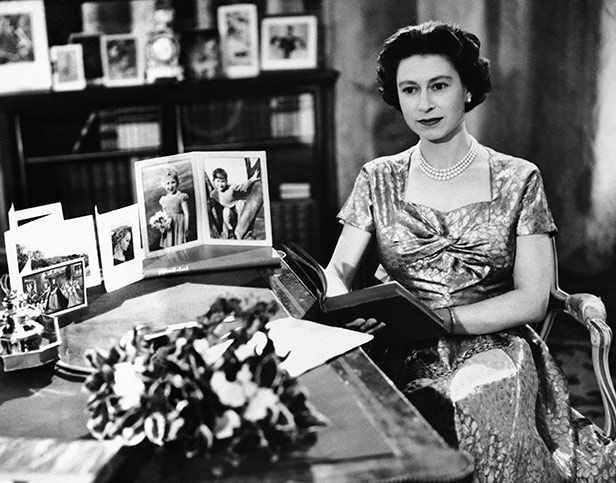
Queen Elizabeth II made her first Christmas Broadcast on radio in 1952, and on television in 1957. Like her father George VI and grandfather George V, the Queen used to broadcast her message live but since 1960, the Christmas Message has always pre-recorded, and sent in advance to Commonwealth countries for broadcast at a suitable local time. The television programme incoporates material specially recorded for it during the preceding year. The speech is now also made available on the Internet.