A turkey is more occult and awful than all the angels and archangels. In so far as God has partly revealed to us an angelic world, he has partly told us what an angel means. But God has never told us what a turkey means. And if you go and stare at a live turkey for an hour or two, you will find by the end of it that the enigma has rather increased than diminished. G. K. Chesterton – “Christmas”
Category: Christmas
A Christmas Quote
I know many Americans think of Christmas as a single day and like to clear away the trappings of the season well before the fifth of January, but that is sheer barbarism, if you ask me, morally only a few steps removed from human sacrifice, cannibalism, or golf.
(from “The Dream-Child’s Progress and Other Essays” by David Bentley Hart)
The Manger
A box or trough in which food for livestock is placed. Luke’s gospel relates how when Jesus was born in a stable his mother laid him in a manger; pious legend has it that the animals of the stable warmed him and watched over him there. Representations of the manger can be seen in the near-universal crèche, in artwork depicting the Nativity as well as in the lattice-work crust of the Christmas mince pie and the straw placed under the tablecloth in eastern European homes. Carols celebrating the scene include “Away in a Manger”, “O Holy Night” and “Tomorrow Shall Be My Dancing Day”.
The church of Santa Maria Maggiore in Rome claims to possess pieces of the original Bethlehem crib, seen above — five wooden slats of sycamore brought from the Holy Land in the seventh century which are exposed on the high altar every Christmas Eve. These are believed to have formed part of an x-shaped support for the manger itself which was probably made of the same limestone that formed the cave where Jesus was born. In the sixteenth century Frederick the Wise of Saxony, Martin Luther’s patron, also had portions of the manger among his vast collection of relics but the fate of these pieces is unknown.
The War Against Christmas, episode 212
When legal threats by the Freedom From Religion Foundation forced the Minnesota town of Wadena to take down its traditional nativity scene in 2015, disappointed citizens responded by turning the township into an orgy of crèches. A local movement sprang up to replace the single banned nativity scene with hundreds of them in businesses, offices and private yards. The mayor, who had reluctantly yielded to the FFRF demand, put up eight displays in front of his own house
The Santa Claus Bank Robbery
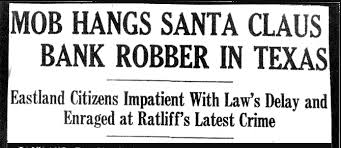
On December 23, 1927 Santa Claus robbed the First National Bank in Cisco, Texas. Dressed as St. Nick, Marshall Ratliff and three undisguised companions looted the bank and took hostages but were greeted by police and heavily-armed townspeople when they emerged from the building. In the shoot-out that followed, two officers and a bandit were mortally wounded. Though Ratliff and his two remaining partners temporarily escaped after a series of car-jackings and hostage takings, they were forced to abandon the stolen money and were all rounded up within a week.
The erstwhile Santa, who killed again in a failed escape attempt, was eventually taken from his jail cell by an angry mob and lynched. A piece of the rope used in the impromptu hanging is on display in the Callahan County Courthouse in Baird, Texas.
Shoes and Christmas
Shoes have played a number of roles in Christmas observances around the world. The most common dates from the Middle Ages — the placing out of shoes on St. Nicholas Eve or Christmas Eve or Epiphany Eve so that the Gift-Bringer can fill them with treats or gifts. In many European countries it is essential that these shoes be freshly-polished if they are to be used in this way. These same shoes often hold grass or grain for the Gift-Bringer’s animals. A related use is to place one’s letter to Santa or other Gift-Bringer in a shoe so that he will know what to bring for a Christmas present.
In Greece, some people burn their old shoes during the Christmas season to prevent misfortunes in the coming year while others burn them to prevent the monstrous kallikantzaroi from coming down the chimney to torment the family. In Scandinavian countries it is believed that shoes placed side-by-side on Christmas Eve will prevent a family from quarrleing in the year to come.
Throwing shoes is also a means of Christmas divination. A girl who successfully throws her slipper into a tree or who throws her shoe at a door at midnight and finds that it points toward the door will receive a marriage proposal within the year.
The Salvation Army and Christmas
The Salvation Army, part church, part world-wide social service agency, has become identified with Christmas charity since its foundation in London in 1865 by General William Booth. The sounds of Army brass bands playing Christmas carols and the sight of street-corner kettles are an integral part of Christmas in many countries.
In 1891 Captain Joseph McFee of San Francisco set up the world’s first Salvation Army street kettle to collect donations for Christmas charities. It was such a success in raising money to provide a Christmas meal for the area’s poor people that within a few years kettles were a common site on the West Coast. In 1897 the idea spread to Boston; though some officers were reluctant to man the kettles lest they make a spectacle of themselves enough money was collected to feed thousands. In 1901 the Salvation Army set up the first mammoth sit-down dinners for the poor in New York’s Madison Square Garden, a custom that perisisted for decades. This kind of communal Christmas dinner is still offered to the homeless but around the world today the collections from street kettles also fund groceries, clothing and toys for poor families with their own homes, meals for and visits for shut-ins, services for the families of prisoners and the Christmas needs of inmates.
At one time the Army employed the homeless to dress as Santa Claus while they manned the kettles but the proliferation of street-corner and department-store Santas confused children so the practice was dropped. Nowadays many kettles are automated with a self-ringing bell, and a public address system broadcasting carols.
Royal Christmas Message
At 3 pm on every Christmas Day since 1932 the reigning British monarch has spoken to the people of the Empire and Commonwealth. The first to make a royal Christmas broadcast was George V, who had been asked by BBC General Manager John Reith for such a speech since 1923. Written by Rudyard Kipling, the speech was delivered from Sandringham Castle. Listening to it has become part of the traditional British Christmas afternoon activity.
The First Royal Christmas Broadcast
Through one of the marvels of modern science I am enabled this Christmas Day to speak to all my peoples throughout the Empire. I take it as a good omen that wireless should have reached its present perfection at a time when the Empire has been linked in closer union, for it offers us immense possibilities to make that union closer still.
It may be that our future will lay upon us more than one stern test. Our past will have taught us how to meet it unshaken. For the present the work to which we are all equally bound is to arrive at a reasoned tranquillity within our borders, to regain prosperity without self-seeking, and to carry with us those whom the burden of past years has disheartened or overborne.
My life’s aim has been to serve as I might towards those ends. Your loyalty, your confidence in me has been my abundant reward. I speak now from my home and from my heart to you all; to men and women so cut off by the snows, the desert, or the sea that only voices out of the air can reach them; to those cut off from fuller life by blindness, sickness, or infirmity, and to those who are celebrating this day with their children and their grandchildren—to all, to each, I wish a happy Christmas. God bless you.
Queen Elizabeth II made her first Christmas Broadcast on radio in 1952, and on television in 1957. Like her father George VI and grandfather George V, the Queen used to broadcast her message live but since 1960, the Christmas Message has always pre-recorded, and sent in advance to Commonwealth countries for broadcast at a suitable local time. The television programme incoporates material specially recorded for it during the preceding year. The speech is now also made available on the Internet.
The Passions of Carol
There have been many variations on Charles Dickens’s A Christmas Carol: it has been set in London, in the American Midwest, in black ghettoes and modern television studios; Scrooge has been played by men, women, Muppets, puppets and cartoon ducks. Few versions, however, have stretched the genre as much as The Passions of Carol, a 1975 pornographic movie starring Merrie Holiday. Directed by Shaun Costello, the movie examines the change of heart Christmas brings to Carol Scrooge, a cruel editor of a skin magazine.
The Parson Has Lost His Cloak
A traditional English Christmas game whose rules are now lost to us. A passage from The Spectator of 1712 refers to it:
Mr Spectator
I desire to know in your Next, if the merry Game of the Parson has lost his Cloke, is not mightily in Vogue amongst the fine Ladies this Christmas; because I see they wear Hoods of all Colours, which I suppose is for that Purpose; if it is, and you think it proper, I will carry some of those Hoods with me to our Ladies in Yorkshire; because they injoined me to bring them something from London that was very new. If you can tell any Thing in which I can obey their Commands more agreeably, be pleas’d to inform me, and you will extreamly oblige,
Your humble Servant