Advent

Home / Uncategorized / Advent

For such a momentous occasion as the birth of the baby-god Jesus, one might think that the first Christians would be quick to celebrate the event. Christmas is the second-highest festival on the Christian calendar and the most widely-celebrated holy day in history, but the fact is that it was an after-thought to the early church. The first generations of believers concentrated on the death and resurrection of Jesus and lived in profound expectation of his imminent return. What need was there to make a fuss over his humble origins when he would soon return again in glory to judge the living and the dead and to usher in a new heaven and a new earth?

As the years went by, and Christ seemed to be tarrying, the circumstances of his birth attracted more interest. Pagan critics of the new religion, such as Celsus, made mock of the claims of a virgin birth and asserted that Jesus was the illegitimate product of an adulterous union. Certain 2nd-century Christians, influenced by Greek Gnosticism, were skeptical of the idea of a god dwelling in human flesh – this was a repellent notion to the philosophers; the very purpose of the soul was not to become trapped in a body but to escape its earthly prison of meat and bone. These criticisms prompted the second-century Church to emphasize the truth of the nativity stories told in the gospels of Matthew and Luke and even to add to them in pious fictions such as The Protoevangelium of James which invented details about the youth of Mary and introduced the character of Salome, a midwife, to the events in Bethlehem.

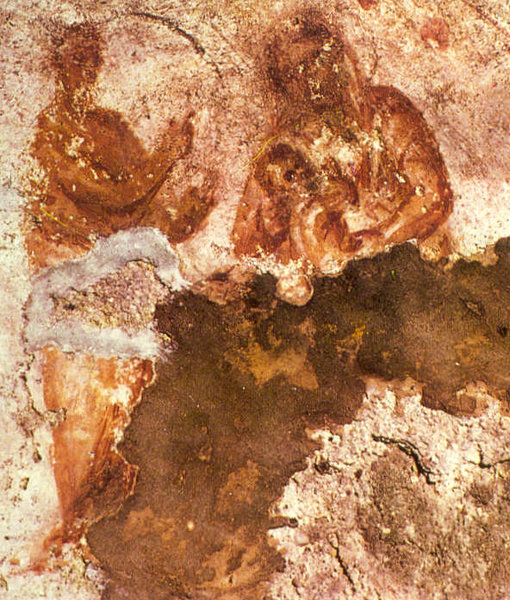
By the year 200 Christian writers had begun to speculate about when the birth of Jesus had taken place and numerous dates were bandied about. This does not mean that Christians were seeking to know the date of the birth of Jesus in order to celebrate it. The theologian Origen declared that only pagan rulers had their birthdays trumpeted and, indeed, King Herod Antipas had given birthdays a bad name in the Christian community when he had used the occasion of his to order the execution of John the Baptist. Despite such a view, believers were growing fonder of recounting the story of the birth of Jesus. In Rome, where Christians gathered to worship in the funeral caves outside the city, they decorated a wall with a picture of the Nativity scene. The catacomb of St Priscilla bears an image of three Magi advancing toward the seated Virgin and child while a man standing beside her (probably meant to represent an Old Testament prophet) points to the guiding star in the heavens. Second and third-century pseudo-gospels such as The Revelation of the Magi were particularly interested in the appearance of the wise men who, guided by this miraculous star, became the first Gentiles to worship the Christ Child.

With the accession of the emperor Constantine in 312, Christianity became a legal religion, free to marks its holy days publicly, and the celebration of the Nativity soon was celebrated joyfully. During the 300s and 400s Christmas grew in importance on the church calendar as music, drama and liturgy were added in spectacular fashion. And then it occurred to someone – we know not who or where – that Christmas deserved a period of preparation such as Easter had with Lent. By the 500s there seems to have been a formally recognized fast beginning in mid-November on St Martin’s Day, a custom starting first in the Frankish church and then spreading in the West; other restrictions include a ban on matrimony, feasting  and games. In Rome itself the Advent period, as it was now known, named for the Latin “coming”,  was shorter, less penitential and more joyful and by the high Middle Ages the contrary tendencies had merged – the season had become shortened to a four-week fast with Lenten-type behaviour required.  These restrictions, however, were abolished in the twentieth century and the season is now one of reflection and spiritual preparation.

For liturgical churches of the West it marks the beginning of the Christian year. It is reckoned as a period of four Sundays beginning with the one closest to St Andrew’s Day on November 30. The faithful are to use this time to prepare themselves worthily to celebrate the anniversary of the Lord’s coming into the world as the incarnate God of love and also to make themselves ready for His final coming as judge, at death and at the end of the world. In church services, there are glorious hymns and lessons that point us to the prophecies and promises of coming redemption and the importance of heeding the injunction “prepare ye the way of the Lord.” 

November 30

Home / Today in Church History / November 30

November 30 is Saint Andrew’s Day. Andrew was a fisherman, the brother of Simon Peter and a follower of John the Baptist. He recognized Jesus as the Messiah and was called by the Lord to be an apostle. Andrew appears a number of times in Gospels, such as when Jesus discusses the end of the world in Mark 13 and at the Feeding of the Five Thousand in John 6.

Legend says that after the death of Jesus Andrew travelled widely, spreading the faith to Asia Minor, the Caucasus, what is now Ukraine and Russia, Byzantium and the Balkans. The churches in Constantinople and Georgia thus claim an apostolic founder. In Greece he was martyred on an X-shaped cross which became his symbol. The saltire or St Andrew’s cross is on the flag of Scotland, which claims him as a patron saint, and on the naval flag of Russia, where he is also a patron. Because Andrew was the first disciple called by Jesus, his feast day heralds the start of the Christian calendar.

November 30 is also the birthday of Winston Churchill and Mark Twain, and the anniversary of the death of Oscar Wilde.

For Winston Spencer Churchill I have nothing but praise. The greatest Briton of his era (and of all time according to a BBC poll which placed Princess Diana third, far ahead of Isaac Newton and William Shakespeare) he saved civilization at the cost of the British Empire. He assumed office as the Allied position in the west was collapsing and the French government and army were too intent on speed-reading their German phrase books to defend their country. But herein lies a salutary lesson for those who think that the events of 1940 prove that Gauls are, by nature, cheese-eating surrender monkeys. Antony Beevor’s monumental history Berlin: The Downfall, 1945 notes that in the final few days of World War II, when Hitler lay dead and the survivors of the Nazi hierarchy were scuttling like rats out of the ruins of Berlin, the last Axis defenders in the city were Frenchmen. These remnants of the SS Charlemagne Division fought on in the wreckage of the Third Reich until they were overrun by the Red Army.

Mark Twain is little appreciated outside of the United States and for good reason. Next to Walt Whitman he is the most insufferable of American writers and next to Herman Melville the most unreadable.

There was a lot that was insufferable about Oscar Wilde too. He continually betrayed a loving wife and found furtive pleasure on the bodies of under-age servant boys and rancid young aristocrats. He made almost an entire career of far-too-artfully polished apothegms (‘All women become like their mothers. That is their tragedy. No man does. That is his.’) and a smirking inversion of received truths (‘As for the virtuous poor, one can pity them, of course, but one cannot possibly admire them.’) He brought his sad end upon himself, but for the sake of his children’s stories, Oscar Wilde will be forgiven much. Requiescat in pace.

November 29

Home / Today in Church History / November 29
 

A great day for massacres

On November 29, 1729 the Natchez tribe rose up against French settlers in Louisiana. Vexed by French encroachment on their territory the Natchez attacked Fort Rosalie and settler farms, killing over 200 colonists. The French reacted vigorously and allied with Choctaw warriors, traditional enemies of the Natchez, they destroyed many villages and enslaved hundreds. By 1736 the Natchez had ceased to exist as an independent people.

On this date in 1781 the crew of the English slave ship Zong, faced with a lack of drinking water, threw 130 enslaved Africans overboard. As was customary, the lives of these slaves had been insured and the woners of the Zong made a claim for their losses. A jury found that the slavers could recive compensation for the people thay had murdered by an appeal court reversed that ruling. The incident was a great spur to the abolition movement, leading to laws prohibiting such insurance claims, mandating better treatment in shipping slaves, and finally an end to British participation in the African slave trade.

In the early years of the American Civil War, the Cheyenne tribe took advantage of Washington’s preoccupation in subduing the southern rebellion by fighting back against white settlement in the territory they claimed, carrying out a number of massacres and atrocities. On this date in 1864 a troop of volunteer cavalry under Colonel John Chivington attacked and destroyed a village of Cheyenne and Arapaho people in southeastern Colorado Territory, killing and mutilating an estimated 70–500 Native Americans, about two-thirds of whom were women and children. A subsequent inquiry was scathing in its assessment:

As to Colonel Chivington, your committee can hardly find fitting terms to describe his conduct. Wearing the uniform of the United States, which should be the emblem of justice and humanity; holding the important position of commander of a military district, and therefore having the honor of the government to that extent in his keeping, he deliberately planned and executed a foul and dastardly massacre which would have disgraced the veriest savage among those who were the victims of his cruelty. Having full knowledge of their friendly character, having himself been instrumental to some extent in placing them in their position of fancied security, he took advantage of their in-apprehension and defenceless condition to gratify the worst passions that ever cursed the heart of man.

On November 29, 1986 the Surinamese army attacked the village of Moiwana, killing at least 35 of the inhabitants, mostly women and children, and burning the house of rebel leader Ronnie Brunswijk who was leading a fight to protect the rights of the maroon (descendants of escaped African slaves) minority. The survivors fled with thousands of other inland inhabitants over the Marowijne River to neighboring French Guiana. An end to the conflict was eventually negotiated and Brunswijk is now vice-president of the country.

November 28

Home / Today in Church History / November 28
bunyan

1628 Birth of John Bunyan

John Bunyan was born in Bunyan’s End, Bedfordshire to a family of small means. As a teenager he followed the tinker’s trade and then served in the rebel armies during the English Civil War. At the war’s end in 1649 he returned home where he underwent a religious conversion and joined a congregation of nonconformist Protestants. In 1655, though unlearned in anything except the English scriptures, he began to preach and write tracts. He had been cautioned for unlicensed preaching in 1659 but his real troubles began with the return of the English monarchy in 1660 and the reestablishment of the Anglican Church which cracked down on the radical sects and demanded that all services be conducted according to the Book of Common Prayer. Bunyan refused to abandon his calling and was arrested and imprisoned numerous times for unlicensed preaching and abstaining from attendance at a lawful church. After 1672 the government relaxed its oppression of nonconformists for a time; Bunyan was released from prison and became a popular minister, even being named chaplain to the Lord Mayor of London.

Bunyan was an indefatigable writer, producing some 6o tracts and books of a religious nature. His spiritual autobiography, Grace Abounding to the Chief of Sinners, and The Life and Death of Mister Badman are still read, but most of his other works such as Seasonal Counsel or Suffering Saints in the Furnace – Advice to Persecuted Christians in Their Trials & Tribulations are not. His masterwork is Pilgrim’s Progress or to give it its full title, The Pilgrim’s Progress from This World to That Which Is to Come; Delivered under the Similitude of a Dream, published in 1678. It follows the journey of sin-burdened Christian from the City of Destruction past the Slough of Despond, Vanity Fair, the Valley of Humiliation, the Hill of Difficulty and other trials to his destination in the Celestial City. Along the way he will meet Evangelist, Mr Worldly Wiseman, Simple, Sloth, Presumption and the demonic Apollyon. Pilgrim’s Progress is the most famous allegory in the English language, a monument of religious literature which has inspired many. It has been translated into more than 200 languages and has never been out of print. Modern-language versions are now being produced for those whose taste does not run to seventeenth-century English prose.

November 27

Home / Today in Church History / November 27
images

511 Death of the first Christian king of France.

Early in the 400s the Roman empire was invaded by a host of Germanic tribes moving down out of northern and central Europe. The empire in the east with its capital at Constantinople had the money and troops to defend itself, but the western half of the empire was overrun. Rome was sacked, the last emperor was deposed by a German warlord, and what had once been a single state was now a motley collection of barbarian kingdoms established by Ostrogoths, Visigoths, Burgundians, Angles, Saxons, Vandals and Jutes. One of the most formidable of the new states was the Kingdom of the Franks which covered most of what had been Gaul and which was ruled by the ruthless Clovis who managed to claw his way to the top over the bodies of rival Frankish leaders.

Most of the original inhabitants of Clovis’s new kingdom were Catholic Christians while invaders such as the Franks were either pagan or Arian Christian. On Christmas Day in 496 Clovis agreed to a Catholic baptism in order to better secure his rule, associating himself with the religion of his people and of Rome. This baptism was miraculously marked by the arrival of a container of holy oil from heaven which was used to anoint Clovis and many subsequent kings of what became France. French monarchs could thus claim the title of “Most Christian King”.

Clovis had brutally united his kingdom and many historians consider this the foundation of the French nation and Clovis the founder of the Merovingian dynasty. However, the Franks followed the custom of partible inheritance whereby a father divided his land equally among his sons and on the death of Clovis in 511 his kingdom was partitioned among his four sons. The tawdry history of the Merovingian Franks is one long story of conquest, unification, partition, battle and reunification. Why Dan Brown in The Da Vinci Code chose the thuggish family of Clovis to be the supposed bloodline of Jesus remains a mystery best left unsolved.

November 26

Home / Today in History / November 26

casa-wall01

1942 The premiere of the world’s greatest movie

The movie Casablanca, directed by Michael Curtiz, and starring Humphrey Bogart, opens in New York. Released to take advantage of the invasion of North Africa and buoyed by the Casablanca Conference of 1943, the film did well at the box office but it was not a smashing success. Only after the Second World War did it become a cult hit and viewed as a critical triumph.

The film, based on the unproduced play Everybody Comes to Rick’s, charts the dilemma of night-club owner Rick Blaine in French Morocco; he claims to stick his neck out for no one but will his good instincts and chivalry trump his love for another man’s wife?

The cast was superb. Everyone remembers the luminous Ingrid Bergman but there were two other radiant beauties involved with Rick: the lovely Yvonne (played by 19-year old French refugee Madeleine Lebeau who in real life was married to the actor who played he roulette croupier) and Annina, the Bulgarian newlywed (Joy Page). Claude Rains was never better than as corrupt Captain Louis Renault; Peter Lorre oiled his way on screen as the odious Ugarte (“You despise me, don’t you Rick?”); and Conrad Veidt (the highest-paid member of the cast) sneered as German Major Heinrich Strasser. Only Paul Henried underperformed as the wooden resistance leader Victor Lazlo. Dooley Wilson enchanted as the piano player Sam, singing “As Time Goes By” and “Knock on Wood”.

Consider these great lines:

Rick: Of all the gin joints, in all the towns, in all the world, she walks into mine.

Yvonne: Where were you last night?  RickThat’s so long ago, I don’t remember.  Yvonne: Will I see you tonight?  Rick: I never make plans that far ahead.

Strasser: You give him credit for too much cleverness. My impression was that he’s just another blundering AmericanRenault: We musn’t underestimate “American blundering”. I was with them when they “blundered” into Berlin in 1918.

Renault: I’ve often speculated why you don’t return to America. Did you abscond with the church funds? Did you run off with a Senator’s wife? I like to think that you killed a man. It’s the romantic in me.
RickIt’s a combination of all three.
Renault: And what in Heaven’s name brought you to Casablanca?
RickMy health. I came to Casablanca for the waters.
RenaultThe waters? What waters? We’re in the desert.
RickI was misinformed.

Renault: Major Strasser has been shot… round up the usual suspects.

Roger Ebert claimed Casablanca was “probably on more lists of the greatest films of all time than any other single title, including Citizen Kane“. Leonard Maltin said it was the best loved of all Hollywood films. But clever people who talk loudly in restaurants had other ideas. Pauline Kael thought it was far from great, Umberto Eco thought it was mediocre, a “a comic strip, a hotch-potch, low on psychological credibility, and with little continuity in its dramatic effects” while the New Yorker deemed the film “pretty tolerable”.  Ha!

November 25

Home / Today in History / November 25

whiteshipsinking1120 The loss of the White Ship

Henry I of England was a philoprogenitive individual: he produced children in great numbers. Henry sired at least 26 offspring by his wives and various mistresses, but of these only one legitimate son survived to maturity. This was Prince William, a 17-year old who died when the drunken crew of the “White Ship” which was taking him to England wrecked the vessel on a rock off the coast of Normandy. The prince had been safely put into a small boat which was rowing to shore when he demanded it turn back to rescue his sister. As others tried to clamber aboard, the boat capsized and all were drowned.

William’s death caused a succession crisis. Royal fashion was turning against illegitimate heirs, though a number of previous kings (including the lad’s grandfather) had been bastards, so Henry attempted to make his barons swear allegiance to his daughter Matilda (aka Maud). After Henry’s death many of the barons went back on their oaths and supported a male claimant, Stephen of Blois. The result was a generation of civil war and anarchy.

A 19th century poem by Felicia Dorothea Hemans portrays Henry’s grief.

The bark that held the prince went down,
The sweeping waves rolled on;
And what was England’s glorious crown
To him that wept a son?
He lived, for life may long be borne
Ere sorrow breaks its chain:
Why comes not death to those who mourn?
He never smiled again.

There stood proud forms before his throne,
The stately and the brave;
But who could fill the place of one,–
That one beneath the wave?
Before him passed the young and fair,
In pleasure’s reckless train;
But seas dashed o’er his son’s bright hair–
He never smiled again.

He sat where festal bowls went round;
He heard the minstrel sing;
He saw the tour-ney’s victor crowned
Amid the knightly ring.
A murmur of the restless deep
Was blent with every strain,
A voice of winds that would not sleep–
He never smiled again.

Hearts, in that time, closed o’er the trace
Of vows once fondly poured,
And strangers took the kins-man’s place
At many a joyous board;
Graves which true love had bathed with tears
Were left to heaven’s bright rain;
Fresh hopes were born for other years–
He never smiled again.

November 24

Home / Today in History / November 24
440px-origin_of_species_title_page

1859 Darwin publishes The Origin of Species

In 1831 Charles Darwin boarded the survey vessel HMS Beagle for a trip to chart the coast of South America. A well-to-do young layabout with a passion for collecting bugs, Darwin joined the ship as a companion to the captain Robert Fitzroy. In the end the voyage of  the Beagle lasted five years taking him around the world, during which time he amassed a collection of specimens and fossils and a trove of observational data. The fruit of his labour was, first, The Voyage of the Beagle, and a series of books and papers on coral reefs, fossils and barnacles. His growing belief in biological and geological evolution over time did not see book form until he was jarred by similar findings by Alfred Russell Wallace. On this date in 1859 he published his masterwork On the Origin of Species By Means of Natural Selection, or The Preservation of Favoured Races in the Struggle for Life. Darwin’s work revolutionized science, and though many of his findings are now considered obsolete or incomplete, Darwin maintains an honoured place in the history of intellectual life.

November 23

Home / Today in History / November 23


534 BC The first actor in a written play

Say kids, ever wondered why actors are called “thespians”? Sure you did. It’s because the earliest known person to appear on a stage speaking lines written for him in the character of another was Thespis of Icaria. By stepping out from the traditional chorus and as a soloist and wearing masks that allowed him to portray different characters, Thespis essentially invented Greek drama at the Athenian festival to Dionysos in 534 BC. He also invented the theatrical tour, taking his show on the road with his props and costumes in a wagon.

Other notable thespians associated with November 23 are

440px-borris_karloff_still

Boris Karloff, né William Henry Pratt, and best known as the original film Frankenstein, was born on this day in 1887 in London. He began his theatrical career in Canada before achieving fame in Hollywood.

440px-harpo_marx_playing_the_harp

The next year saw the birth of  Adolph Marx, better known as Harpo, the silent Marx Brother.

To the list we can add Victor Joy (b. 1902), Susan Anspach (b. 1942), Diana Quick (b. 1946), and Namthip Jongrachatawiboon (b. 1982)

oberon

Departing this vale of tears on November 23 was the  unspeakably lovely Merle Oberon (d. 1979).

November 22

Home / Today in Church History / November 22

1963 Death of C.S. Lewis.

While most of the world was riveted by the horrible events in Dallas and the assassination of president John Kennedy, in England the Christian academic and apologist C.S. Lewis drew his last breath.

Clive Staples Lewis was born in Belfast, Ireland in 1898, the second son of a lawyer. He was educated in a series of private schools and tutors and was awarded a scholarship to attend Oxford but in 1917 he enlisted in the British army. He was commissioned as a junior officer and sent to the trenches on the Western Front. In 1918 he was wounded by shellfire and sent back to England to recover. After the war he completed his Oxford degree and taught philosophy and English at that university (which never treated him as well as he deserved) until 1954 when he moved to Cambridge University to take up the chair in Medieval and Renaissance Literature.

For many years Lewis lived as a bachelor in the same house with his older brother Warren and Jane Moore, the mother of a friend who died in the war. Biographers have long speculated on the relationship between Lewis and Mrs Moore, some thinking they were lovers, at least for a time, and some not so sure. In 1956 he contracted a civil marriage with the American Jewish divorcée Joy Davidson, ostensibly to allow her to remain in England with her two sons. The relationship turned into a love match and Lewis mourned her deeply on death to cancer in 1960. Lewis died of kidney failure on this date in 1963.

Lewis’s reputation was first made as a scholar of medieval literature and his works The Allegory of Love and The Discarded Image are still well regarded by experts in the field. But it is as a defender of the Christian faith in fiction, essays, and broadcasting that Lewis is now best known. Lewis had come back to his childhood religion after a period of atheism as a young adult and it is perhaps the process of rebuilding his faith that led him to be such an effective expositor of the Christian fundamentals. A series of BBC broadcasts during the second World War turned into Mere Christianity, which the magazine Christianity Today termed the greatest book of the twentieth century. Lewis expounded the Christian faith in a science-fiction trilogy, a series of children’s books entitled the Chronicles of Narnia, the Screwtape Letters, Till We Have Faces ,and The Great Divorce. His more famous non-fiction works include God in the Dock, Miracles and The Problem of Pain. He wrote an autobiography, Surprised by Joy.

Lewis is buried in Oxford. A memorial stone honouring him in Westminster Abbey reads: I believe in Christianity as I believe that the Sun has risen, not only because I see it but because by it I see everything else.

The Feast of St Cecilia

Cecilia is reputed to be a martyr of the second century who perished in the persecutions of Emperor Marcus aurelius. She is the patron saint of musicians and the inspiration for works by Henry Purcell, Benjamin Britten and (most effectively) by Georg Handel. The latter’s Ode for St Cecilia’s day takes as its text a poem by John Dryden which speaks of the power of music to not only arouse human passions but to shape and unshape the very fabric of the universe. The last verse reads.

As from the power of sacred lays

The spheres began to move,

And sung the great Creator’s praise

To all the blest above;

So when the last and dreadful hour

This crumbling pageant shall devour,

The trumpet shall be heard on high,

The dead shall live, the living die,

And music shall untune the sky.