A Lebensborn Christmas

Home / Christmas / A Lebensborn Christmas

One of the creepier programs of the Nazi state was the Lebensborn (Fountain of Life) project. Originally a maternity service for wives of SS men, it turned into a means to encourage the birth of racially-pure babies by every means possible. It took in unwed mothers who could pass a racial-conformity test; it encouraged young German women to be impregnated by SS officers or physically-correct strangers; it kidnapped children in conquered lands; and it sheltered women from conquered countries who had become pregnant by German soldiers.

After the end of World War II officials of the program were put on trial and attempts were made to recover kidnapped children from the Aryan families with whom they had been placed.

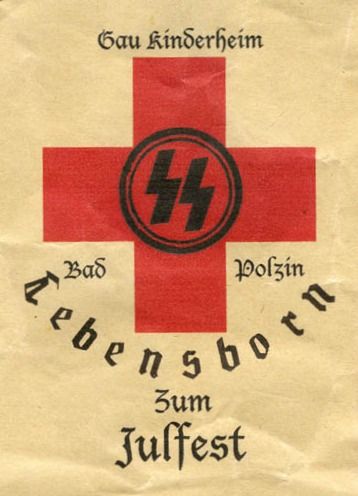
The image below is from a paper bag full full of goodies distributed to expectant mothers for Christmas (or in SS parlance, “Julfest”) at the Bad Polzin Lebensborn home in Pomerania.

Beatings at Christmas

Home / Christmas / Beatings at Christmas

There are a number of different types of thrashings connected with the Christmas season in many countries over the centuries. The first is a threat of chastisement and is connected with the switches and rods carried by gift-bringers and their helpers. St Nicholas was equally adept at thrashing bad children as he was in rewarding good behaviour.  German families kept a Klausholz – a Nicholas stick – on which to keep track of the number of Our Fathers said by the child, both to impress the saint when he arrived and to remind the child of the conditional nature of the anticipated gifts. In England a 1483 book of saints’ legends printed by William Caxton noted that while Nicholas was humble and joyous, he was also “cruel in correctyng”.

In the sixteenth-century Germany the Christmas bundle of presents included: “things that belong to teaching, obedience, chastisement and discipline, as A.B.C tablets, Bibles and handsome books, writing materials, paper, etc. and the Christ-rod”. The first book in the United States to include a picture of Santa Claus, the 1821 Children’s Friend, has the gift-giver state that he was happy to reward good girls and boys but

Where I found the children naughty,

In manners rude, in temper haughty,

Thankless to parents, liars, swearers,

Boxers, or cheats, or base tale-bearers,

I left a long, black birchen rod,

Such as the dread command of God

Directs a parent’s hand to use

When virtue’s path his sons refuse.

 December 28, the Feast of the Holy Innocents, commemorates the murder of the male babies of Bethlehem by King Herod. In England the day was known as Childermas (or Dyzemas) and was considered an ill-omened time; few would want, for example, to be married on that date. Not only was no business conducted on that day, but the day of the week on which it fell was deemed unlucky for the rest of the year. In Ireland it was the “cross day of the year” when no new enterprise was begun. Many sailors would not sail on that day; on the Aran isles no one was buried on Childermas (or the day of the week on which it occurred); and in Cornwall to wash on that day was to doom one of your relatives to death. On Childermas it was once customary in England to beat children. The explanation given in the seventeenth century was that that the memory of Herod’s crime “might stick the closer; and, in a moderate proportion, to act over the crueltie again in kind” but anthropologists have noted that ritual beatings are more likely descended from pagan rituals of good luck than punishment. An old German custom called “peppering” saw children beating their parents and servants beating their masters with sticks while asking in verse form for a treat. An equally venerable tradition in Normandy allowed children to give a thrashing to those who stayed too long in bed on December 28. In Wales on St Stephen’s Day, the practice was called “holming” or “holly-beating” — the last person to get out of bed was hit with holly sprigs and made to act as servant to the rest of the family. Sometimes the purpose of the holming was to draw blood. In parts of Scotland on New Year’s Eve boys beat each other with holly branches in the belief that for every drop of blood shed a year of life was saved for the victim. In Sweden it was once customary for the first-riser on Christmas Eve to give other family members small bundles of twigs which they would use to beat each other in the spirit of imparting vitality. In France children who let themselves be caught in bed on the morning of Holy Innocents’ came in for a whipping from their parents; while in one province, Normandy, the early risers among the young people themselves gave the sluggards a beating. The practice even gave birth to a verb—innocenter.

Buzzlewit Day Encore

Home / Christmas / Buzzlewit Day Encore

Four years ago I posted the following, with the caveat that I had only seen it in one source. Later, I had the source confirmed, so, in the hope that this is all true, I wish a Happy Buzzlewit Day to you all. Buzzlewit seems to me to be a more congenial creature than the creepy Elf on the Shelf.

Altoona, Pennsylvania, and a growing number of communities in the Boston area celebrate Buzzlewitz Day on November 11. According to the Lowther tradition, Buzzlewitz is the elf that is sent by Santa to collect children’s Christmas lists. On 11 November of each year at 11 pm, children leave their Christmas lists and a snickerdoodle cookie on the mantle or in the kitchen. Buzzlewitz comes in the night to collect the lists. In return, he leaves a mint and an acorn.

Canadian Santas of Yesteryear

Home / Christmas / Canadian Santas of Yesteryear

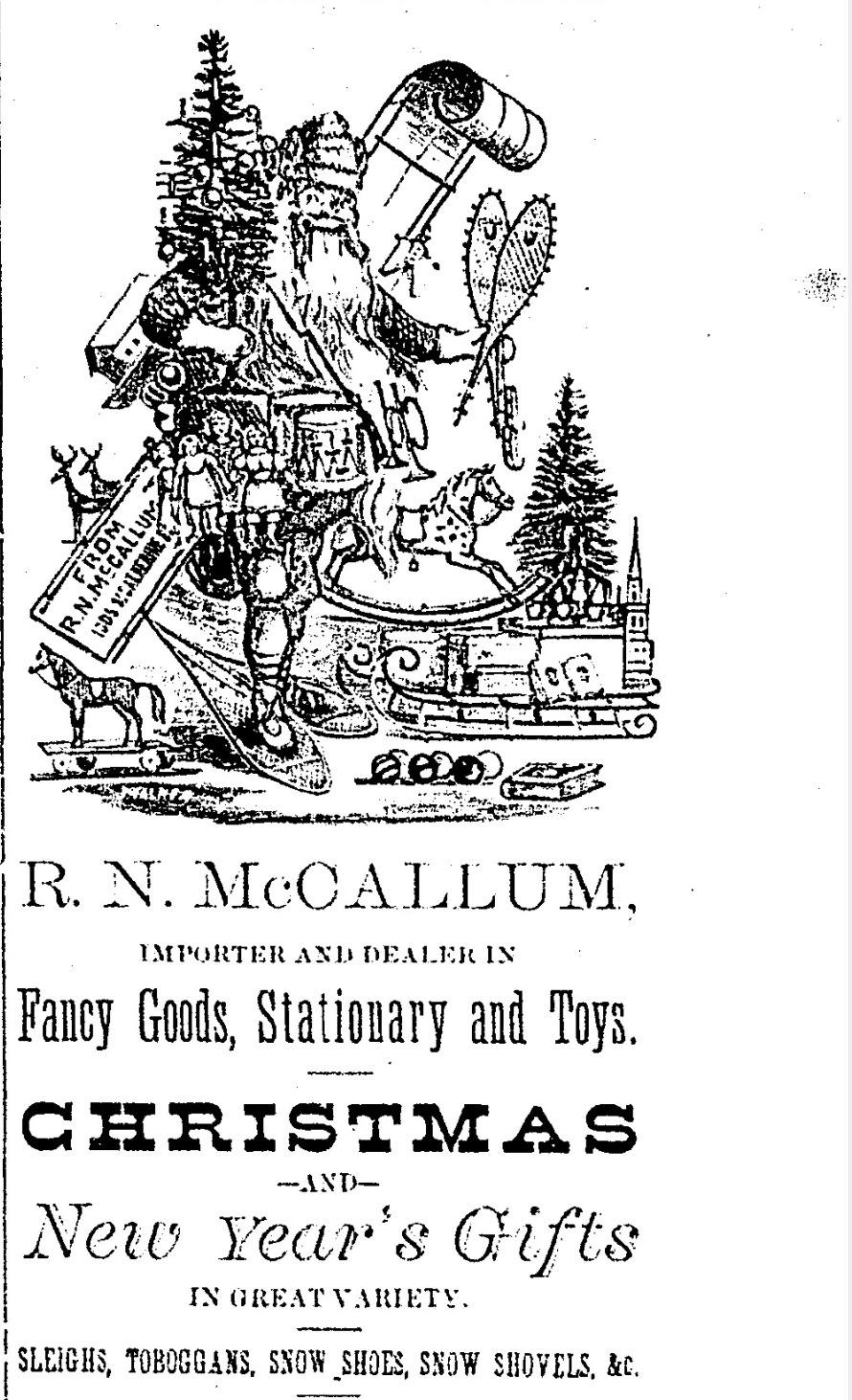
Here is a Santa Claus figure featured in an advertisement from the Canadian Illustrated News of 1883.

Being Canadian he is, of course, equipped with snowshoes and sled.

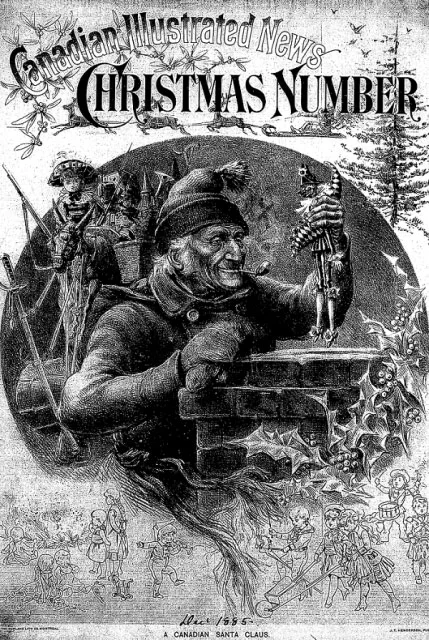
Here is a Santa from the same magazine in 1885.

You will note how distinctive this version of the Gift Bringer is. He is clean-shaven and wears no furs; instead he had a voyageur’s ceinture flechée sash, a floppy voyageur toque, and he is pulled by six reindeer. His sleigh has no runners (which would be useful on snowy roads) but is flat-bottomed like dog-powered sleds, good for deeper snow. Among the gifts he carries are a sword and a musket.

The Great Paignton Pudding Disaster

Home / Christmas / The Great Paignton Pudding Disaster

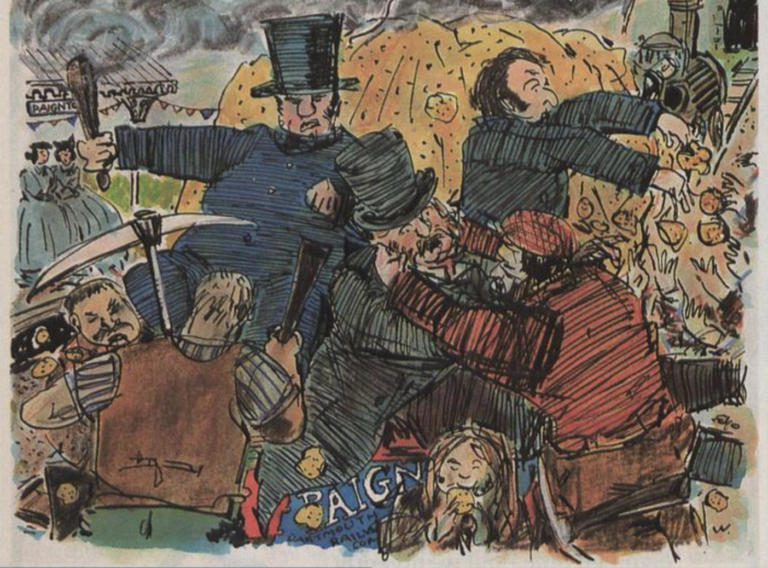
In 1819 the English town of Paignton produced a 900 lb. Christmas pudding in honour of the anniversary of their town charter. Despite being boiled in a brewer’s furnace for four days it remained uncooked, with the inside still raw. The townsfolk attempted an even more massive pudding in 1859 as part of a celebration of the arrival of the railway. This time it was cooked to perfection; made of 500 lbs of flour, 190 lbs of bread, 400 lbs of raisins, 184 lbs of currants, 400 lbs of suet, 96 lbs of sugar, 320 lemons, 150 nutmegs and 360 quarts of milk. The Monster Pudding (as newspapers referred to it) was over 13’ feet in circumference and rested on a wagon pulled by 8 horses. It was meant to feed 850 poor of the parish as well as 300 railway labourers but before that could happen a crowd of 18,000 sight-seers, well-lubricated by the local cider, rushed the pudding, swept aside its police escort and demolished the dessert in scenes of riotous disorder.

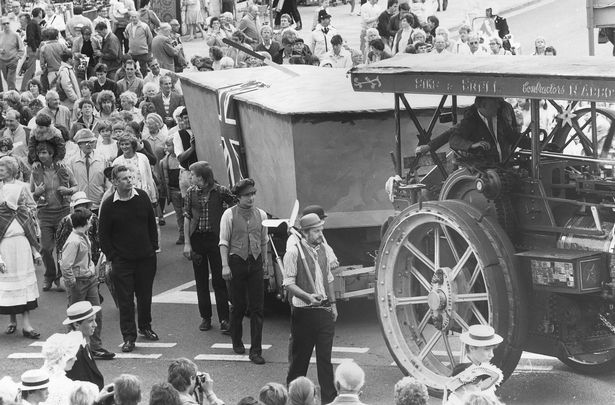
To this day residents of Paignton are called “Pudden Eaters” and pudding festivities are still observed with pride. In 1986 a giant casket containing 900 individual puddings on little pots was mounted on a wagon and pulled through the town by a steam-powered tractor. Mercifully, no rioting took place.

As monstrous as the Paington Pudding was, it would have been dwarfed by that giant Christmas pudding of over 3 tons made in Aughton, Lancashire in 1992. This confection was verified by the Guinness Book of World Records but there are stories of a 10-ton pudding created in 1931 in London.

July 1

1916 Battle of Beaumont Hamel


While the rest of Canada celebrates its 1867 founding with polite indifference and the occasional folk dance, July 1 is marked in Newfoundland as Memorial Day, a time to remember the tragedy of the Battle of Beaumont Hamel. That name remains indelibly imprinted in the history of Newfoundland. So much of the role played by England’s oldest and most loyal colony during the First World War is out of proportion to the island’s relative size and population within the British Empire, be it the number of Newfoundlanders who served, their contribution on land and at sea, or the tragedy that befell the 1st Newfoundland Regiment on July 1st, 1916.

As a Dominion of the British Empire (and still proudly independent of Canada) Newfoundland responded quickly to the motherland’s entry into the Great War. Men rushed to enlist and a regiment was sent to battle the forces of the Ottoman Turks at Gallipoli. Transferred from that disaster, the Newfoundlanders found themselves in the front lines of the Western Front in 1916 just in time for the unspeakable misery of the Battle of the Somme.

The sector to which they were assigned required them to cross 500 metres of open ground exposed to a dug-in enemy who knew they were coming. The result was horrible – of the eight hundred men who went into the attack that morning, just sixty-eight answered the roll call the following day. They were mowed down by machine-gun fire and blasted by artillery, yet they kept coming on. As they walked into the hail of machine gun and artillery fire, it was said that many of them tucked their chins in, almost like they were walking into the teeth of a blizzard back home

It is is probable that the defence of their front line that morning cost the Germans not a single man. So concentrated was German fire and so constricted was the advance, that nearly every Newfoundlander killed fell on ground held by the British before the attack began.

June 30

Home / Today in History / June 30

1934

The Night of the Long Knives

If anyone reproaches me and asks why I did not resort to the regular courts of justice, then all I can say is this. In this hour I was responsible for the fate of the German people, and thereby I became the supreme judge of the German people. I gave the order to shoot the ringleaders in this treason, and I further gave the order to cauterise down to the raw flesh the ulcers of this poisoning of the wells in our domestic life. Let the nation know that its existence—which depends on its internal order and security—cannot be threatened with impunity by anyone! And let it be known for all time to come that if anyone raises his hand to strike the State, then certain death is his lot.

So said Adolf Hitler, justifying a murderous rampage by his elite SS forces against his enemies inside, and outside, of the Nazi party.

Hitler had come to power on the backs of the Sturmabteilung, the SA, the brown-shirted storm troopers, who had battled Communist and Social Democrat paramilitaries at rallies, guarded party functions, intimidated rivals, handed out leaflets, and bullied Jews in the streets.  At the time of the 1933 elections that made Hitler the Chancellor of Germany, the SA numbered in the millions. Many of them, especially its leaders like Ernst Röhm (above), were genuine radicals, anticapitalist believers in the “socialist” part of the National Socialist ideology. They terrified the German upper class, and worried the official army generals who believed that they might be supplanted by the SA. Hitler needed the support of both the rich industrialists and the armed forces, so he plotted to reduce the power of the SA. Meeting secretly with army generals and navy admirals on board the battleship Deutschland, Hitler agreed to tame his storm troopers in return for the allegiance of the Wehrmacht, Luftwaffe, and Kriegsmarine, whose men would henceforth wear Nazi insignia on their uniforms.

On June 29, 1934 black-clad Schutzstaffel (SS) squads across Germany arrested both the leadership of the SA, and assorted other politicians and officers that Hitler wished to be rid of. Many of them were shot on the spot. Röhm was given a pistol with one bullet and told to commit suicide; he replied that if Adolf wanted him dead he could kill him in person, so he too was gunned down. Many SA men went to their death vowing loyalty to Hitler, not knowing he had ordered their executions. Among those outside the party murdered on the Night of the Long Knives, was former Chancellor Kurt von Schleicher and his wife, General Ferdinand von Bredow, several members of the Catholic Centre Party, and a music critic whose name resembled that of someone else on the death list.

Most Germans seem to have accepted Hitler’s excuses for the illegal actions. Henceforth the SA declined in power, losing half its membership inside a year, and Hitler remained unchallenged.

June 29

Home / Today in History / June 29

1861 The death of Elizabeth Barrett Browning

They don’t make poetical romances as romantic as the real-life love story of the two English versifiers Robert Browning and Elizabeth Barrett. She was the chronically ill daughter of a tyrannical father and he was a younger and more famous poet who courted her in secret. They wed, moved to Florence, Italy, and lived in bliss until her death. Here is a contemporary account of her passing:

When in the summer of 1861 the sad news reached England that Mrs. Browning was no more, the newspapers confessed with singular accord that the world had lost in her the greatest poetess that had appeared in all its generations.

Elizabeth Barrett, the subject of this supreme eulogy, was the daughter of a gentleman of fortune, and at his country-seat in Hereford-shire, among the lovely scenery of the Malvern Hills, she passed her girlhood. At the age of ten she began to attempt writing in prose and verse; and at fifteen her powers as a writer were well known to her friends. She was a diligent student, and was soon able to read Greek, not as a task, but as a recreation and delight. She began to contribute to the magazines, and a series of essays on the Greek poets proved how deeply she had passed into and absorbed their spirit. In 1833 she published an anonymous translation of the Prometheus Bound of Æschylus, which afterwards she superseded by a better version. Her public fame dates, however, from 1838, when she collected her best verses from the periodicals, and published them as The Seraphim and other Poems. 

At this time occurred a tragic accident, which for years threw a black shadow over Miss Barrett’s life. A blood-vessel having broke on her lungs, the physician ordered her to Torquay, where a house was taken for her by the sea-side, at the foot of the cliffs. Under the influence of the mild Devonshire breezes she was rapidly recovering, when, one bright summer morning, her brother and two other young men, his friends, went out in a small boat for a trip of a few hours. Just as they crossed the bar, the vessel capsized, and all on board perished. Even their bodies were never recovered. This sudden and dreadful calamity almost killed Miss Barrett. During a whole year she lay in the house incapable of removal, whilst the sound of the waves rang in her ears as the moans of the dying. 

Literature was her only solace. Her physician pleaded with her to abandon her studies, and, to quiet his importunities, she had a small edition of Plato bound so as to resemble a novel. When at last removed to London, it was in an invalid carriage, at the slow rate of twenty miles a day. In a commodious and darkened room in her father’s house in Wimpole Street she nursed her remnant of life, seeing a few choice friends, reading the best books in many languages, and writing poetry according to her inspiration. 

Gradually her health improved, and in 1846 the brightness of her life was restored and perfected in her marriage with Robert Browning. They went to Italy, first to Pisa, and then settled in Florence. Mrs. Browning’s heart became quickly involved in Italy’s struggles for liberty and unity, and various and fervent were the poetical expressions of her hopes and alarms for the result. Her love for Italy became a passion stronger even than natural patriotism. Inexplicably to English readers, she praised and trusted the Emperor of the French as Italy’s earnest friend and deliverer; and Louis Napoleon will live long ere he hear more ardent words of faith in his goodness and wisdom than the English poetess uttered concerning him. Blest in assured fame, in a rising Italy, in a pleasant Florentine home, in a husband equal in heart and intellect, and in a son in the prime of boyhood—a brief illness snapped the thread of her frail life, and she was borne to the tomb, bewailed scarcely less in Tuscany than in England.

June 28

Home / Uncategorized / June 28

I believe that if one is going to say cruel things in print, particularly if one is being paid for such writing, that the cruelty should be leavened by wit or, at least, elegance. Consider the case of the infamous New York critic John Simon whose was tendency to dislike all that he saw and to denigrate performers based on their personal appearance. Of him fellow critic Roger Ebert remarked, “I feel repugnance for the critic John Simon, who made it a specialty to attack the way actors look. They can’t help how they look, any more than John Simon can help looking like a rat.” He is said to have an abiding concern for the elevation of the art of criticism and the use of the English language but one struggles to find that concern in remarks like these:

Built like a brick mausoleum with insufficient flying buttresses. 
– John Simon on Diana Rigg as a naked Heloïse


What is one to make of that metaphor? Mausoleums never came equipped with flying buttresses and his description of the sublime Dianna Rigg does not match with her svelte reality. A poor attempt at a medieval reference.

She looks like a cross between an aardvark and an albino rat surmounted by a platinum-coated horse bun. 
– John Simon on Barbra Streisand

The mind struggles to conceive of the fruit of an aardvark-rat union. Another failed metaphor made no better by the incongruous addition of a metallic horse puck. Simon just plain didn’t like Streisand and it looks like he threw a bunch of bad-sounding animal names in a sentence and hoped for the best.

Here is another failed figure of speech from the animal kingdom. Ask yourself if constipated gazelles sulk.

Christopher Duva, as Valère, Mariane’s lover, seems to have just drifted in from the nearest gay bar, and often sulks and postures like a constipated gazelle. – John Simon on a performance of Tartuffe

The British do nastiness much better.

Twin miracles of mascara, her eyes looked like the corpses of two small crows that had crashed into a chalk cliff. – Clive James on Barbara Cartland

He looks like a brown condom stuffed with walnuts. – Clive James on Arnold Schwarzenegger

Whenever Clare Short wrestles with her conscience, she wins. – Ben Macintyre on a Labour politician

Randolph Churchill went into the hospital . . . to have a lung removed. It was announced that the trouble was not “malignant.”. .. I remarked that it was a typical triumph of modern science to find the only part of Randolph that was not malignant and remove it. – Evelyn Waugh on a friend

He reduced everything to politics… He would not blow his nose without moralizing on conditions in the handkerchief industry. – Cyril Connolly on George Orwell

In the Dally Telegraph not long ago, A.N. Wilson produced one of those short but seemingly interminable opinion columns at which he so often excels, this one putatively in praise of the present Archbishop of Canterbury. The panegyric, however, was somewhat overwhelmed by the comical dolorousness of the prose. No fewer than sixteen-hundred times (at least, if the impression lingering in my memory Is to be believed), Wilson departed from his theme to inform us that we are living In the waning days of the Christian religion, that it will not be long before the last church is closed, and that hence we may not see the likes of the good Archbishop very often again. Surely, I thought as I was reading, this is a man in whom parochialism has metastasized into a psychosis. Here we are living In an age when Christianity is spreading more rapidly and more widely than at any other point in the two millennia of its history throughout the global South and East and yet, because the Church languishes in the senile cultures of a small geological apophysis (with a few appertinent isles) at the western edge of continental Asia, Wilson concludes that the faith is in its death throes. Of course, being morbidly tiresome is part of Wilson’s special post-Christian style: the air of weary, sage solemnity and flaccid resignation, the boring declarations of religious disenchantment, the bleak glimpses he affords us into the empty closets of his soul, the oracular intimations of the fate he has suffered for all of us in advance. – David Bentley Hart,  In the Aftermath: Provocations and Laments