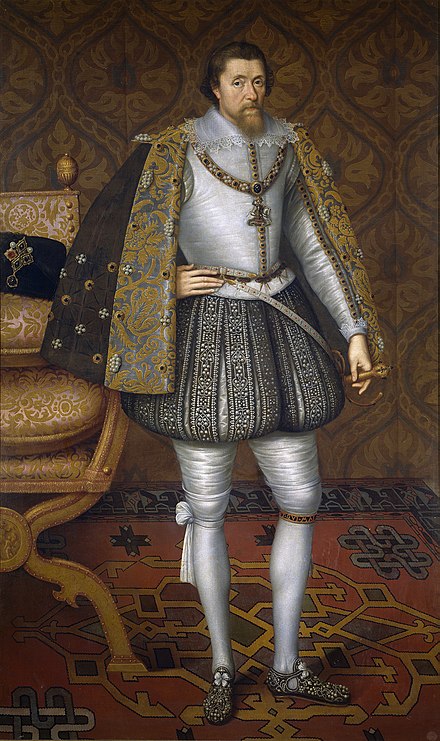
James VI and I,(1566-1625) King of Scotland (1567-1625) and England (1603-25), was a staunch defender of Christmas.
Raised in Scotland where the Calvinist church had forbidden Christmas celebrations, it was feared that he would be an opponent of the feast when he travelled south to assume the throne of England in 1603. Instead, James proved to be a stout advocate of Christmas customs, commissioning lavish holiday entertainments for his court from Richard Middleton and Ben Jonson (including Christmas His Masque).
He ordered the English nobility to leave London in December for their country estates so that they could keep Christmas and its traditional hospitality to their tenants as in days of old. In the Puritan opposition to Christmas and to religious ceremonial in general, King James peceived a kind of sedition and opposition to royal authority. He defended “the freedom to be merry”, commanding dour Scotland in the Five Articles of Perth to keep Christmas in the English manner and issuing the Book of Sports which prescribed the activities that could lawfully be enjoyed after church on Sundays.
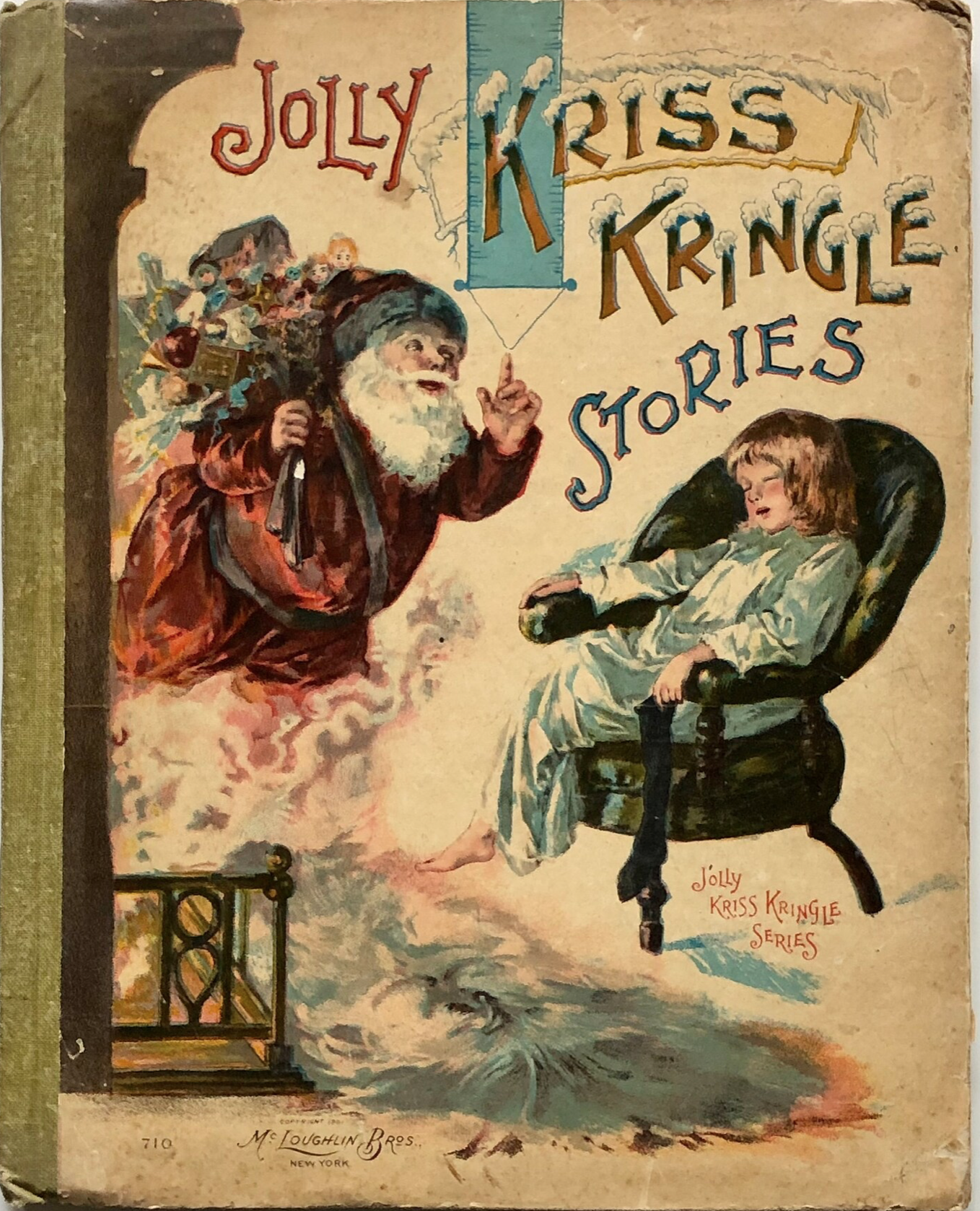
In mid-nineteenth-century America, the elfin gift-bringer had more than one name depending on his locale. In New York he was Santa Claus or St Nicholas; in Philadelphia he was Kriss Kringle or Belsnickel. At one time, as we have seen these names meant very different characters, Kriss Kringle was an American corruption of das Christkindl, the Christchild, portrayed either as an infant or as a white-clad adolescent; Belsnickel was a shaggy and fearsome creature, often accompanying St Nicholas or the Christchild. By the 1840s, however, the allure of Santa Claus was such that though Pennsylvanians clung to the familiar names, the gift-bringer they were attached to was that described by Clark Clement Moore in “ ‘Twas The Night Before Christmas”. We can see this in works published in Philadelphia such as Kriss Kringle’s Book and Kriss Kringle’s Christmas Tree where the generous elf in question is clearly the newly minted Santa Claus and no Germanic import. In an 1855 article in Putnam’s Monthly, the narrator, Mr. Sparrowgrass implores his wife to mind her language:
“My dear,” said I after a pause, “speaking of children I wish you would not teach the young ones so many of your Philadelphia phrases….Mrs. Sparrowgrass, next Christmas Santa Claus, if you please – no, Kriss Kringle. Santa Claus is the patron saint, Mrs. Sparrowgrass, of the New Netherlands, and the ancient Dorp of Yonkers; he it is who fills the fireside stockings; he only can come down Westchester chimneys, and I would much prefer not to have the children’s minds and the flue occupied with his Pennsylvania prototype.”
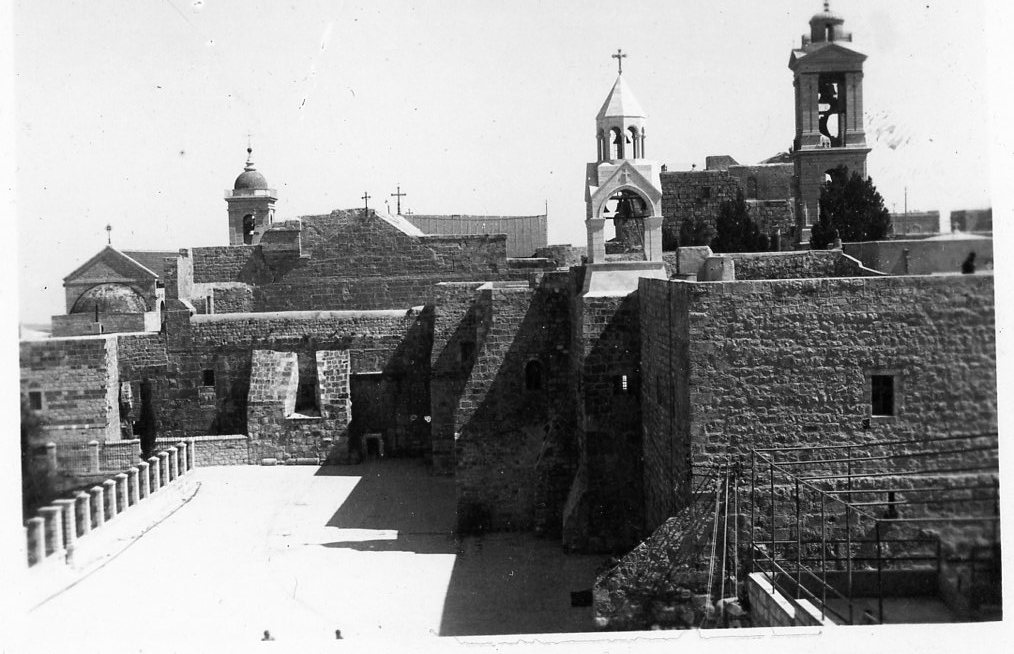
A large fortress-like church complex on Manger Square in Bethlehem is centred on the site where Jesus was said to have been born. The picture above was taken in 1944 by my father when he was stationed in Palestine with the RAF.
As early as the second century local tradition claimed that the Nativity of Christ had taken place in a stable-cave, the location of which was sufficiently well-known that the Roman emperor Hadrian established a pagan grove there dedicated to Adonis in order to discourage Christian worship on the site. In the third century Origen and other visitors were still being directed to the spot. The theologian reported: “In Bethlehem the cave is pointed out where He was born, and the manger in the cave where He was wrapped in swaddling clothes, and the rumor is in those places and among foreigners of the Faith that indeed Jesus was born in this cave.”
The first Church of the Nativity was built over the cave by Saint Helena, mother of the emperor Constantine, Rome’s first Christian ruler. This church was later damaged in an uprising and was rebuilt in the sixth century at the command of the Byzantine emperor Justinian. When the area was overrun by Persian invaders in 614, legend claims that the Church of the Nativity was spared because of depictions in a mosaic of Magi in Persian dress.
The cross-shaped Church of St Mary of the Nativity, 170 feet long and 80 feet wide, stands above the small grotto where a silver star marks the spot where Jesus was born; the inscription reads Hic De Virgine Maria Jesus Christus Natus Est — “Here Jesus Christ was Born of the Virgin Mary.” Nearby is a chapel where the manger stood in which the infant was placed. Surrounding the Church of the Nativity are other chapels and convents of the Catholic, Orthodox and Armenian churches; these three denominations share the administration of various parts of the complex. Quarrels between them in the nineteenth century took on dangerous overtones. The Russian goverment supported the Orthodox claims while the Catholics were backed by the French government; these hard feelings were one of the reasons for the outbreak of the Crimean War in the 1850s.
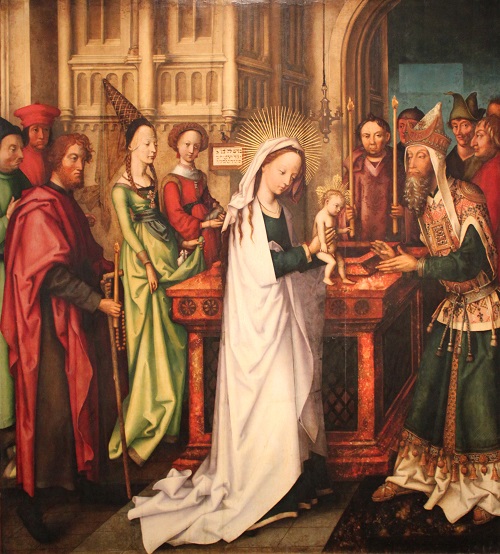
February 2; since the sixth century the day of the Feast of the Purification of the Blessed Virgin Mary, and now known as the Feast of the Presentation, marked the ritual in the Temple required by Jewish law law forty days after the birth of a male child.
When the infant Jesus was brought to the Temple, Simeon spoke of him as “a light to lighten the Gentiles” (Luke 2:32) and so light is the theme of the day. Believers bring a candle to the church to be blessed; these candles are thought to possess magical powers against sickness and thunder storms. In England the Yule log for the next Christmas was selected and set to dry; in Mexico it is the Dia de Candelaria when the image of the baby Jesus is removed from the cradle. On Candlemas, Scottish school children used to bring money to their teacher to buy candles to light the school room, a practice that turned into simply bringing gifts to the master. The boy who brought the most money (the term for this gratuity was bleeze-money) was named Candlemas King whose reign lasted six weeks and who was allowed to remit punishments.
The custom of predicting the weather based on conditions on Candlemas has turned into Groundhog Day wherein North Americans watch the emergence of particular groundhogs from their hibernation — if they see their shadows on February 2, six more weeks of winter will follow. (Americans scrutinize the reaction of the Pennsylvania groundhog named Punxsutawney Phil while Canadians observe Ontario’s Wiarton Willie.) Candlemas was also believed to be a time when the soul of Judas was temporarily allowed out of Hell to ease his torment in the sea.
Across many cultures it is the last day of the Christmas season when all ornaments must be taken down and greenery burnt. My friend and Tudor history colleague John Murphy tells me that In Ireland holly was kept from the greenery to use as kindling for the fire to make the pancakes on Shrove Tuesday. The Irish originally burnt this holly exclusively at the shines to the goddess Brigid whose festival was kept at Imbolc – again at early February – Goddess Brigid was patroness of poets and healing amongst many things – attributes passed over to the Irish Saint Brigid whose feast day is 1st Feb. I think at these dates were originally a bit moveable as they conformed rather to the interface of solar and lunar cycles. St Blaise on 3rd February has blessing of throats – so the healing powers associated with the holy candles of Candlemas looked beyond its place in the Christian sanctoral calendar to the ceremonies from a pagan past.
In the modern world many tend to see the Christmas season over on December 26th. In fact, it is just beginning. One hears of the Twelve Days of Christmas which end on Epiphany but really Christmastide is forty days long and only comes to completion on Candlemas, February 2. Here is a 15th-century English carol to remind us.
1. The first day of Yule have we in mind, How God was man born of our kind; For he the bonds would unbind Of all our sins and wickedness.
2. The second day we sing of Stephen, Who stoned was and rose up even To God whom he saw stand in heaven, And crowned was for his prowess. [bravery]
3. The third day belongeth to Saint John, Who was Christ’s darling, dearer none, To whom he entrusted, when he should gone, [when he had to die] His mother dear for her cleanness. [purity]
4. The fourth day of the children young, Whom Herod put to death with wrong; Of Christ they could not tell with tongue, But with their blood bore him witness.
5. The fifth day belongeth to Saint Thomas, Who, like a strong pillar of brass, Held up the church, and slain he was, Because he stood with righteousness.
6. The eighth day Jesu took his name, Who saved mankind from sin and shame, And circumcised was, for no blame, But as example of meekness.
7. The twelfth day offered to him kings three, Gold, myrrh, and incense, these gifts free, For God, and man, and king was he, Thus worshipped they his worthiness.
8. On the fortieth day came Mary mild, Unto the temple with her child, To show herself clean, who never was defiled, And therewith endeth Christmas.
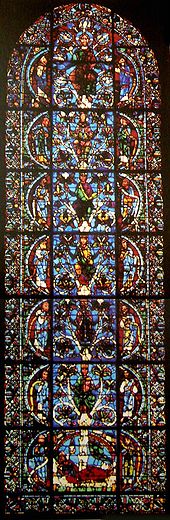
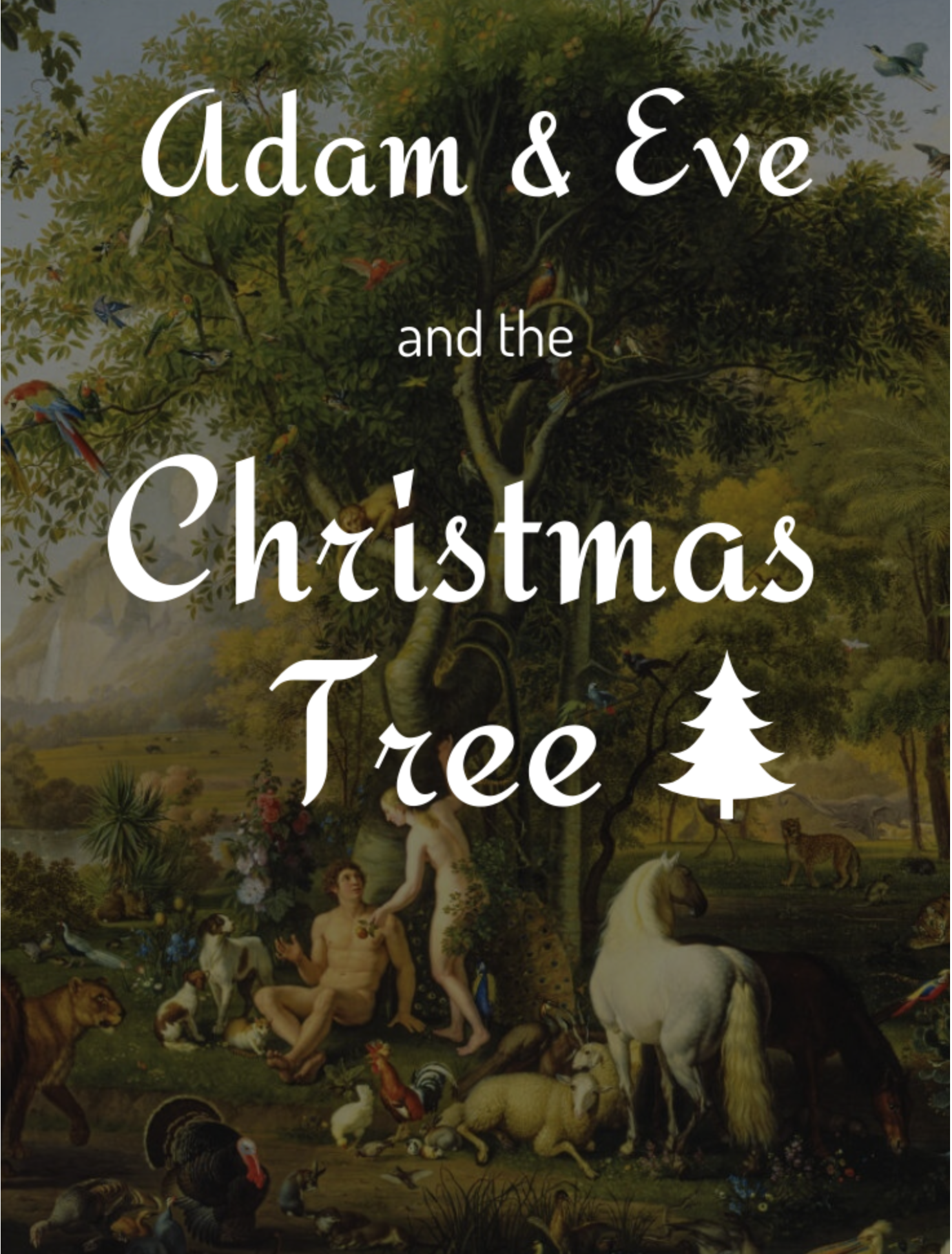
Adam and Eve, the ancestors of the human race, were first honoured as saints in the churches of Eastern Christianity and during the Middle Ages their cult spread into the West. Though the Catholic church never officially recognized them with a feast day, popular veneration of Adam and Eve was widespread, particularly on December 24 when it was thought fitting that those responsible for the Fall of mankind be linked with the birth of the Saviour who came to redeem humanity.
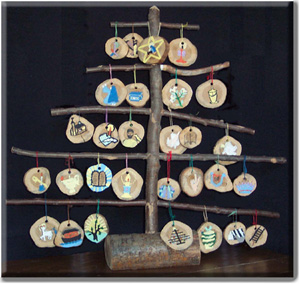
Medieval dramas which told the story of Adam and Eve had as a stage prop a tree representing the Garden of Eden and the Tree of the Fruit of the Knowledge of Good and Evil. This tree was decorated with apples or round wafers representing the host of the Mass and it is this “Paradise Tree” which some historians (not me) see as a precursor to the modern Christmas tree. This link is evident when we note that as late as the nineteenth century some American and German Christmas trees had images of Adam and Eve and the Serpent underneath them. Godey’s magazine claimed “an orthodox Christmas-Tree will have the figures of our first parents at its foot, and the serpent twining itself. The apples were placed on the table on Christmas Eve to recall those through whose sin mankind first fell as well as the Virgin Mary, the new Eve.
In the early 20th century German parties of the left opposed Christmas. The Communist Party liked to use the holiday to attack capitalism by vandalizing stores and interrupting church services. The Social Democrat Party was less violent but criticized middle class attitudes to Christmas, reminding their followers that it was the workers who provided all the goods: the real Weihnachtsmann was the “working proletariat’. A 1900 collection entitled The Worker’s Christmas in Song published “Arbeiter-Stille-Nacht” – “The Worker’s Silent Night”, by Boleslaw Strzelewicz (1857-1938).
Silent night, sorrowful night, All around splendid light. In the hovels just torment and need, Cold and waste, no light and no bread. The poor are sleeping on straw. The poor are sleeping in straw.
Silent night, sorrowful night, The hungry babe cries out his plight, Did you bring us home some bread? Sighing the father shakes his head, “I’m still unemployed.” “I’m still unemployed.”
Silent night, sorrowful night, Working folk, arise and fight! Pledge to struggle in all holiness Until humanity’s Christmas exists Until peace is here. Until peace is here.
Aguinaldo is a word with a number of Christmas associations: in Cuba it is a vine with blue flowers that blooms in the winter; in the Philippines and Puerto Rico it is an early morning mass in Advent; in much of Spanish America it is a name for Christmas presents; in Honduras, Costa Rica and Ecuador the term refers to the annual Christmas bonus given by employers; and in Spain and the Spanish Caribbean it is a song sung by visiting carolers.
Here is an example of a Spanish aguinaldo:
Todo los años venimos, A cantar por este tiempo Las coplas del aguinaldo De Divine Nacimiento.
A esta casa liegamos Casa rice y principal. Cantaremos y principal, Tomaremos si nos dan.
De la sacrista sale El cura bien revestido A darle felices pascuas Al Nino recien nacido.
Every year we come To sing at this time The verses of the aguinaldo Of the divine birth.
We come to this house, A rich and illustrious house, We will sing and we will drink, If you give us something.
From the sacristy comes The priest, finely attired, To give Christmas greetings To the new-born babe.
Robert Ingersoll (1833-99) was the most famous atheist of his generation, outraging American Christians with his attacks on their religion. In December, 1891 the Evening Telegraph printed the following “sermon”, sparking rebuttals and counter-rebuttals in the press.
The good part of Christmas is not always Christian — it is generally Pagan; that is to say, human, natural.
Christianity did not come with tidings of great joy, but with a message of eternal grief. It came with the threat of everlasting torture on its lips. It meant war on earth and perdition hereafter.
It taught some good things — the beauty of love and kindness in man. But as a torch-bearer, as a bringer of joy, it has been a failure. It has given infinite consequences to the acts of finite beings, crushing the soul with a responsibility too great for mortals to bear. It has filled the future with fear and flame, and made God the keeper of an eternal penitentiary, destined to be the home of nearly all the sons of men. Not satisfied with that, it has deprived God of the pardoning power.
And yet it may have done some good by borrowing from the Pagan world the old festival called Christmas.
Long before Christ was born the Sun-God triumphed over the powers of Darkness. About the time that we call Christmas the days begin perceptibly to lengthen. Our barbarian ancestors were worshipers of the sun, and they celebrated his victory over the hosts of night. Such a festival was natural and beautiful. The most natural of all religions is the worship of the sun. Christianity adopted this festival. It borrowed from the Pagans the best it has.
I believe in Christmas and in every day that has been set apart for joy. We in America have too much work and not enough play. We are too much like the English.
I think it was Heinrich Heine who said that he thought a blaspheming Frenchman was a more pleasing object to God than a praying Englishman. We take our joys too sadly. I am in favor of all the good free days — the more the better.
Christmas is a good day to forgive and forget — a good day to throw away prejudices and hatreds — a good day to fill your heart and your house, and the hearts and houses of others, with sunshine.
No part of Europe suffered as much from the fall of the Roman Empire to the barbarian invasions as did Britain. After the last legion pulled out in 410, the island was left to its own resources which proved insufficient to repel the waves of Picts, Saxons, Irish, Angles and Jutes that assailed the Romano-Britons. Civilization gradually died; literacy almost vanished; the barter system replaced coinage; and Christianity retreated into the Welsh hills and the remoter regions; Germanic petty kingdoms were established on the ruins.
The task of reintroducing Christianity fell to Irish monks who evangelized the north and to a mission sent out from Rome in the 590s. Aethelbert, a barbarian king in Kent, had married a Frankish princess who had won permission to include Christian priests in her retinue. Pope Gregory the Great took the opportunity to send monks from his own monastery to the Kentish capital at Canterbury and the expedition was to be led by the abbot Augustine. On the way to his post Augustine apparently heard stories of the bloodthirsty people to whom he was being sent and wanted to turn back. His spine was stiffened by exhortations from Gregory so the monk continued to Britain, arriving in 597.
Augustine’s mission was made easier by a change in Church attitudes to pagan customs. Hitherto, the Church had resolutely resisted the pressures of local culture on the Christian message. Early believers had spent centuries refusing to take part in Roman civic religion, the sacrifices, holiday celebrations, and the bloody arena sports, and suffered for it. But by the start of the 7th century, the papacy was willing to become more accommodating in order to meet the challenge of evangelizing the Germanic barbarians. Pope Gregory sent the following message to Augustine:
By no means destroy the temples of the gods but rather the idols within those temples. Let him, after he has purified them with holy water, place altars and relics of the saints in them. For, if those temples are well built, they should be converted from the worship of demons to the service of the true God. Thus, seeing that their places of worship are not destroyed, the people will banish error from their hearts and come to places familiar and dear to them in acknowledgement and worship of the true God. Further, since it has been their custom to slaughter oxen in sacrifice, they should receive some solemnity in exchange. Let them therefore, on the day of the dedication of their churches, or on the feast of the martyrs whose relics are preserved in them, build themselves huts around their one-time temples and celebrate the occasion with religious feasting. They will sacrifice and eat the animals not any more as an offering to the devil, but for the glory of God to whom, as the giver of all things, they will give thanks for having been satiated. Thus, if they are not deprived of all exterior joys, they will more easily taste the interior ones. For surely it is impossible to efface all at once everything from their strong minds, just as, when one wishes to reach the top of a mountain, he must climb by stages and step by step, not by leaps and bounds.
This policy helped ensure Christmas celebrations over the ages would be syncretic, varied with many local flavours. Moreover, Christmas Day was the date in 597 when Augustine was able to baptize Aethelbert and thousands of his Saxon followers.