A 1942 publication entitled Manx Calendar Customs makes the following observation about Oie’l Verrey:
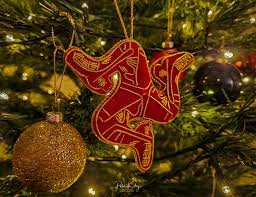
On Christmas Eve, called in Manx, “Oie’l Verrey,” the Eve of Mary, a singular and interesting custom is observed, which attracts large numbers to the parish church for the purpose of singing carols (in Manx called Carvals) and which appears to be peculiar to the Isle of Man.
On this evening, the church having been decked with holly, ever greens, and flowers, after prayers the congregation commence singing their carvals, which they keep up with a spirit of great rivalry until a late hour. On this occasion the church assumes a brilliancy seen at no other time, for each person brings their own light, some of the candles being of large size, many of them formed into branches for the occasion, and adorned with gay ribbons. During the interval of the carols, parched peas are flung from all directions, the female portion of the singers having previously provided themselves with an ample stock to pelt their bachelor friends.
Alas, such a wonderful custom seems to have been abandoned by contemporary island folk. A traditional greeting for the season from the Isle of Man says:
Nollick Ghennal erriu, as blein feer vie Seihll as slaynt da’n slane lught-thie; Bea as gennallys eu bio ry-cheilley, Shee as graih eddyr mraane as deiney
A Merry Christmas to you, and a very good year Long life and health to the whole household; Life and joy to you living together, Peace and love between women and men.
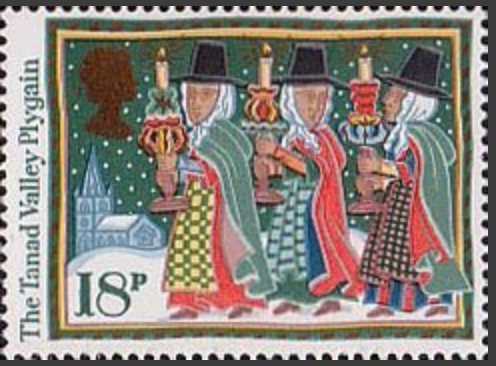
Plygain is the pre-dawn church service on Christmas morning in Wales, the last surviving remnant of the pre-Reformation Sarum rite. It was customary for many to spend the long night waiting for the service in the company of friends and family singing and celebrating. The service was lit by special plygain candles and consisted largely of singing carols. Plygain was originally a Catholic ceremony but survived in the Anglican tradition as a replacement of the Midnight Mass when Wales converted to Protestantism; it was kept alive in the nineteenth century by Methodist churches. In Carmarthenshire people paraded through the streets with torches on Christmas Eve before the service. Plygain gradually disappeared for a time from most areas because of the rowdiness of many of the participants who had spent their time waiting for the service by getting drunk but the tradition has been revived in many parts of the country.
The name seems to derive from the Latin pulli cantus or “cock crow song” which suggests that carol singing was long a part of the custom, or perhaps from a Welsh word for “bending”, as in prayer. A related observance which survives on the Isle of Man is the Oie’l Verrey.
Christmas in Peru mixes the Spanish heritage of the country’s colonial past with the native American experience to produce a noisy, pious and colourful celebration. The season begins in late November with the opening of Christmas markets. Peruvians are devotees of the home Nativity scene and are always looking for new figures to add to the crèche or new backdrops and landscapes for the characters; carvings by the native Quechuans, in wood or plaster, are becoming sought after around the world. These crèches are set up in churches and homes and can become quite complex as pieces are added every year.
During December fairs and festivals are common, with music heard in the streets played on native instruments such as the harp, Indian flute or whistle. Peruvians have have adopted the traditional villancico or Christmas carol and made it their own, singing them in Spanish or in native languages. Popular carols include “Allegria, Allegria en Navidad” (“Joy, Joy at Christmas”), “Vamos Pastores” (“Let’s Go Shepherds”) “Chillín, Chillín Campanilla” (“Bells are Ringing”) and “Rueda, Rueda”:
Rueda, rueda por la montaña Blanca luz de sol. Rueda, rueda la buena nueva Que nació el Redentor. Rueda, ruedala buena nueva Que Él y nació.
Roll, roll down the mountain, White light of the sun. Roll, roll the good news That the Redeemer is born. Roll, roll the good news That He is born.
As in all of Latin America Christmas Eve is the time for the family dinner and the midnight church service. Turkey is usually the main dish with papas a la Huancaína, a potato salad or tamales. Paneton fruit cake and chocolate will be for dessert with champagne the beverage of choice. Noche Buena is the night when children open their presents and see what Santa Claus has put in the stockings placed by the crèche. At twelve o’clock the image of the baby Jesus will be placed in the manger and fireworks will continue long into the night.
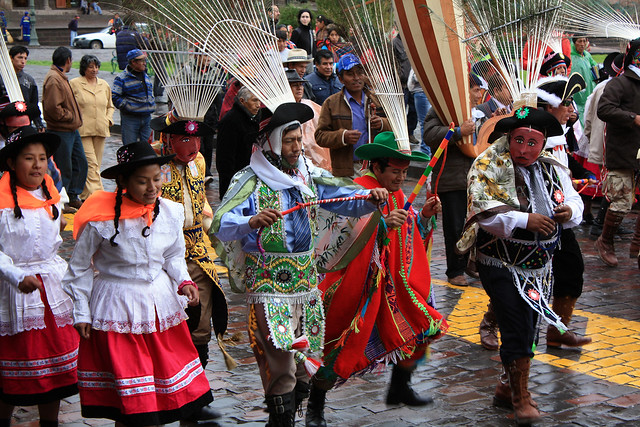
From Christmas to Epiphany Peruvians will continue to celebrate. There will be bull-fights in the cities, processions, more fiireworks, dances and parties. High in the Andes in the Huancayo district native miners hold the exotic Dance of the Beasts and Birds complete with masked dancers and animals they have snared to populate the manger scene in the churches. On January 6 Peruvians keep the old custom of the King’s Ring, the rosca de reyeswhich contains a surprise hidden within.
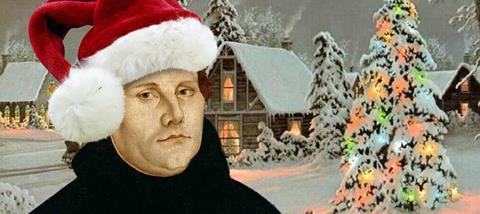
The German religious reformer (1483-1546) is credited with a number of Christmas innovations and certainly altered the course of Christmas history
Legend says that Martin Luther, inspired by the starry sky on Christmas Eve, was the first to put lights on a Christmas tree. He is also said to have been the first to put a small crèche under the tree. The Christmas carol “Away in a Manger” was attributed to him. The first two of these claims are extremely unlikely while the third is utterly false. Luther however did play an important role in the development of Christmas in other ways.
Unlike other Reformers who broke away from Rome in the sixteenth century, Luther was by no means willing to shed Christmas as a popish invention. He loved the holiday and continued to celebrate it all his life. He wrote five Christmas carols; the most famous, “From Heaven Above”, was probably written for his own children. Some of his finest sermons were delivered at Christmas time and were devoted to making the Nativity real in the eyes of his listeners — Luther described what Mary lacked at the birth in Palestine in terms of what might have been found in a German home; he described the distance from Nazareth to Bethlehem as being that from Saxony to Franconia. He spoke to those in his congregation of the predicament of the Holy Family in the stable:
Think, women, there was no one there to bathe the baby. No warm water, nor even cold. No fire, no light. The mother was herself midwife and the maid. The cold manger was the bed and the bathtub. I am amazed that the little one did not freeze. Who showed the poor girl what to do? Do not make of Mary a stone. It must have gone straight to her heart that she was so abandoned. She was flesh and blood, and must have felt miserable — and Joseph too — that she was left in this way, all alone with no one to help, in a strange land in the middle of winter. Her eyes were moist even though she was happy, and aware that the baby was God’s Son and Saviour of the world. She was not stone. For the higher people are in the favour of God, the more tender they are.
There are some of us…who think to ourselves, “If I had only been there! How quick I would have been to help the Baby. I would have washed His linen. How happy I would have been to go with the shepherds to see the Lord lying in the manger!” Yes, we would. We say that because we know how great Christ is, but if we had been there at that time, we would have done no better than the people of Bethlehem….Why don’t we do it now? We have Christ in our neighbor.
Luther also played a destructive role in his attitudes toward Christmas. He was an opponent of the cult of saints at a time when Christmas was rife with the presence of saints and their holy days. He criticized the veneration directed toward the Magi and sneered at their relics in Cologne which he had seen and which he said had no claim to authenticity. As late as 1531 he mentioned St Nicholas as the Gift-Bringer and the one to whom German children looked when putting out their stockings, but in the long run his attack on saints led to the replacement of Nicholas by the Christ Child and, later, the Weihnachtsmann as the nation’s supplier of Christmas presents.
It is now widely accepted that Christmas is the time of home-coming. Songs such as “Home for the Holidays” or “I’ll Be Home for Christmas” testify to the place that the season holds in the life of modern, scattered families. This theme, however, was not always present among the many meanings that Christmas conveys. It was only in the nineteenth century, when industrialization and – in England – the rise of the popularity of boarding schools took millions away from their homes, that the impulse arose. The sentiment was enhanced by the revival of an emphasis on the humanity of Jesus in the Nativity and the notion of the original Christmas as a family event.
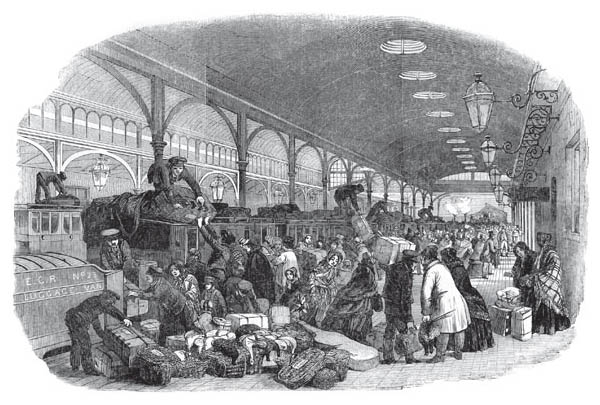
The expansion of railway travel and cheap fares made it possible for those away from home to consider returning for the holidays and more and more countries legislated Christmas as a holiday time. By the twentieth century Christmas was the principal time for family reunion – except in the United States where it is edged out by Thanksgiving (see, for example, the desperate struggle to make it home in time for that holiday portrayed by the John Candy / Steve Martin movie Planes, Trains, and Automobiles.)
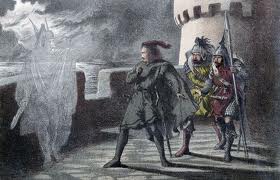
The plays and poems of William Shakespeare seldom mention Christmas but there is an important seasonal tradition contained (or perhaps invented?) early on in Hamlet where Marcellus refers to the ghostly apparition of the dead king, remarks
Some say that ever ‘gainst that season comes Wherein our Savior’s birth is celebrated. The bird of dawning singeth all night long; And then, they say, no spirit can walk abroad; The nights are wholesome; then no planets strike, No fairy takes, nor witch hath power to charm, So hallow’d and so gracious is the time (1.1.178).
An article in an 1881 edition of Notes & Queries makes the counter-argument that in England the Christmas season is full of spooky comings and goings:
That Christmas ghostly season is shown by certain supernatural noises, such as the subterranean ringing of bells which are said to be distinctly beard in certain localities. Thus, for instance, near Raleigh in Nottinghamshire, there is a valley said to have been caused by an earthquake, several hundred years ago, which swallowed up a whole village, together with the church. It was formerly customary for the people to assemble in this valley every Christmas morning to listen to the ringing of the bells of the church beneath them. Where, too, churches are said to have been swallowed up by the ravages of the sea, their peals are supposed to be heard ringing their Christmas notes from beneath the ocean deep. Again, amongst the numerous other reasons which may be assigned for considering Christmas a ghostly season may be quoted the following: In Northamptonshire the ghosts of unfortunate persons buried at cross-roads are believed to have a particular licence to wander about on Christmas Eve, and to wreak their evil designs upon defenceless humanity. Hence the peasantry take particular care to avoid running the risk of exposing themselves to such an unpleasant sight, and more often than otherwise remain at home. In years gone by, too, we are told how at Walton-le-Dale the inmates in most houses sat up on Christmas Eve with their doors open, whilst one of the party read the narrative of St. Luke, the saint himself being supposed to pass through the house.
Many of the divinations practised, also, at the present season have a distinct reference to its ghostly character. Thus, in Northamptonshire, at the witching hour of midnight on Christmas Eve, the young lady who is anxious to ascertain her lot in the married state goes into the garden and plucks twelve sage leaves, under a firm conviction that she will be favoured with a glimpse of the shadowy form of her future husband as he approaches her from the opposite end of the ground, Great care, however, must be taken not to damage or break the sage stalk, as should this happen serious consequences would ensue.
But these are not the only supernatural elements associated with Christmastide; our forefathers having regarded the budding and flowering of the celebrated Glastonbury thorn as a miraculous occurrence. A magic charm, too, is commonly supposed to fall upon bees, which under its influence celebrate the Nativity by a making a humming poise, while oxen fall down in their stalls as if in adoration. These and such-like occurrences justly stamp the present season as a ghostly one.
As befits a wintry nation, Canada has given the world a number of Christmas innovations, such as the world’s first Santa Claus parade, put on by the Eaton’s department store. That retail chain is also responsible for a mid-20th century toy craze.
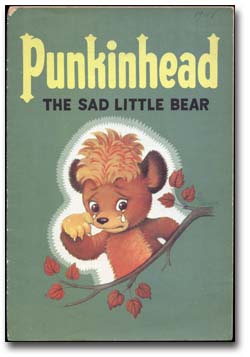
Inspired by the success of Rudolph the Red Nosed Reindeer as an advertising tool for the Montgomery Ward department stores, the Canadian retailer Eaton’s was moved to develop its own Christmas creature, Punkinhead the Sad Little Bear, who became one of Santa’s helpers. Punkinhead, with his distinctive orange hair, appeared first in Eaton’s 1948 Christmas parade and for the next decade could be found in a series of 13 promotional books and on many items such as pyjamas, records, children’s furniture and toys. He was also popular with Canadian children in the form of a teddy-bear.
Punkinhead was the creation of animation legend Charlie Thorson (1890-1966) of Winnipeg, who had helped develop Snow White for Walt Disney, Bugs Bunny for Warner Brothers, and Elmer the Safety Elephant for the Toronto police department.
The second-last in our series of department store Christmas icons is Mr. Bingle. The snowman-like figure appeared in 1947, the creation of Emile Aline for New Orleans’ Maison Blanche store. (Note that the store and Bingle share the same initials.) He appeared most frequently as a marionette puppet on children’s shows as Christmas approached but also appeared in a lively form for charitable events such as hospital visits.
His catchy theme song went:
Jingle, jangle, jingle Here comes Mr. Bingle With another message from Kris Kringle Time to launch your Christmas season Maison Blanche makes Christmas pleasin’ Gifts galore for you to see Each a gem from MB!
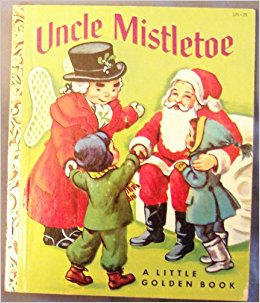
Uncle Mistletoe was only one of a number of additions to the mythology of Christmas made by North American department stores. He was commercially-inspired analogue of Santa Claus invented in the late 1940s by Marshall Fields department store in Chicago. Described as a “black-browed, winged sprite, wearing a cape and top hat” he lived with his wife Aunt Holly in Cozy Cloud Cottage (the creation of store designer Homer Sharp) on the eighth floor. Uncle Mistletoe attracted a loyal following of children who joined his “Happiness Clubs” and he even made television appearances in cartoon form during the holiday season. In 1951 the Three Suns issued a 45 rpm recording entitled “Uncle Mistletoe” and he was the subject of a children’s book. Collectibles of Uncle Mistletoe and Aunt Holly are still a hot item.
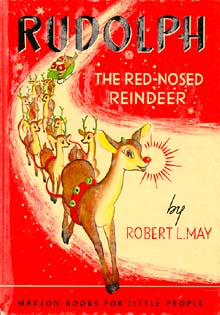
The first, and most enduring, addition to the Santa Claus canon in the 20th century was the product of a Chicago department store. “Rudolph the Red-Nosed Reindeer” first appeared in 1939 in an promotional give-away for Chicago’s Montgomery Ward department store. His creator was advertising editor Robert Lewis May (1905-1976) who conceived of an illustrated booklet with a Christmas poem that families could read every year. The story was to be about a rejected reindeer with few friends (like May in his own childhood) to whom Santa Claus would turn for assistance. Denver Gillen did the artwork for the booklet based on sketches made visiting the city zoo and May wrote the poem about the reindeer named Rollo. Or perhaps Reginald. Both these names and others were rejected in favour of Rudolph, the choice of May’s four-year-old daughter. The company loved the project and gave away millions of the books throughout the 1940s.
In 1947 song writer Johnny Marks (the brother-in-law of May) penned the lyrics which summarized the Rudolph story:
You know Dasher and Dancer and Prancer and Vixen Comet and Cupid and Donner and Blitzen But do you recall… The most famous reindeer of all?
Rudolph, the Red-nosed Reindeer Had a very shiny nose And, if you ever saw it You would even say it glows
All of the other reindeer Used to laugh and call him names They never let poor Rudolph Join in any reindeer games
Then one foggy Christmas Eve Santa came to say, “Rudolph, with your nose so bright, Won’t you guide my sleigh tonight?”
Then how the reindeer loved him As they shouted out with glee, “Rudolph, the Red-nosed Reindeer You’ll go down in history!”
Marks couldn’t interest any music publishers in his work so he had to found his own St. Nicholas music company; nor could he find a singer willing to take a chance with a song about an advertising character. He was turned down by Bing Crosby, Dinah Shore and Perry Como before Gene Autry “the Singing Cowboy” recorded it in 1949, selling 2,000,000 copies in the first year alone and launching Rudolph to further success. The reindeer went on to appear in movie form, books with translations in dozens of languages and a host of marketing devices and toys.