Oaxaca, Mexico is famous for its “Night of the Radishes”. On every December 23, theNoché del Rábano, local giant radishes are carved into elaborate shapes depicting characters in the Nativity story, Aztec gods or animals; prizes are awarded for the most creative while dances, firework displays and a huge Christmas fair take place.
This hipster crèche features a Joseph with a man-bun taking a selfie. The Magi drive on Segways bearing gifts from Amazon. The stable is solar-powered and the cow eats only gluten-free feed. 11
In the city of Mérida, Venezuela, a fascinating local custom is the La Paradura del Niño, or The Standing Up of the Christ Child. Here the Nativity scenes in homes are particularly cherished; some are table-top size, some are room-size with all of Bethlehem portrayed in the Venezuelan context — the landscape is mountainous and divided by rivers. The figures often look like local people. On Christmas Eve the Holy Family is placed in the scene with the Wise Men nearby and moving closer daily. On New Year’s Day the tradition dictates that the baby Jesus must be moved to an upright position and stay there until Candelaria (February 2). If a friend or neighbour sees this is not done, the baby may be kidnapped and the family who neglected their duty must hold a parandura party for the kidnappers and friends.
This consists of choosing godparents for the Niño— they will not only bring home the baby in a basket or handkerchief but arrange for the musicians, candles, fireworks and refreshments. The procession consists of first of fireworks boys, followed by the musicians who will be mute until the baby is found, a pair of teens as Mary and Joseph, children as shepherds singing a carol about searching for the baby and, lastly, the godparents. When the candle-lit procession get to the house where the baby is stored, it is handed over to the kerchief and its god-parents and the joyous music breaks out. All march home joyfully where the party awaits after the baby is replaced standing up. Little kids may offer a poem of welcome, women will say the rosary and then all eat, dance and drink until dawn.
A Kastenkrippe is a small Austrian nativity scene made inside a box, with characters often made of baked clay.
In 1782 Emperor Joseph II, influenced by Enlightenment anti-Catholic attitudes, banned the display of large nativity scenes, especially in churches. HIs Christmas-loving subjects responded by building their own elaborate nativity scenes in hand-made wooden boxes, and displaying them in their homes during the sacred season. The Kastenkrippe) was usually set up in the “Lord’s nook” (Herrgottswinkel), a corner of the main room with a crucifix and a small altar. This also led to the blossoming of nativity scene construction in the village of Thaur near Hall in Tirol.
Here are three ornaments that I consider inappropriate. The first two come from American evangelicals who sometimes find it hard to concentrate on the details and importance of the Incarnation of Christ and the celebration of the Nativity. The third is laughably out of place for a different reason.
Literally “grandfather” or “forefather spirit”, the didukh is a sheaf of grain brought into Ukrainian houses at Christmas Eve to symbolize the unity of the family: the dead, the living and those to come. It is a remnant of pagan beliefs that the spirits of the ancestors guarded the fields in the summer and entered the house in the winter when the didukh was brought in. Made of the best grain of the harvest the sheaf was often decorated with flowers or ribbons or tied around the middle with an embroidered cloth called a rushnyk. Once inside, the didukh (perhaps about 4’ in height) was given a place of honour near the icons. It remained in the home until the eve of Epiphany when it was taken out and burnt and its ashes scattered over the fields or orchard to induce fertility in the coming year and free the spirits within.
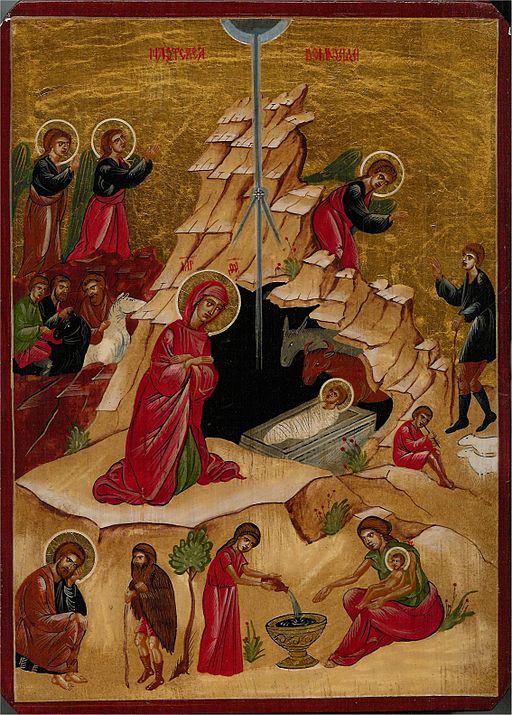
Using this Romanian icon in yesterday’s post, we pointed out two figures who do not usually appear in Western portrayals of the Nativity: Salome and the midwife. Elsewhere in the illustration we can see those characters who are more familiar to us: the Magi journeying to Bethlehem, an angel announcing the birth to the shepherds, Mary, the baby Jesus wrapped in swaddling clothes, and the ox and the ass. In the lower left is Joseph — but who is the mysterious dude talking to him? That would be the Devil.
What is the Evil One doing in a picture of the birth of Jesus? He is there to tempt Joseph to doubt the story of Mary’s virgin delivery. Joseph, we know, was initially troubled by his betrothed’s news of her pregnancy but was reassured in a vision. Here, again, he has to overcome his suspicions and live a life of faith.
(Ch XIX, 3) And the midwife went forth of the cave and Salome met her. And she said to her: Salome, Salome, a new sight have I to tell thee. A virgin hath brought forth, which her nature alloweth not. And Salome said: As the Lord my God liveth, if I make not trial and prove her nature I will not believe that a virgin hath brought forth.
(XX. 1) And the midwife went in and said unto Mary: Order thyself, for there is no small contention arisen concerning thee. And Salome made trial and cried out and said: Woe unto mine iniquity and mine unbelief, because I have tempted the living God, and lo, my hand falleth away from me in fire. And she bowed her knees unto the Lord, saying: O God of my fathers, remember that I am the seed of Abraham and Isaac and Jacob: make me not a public example unto the children of Israel, but restore me unto the poor, for thou knowest, Lord, that in thy name did I perform my cures, and did receive my hire of thee. 3 And lo, an angel of the Lord appeared, saying unto her: Salome, Salome, the Lord hath hearkened to thee: bring thine hand near unto the young child and take him up, and there shall be unto thee salvation and joy. 4 And Salome came near and took him up, saying: I will do him worship, for a great king is born unto Israel. And behold immediately Salome was healed: and she went forth of the cave justified. And lo, a voice saying: Salome, Salome, tell none of the marvels which thou hast seen, until the child enter into Jerusalem.
According to the apocryphal second-century gospel, the Protoevangelium of James, Joseph went in search of a mdwife for Mary when it became time to give birth. He brought back to the cave two women, Zelomi and Salome, who were too late to assist in the delivery but who marvelled at the possibility of a virgin birth. Zelomi expressed her belief but Salome, doubting, wished to make an examination herself. For her impudence Salome’s hand was withered but an angel urged her to place it on the baby who at once healed it — the first miracle of Jesus. The two midwives were often portrayed in Nativity art of the Middle Ages until the Council of Trent discouraged it as non-scriptural. The two women continue to appear in Eastern Orthodox icons, as illustrated above on the bottom right.
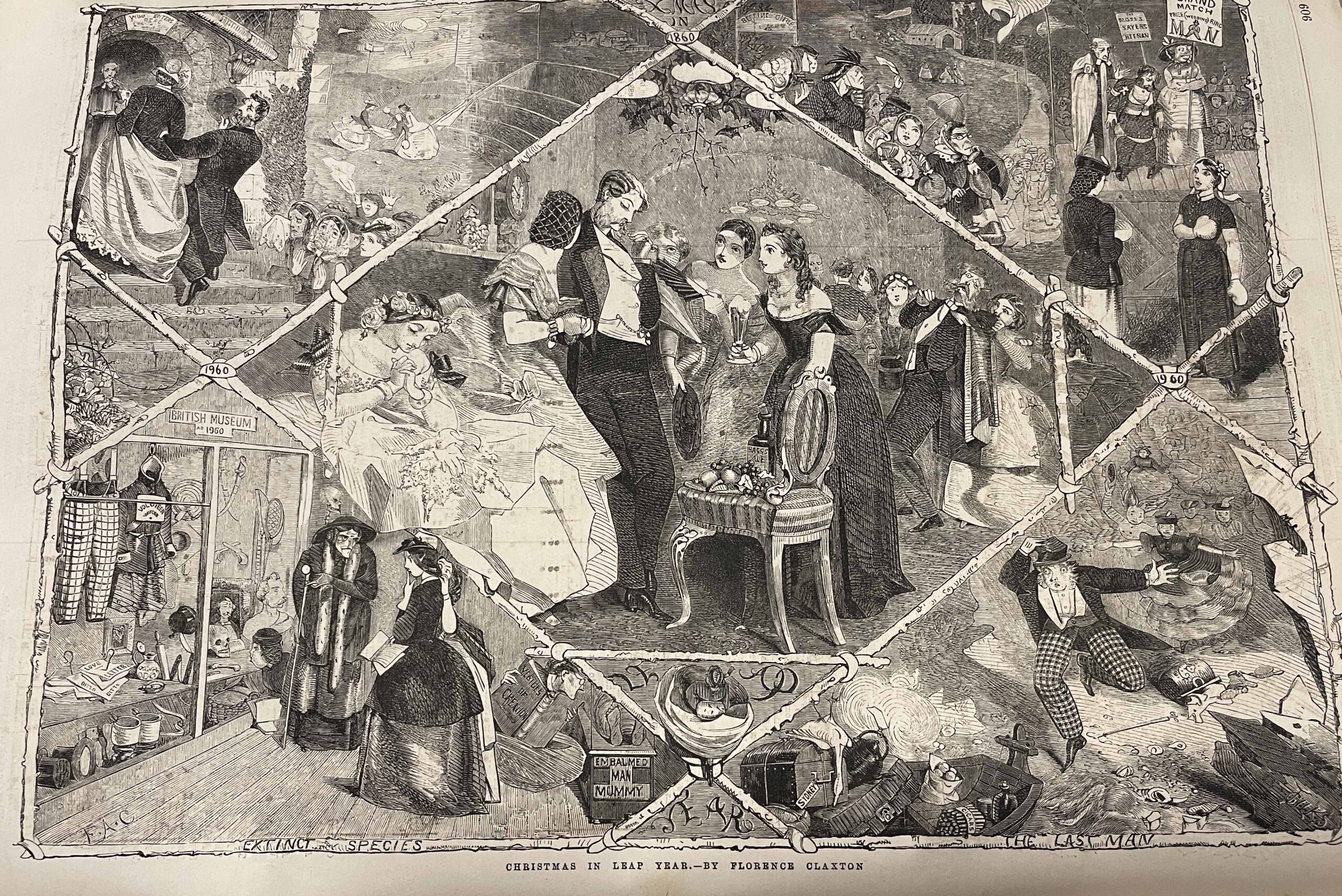
This is a strange one. In 1860 the Illustrated London News published this full-page graphic depicting a future in which women dominated men. (The Leap Year tag refers to a custom whereby in every four years Victorian women were allowed to be more forward.) In the bottom left, a scene from 1960 depicts males as an extinct species. Other illustrations show submissive men or a fellow fleeing a crowd of women for a boat leaving for Australia. In the centre a Christmas scene shows a mistletoe entirely plucked of its berries, meaning the poor man has been exhausted from kissing so many young women.