The tears of childhood fall fast and easily, and evil be to him who makes them flow.
Leacock 4
Home
/ Something Wise / Leacock 4
The tears of childhood fall fast and easily, and evil be to him who makes them flow.
Advertising may be described as the science of arresting the human intelligence long enough to get money from it.

Ginger was one of the spices brought back to Europe from the Middle East by returning Crusaders in the twelfth century. Though it had other uses in medicine and the kitchen it was the baking of gingerbread that made it a popular treat and one eventually associated with Christmas. During the Middle Ages it became so popular that special guilds of bakers were granted exclusive rights to produce the food. When it began to appear at Christmas markets in Germany in the sixteenth century, especially in Nuremberg which was a centre of the ginger trade, it began to be linked in the public mind with holiday eating.
Gingerbread appears in many varieties, light and dark, moist and dry and can be shaped into figures such as the pigs sold in the Nuremberg market or human forms or the famous gingerbread houses that grew in popularity during the nineteenth century. It has long been a custom for gingerbread ornaments to be hung on the Christmas tree and eaten when it is taken down.
Hockey captures the essence of Canadian experience in the New World. In a land so inescapably and inhospitably cold, hockey is the chance of life, and an affirmation that despite the deathly chill of winter we are alive.
I think I’ll spend the month of November celebrating the wit of Canada’s own Stephen Leacock. Here we go:
I detest life-insurance agents: they always argue that I shall some day die, which is not so.
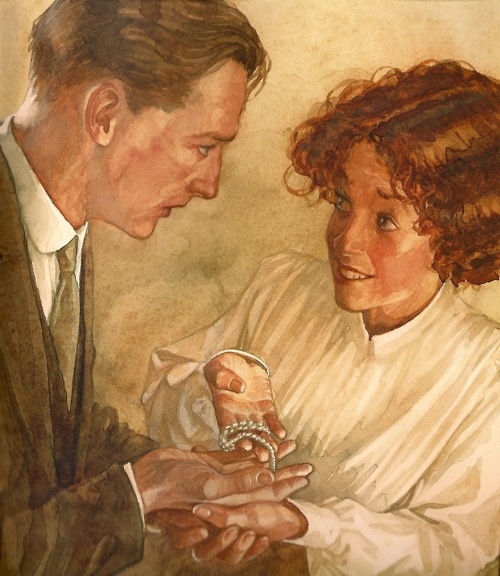
Probably the most famous of modern Christmas short stories, American author O. Henry (1862-1910; real name William Sydney Porter) tells the tale of the young married couple Jim and Della. Money is short for presents and economies have to be made but the love each bears for the other produces willing sacrifices. Della sells her gorgeous hair to buy Jim a watch-fob while, in sad irony, Jim has sold his watch to buy combs for his wife.
It is said that O. Henry’s love of alcohol often made him late in submitting his stories and that in 1906 his Christmas story was particularly behind schedule. In desperation the artist whose job it was to illustrate O. Henry’s work went to the author to be given at least an idea of what to draw. O. Henry replied that he had not got a completed story, nor even a word of it written, but that he did have a vision of a poorly-furnished room with a man and a woman talking about Christmas. The man had a watch fob in his hand while the woman’s principal feature was long beautiful hair. The illustrator began to draw and within a few hours O. Henry had produced a classic.
In the 1990s Mark St. Germain and Randy Curtis produced a Christmas musical combining the plots of two O. Henry stories, “The Gifts of the Magi” and the “The Cop and The Anthem”.
Change your opinions, keep to your principles; change your leaves, keep intact your roots.
An adaptation of a North Carolina folk tune by John Jacob Niles (1892-1980), the American balladeer and collector of folk music. Niles is said to have paid the young girl whom he first heard singing the song 25¢ to repeat it until he had written it down. Among his other songs are “Black is the Color of My True Love’s Hair” and “Jesus, Jesus Rest Your Head”. Late in life he turned to art song, writing oratorio and music based on the poetry of the mystic and monk Thomas Merton.
I wonder as I wander out under the sky,
How Jesus the Savior did come for to die
For poor or’n’ry people like you and like I.
I wonder as I wander out under the sky.
When Mary birthed Jesus, ’twas in a cow’s stall,
With wise men and farmers and shepherds and all;
But high from God’s heaven, a star’s light did fall
And the promise of ages it then did recall.
If Jesus had wanted for any wee thing,
A star in the sky or a bird on a wing
Or all of God’s angels in heav’n for to sing —
He surely could have it, ’cause He was the King.
I wonder as I wander out under the sky,
How Jesus the Savior did come for to die
For poor or’n’ry people like you and like I.
I wonder as I wander out under the sky.
The blade itself incites to deeds of violence.
A 1990 religious tract from North Carolina shows Santa Claus in the form of a devil. It includes a poem called “Ho! Ho! Ho!”:
The devil has a demon,
His name is Santa Claus.
He’s a dirty old demon
Because of last year’s flaws.
He promised Jack a yo-yo,
And Jill a diamond ring.
They woke up on Christmas morning
Without a single thing…..
One day they’ll stand before God
Without their bag of tricks.
Without their red-nosed reindeer
Or their phony old Saint Nicks;
For Revelation twenty-one,
Verse eight, tells where they’ll go:
Condemned to everlasting hell,
Where there’ll be no Ho! Ho! Ho!