In 1223, Francis of Assisi presented the Nativity story in Greccio in a unique way. The story is told here by Thomas of Celano, a contemporary biographer of Francis. Note, in the last paragraph, the miracles wrought by the manger.
His highest intention, greatest desire, and supreme purpose was to observe the holy gospel in and through all things. He wanted to follow the doctrine and walk in the footsteps of our Lord Jesus Christ, and to do so perfectly, with all vigilance, all zeal, complete desire of the mind, complete fervor of the heart. He remembered Christ’s words through constant meditation and recalled his actions through wise consideration. The humility of the incarnation and the love of the passion so occupied his memory that he scarcely wished to think of anything else. Hence what he did in the third year before the day of his glorious death, in the town called Greccio, on the birthday of our Lord Jesus Christ, should be reverently remembered.
There was in that place a certain man named John, of good reputation and even better life, whom the blessed Francis particularly loved. Noble and honorable in his own land, he had trodden on nobility of the flesh and pursued that of the mind. Around fifteen days before the birthday of Christ Francis sent for this man, as he often did, and said to him, “If you wish to celebrate the approaching feast of the Lord at Greccio, hurry and do what I tell you. I want to do something that will recall the memory of that child who was born in Bethlehem, to see with bodily eyes the inconveniences of his infancy, how he lay in the manger, and how the ox and ass stood by.” Upon hearing this, the good and faithful man hurried to prepare all that the holy man had requested.
The day of joy drew near, the time of exultation approached. The brothers were called from their various places. With glad hearts, the men and women of that place prepared, according to their means, candles and torches to light up that night which has illuminated all the days and years with its glittering star. Finally the holy man of God arrived and, finding everything prepared, saw it and rejoiced.
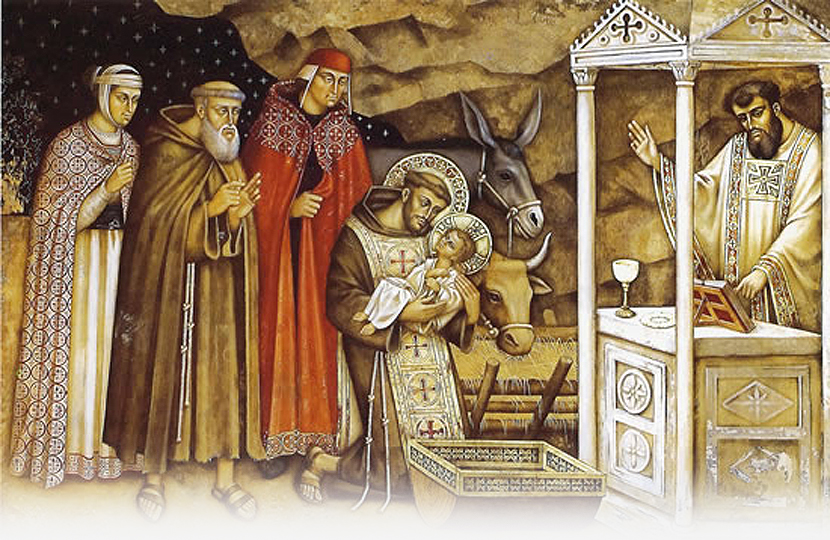
The manger is ready, hay is brought, the ox and ass are led in. Simplicity is honored there, poverty is exalted, humility is commended and a new Bethlehem, as it were, is made from Greccio. Night is illuminated like the day, delighting men and beasts. The people come and joyfully celebrate the new mystery. The forest resounds with voices and the rocks respond to their rejoicing. The brothers sing, discharging their debt of praise to the Lord, and the whole night echoes with jubilation. The holy man of God stands before the manger full of sighs, consumed by devotion and filled with a marvelous joy. The solemnities of the mass are performed over the manger and the priest experiences a new consolation.
The holy man of God wears a deacon’s vestments, for he was indeed a deacon, and he sings the holy gospel with a sonorous voice. And his voice, a sweet voice, a vehement voice, a clear voice, a sonorous voice, invites all to the highest rewards. Then he preaches mellifluously to the people standing about, telling them about the birth of the poor king and the little city of Bethlehem. Often, too, when he wished to mention Jesus Christ, burning with love he called him “the child of Bethlehem,” and speaking the word “Bethlehem” or “Jesus,” he licked his lips with his tongue, seeming to taste the sweetness of these words.
The gifts of the Almighty are multiplied here and a marvelous vision is seen by a certain virtuous man. For he saw a little child lying lifeless in the manger, and he saw the holy man of God approach and arouse the child as if from a deep sleep. Nor was this an unfitting vision, for in the hearts of many the child Jesus really had been forgotten, but now, by his grace and through his servant Francis, he had been brought back to life and impressed here by loving recollection. Finally the celebration ended and each returned joyfully home.
The hay placed in the manger was kept so that the Lord, multiplying his holy mercy, might bring health to the beasts of burden and other animals. And indeed it happened that many animals throughout the surrounding area were cured of their illnesses by eating this hay. Moreover, women undergoing a long and difficult labor gave birth safely when some of this hay was placed upon them. And a large number of people, male and female alike, with various illnesses, all received the health they desired there. At last a temple of the Lord was consecrated where the manger stood, and over the manger an altar was constructed and a church dedicated in honor of the blessed father Francis, so that, where animals once had eaten hay, henceforth men could gain health in soul and body by eating the flesh of the Lamb without spot or blemish, Jesus Christ our Lord, who through great and indescribable love gave himself to us, living and reigning with the Father and Holy Spirit, God eternally glorious forever and ever, Amen. Alleluia! Alleluia!