June 4

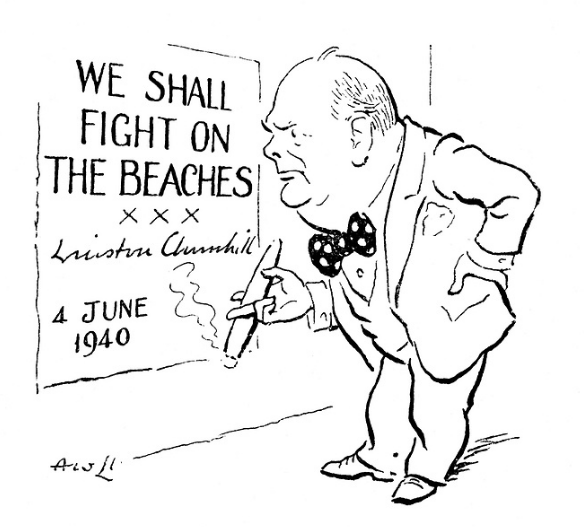
1940 Winston Churchill defies Hitler

On June 4, 1940 things were looking pretty grim for Britain and western civilization. Belgium, Denmark, Norway and the Netherlands had been overrun by the German army, France was near collapse and close to surrender, while the British Expeditionary Force had been thrashed and sent fleeing back to England, saved only by a series of miracles and the sacrifice of the rearguard at Dunkirk.

Prime Minister Winston Churchill, whose brief time in office had seen nothing but calamity after calamity, rose to sum the situation up in Parliament. His speech was a catalogue of the setbacks the armed forces had suffered but he put a brave face on it all, and made the most of a horrible situation, rallying his people in the famous final two paragraphs.

I have, myself, full confidence that if all do their duty, if nothing is neglected, and if the best arrangements are made, as they are being made, we shall prove ourselves once again able to defend our Island home, to ride out the storm of war, and to outlive the menace of tyranny, if necessary for years, if necessary alone. At any rate, that is what we are going to try to do. That is the resolve of His Majesty’s Government-every man of them. That is the will of Parliament and the nation. The British Empire and the French Republic, linked together in their cause and in their need, will defend to the death their native soil, aiding each other like good comrades to the utmost of their strength. Even though large tracts of Europe and many old and famous States have fallen or may fall into the grip of the Gestapo and all the odious apparatus of Nazi rule, we shall not flag or fail.

We shall go on to the end, we shall fight in France, we shall fight on the seas and oceans, we shall fight with growing confidence and growing strength in the air, we shall defend our Island, whatever the cost may be, we shall fight on the beaches, we shall fight on the landing grounds, we shall fight in the fields and in the streets, we shall fight in the hills; we shall never surrender, and even if, which I do not for a moment believe, this Island or a large part of it were subjugated and starving, then our Empire beyond the seas, armed and guarded by the British Fleet, would carry on the struggle, until, in God’s good time, the New World, with all its power and might, steps forth to the rescue and the liberation of the old.

June 3

Home / Uncategorized / June 3

In 1879 Catholicism began spreading in Uganda when the White Fathers, a congregation of priests founded by Cardinal Lavigerie were peacefully received by King Mutesa of Uganda. The priests soon began preparing catechumens for baptism and before long a number of the young pages in the king’s court had become Catholics.

However, on the death of Mutesa, his son Mwanga, a corrupt man who ritually engaged in pedophilic practices with the younger pages, took the throne. When King Mwanga had a visiting Anglican Bishop murdered, his chief page, Joseph Mukasa, a Catholic who went to great length to protect the younger boys from the king’s lust, denounced the king’s actions and was beheaded on November 15, 1885.

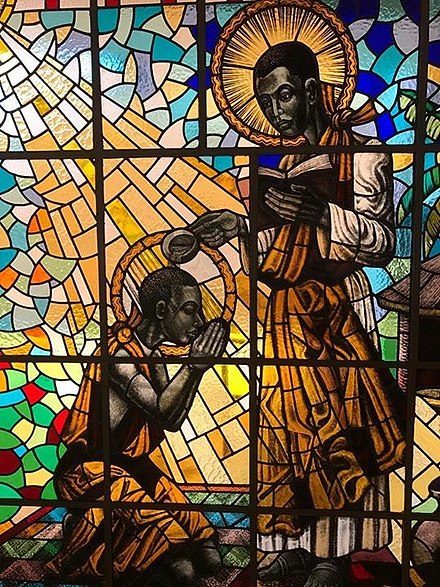
The 25 year old Charles Lwanga, a man wholly dedicated to the Christian instruction of the younger boys, became the chief page, and just as forcibly protected them from the kings advances. On the night of the martyrdom of Joseph Mukasa, realizing that their own lives were in danger, Lwanga and some of the other pages went to the White Fathers to receive baptism. Another 100 catechumens were baptized in the week following Joseph Mukasa’s death.

The following May, King Mwanga learned that one of the boys was learning catechism. He was furious and ordered all the pages to be questioned to separate the Christians from the others.  The Christians, 15 in all, between the ages of 13 and 25, stepped forward. The King asked them if they were willing to keep their faith. They answered in unison, “Until death!”

They were bound together and taken on a two day walk to Namugongo where they were to be burned at the stake.  On the way, Matthias Kalemba, one of the eldest boys, exclaimed, “God will rescue me. But you will not see how he does it, because he will take my soul and leave you only my body.”  They executioners cut him to pieces and left him to die alone on the road. When they reached the site where they were to be burned, they were kept tied together for seven days while the executioners prepared the wood for the fire.

On June 3, 1886, the Feast of the Ascension, Charles Lwanga was separated from the others and burned at the stake. The executioners slowly burnt his feet until only the charred remained. Still alive, they promised him that they would let him go if he renounced his faith. He refused saying, “You are burning me, but it is as if you are pouring water over my body.”  He then continued to pray silently as they set him on fire. Just before the flames reached his heart, he looked up and said in a loud voice, “Katonda! – My God!,” and died. His companions, some Catholic, some Anglican, were all burned together the same day all the while praying and singing hymns until they died.

June 2

177  Saint Blandina and the martyrs of Lyons

Butler’s Lives of the Saints tells that that a fierce persecution broke out during the reign of Marcus Aurelius,“at Vienne and Lyons, in 177, whilst St. Pothinus was Bishop of Lyons, and St. Irenæus, who had been sent thither by St. Polycarp out of Asia, was a priest of that city. Many of the principal Christians were brought before the Roman governor. Among them was a slave, Blandina: and her mistress, also a Christian, feared that Blandina lacked strength to brave the torture. She was tormented a whole day through, but she bore it all with joy till the executioners gave up, confessing themselves outdone. Red-hot plates were held to the sides of Sanctus, a deacon of Vienne, till his body became one great sore, and he looked no longer like a man; but in the midst of his tortures he was “bedewed and strengthened by the stream of heavenly water which flows from the side of Christ.” Meantime, many confessors were kept in prison and with them were some who had been terrified into apostasy. Even the heathens marked the joy of martyrdom in the Christians who were decked for their eternal espousals, and the misery of the apostates. But the faithful confessors brought back those who had fallen, and the Church, “that Virgin Mother,” rejoiced when she saw her children live again in Christ. Some died in prison, the rest were martyred one by one, St. Blandina last of all, after seeing her younger brother put to a cruel death, and encouraging him to victory.”

According to Eusebius, Blandina seems to have been roasted on a grill before being released in the arena where she was gored by wild bulls. She is the patron saint of those falsely accused of cannibalism, servant girls, and victims of torture.

June 1

1967 Sgt. Pepper arrives

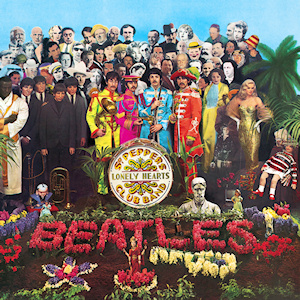
What was called “the most important and influential rock and roll album ever recorded” appeared on this day in 1967.

The Beatles began their careers singing a mixture of light-weight pop ballads and covers of American rhythm and blues numbers but had gradually matured, writing their own material and experimenting with different musical approaches and technologies. They had also grown disenchanted with touring, singing the same old songs over the ear-splitting shrieks of their female teenage fans. Moreover, their music had grown more complicated and reliant on studio effects so that it could not be satisfactorily performed live.

Inspired by Brian Wilson’s concept album “Pet Sounds” for the Beach Boys, the Beatles conceived in 1966 of a collection of songs as if it were performed by an early-twentieth century military band. The budget for this album was enormous, allowing for hiring the London Symphony Orchestra and endless studio time, and the technological manipulation of sound by producer George Martin was cutting-edge. Critics speculated on the reasons for the lengthy delay in releasing the LP and many concluded that the Beatles had run out of ideas but the five months of production would prove to be fruitful.

“Sgt. Pepper’s Lonely Hearts Club Band” emerged as a bewildering mixture of genres: rock and roll, Indian, psychedelia, music hall, and jazz, combining in a way to suggest an extended drug trip. Indeed, a number of the cuts were banned from the BBC for being too suggestive of drug use. It was instantly hailed as a musical marvel; it would sell 32 million copies around the world. Its album jacket inspired a whole new genre of pop music consumerism. Rolling Stone placed the record at the top of the list of the 500 greatest of all time.

May 31

1916  Battle of Jutland

In the prelude to World War I, both of the great and hostile alliances spent extravagantly on the development of a new type of battleship, the dreadnought — heavily armoured, carrying all big guns (11-inch or larger). Both sides planned on huge naval battles that would see whole fleets of dreadnoughts encountering each other. The Battle of Jutland, however, was the only time this occurred.

By 1916 the German High Fleet had not ventured forth from its bases on the North Sea, penned in by the British Grand Fleet operating from bases in Scotland. It was the intention of German Admiral Reinhard Scheer to lure the British out and destroy them in one great action, allowing his navy access to the North Atlantic. To do so he dangled as bait a detachment of battle cruisers — lighter and faster than dreadnoughts — under Admiral Franz Hipper who was to sail across the path of the British and lead them on to the guns of Scheer’s main force. The British took the bait; Admiral Beatty’s squadron pursued Hipper and ran into the German main force which mauled his ships and forced them to withdraw. The Germans pursued, thus blundering into the bigger British armada, and a battle ensued.

The British outnumbered and outgunned their opponents and proved to be more accurate, but the German ships were more “survivable” and could take greater punishment without sinking. Moreover, British shells lacked the penetrating power of German artillery, because of different explosives used. In the melee that followed, the Royal Navy suffered over 6,000 dead, and lost 3 battlecruisers, 3 armoured cruisers, and 8 destroyers while the German casualty list was 2,500 dead, while losing 1 battlecruiser, 1 pre-dreadnought battle ship, 4 light cruisers, and 5 torpedo-boats. As night fell, the fighting ended with the Germans retreating to their home ports.

Both sides claimed victory; the Germans had certainly done better in the battle, but they had failed to break the British naval blockade of Germany and their fleet never ventured out again. The future lay in submarine attacks for the rest of the war.

May 30

A plethora of medieval churchly events on this day.

1381 The beginning of the English Peasant Rebellion

A frequent target of the rebels will be the rich churches and monasteries that have profited from the devastation caused by the arrival of the Black Death. A Lollard hedge priest named John Ball will give the most revolutionary speech of the Middle Ages when he asks peasants: “When Adam delved/ And Eve span/ Who was then the gentleman?”, implying that God’s original creation did not include kings or aristocrats.

1416 The Council of Constance burns Jerome of Prague for heresy

The Council, called to settle the problem of three simultaneous popes and the Hussite heresy, condemns the Czech reformer to death. Jerome had come to Constance in support of his mentor Jan Hus, but like Hus, was arrested and burnt despite an imperial safe-conduct.

1431 Joan of Arc is executed

Joan, a 19-year old peasant girl inspired the forces of the Dauphin Charles in their battle to expel the English from France. Taken prisoner by the Burgundians, she is turned over to the English who put her on trial at Rouen for witchcraft and transvestism. The rigged trial and her burning at the stake aroused much controversy. Twenty years later the Church annulled her conviction and in 1920 she was named one of the patron saints of France.

1434 The Battle of Lipany extinguishes the Hussite Rebellion

In 1419 a rebellion of the proto-Protestant Hussite reformers breaks out in the Czech lands. Significant military successes are won by the Taborites, the radical millenialist wing of the movement, using the tactic of the war wagon, a mobile battlefield artillery platform and fortress. The moderate Utraquist faction, willing to compromise with the established Church in return for a few reforms, combines with Catholic forces to defeat the Taborites.

May 28

1999 Leonardo’s restored “Last Supper” is back on display

This is the painting that keeps on wanting to disappear. Commissioned by Ludovico Sforza, the Duke of Milan, it took Leonardo from 1495 to 1498 to complete. Unfortunately, humidity began eating away at the picture almost as soon as it was completed. Within 50 years it was almost invisible and observers felt it was ruined; no one seems to have objected when builders created a doorway through the mess on the wall and later bricked it up. Numerous attempts at restoration were made, based on several excellent copies that had been made, but these were not successful and more damage was done by occupying French troops in the days of Napoleon. In 1943 the convent that housed it was hit by Allied bombs; though the painting had been walled by sandbags the vibration of the explosions did more damage.

In 1978 a twenty-year restoration project began. The site was sealed and made climate-controlled; centuries of dirt were removed; and the old repair work was removed. Some areas were beyond repair and are marked by pastel watercolour effects. When it was unveiled to the public 1999, some critics were horrified at the colours and facial shapes. “There may now be a serious misrepresentation of Leonardo’s final design”, said one; “a distinctly mongrel work showing alarmingly little original paint and very much alien ‘compensatory‘ and ‘reintegrating‘ new paint”, said another.

A 1520 copy is shown below to illustrate the differences.

May 27

1933 Walt Disney releases “The Three Little Pigs”

The most successful animated short of all time, it won an Academy Award in 1934. The song “Who’s Afraid of the Big Bad Wolf?” had been written by Frank Churchill who went on to become head of music for Disney. The cartoon wolf was originally given a Jewish voice but the version below has been redubbed to make him a “Fuller Brush Man” working his way through college.

May 26

The birthday of two great musicians:

1904 George Formby

The first great British film comedian was born blind to the family of a successful music hall performer. He recovered his sight but never learned to read or write. He wished to follow his father on the stage but his family decreed that “one fool was enough” so he became an apprentice jockey, aided by his very small frame.After his father’s death in 1925, his mother allowed him to pursue a career in the footlights, which he did by imitating his father’s routines — not very successfully as he was often booed off the stage.

Two things changed his future: he took up playing the ukulele and married the very forceful Beryl Ingham, a clogdancer who became his manager. Under her guidance Formby became the premiere music hall act of his generation, making movies and records between his lucrative tours. His greatest hit was “When I’m Cleaning Windows”, a racy little number banned by the BBC. He died in 1961.

1940 Levon Helm

Raised in Turkey Scratch, Arkansas, Levon Helm wanted to be a musician from an early age. By the time he was in high school his drumming was of professional caliber. He joined rockabilly star Ronnie Hawkins in Canada where he was an important part of The Hawks with Robbie Robertson and Rick Danko. After leaving Hawkins, the group backed up Bob Dylan in his new electric phase and became known as The Band, famous for “The Night They Drove Old Dixie Down”, “The Weight” and “Up on Cripple Creek”. After success in Hollywood, solo performances and tours, Helm lost his voice for time in 1990 after a bout with throat cancer but regained to resume his career. His died of cancer in 2012.

Here is a tribute to him by the great Marc Cohn:

May 25

1525

The execution of Thomas Müntzer

When Martin Luther stood before the Holy Roman Emperor in 1521, he asserted that one man’s conscience, formed by reading the Bible, could stand against the might of the Church and a thousand years of tradition. His Catholic opponents argued that individual interpretation of Scripture would lead to chaos and a multitude of opinions, many of them erroneous and heretical. And so it came to be. While Luther was fleeing into hiding after his trial, a host of wild men with wild ideas, sprang up across the German-speaking lands – some of them even entered into Wittenberg where Luther had taught. These were the “Zwickau Prophets” who claimed that Luther had not gone nearly far enough in his rejection of established religion, for what mattered was not Scripture but the direct inspiration of the Holy Spirit. These “Spiritualists” argued that God came in the form of visions and dreams, not in the words of an old book, and they caused the chaos that the Catholics had predicted.

One such Spiritualist was Thomas Müntzer (1489-1525), a priest who was already deemed a radical even before he met, and studied with, Luther. As he wandered from town to town, looking for an audience that would respond to his views, Müntzer became convinced that that End Times were at hand. Christ’s Second Coming was not long off (a widely-held belief even professed by Luther) but that His coming must be preceded by a bloody cleansing of the earth wherein the enemies of Christ: priests, princes, nobles and those who did not follow this Spiritualist line, would be killed. Following the cleansing all would be equal and all property would be held in common.

Peasants in the 16th century were seeing their traditional rights eroded: from hunting and fishing to representation at local diets. Peasants had long used biblical and religious justification to back their anti-feudal demands. For decades the Bundschuh (peasant legging and shoe) had served as the symbol of peasant resistance and striving in dozens of local rebellions. The Bundschuh was often linked with a religious slogan which implied that God’s laws were not being followed by their feudal overlords and so peasants knew how to exploit a cognate theological argument for spiritual freedom when they heard it in Lutheran sermons. When Luther in 1523 urged communities to pick their own pastors, peasant leaders claimed his approval for local political control as well. There was, therefore, mutual exploitation during these years: the Lutherans by the peasants, and the peasants by the Lutherans. Reformers sought to enlist the support of the peasants and portrayed farmer Hans with his plough as the ideal Christian, the sort of man that God intended: working with his hands, not puffed up with vain theological knowledge. Luther urged lords to treat their peasants as fellow Christians and not to exploit them lest they rise in rebellion but there was no way that mainstream reformers could sanction peasant rebels when fighting broke out in late 1524.

The first outbreak came in Stühlingen where, in the middle of the harvest, the countess demanded that the peasants stop taking off the crop and search for snail shells for her (she was going to wind yarn around them). The fighting spread in Switzerland and across much of Germany. The reasons for the rebellion were overwhelmingly economic and social but there was a religious element too and an involvement by reforming preachers. The “Twelve Articles” which became the peasant manifesto included the demand that local communities have the right to name their own pastors and vowed that they wanted no reform that was not according to Holy Scripture.

Thomas Müntzer had by 1525 become one of the leaders of the rebellion. He began to style himself “Destroyer of the Unbelievers” and to preach of the imminent end of the old era and the dawn of a new age of social justice. His appeal to German princes to lead his crusade having fallen on deaf ears, Müntzer turned to the poor to be the new Elect, a covenanted people of God. When the rebellion broke out he urged his poor followers on to violence and a liberating slaughter that would open the way to the new age of godliness and peace.

Luther began by urging peace and moderation – criticizing both the lords for their refusal to recognize the justice of some of the peasant demands and the peasants for using violence to further their ends. He personally mediated some disputes and pacified areas at the risk of his own life but in 1525 when news of peasant atrocities reached him he turned decisively against them. The title of his work Against the Robbing and Murdering Hordes of Peasants pretty much tells the tale. He urged the authorities to repress the rebels like mad dogs and to show no mercy until the rebellion had been crushed. By the time Luther’s book appeared the fighting was over. The critical battle took place at Frankenhausen where Müntzer was urging violence every bit as harsh as Luther. “On! On! On!”, he told the peasant soldiers, “Spare not. Pity not the godless when they cry. Remember the command of God to Moses to destroy utterly and show no mercy. The whole countryside is in commotion. Strike! Clang! Clang! On! On!” He told the peasants that he would precede them and catch their enemies’ bullets in his sleeves but in fact he ran away and was hiding in bed when he was captured by the forces of the triumphant princes. He was executed on this day in 1525.