Christmas in Paris 1823

Home / Christmas / Christmas in Paris 1823

From an account of an English visitor, 1823:

The habits and customs of the Parisians vary much from those of our own metropolis at all times, but at no time more than at this festive season. An Englishman in Paris, who had been for some time without referring to his almanac, would not know Christmas-day from another by the appearance of the capital. It is, indeed, set down as a jour de fete in the calendar, but all the ordinary business of life is transacted; the streets are, as usual, crowded with waggons and coaches; the shops, with few exceptions, are open, although on other fête days the order for closing them is rigorously enforced, and if not attended to, a fine levied; and at the churches nothing extraordinary is going forward. All this is surprising in a catholic country, which professes to pay such attention to the outward rites of religion.

On Christmas-eve indeed, there is some bustle for a midnight mass, to which immense numbers flock, as the priests, on this occasion, get up a showy spectacle which rivals the theatres. The altars are dressed with flowers, and the churches decorated profusely; but there is little in all this to please men who have been accustomed to the John Bull mode of spending the evening. The good English habit of meeting together to forgive offences and injuries, and to cement reconciliations, is here unknown. The French listen to the church music, and to the singing of their choirs, which is generally excellent, but they know nothing of the origin of the day and of the duties which it imposes. The English residents in Paris, however, do not forget our mode of celebrating this day. Acts of charity from the rich to the needy, religious attendance at church, and a full observance of hospitable rites, are there witnessed. Paris furnishes all the requisites for a good pudding, and the turkeys are excellent, though the beef is not to be displayed as prize production.

On Christmas-day all the English cooks in Paris are in full business. The queen of cooks, however, is Harriet Dunn, of the Boulevard.—As sir Astley Cooper among the cutters of limbs, and d’Egville among the cutters of capers, so is Harriet Dunn among the professors of one of the most necessary, and in its results, most gratifying professions of existence; her services are secured beforehand by special retainers; and happy is the peer who can point to his pudding, and declare that it is of the true “Dunn” composition. Her fame has even extended to the provinces. For some time previous to Christmas-day, she forwards puddings in cases to all parts of the country, ready cooked and fit for the table, after the necessary warming. All this is, of course, for the English. No prejudice can be stronger than that of the French against plum-pudding—a Frenchman will dress like an Englishman, swear like an Englishman, and get drunk like an Englishman; but if you would offend him for ever, compel him to eat plum-pudding. A few of the leading restaurateurs, wishing to appear extraordinary, have plomb-pooding upon their cartes, but in no instance is it ever ordered by a Frenchman. Every body has heard the story of St. Louis—Henri Quatre, or whoever else it might be, who, wishing to regale the English ambassador on Christmas-day with a plum-pudding, procured an excellent recipe for making one, which he gave to his cook, with strict injunctions that it should be prepared with due attention to all the particulars. The weight of the ingredients, the size of the copper, the quantity of water, the duration of time, every thing was attended to except one trifle—the king forgot the cloth, and the pudding was served up like so much soup, in immense tureens, to the surprise of the ambassador, who was, however, too well bred to express his astonishment. Louis XVIII., either to show his contempt of the prejudices of his countrymen, or to keep up a custom which suits his palate, has always an enormous pudding on Christmas-day, the remains of which, when it leaves the table, he requires to be eaten by the servants, bon gré, mauvais gré; but in this instance even the commands of sovereignty are disregarded, except by the numerous English in his service, consisting of several valets, grooms, coachmen, &c., besides a great number of ladies’ maids, in the service of the duchesses of Angouleme and Berri, who very frequently partake of the dainties of the king’s table.

The Moravian Christingle

Home / Christmas / The Moravian Christingle

The following informative piece comes from a posting of the Moravian Church British Province, but the link is broken.

The idea of the Christingle began in the Moravian congregation of Marienborn, Germany, on 20th December, 1747. At a children’s service, hymns were sung and the minister, John de Watteville, read verses which the children had written to celebrate the birth of Jesus. He then explained to the children the happiness that had come to people through Jesus, “who has kindled in each little heart a flame which keeps burning to their joy and our happiness”. To make the point even clearer, each child then received a little lighted wax candle, tied round with a red ribbon. The minister ended the service with this prayer, “Lord Jesus, kindle a flame in these children’s hearts, that theirs like Thine become”. The Marienborn Diary concludes, “hereupon the children went full of joy with their lighted candles to their rooms and so went glad and happy to bed”.

The Moravian Church took the custom of this service with them to Labrador and Pennsylvania, to Tibet and Suriname, to the Caribbean and South Africa, and people in each part of the world adapted it for their own use.

No one knows for certain when the word “Christingle” was first used or from what it is derived. Various suggestions have been made. One is that it comes from the old Saxon word “ingle” (fire), meaning “Christ-fire or light”. Another is that it derives from the German “engel” (angel), meaning “Christ-angel”, or it may derive from the German “kindle” (child), meaning “Christ-child”. page2image44592192 page2image44590656page2image44593344page2image38546608

The symbolism gradually developed, and today in the Moravian Church in the British Province, the Christingle consists of

an orange, representing the world, with a lighted candle to represent Christ, the Light of the World. Nuts, raisins and sweets on cocktail sticks around the candle represent God’s bounty and goodness in providing the fruits of the earth. Red paper, forming a frill around the base of the candle, reminds us of the blood of Christ shed for all people on the cross at Calvary.

In Moravian churches, the Christingle Service is usually held on the Sunday before Christmas or on Christmas Eve. Essentially, it is a children’s service, which reminds us that the Christ-child lies at the heart of our Christmas celebrations. The service usually includes the traditional Moravian carol:-

Morning Star, O cheering sight! Ere thou cam’st how dark earth’s night! Jesus mine,
In me shine;
Fill my heart with light divine.

Morning star, thy glory bright Far excels the sun’s clear light: Jesus be Constantly,
More than thousand suns to me.

Thy glad beams, thou morning star, Cheer the nations near and far; Thee we own
Lord alone,
Man’s great Saviour, God’s dear Son.

Morning star, my soul’s true light, Tarry not, dispel my night; Jesus mine,
In me shine;
Fill my heart with the light divine.

At the climax of the service every child receives the gift of a Christingle, reminding us that “God so loved the world that he gave his only Son……” (John 3:16). In this wonderful moment, in the darkened church, the visual symbol of the Christingle expresses the truth that in the darkness of the world there shines a great light.

Doom to the World

Home / Christmas / Doom to the World

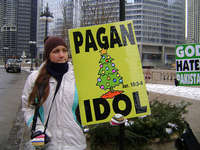
Not everyone loves Christmas or associates it with good things. The hate-mongers of Westboro Baptist Church in Topeka, Kansas, use Christmas as an opportunity to castigate America for its sins. They have produced a whole catalogue of Christmas carols with altered lyrics and here is one based on “Joy to the World”.

Doom to the world

The time has come

 For God to punish you

He’s listened to your blasphemy

He will ignore your cry and plea

 No prayer will change his mind

No prayer will change his mind

It’s too late; it’s too late to change his mind.

This town is lost

It’s way too late

For God to bless this land

 He told you what you ought to do

 And then we came and told you too

 But you ignored his words

 Yes, you ignored his words

There’s no excuse, because you heard his words.

“Grandma Got Run Over By a Reindeer”

Home / Christmas / “Grandma Got Run Over By a Reindeer”

A novelty song written in 1979 by veterinarian Elmo Shropshire and popularized by Elmo and Patsy. In it Grandma, who had been drinking too much eggnog, was found dead under circumstances that suggested she had been hit by Santa’s sleigh. The song achieved notoriety in Canada when complaints were lodged with politicians, women’s groups and seniors’ organizations that it was offensive to the female elderly and that the death of a matriarch was no laughing matter. Though nothing was done to limit its airplay, the song was voted one of the “Three Most Dreaded Christmas Songs Ever” and an American disk jockey was fired for playing it (by request) 27 times in a row. A parody followed entitled “Grandpa Got Runned Over by a John Deere.”


Grandma got run over by a reindeer.
Walking home from our house Christmas eve.
You can say there’s no such thing as Santa,
but as for me and grandpa we believe.

She’d been drinking too much eggnog,
and we begged her not to go.
But she forgot her medication, and she
staggered out the door into the snow.

When we found her Christmas morning,
at the scene of the attack,
she had hoof-prints on her forehead,
and incriminating Claus marks on her back.

Now we’re all so proud of grandpa,
He’s been taking this so well.
See him in there watching football,
drinking root beer and
playing cards with Cousin Mel.

It’s not Christmas without Grandma,
All the family’s dressed in black
and we just can’t help but wonder:
Should we open up her gifts,
or send them back?
Send them back!!

Now the goose is on the table
and the pudding made of fig
and the blue and silver candles
that would just have matched
the hair on grandma’s wig.

I’ve warned all my
friends and neighbors
better watch out for yourselves,
they should never give a license
to a man who drives a sleigh
and plays with elves.

Farolitas

Home / Christmas / Farolitas

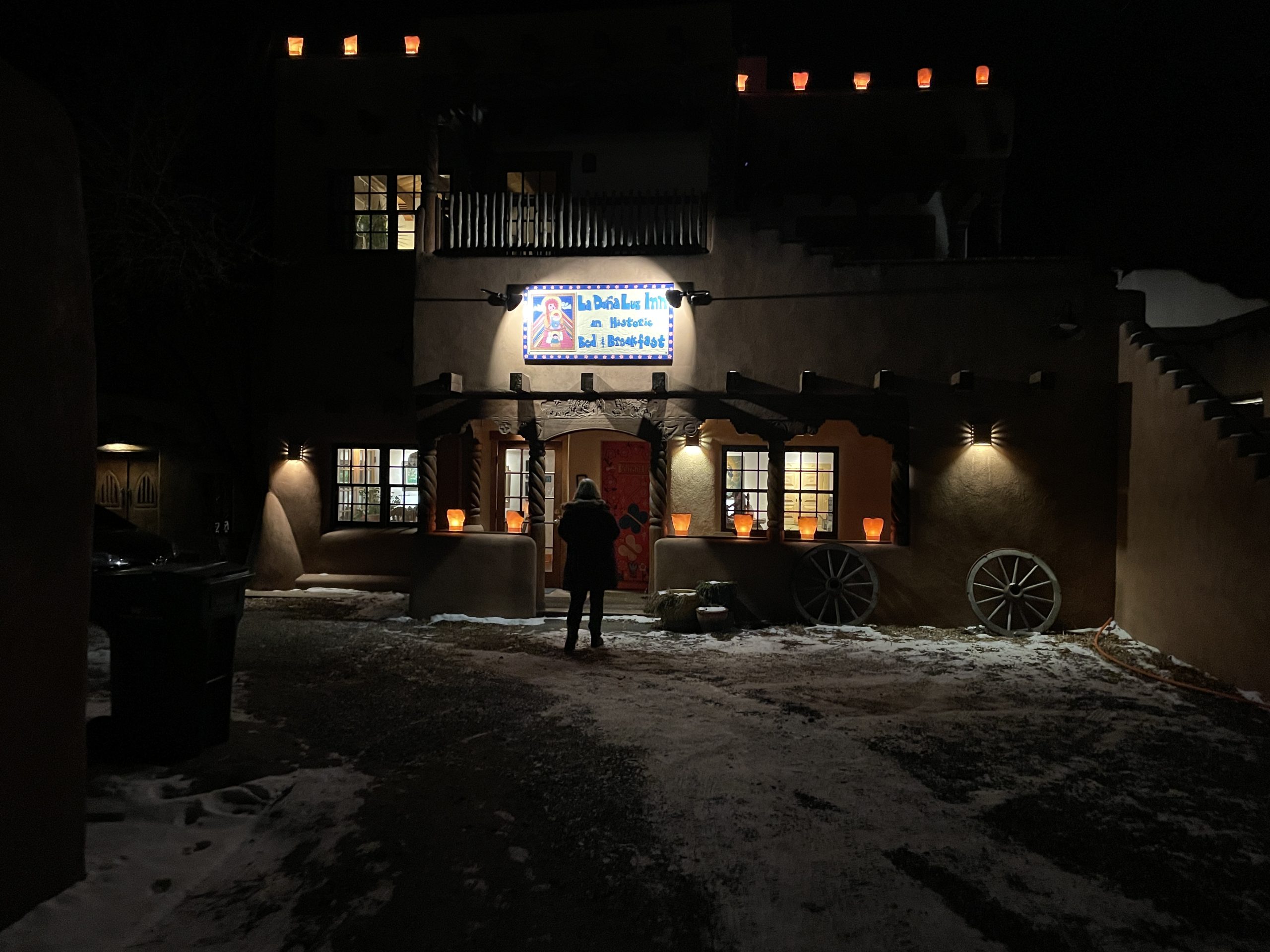
Often confused with luminaria, these are small lanterns used to decorate houses and walkways at Christmas in the southwestern United States and Mexico. Farolitas were originally Chinese-paper lanterns but evolved into paper sacks lined with wax with gravel or sand in the bottom into which a votive candle was stuck. Imitation farolitas are now plastic containers holding an electric bulb. In an example of reverse cultural imperialism this custom has now been adopted in Spain itself. .

The largest display of these lights occurs every Christmas in Farmington, New Mexico where students of San Juan College set out 45,000 home-made candles in paper bags across the campus, along rooftops, sidewalks and parking lots.

In Canada and other chilly countries the candles are often inserted into blocks of ice.

A Prairie Christmas Tree

Home / Christmas / A Prairie Christmas Tree

Yesterday, I posted an excerpt of Albert Bryski’s autobiography and his memories of a Canadian prairie Christmas in the mid-20th century. Here is his reminiscence of how his family contrived a Christmas “tree” out of a single spruce branch.

We were poor and couldn’t afford a tree from a commercial lot so, my dad would look at me one day in the last week before Christmas and announce that it was time for us to go and cut our tree from our usual source.

We would take a cross-cut saw, hitch our Allis Chalmers tractor to a two-wheeled trailer, and head for the abandoned home-site that was located on one of the quarters of land my father owned. On this site grew four of the largest spruce trees for miles around. Each stood about fifteen metres tall, and each had a girth of about two metres. My dad would carefully walk around each one beforemaking his selection. I would climb up into the tree with the saw until I reached the branch he had so diligently selected. I would cautiously saw through the branch close to the trunk, then hand the branch down into the hands of my dad. He would lay it gently onto the trailer. This branch was now destined to become our two-dimensional Christmas tree.

At home, my dad would mount the tree in a five-gallon pail of sand soaked with water. The firm sand kept the tree erect, and the moisture in the sand helped keep the tree from drying out too quickly. Our tree had to last until at least January 20th, which was the Feast of the Epiphany on the Julian calendar. Because our family celebrated Christmas on December 25th, as it fell in the Gregorian calendar, our tree had to serve its purpose two weeks longer, because all our Ukrainian neighbours celebrated Christmas on January 7th, the day Christmas occurred in the Julian calendar.

The tree would be placed in the corner of the living room. My mom would carefully turn it so it lost its two-dimensional look and resembled a real tree from the front. Because of its location in the corner, you couldn’t see the flatness of the tree from the sides.

In earlier years my brothers and sister would decorate the tree, When they all went to boarding schools for their high school education, my mom and I were left with the task of “putting up” the Christmas tree. Mom and I would decorate the tree with the few cherished ornaments we had. We would hang tinsel and icicles on it, and we would encircle its branches with a golden garland made of twined tinsel. On the top – or at the end of the branch as it really was – we would place an ornament that somewhat resembled a star. The pail at the bottom would have green or red tissue paper covering it. The top of the pail had to be left uncovered so we could water our “tree” daily.

It didn’t even come close to comparing to the magnificence of our present day Christmas trees, but to me in that distant time and distant place, it was a thing of great beauty, and it made our home a warm and happy place during our Christmas celebrations with family and friends.

A Prairie Boy’s Christmas

Home / Christmas / A Prairie Boy’s Christmas

Albert Bryski grew up on the Canadian prairies in the middle of the 20th century. His farming family was Polish Catholic on his father’s side and Ukrainian Orthodox on his mother’s. Their Christmas celebrations were largely drawn from his mother’s customs but the family marked it on December 25th rather than on January 7th. In his autobiography Saskatchewan Farm Boy, he recounts the special day.

The most important part of Christmas was the Christmas Eve evening meal called “Holy Supper” in literal translation. According to custom, all members  of the family should be home that night for a family reunion. 0ur last Christmas Eve supper on the farm where our whole family of six was present occurred in 1951. The next time we would all be present as one unit had to wait for another thirty years in the city of Winnipeg.

The supper on this special evening differed from other evening meals, having twelve Lenten dishes, as a symbol of the twelve Apostles who gathered at the Last Supper.

In many households the dishes were prepared with a vegetable shortening or cooking oil, omitting all animal fat, milk and milk products, because Christmas is preceded by a period of fast which ends on Christmas Day after midnight or morning church service. The day of the Christmas Eve is a strict fast in commemoration of the hardships endured by the Virgin Mary, Jesus’s blessed mother, en route to Bethlehem. The table was set according to time-honoured tradition. It was the chore of the children to cover the table with a small handful of fine hay in memory of the Christ Child in the manger. Over it my mom spread her very best tablecloth adorned with embroidery that she had lovingly and carefully done by lamplight, seated at the same table through long winter evenings. We would also spread hay on the floor of the kitchen and the living room. My father would scatter walnuts, filberts, pecans, Brazil nuts, almonds, and peanuts, all in the shell, in the areas where we wouldn’t walk on them. After supper, while the older people visited and sang Ukrainian Christmas carols, we young people would search out the nuts, and take turns with the nutcracker to shell them and enjoy this special treat.

Bread (kalach), symbolizing prosperity, was the main table decoration. Three round, braided loaves, which my mom had baked the previous day, were placed one on top of the other with a candle inserted into the top loaf. The bottom loaf was encircled with tiny twigs of evergreen left over from trimming our Christmas tree. Lit candles on both sides of the loaves completed the table decoration. If a member of the family had died during the year, a place was set for that person in the belief that the spirit of the deceased unites with the family on that Holy Night. A lighted candle was always placed in the window as an invitation to any homeless stranger to join the family in celebrating the birth of Christ.

In many Ukrainian households before the evening meal, a spoonful of each dish was mixed into the feed of the domestic animals, because animals were the first creatures to behold the newborn Christ. The first star in the eastern sky announces the time for the beginning of the meal. It was the children’s duty to watch for the star. This “honour” often fell to me. I suspected it was to keep me from underfoot during the meal preparation.

Sheaf of wheat (Didukh) on Ukrainian embroidered cloth as a symbol of Christmas

Each member of the family was dressed in their Sunday best. Ukrainian fathers, in keeping with tradition, would bring a small bundle of wheat, or what was called “did” or “didukh” (grandfather), a symbol of the gathering of the clan. The father would greet everyone formally with traditional salutations, expressing joy that God had favoured us with good health and general well-being. The sheaf was then placed in the corner of the living room and remained there until New Year, when it was taken out and burned.

We would all gather around the table, and begin the meal with the Lord’s prayer in Ukrainian. The first dish was kutya, a preparation of cooked wheat dressed with honey, ground poppy seed, and sometimes chopped nuts. This ritual dish of very ancient origin has survived innumerable generations without losing its importance in the Christmas festivity. My father would raise the first spoonful of kutya, invoking Gods grace, then greet the family with the traditional Ukrainian Christmas greeting, “Khrystos Rodyvsya” (Christ is born), to which we would reply in unison: “Slavimo Yoho!” (Let us glorify Him). Following this, everyone had to partake of the kutya, if only but a spoonful. Occasionally, my uncle would take a spoonful of kutya and carefully fling it at the ceiling. If it stuck that meant a prosperous year. My mom was not crazy about this tradition.

Kutya was followed with a serving of my mom’s most excellent borsch. After which came one or more preparations of fried fish, two kinds of meatless cabbage rolls made of buckwheat and rice. My mom was famous for her cabbage perogies, or vereneki or perohi as we knew them, and her potato-cottage-cheese ones with a fried butter-and-onion sauce. We also had mushrooms, picked and dried the previous summer and fall, cooked in a special gravy on Christmas Eve morning. There was a pickled beet relish along with an eye-watering hot horseradish relish. There were pickled herrings. We ended the meal with more kutya and Christmas pastries.

During the course of the meal, we would toast each other with sweet wine. Usually, my father would raise his glass and say, “Dy Boszhe,” literally “God grant us.” We would have to put down our utensils, grab our glasses, and respond with “Pay zdorovya” or “To your health.” Nowadays you may hear it said as “pave the road” by non-speakers of Ukrainian. After the meal we would sing carols and then the older people would reminisce about the past year. There would be a minimal number of gifts under the tree. Times were rough, and gifts cost money, which was better used for daily survival. Nevertheless, this was one of the the best evenings of the year.

St Bridget of Sweden

Home / Christmas / St Bridget of Sweden

Bridget (1303-73) wasa Swedish mystic and saint, patron of Sweden, founder of the Brigittine Order, and a visionary whose revelations about the Nativity were highly influential in the way it was artistically depicted during the Middle Ages.

After the death of her aristocratic husband Bridget entered a convent and began to have a series of visions, some political, some personal and some of which dealt with the birth of Jesus. Until Bridget’s revelations it was believed that Mary had given birth in the normal fashion but after she announced that it had been revealed to her that Mary had given birth standing in prayer, without pain or effort, medieval art changed its portrayal of the Nativity.

Bridget was canonized in 1391 and her Revelations were printed in 1492.