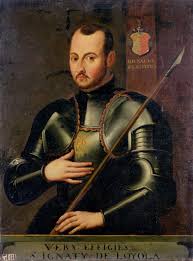
Ignatius Loyola, ‘a Spanish soldier and hidalgo with hot Biscayan blood,’ was, in 1521, assisting in the defence of Pampeluna against the French, when a cannon-ball fractured his right leg and a splinter injured his left. He was carried to the neighbouring castle of Loyola, and in the weary months during which he lay stretched upon his couch, he tried to while away the time in reading the Lives of the Saints. He was only thirty; he had a strong and vehement will; he had led a wild and vicious life; and had burned for military glory. As it was evident that for him henceforward the part of the soldier was barred, the question arose, Why might he not be a saint, and rival St. Francis and St. Dominic?
He decided to try. He tore himself from his kindred and friends, and made a pilgrimage to the Holy Land. In the church of the Virgin at Mount Serrat, he hung up his arms, and vowed constant obedience to God and the church. Dressed as a beggar, and in the practice of the severest austerities, he reached Jerusalem on the 4th of September 1523. On his return to Spain, at the age of thirty-three, he resumed his education, which had been neglected from childhood, and laboriously from the rudiments of grammar worked his way through a full university course, making no secret of his ignorance. The rigour of his life, and the rebukes he administered to lax ecclesiastics, not unfrequently brought him into trouble as a Pharisaic meddler.
He went to Paris in 1528, and at the university he made the acquaintance of Xavier, Faber, Lainez, Bobadilla, and Rodriguez, five students whom he inspired with his own devout fervour. In an underground chapel of the church of Montmartre, on the 15th of August 1534, the six enthusiasts took the solemn vows of celibacy, poverty, and the devotion of their lives to the care of Christians, and the conversion of infidels. Such was the beginning of the famous Society of Jesus.
The plan of the new order was laid before Pope Paul III, who raised several objections to it; but, on the engagement that Jesuits should in all matters yield implicit obedience to the holy see, he granted them a constitution in a bull, dated the 27th of September 1540. Loyola was elected president, and was established at Rome as director of the movements of the society. Very opportunely did the Jesuits come to the service of the popedom. Unhampered by the routine of other ecclesiastical orders, they undertook services for which they alone were fit; and, as sharp-shooters and skirmishers, became the most annoying and dangerous antagonists of Protestantism. To a certain freedom of action the Jesuit united the advantages of perfect discipline; obedience was his primary duty. He used his faculties, but their action was controlled by a central authority; every command had to be wrought out with all his skill and energy, without questioning, and at all hazards. It was the aim of the society to discover and develop the peculiar genius of all its members, and then to apply them to the aggrandizement of the church. Soon the presence of the new order, and the fame of its missionaries, spread throughout the world, and successive popes gladly increased the numbers and enlarged the privileges of the society. Loyola brought more ardour than intellect to the institution of Jesuitism. The perfection of its mechanism, which Cardinal Richelieu pronounced a master-piece of policy, was due to James Lainez, who succeeded Loyola as president.
Worn out with labours and privations, Loyola died on the 31st of July 1556, aged sixty-five. He was canonised as a saint in 1622, and his festival is celebrated on the 31st of July. He is a patron saint of soldiers.
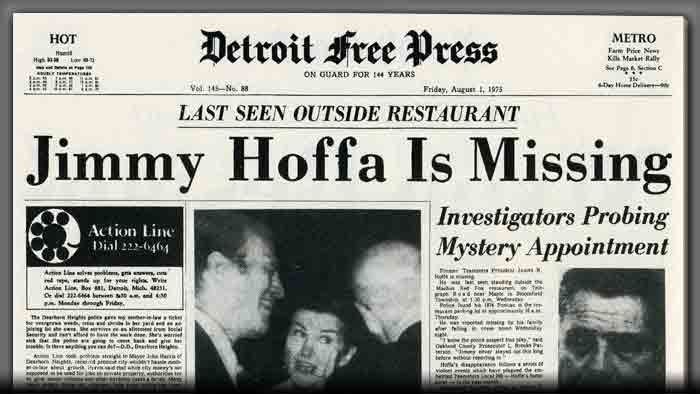
James Riddle Hoffa (1913-75) was a working-class kid who got into the union-organizing business while working in a grocery store. By the time he was in his 20s he was working for the International Brotherhood of Teamsters, a union of truckers and warehouse workers. As Hoffa rose through its ranks, he helped the Teamsters organize on a national basis and become one of the most powerful unions in America, able to disrupt the country’s transport of goods with strikes and boycotts. In order to do so, Hoffa and the Teamsters developed links with organized crime, which wanted to get its hands on the pension fund. He became union vice-president in 1952 and president in 1958, a position he held until 1971.
The corruption of the Teamsters was well-known to authorities in the government and labour circles. The union was expelled from the AFL-CIO, the umbrella organization for organized labour, and Attorney-General Robert Kennedy went after Hoffa and the Teamsters with a vengeance. He was convicted in 1964 of jury-tampering and fraud and served time in prison from 1967-71, though it was widely-believed he continued to control the union through stooges. He was released by President Nixon (some say in return for an exchange of money and guarantee of union support) but only on the condition that he refrain from Teamster activity until 1980.
Hoffa’s attempts to regain control of the Teamsters was resisted from many inside the union and may have disrupted plans by organized crime to work closely with those now in charge of the union. On the afternoon of July 30, 1975 he was scheduled to meet Anthony Giacalone and Anthony Provenzano, two Mafia bosses, at a restaurant in Detroit but he was never seen again. Though his body has never been recovered (its position was said to be under various highways, in various fields or beneath Giants Stadium in New Jersey) the consensus is that he was murdered very soon after his disappearance. Hoffa’s son James has been president of the Teamsters since 1999.
A great wedding and a terrible marriage. On this day in 1981, Lady Diana Spencer and His Royal Highness Prince Charles Philip Arthur George, Prince of Wales, KG, KT, GCB, OM, AK, CC, QSO, PC, ADC, Earl of Chester, Duke of Cornwall, Duke of Rothesay, Earl of Carrick, Baron of Renfrew, Lord of the Isles and Prince and Great Steward of Scotland, Field Marshal, Admiral of the Fleet in the Royal Navy, Marshal of the Royal Air Force and Colonel in the Papua New Guinea Defence Force, (MA Cantab), were wed at St Paul’s Cathedral in London in a ceremony watched by 3,000 in the church, 750,000,000 on television around the world. Among the guests were most of the crowned heads of the planet, including the dispossessed claimants to monarchies that had ceased to exist, such as Greece, Romania, Bulgaria and Yugoslavia.
As heir to the throne it was essential that Charles should wed. Though he had had numerous girl friends and mistresses before his proposal to Lady Diana, none of these women were considered suitable marriage partners or a future Queen — soft porn actresses, wives of his friends, and Catholic princesses all fell short of the required standard. It does not appear that he was much in love with his intended spouse but she was young, beautiful, of noble birth, and a virgin: four qualities rarely found in the same woman in England at the time. They became engaged in February 1981 and plans for a sumptuous ceremony were set in motion immediately.
The bride wore a gown of ivory silk taffeta, decorated with lace, hand embroidery, sequins, and 10,000 pearls with a 25-foot train of ivory taffeta and antique lace. The dress had to be altered considerably as Diana had suffered a weight loss due to bulimia. (One critic called the outfit “too much dress, too little princess.”) Charles wore the uniform of a naval commander, festooned with the decorations of the Orders of the Garter, Thistle, and the Bath. Three choirs, three orchestras and a brass ensemble provided the music; the Archbishop of Canterbury, the Dean of St Paul’s, a Catholic cardinal and sundry Protestant clerics conducted the service.
The marriage soon fell apart. Charles insisted on the royal prerogative of keeping a mistress and Diana took to preying on other women’s husbands.
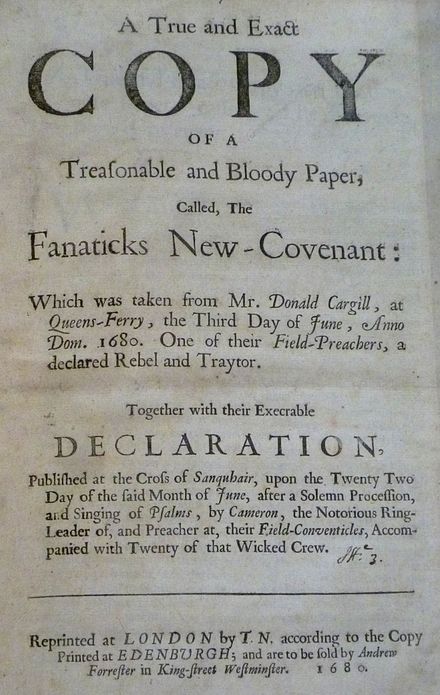
Though they were ruled by the same monarch, Scotland and England in the seventeenth century were separate countries, with their own laws and their own churches. Though the Church of England was ruled by bishops, there was a strong anti-episcopal sentiment in Scotland where many preferred a presbyterian form of church government. Out of this was born the Covenanter movement, so-called after the Solemn League and Covenant in which many Scots pledged themselves to resist Catholicism and religious innovation. Covenanters dominated Scotland from 1638-51 but were crushed by Oliver Cromwell and repressed by the restored Stuart dynasty after 1660. Despite this, secret congregations continued to exist and some of them began to advocate armed rebellion against the king. Among the preachers advocating overthrowing the Stuarts was Donald Cargill who pronounced a sentence of excommunication against those who supported the government.
Cargill was captured in May 1681 and convicted of high treason. As he mounted the ladder to be hanged, he said, “The Lord knows, I go up this ladder in less fear and perturbed of mind than ever I entered the pulpit to preach… Farewell, all relations and friends in Christ; farewell all acquaintances and all earthly enjoyments; farewell reading and preaching, praying and believing, wanderings, reproaches and sufferings. Welcome joy unspeakable and full of glory. Welcome Father, Son and Holy Ghost. Into thy hands I commit my spirit.”
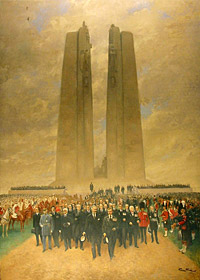
After World War I Canadians were anxious to remember their deeds and their dead in monumental form; all across the country hundreds upon hundreds of local statues, cairns, and cenotaphs were erected. The government also planned to memorialize battle sites in Europe with a series of identical monuments in Belgium and France and held a competition for designs. When over 160 proposals were submitted in 1921, what emerged was overwhelming support for a single spectacular construction based on a design by architect Walter Allward, on Vimy Ridge where Canadian troops had won a bloody victory in 1917. France agreed to donate land to Canada in perpetuity for such a memorial, provided Canada was responsible for its upkeep.
The monument was years in the making, partly because of the difficulty in finding and transporting exactly the right stone. The original plan called for marble but this was deemed to be too susceptible to erosion in the climate of northern France and builders chose instead a type of limestone found in Croatia — it had been used in Diocletian’s palace at Split built 1,650 years earlier and was still in fine shape. 6,000 tonnes of the stone had to be quarried and moved to Vimy while 11,000 tonnes of concrete and hundreds of tonnes of steel were being employed on the foundation.
An enormous pilgrimage of veterans was planned for the official dedication in 1936. Politicians, military units, bands, and clergy were in abundance, presided over by King Edward VIII, performing one of his few official duties before his abdication.
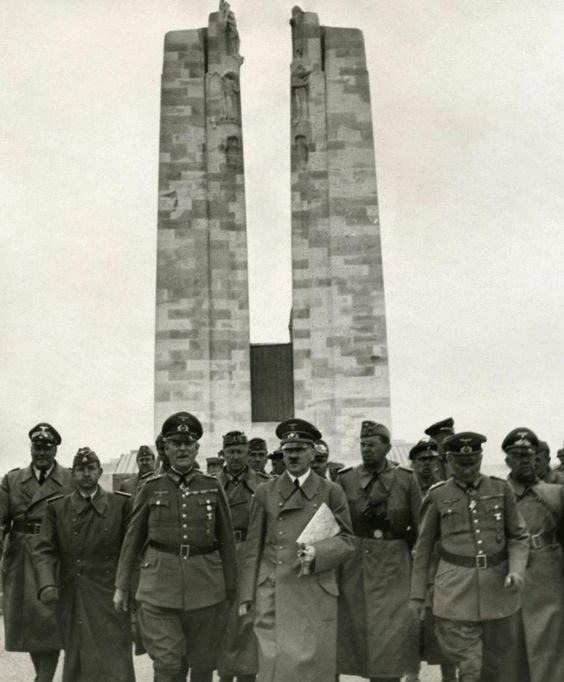
During World War II, the site was in German-occupied France and rumours spread that the Nazis would desecrate the memorial. In order to dispel such stories the German government published pictures of Adolf Hitler triumphantly visiting the monument and showing that it was still being preserved.
At Queenston Heights and Lundy’s Lane, Our brave fathers, side by side, For freedom, homes and loved ones dear, Firmly stood and nobly died; And those dear rights which they maintained, We swear to yield them never! Our watchword evermore shall be “The Maple Leaf forever!”
Those pesky Americans keep trying to invade Canada and keep failing. Yankee intruders were forced to retreat from Montreal and Quebec during their ill-advised War of Independence and in the aftermath of their Civil War the Fenians were repelled from New Brunswick, Ontario, Quebec and Manitoba. The only American defeats we actually sing about, however, are those drubbings we dealt them in the War of 1812, at Queenston Heights and Lundy’s Lane.
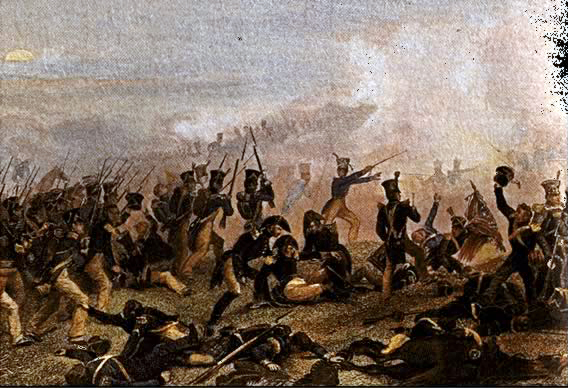
Lundy’s Lane was along a commanding piece of ground in the Niagara peninsula and there British and Canadian troops were attacked by an American force led by Generals Jacob Brown and Winfield Scott who had been successfully racking up victories in Ontario since early July. This battle was particularly bloody with hundreds of casualties from artillery duels, rocket barrages, friendly fire, and bayonet charges. Ground and guns changed hands several times until the bloodied Americans withdrew. Both sides had exhibited considerable bravery but no military genius. The result of the battle was a thwarted American thrust and a shift in the balance of power in the area to the Canadians and British.
Saints’ lives don’t come much weirder than that of Christina (c.1150–1224), a Belgian woman of low birth. In her early twenties she suffered a seizure that appeared to cause her death. Lying in her coffin in church, she astonished the congregation by levitating to the ceiling, apparently repelled by the stench of sin on her friends and neighbours. She claimed that in her coma she had received a vision of the terrors of Purgatory and was then transported to the presence of God. In her words:
The angels then transported me into Heaven, even to the throne of the Divine Majesty. The Lord regarded me with a favourable eye, and I experienced an extreme joy, because I thought to obtain the grace of dwelling eternally with Him. But my Heavenly Father, seeing what passed in my heart, said to me these words: “Assuredly, my dear daughter, you will one day be with Me. Now, however, I allow you to choose, either to remain with Me henceforth from this time, or to return again to earth to accomplish a mission of charity and suffering. In order to deliver from the flames of Purgatory those souls which have inspired you with so much compassion, you shall suffer for them upon earth; you shall endure great torments, without, however, dying from their effects. And not only will you relieve the departed, but the example which you will give to the living, and your life of continual suffering, will lead sinners to be converted and to expiate their crimes. After having ended this new life, you shall return here laden with merits.”
Back on earth she lived a long life of extreme penance and self-denial, occasionally throwing herself into fires and emerging unscathed or plunging into freezing rivers for long periods. Those around her could not tell if she were mad or blessed and she was imprisoned on more than one occasion. Witnesses, and there were many of them, testified to the miracles she performed and the attention she drew to the plight of souls in Purgatory. She is the patron saint of millers, those suffering from mental illness and mental health workers.
A well-known part of recent Manitoba history is the flight (and descent) of the Gimli Glider, a tale of breath-taking incompetence, serial disasters and unearthly flying skills. The story is best told in the Wikipedia entry, which is reproduced here.
On July 22, 1983, Air Canada’s Boeing 767 (registration C-GAUN) flew from Toronto to Edmonton where it underwent routine checks. The next day, it was flown to Montreal. Following a crew change, it departed Montreal as Flight 143 for the return trip to Edmonton (with a stopover in Ottawa), with Captain Robert (Bob) Pearson, 48, and First Officer Maurice Quintal at the controls. Captain Pearson was a highly experienced pilot, having accumulated more than 15,000 flight hours. First Officer Quintal was also very experienced, having logged over 7,000 hours of total flight time.
On July 23, 1983, Flight 143 was cruising at 12,500 metres (41,000 ft) over Red Lake, Ontario. The aircraft’s cockpit warning system sounded, indicating a fuel pressure problem on the aircraft’s left side. Assuming a fuel pump had failed the pilots turned it off, since gravity should feed fuel to the aircraft’s two engines. The aircraft’s fuel gauges were inoperative because of an electronic fault indicated on the instrument panel and airplane logs.
During the flight, the management computer indicated that there was still sufficient fuel for the flight but only because the initial fuel load had been incorrectly entered; the fuel had been calculated in pounds instead of kilograms by the ground crew and the erroneous calculation had been approved by the flight crew. Effectively, this error meant that less than half the amount of intended fuel had been loaded. Because the incorrect fuel weight data had been entered into the system, it was providing incorrect readings. A few moments later, a second fuel pressure alarm sounded for the right engine, prompting the pilots to divert to Winnipeg. Within seconds, the left engine failed and they began preparing for a single-engine landing.
As they communicated their intentions to controllers in Winnipeg and tried to restart the left engine, the cockpit warning system sounded again with the “all engines out” sound, a long “bong” that no one in the cockpit could recall having heard before and was not covered in flight simulator training. Flying with all engines out was something that was never expected to occur and had therefore not been covered in training. Seconds later, with the right-side engine also stopped, the 767 lost all power, and most of the instrument panels in the cockpit went blank.
The 767 was one of the first airliners to include an electronic flight instrumentation system, which operated on the electricity generated by the aircraft’s jet engines. With both engines stopped, the system went dead, leaving only a few basic battery-powered emergency flight instruments. While these provided sufficient information with which to land the aircraft, a vertical speed indicator – that would indicate the rate at which the aircraft was descending and therefore how long it could glide unpowered – was not among them.
On airliners the size of the 767, the engines also supply power for the hydraulic systems without which the aircraft cannot be controlled. Such aircraft are therefore required to accommodate this kind of power failure. With the 767, this is usually achieved through the automated deployment of a hydraulic pump (and on some airplanes a generator) driven by a small turbine, which is driven by a propeller that rotates because of the forward motion of the aircraft in the manner of a windmill. As the Gimli pilots were to experience on their landing approach, a decrease in this forward speed means a decrease in the power available to control the aircraft.
In line with their planned diversion to Winnipeg, the pilots were already descending through 35,000 feet (11,000 m) when the second engine shut down. They immediately searched their emergency checklist for the section on flying the aircraft with both engines out, only to find that no such section existed. Captain Pearson was an experienced glider pilot, so he was familiar with flying techniques almost never used in commercial flight. To have the maximum range and therefore the largest choice of possible landing sites, he needed to fly the 767 at the optimal glide speed. Making his best guess as to this speed for the 767, he flew the aircraft at 220 knots (410 km/h; 250 mph). First Officer Maurice Quintal began to calculate whether they could reach Winnipeg. He used the altitude from one of the mechanical backup instruments, while the distance travelled was supplied by the air traffic controllers in Winnipeg, measuring the distance the aircraft’s echo moved on their radar screens. In 10 nautical miles (19 km; 12 mi) the aircraft lost 5,000 feet (1,500 m), giving a glide ratio of approximately 12:1.
At this point, Quintal proposed landing at the former RCAF Station Gimli, a closed air force base where he had once served as a Royal Canadian Air Force pilot. Unbeknownst to Quintal or to the air traffic controller, a part of the facility had been converted to a race track complex, now known as Gimli Motorsports Park. It included a road race course, a go-kart track, and a dragstrip. A Canadian Automobile Sport Clubs-sanctioned sports car race hosted by the Winnipeg Sports Car Club was underway the Saturday of the incident and the area around the decommissioned runway was full of cars and campers. Part of the decommissioned runway was being used to stage the race.
Without power, the pilots used a gravity drop, which causes gravity to lower the landing gear and lock it into place. The main gear locked into position, but the nose wheel did not; this later turned out to be advantageous. As the aircraft slowed on approach to landing, the ram air turbine generated less power, rendering the aircraft increasingly difficult to control.
As the runway drew near, it became apparent that the aircraft was coming in too high and fast, raising the danger of running off the runway before it could be stopped. The lack of hydraulic pressure prevented flap/slat extension that would have, under normal landing conditions, reduced the stall speed of the aircraft and increased the lift coefficient of the wings to allow the aircraft to be slowed for a safe landing. The pilots briefly considered a 360-degree turn to reduce speed and altitude, but decided that they did not have enough altitude for the manoeuvre. Pearson decided to execute a forward slip to increase drag and lose altitude. This manoeuvre is commonly used with gliders and light aircraft to descend more quickly without increasing forward speed.
Complicating matters was the fact that with all of its engines out, the plane made virtually no noise during its approach. People on the ground thus had no warning of the impromptu landing and little time to flee. As the gliding plane closed in on the runway, the pilots noticed that there were two boys riding bicycles within 1,000 feet (300 m) of the projected point of impact. Captain Pearson would later remark that the boys were so close that he could see the looks of sheer terror on their faces as they realized that a commercial airliner was bearing down on them.
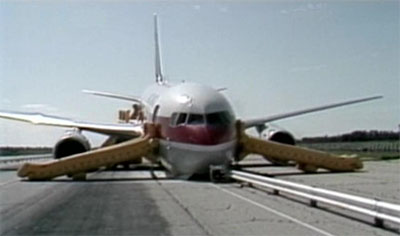
Two factors helped avert a potential disaster: the failure of the front landing gear to lock into position during the gravity drop, and the presence of a guardrail that had been installed along the centre of the decommissioned runway to facilitate its use as a racetrack. As soon as the wheels touched down on the runway, Pearson braked hard, blowing out two of the aircraft’s tires. The unlocked nose wheel collapsed and was forced back into its well, causing the aircraft’s nose to slam into, bounce off, and then scrape along the ground. This additional friction helped to slow the airplane and kept it from careening into the crowds surrounding the runway. After the aircraft had touched down, the nose began to scrape along the guardrail in the centre of the tarmac; Pearson applied extra right brake, which caused the main landing gear to straddle the guardrail creating additional drag that further reduced the speed. Air Canada Flight 143 came to a final stop on the ground 17 minutes after running out of fuel.
There were no serious injuries among the 61 passengers or the people on the ground. A minor fire in the nose area was extinguished by racers and course workers armed with fire extinguishers. Because the aircraft’s nose had collapsed onto the ground, its tail was elevated and there were some minor injuries when passengers exited the aircraft via the rear slides, which were not long enough to sufficiently accommodate the increased height.
In 1920 the British government undertook the rule of some parts of the former Turkish Empire. In the form of a mandate from the League of Nations, Britain occupied Palestine and Transjordan with their mixture of Arabs and Jews, Christians and Muslims. It was an unhappy regime with all sides calling for the withdrawal of the foreigners and independence for the various religious groups; Jews fought Arabs, Arabs fought Jews, and both sides took shots at the British.
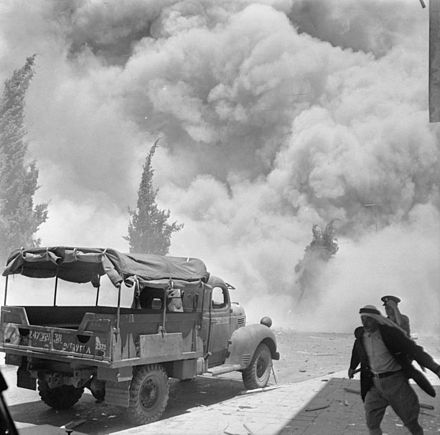
After the end of World War II, Arabs and Jews continued their attacks on each other and on the British occupying force, who had no intention of staying but who had to maintain order until an international settlement was agreed upon to divide the land between Jews and Palestinians. An obvious target was the King David Hotel, headquarters of the Secretariat of the Government of Palestine and of the British Armed Forces in the region. A hard-line group of Jewish terrorists, the Irgun, received permission from the umbrella group guiding the Zionist military movement to attack the hotel and planned to plant hundreds of pounds of explosives in milk cans in the basement. This they did at noon on July 22; phone calls warning of the bombs may — or may not — have been made, but no evacuation had taken place before the devices exploded, bringing down a wing of the hotel.
The explosions killed 91 people, a mixture of British officials and clerks, Jews (including some supporters of Irgun), foreign visitors and Arabs. An outraged Britain clamped down on Jewish life in Jerusalem, achieving Irgun’s aim of causing further discontent with the Mandate occupation. To this day, the Israeli government treats the bombers as heroes.
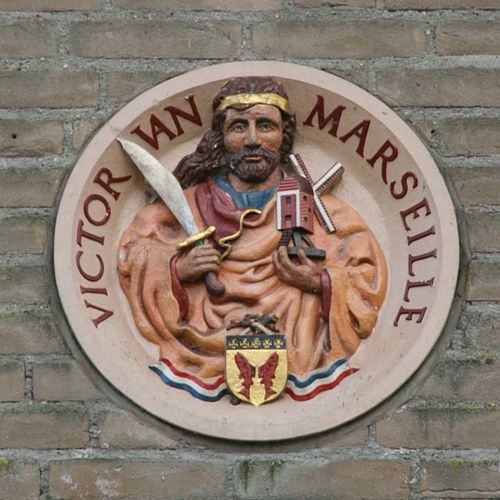
Butler’s Lives of the Saints gives us a vivid account of this martyr:
The Emperor Maximian, reeking with the blood of the Thebæan legion and many other martyrs, arrived at Marseilles, where the Church then flourished. The tyrant breathed here nothing but slaughter and fury, and his coming filled the Christians with fear and alarm. In this general consternation, Victor, a Christian officer in the troops, went about in the night-time from house to house, visiting the faithful and inspiring them with contempt of a temporal death and the love of eternal life. He was surprised in this, and brought before the prefects Asterius and Eutychius, who exhorted him not to lose the fruit of all his services and the favor of his prince for the worship of a dead man, as they called Jesus Christ. He answered that he renounced those recompenses if he could not enjoy them without being unfaithful to Jesus Christ, the eternal Son of God, Who vouchsafed to become man for our salvation, but Who raised Himself from the dead, and reigns with the Father, being God equally with Him. The whole court heard him with shouts of rage. Victor was bound hand and foot and dragged through the streets of the city, exposed to the blows and insults of the populace. He was brought back bruised and bloody to the tribunal of the prefects, who, thinking his resolution must have been weakened by his sufferings, pressed him again to adore their gods. But the martyr, filled with the Holy Ghost, expressed his respect for the emperor and his contempt for their gods. He was then hoisted on the rack and tortured a long time, until, the tormentors being at last weary, the prefect ordered him to be taken down and thrown into a dark dungeon. At midnight, God visited him by His angels; the prison was filled with a light brighter than that of the sun, and the martyr sung with the angels the praises of God. Three soldiers who guarded the prison, seeing this light, cast themselves at the martyr’s feet, asked his pardon, and desired Baptism. Victor instructed them as well as time would permit, sent for priests the same night, and, going with them to the seaside, had them baptized, and returned with them again to his prison. The next morning Maximian was informed of the conversion of the guards, and in a transport of rage sent officers to bring them all four before him. The three soldiers persevered in the confession of Jesus Christ, and by the emperor’s orders were forthwith beheaded. Victor, after having been exposed to the insults of the whole city and beaten with clubs and scourged with leather thongs, was carried back to prison, where he continued three days, recommending to God his martyrdom with many tears. After that term the emperor called him again before his tribunal, and commanded the martyr to offer incense to a statue of Jupiter. Victor went up to the profane altar, and by a kick of his foot threw it down. The emperor ordered the foot to be forthwith chopped off, which the Saint suffered with great joy, offering to God these first-fruits of his body. A few moments after, the emperor condemned him to be put under the grindstone of a hand-mill and crushed to death. The executioners turned the wheel, and when part of his body was bruised and crushed the mill broke down. The Saint still breathed a little, but his head was immediately ordered to be cut off. His and the other three bodies were thrown into the sea, but, being cast ashore, were buried by the Christians in a grotto hewn out of a rock.
St Victor is patron of Tallinn, Estonia, where a medieval brotherhood sponsored art works in local churches which celebrated his deeds.