Depression-era America was a period in which its criminal element were figures of great public interest. The restrictions of Prohibition and the hardships of the Dirty Thirties helped persuade many law-abiding citizens that the nation’s outlaw class were latter-day Robin Hoods or at least celebrities worth reading about. The names of John Dillinger, Machine Gun Kelly, Baby Face Nelson, Bonnie and Clyde, and Ma Barker were on the lips of school children, reporters, politicians, and furious police officials.
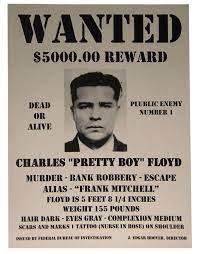
One of the most famed of the banditti was Charles Arthur Floyd, aka “Pretty Boy”, fabled in literature, film, and song. Listen to his tale as recounted by Woody Guthrie:
Well gather round me children, a story I will tell About pretty boy Floyd the outlaw, Oklahoma knew him well. It was in the town of Shawnee on a Saturday afternoon His wife beside him in the wagon as into town they rode.
Then along came the deputy sheriff in a manner rather rude Using vulgar words of language, his wife she overheard. Then pretty boy grabbed a long chain and the deputy grabbed a gun And in the fight that followed he laid that deputy down.
Then he ran to the trees and bushes to live a life of shame Every crime in Oklahoma was added to his name. He ran to the trees and bushes on the Canadian river shore And many a starving farmer opened up his door.
It was in Oklahoma City, it was on a Christmas day A whole carload of groceries with a letter that did say: You say that I’m an outlaw, you say that I’m a thief Well here’s a Christmas dinner for the families on relief.
As through this life you travel you meet some funny men. Some will rob you with a six-gun and some with a fountain pen. As through this life you ramble, as through this life you roam You’ll never see an outlaw take a family from their home.
There is a lot of poetic anti-capitalist license in Guthrie’s version of events. Rather than being forced into a life of crime, Floyd was already a thief and convict by the time he was 21. After his release from prison in 1929 he turned his hand to bank robbing. Despite the killings that often marked his passage, he acquired a reputation as a friend of the common man. Tales spread of his destroying mortgage documentation in banks and giving money to poor farmers, but there is little hard proof of this. What can be proven is a series of murders and thefts in Oklahoma, Missouri, and Ohio.
In June 1933 “the Kansas City Massacre” made the headlines; four policemen and a prisoner were killed in a botched rescue attempt – Floyd was named as a suspect but he publicly denied his involvement. By now local and federal authorities were turning up the pressure on the brigands. Machine Gun Kelly was caught, Bonnie and Clyde and John Dillinger had been gunned down, vaulting Floyd to the top of the Most Wanted List. In October 1934, after a car crash Floyd was cornered in a farmer’s field and shot to death. Baby Face Nelson was killed within weeks and Ma Barker was shot a few months later. The age of the rural outlaws had ended.
We have spoken about ladies-in-waiting and the ease of their transition to the role of royal mistress. Sometimes, however, a woman is just so gosh-darn attractive that the king plucks her from the lower orders and keeps her as a pet. For a while.
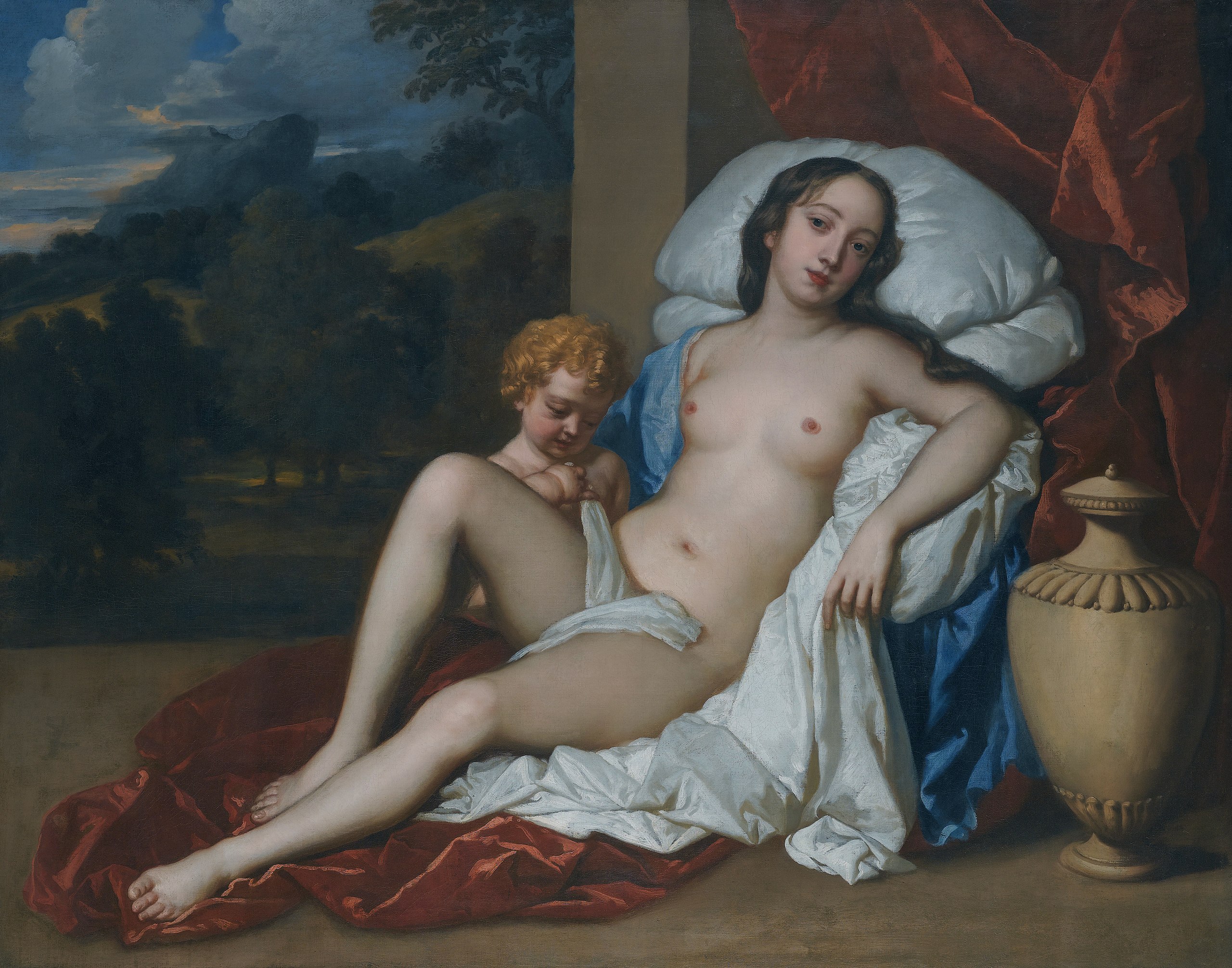
Say hello then to Nell Gwynn, prostitute and actress (then, as now, the two professions were often considered one and the same), born in London in 1650 in the midst of the revolutionary Puritan rule of England. She seems to have grown up in a brothel but was attracted to the life of the stage where, since the restoration of the monarchy in 1660, for the first time in English history women were allowed to take women’s parts. By her mid-teens she had moved from being an orange-seller in the theatre to increasingly large roles in plays, especially comedies. Her reputation as “pretty, witty, Nell” attracted a series of noble lovers and by 1668 she had captured the attention of dissolute King Charles II.
Charles II kept a string of mistresses, often juggling more than one at a time, so there was no reason to think that Nell’s tenure would be a long one. In 1670 she gave birth to a royal bastard, whom she named Charles. The king had so many illegitimate children that he was known as “The Father of his Country” but he was uncommonly good to them, handing out royal titles and pensions with an open hand; in fact many of today’s English upper crust owe their noble status to these episodes. Nell’s son became the Duke of St. Albans.
Charles was a secret Catholic who was receiving bribes from French king Louis XIV to openly proclaim himself a member of the Church of Rome and to bring the country into obedience to the pope but by this time anti-Catholicism had become the English popular religion. Thinking Nell’s coach to be that of the king’s Catholic mistress, the Duchess of Portsmouth, an Oxford mob created a disturbance — to quell it, she stepped out and cried “Good people you are mistaken; I am the Protestant whore.”
Nell was a gambler and big spender, leaving her frequently in debt. On Charles’s deathbed he asked of his brother and heir James II, “Let not poor Nelly starve.” She died in 1687, probably of syphillis. She requested that her funeral sermon be preached on the text from Luke 15: “Just so, I tell you, there will be more joy in heaven over one sinner who repents than over ninety-nine righteous persons who need no repentance.”
As we learned in yesterday’s thrilling episode, the post of lady-in-waiting to a queen may be a launching pad to the role of mistress to the king. Such women are chosen for their beauty and amiability, are generally well-born, and are constantly at court, where they are visible – and accessible– to the monarch. Because royal wives are usually chosen for their dowries or political connections, pretty young ladies-in-waiting often outshine their queen, hanging upon the cheek of night like a rich jewel in an Ethiop’s ear.
Let me then introduce Înes de Castro, lady-in-waiting to Constanza Manuel, wife of the Portuguese Prince Peter. However great the attractions of Constanza were , they paled in Peter’s eyes to those of Înes with whom he soon began an illicit relationship. The prince, nonetheless, did his marital duty and poor Constanza died giving birth in 1345 to a son, Fernando. As far as Peter was concerned, this left him free to marry his true love, but he was forbidden to do so by his father King Afonso who, for dynastic reasons, needed his son to wed higher up the royal ladder than Înes.
Peter stubbornly refused to remarry and rejected the princesses his father suggested for a future bride. He lived apart from the court with Înes who produced three children. King Afonso feared that his son was favouring Spanish relatives of Înes and that civil war might erupt if the relationship continued, so in 1355 he sent three assassins to where she was living. They murdered her in front of one of her children.
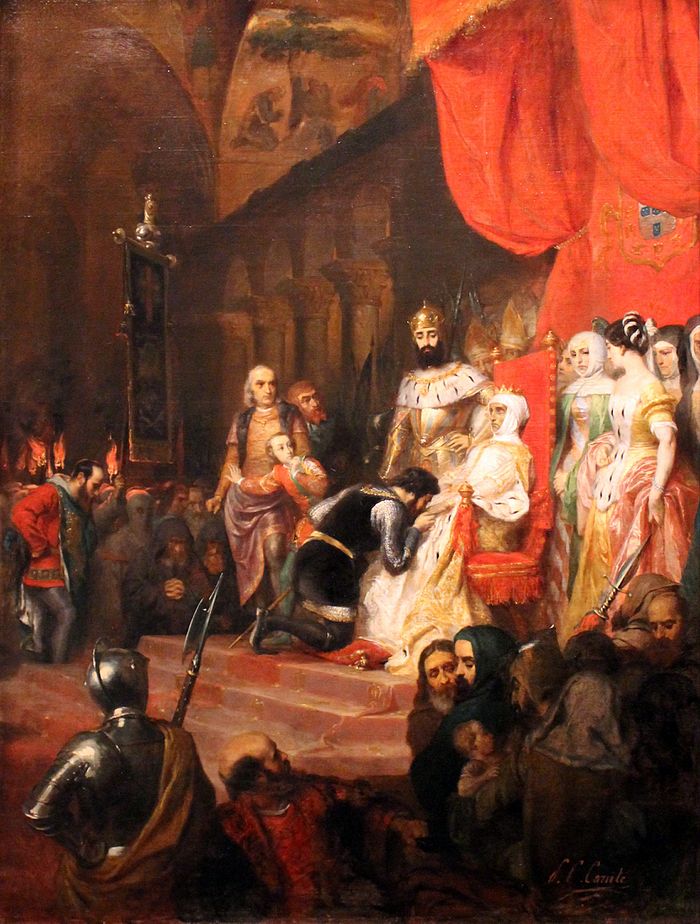
At this affront Peter rebelled against his father. He was defeated but soon after succeeded to the throne of Portugal upon the king’s death. He captured two of the assassins and ripped their hearts out with his own hands. A splendid legend says that he had Înes disinterred, her corpse clad in royal robes and enthroned. All the nobility that had slighted her when she was alive were forced to kneel before the cadaver and kiss the skeletal hands.
Peter had a magnificent dual tomb erected in the Alcobaça monastery. He and Înes were buried facing each other so that on Resurrection Day the first thing they would see would be each other.
Writing the little bio of Peter the Great a few days ago introduced me to the story of Mary Hamilton, aka Maria Danilovna Gamentova, and from that to musing on the often unlucky fate of young women who catch the eyes of sovereigns. For the next few days this blog will recount their sad tales.
Mary Hamilton was the descendant of a Scots family which had emigrated to Russia in the sixteenth century and entered into the service of the tsars.By the early 1700s they were prominent enough to have a girl, Mary, chosen as a lady-in-waiting to the Empress Catherine, wife of Tsar Peter. It is quite common for women such a position to come to the attention of the royal spouse and for that wayward husband to take one as a mistress. So it was with Peter and Mary.
Empress Catherine was of a tolerant nature and for a while all was well with the illicit couple but then, as so often happens, the concubine’s charms fade and the emperor looked elsewhere for his pleasure. Mary remained at court and fell in love with Peter’s military aide-de-camp Ivan Orlov. He was an abusive drunk who beat her; to please her paramour she began to steal from the Empress to buy him gifts. She also aborted two pregnancies and strangled to death a child she was unable to kill in the womb.
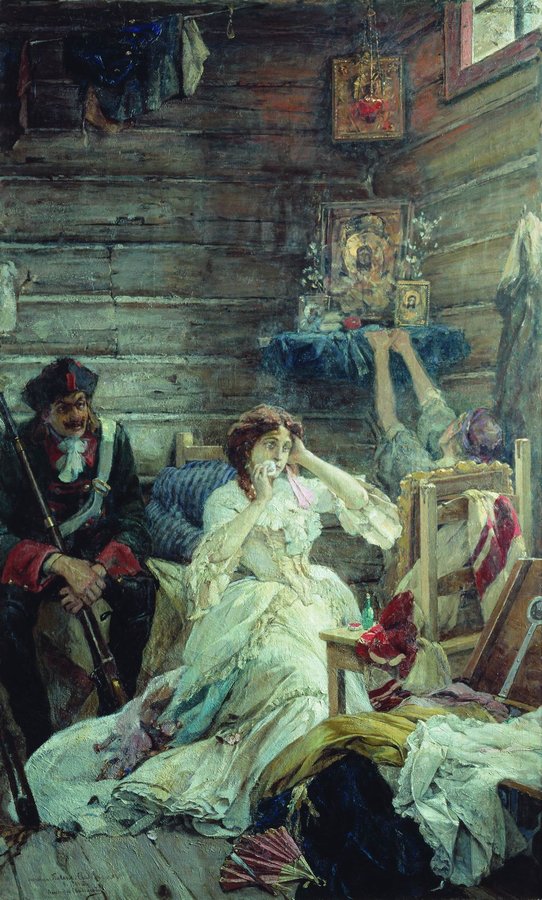
In early 1725 she was betrayed by Orlov; Mary was tortured in the Tsar’s presence and confessed to her crimes. The penalty for murdering a child of the royal blood (the dead baby may have been Peter’s) was to be buried alive but the emperor spared her that, condemning her to be beheaded. He told her, “Without breaking the laws of God and the state, I can’t save you from death, so take your execution and believe that God will forgive you.” The painting above shows her awaiting her end.
1845 “The Raven” is first published under author’s name
One of the English language’s most famous poems appeared on this date, its author Edgar Allen Poe having sold it for $9.00 to a New York magazine. The poem’s clever use of internal rhyme, its supernatural vibes, and mournful tone have made it a favourite for reciters of verse ever since. As a child I learned it from listening to a 16 ⅔ rpm disk with a reading by Lorne Greene, Canada’s famous “Voice of Doom”.
The poem has been recorded by voices great and negligible, from James Earl Jones, to Basil Rathbone, to William Shatner. The most striking version is that produced by The Simpsons, available on YouTube. https://www.youtube.com/watch?v=bLiXjaPqSyY&t=113s
Once upon a midnight dreary, while I pondered, weak and weary,
Over many a quaint and curious volume of forgotten lore—
While I nodded, nearly napping, suddenly there came a tapping,
As of some one gently rapping, rapping at my chamber door.
“’Tis some visitor,” I muttered, “tapping at my chamber door—
Only this and nothing more.”
Ah, distinctly I remember it was in the bleak December;
And each separate dying ember wrought its ghost upon the floor.
Eagerly I wished the morrow;—vainly I had sought to borrow
From my books surcease of sorrow—sorrow for the lost Lenore—
For the rare and radiant maiden whom the angels name Lenore—
Nameless here for evermore.
And the silken, sad, uncertain rustling of each purple curtain
Thrilled me—filled me with fantastic terrors never felt before;
So that now, to still the beating of my heart, I stood repeating
“’Tis some visitor entreating entrance at my chamber door—
Some late visitor entreating entrance at my chamber door;—
This it is and nothing more.”
Presently my soul grew stronger; hesitating then no longer,
“Sir,” said I, “or Madam, truly your forgiveness I implore;
But the fact is I was napping, and so gently you came rapping,
And so faintly you came tapping, tapping at my chamber door,
That I scarce was sure I heard you”—here I opened wide the door;—
Darkness there and nothing more.
Deep into that darkness peering, long I stood there wondering, fearing,
Doubting, dreaming dreams no mortal ever dared to dream before;
But the silence was unbroken, and the stillness gave no token,
And the only word there spoken was the whispered word, “Lenore?”
This I whispered, and an echo murmured back the word, “Lenore!”—
Merely this and nothing more.
Back into the chamber turning, all my soul within me burning,
Soon again I heard a tapping somewhat louder than before.
“Surely,” said I, “surely that is something at my window lattice;
Let me see, then, what thereat is, and this mystery explore—
Let my heart be still a moment and this mystery explore;—
’Tis the wind and nothing more!”
Open here I flung the shutter, when, with many a flirt and flutter,
In there stepped a stately Raven of the saintly days of yore;
Not the least obeisance made he; not a minute stopped or stayed he;
But, with mien of lord or lady, perched above my chamber door—
Perched upon a bust of Pallas just above my chamber door—
Perched, and sat, and nothing more.
Then this ebony bird beguiling my sad fancy into smiling,
By the grave and stern decorum of the countenance it wore,
“Though thy crest be shorn and shaven, thou,” I said, “art sure no craven,
Ghastly grim and ancient Raven wandering from the Nightly shore—
Tell me what thy lordly name is on the Night’s Plutonian shore!”
Quoth the Raven “Nevermore.”
Much I marvelled this ungainly fowl to hear discourse so plainly,
Though its answer little meaning—little relevancy bore;
For we cannot help agreeing that no living human being
Ever yet was blessed with seeing bird above his chamber door—
Bird or beast upon the sculptured bust above his chamber door,
With such name as “Nevermore.”
But the Raven, sitting lonely on the placid bust, spoke only
That one word, as if his soul in that one word he did outpour.
Nothing farther then he uttered—not a feather then he fluttered—
Till I scarcely more than muttered “Other friends have flown before—
On the morrow he will leave me, as my Hopes have flown before.”
Then the bird said “Nevermore.”
Startled at the stillness broken by reply so aptly spoken,
“Doubtless,” said I, “what it utters is its only stock and store
Caught from some unhappy master whom unmerciful Disaster
Followed fast and followed faster till his songs one burden bore—
Till the dirges of his Hope that melancholy burden bore
Of ‘Never—nevermore’.”
But the Raven still beguiling all my fancy into smiling,
Straight I wheeled a cushioned seat in front of bird, and bust and door;
Then, upon the velvet sinking, I betook myself to linking
Fancy unto fancy, thinking what this ominous bird of yore—
What this grim, ungainly, ghastly, gaunt, and ominous bird of yore
Meant in croaking “Nevermore.”
This I sat engaged in guessing, but no syllable expressing
To the fowl whose fiery eyes now burned into my bosom’s core;
This and more I sat divining, with my head at ease reclining
On the cushion’s velvet lining that the lamp-light gloated o’er,
But whose velvet-violet lining with the lamp-light gloating o’er,
She shall press, ah, nevermore!
Then, methought, the air grew denser, perfumed from an unseen censer
Swung by Seraphim whose foot-falls tinkled on the tufted floor.
“Wretch,” I cried, “thy God hath lent thee—by these angels he hath sent thee
Respite—respite and nepenthe from thy memories of Lenore;
Quaff, oh quaff this kind nepenthe and forget this lost Lenore!”
Quoth the Raven “Nevermore.”
“Prophet!” said I, “thing of evil!—prophet still, if bird or devil!—
Whether Tempter sent, or whether tempest tossed thee here ashore,
Desolate yet all undaunted, on this desert land enchanted—
On this home by Horror haunted—tell me truly, I implore—
Is there—is there balm in Gilead?—tell me—tell me, I implore!”
Quoth the Raven “Nevermore.”
“Prophet!” said I, “thing of evil!—prophet still, if bird or devil!
By that Heaven that bends above us—by that God we both adore—
Tell this soul with sorrow laden if, within the distant Aidenn,
It shall clasp a sainted maiden whom the angels name Lenore—
Clasp a rare and radiant maiden whom the angels name Lenore.”
Quoth the Raven “Nevermore.”
“Be that word our sign of parting, bird or fiend!” I shrieked, upstarting—
“Get thee back into the tempest and the Night’s Plutonian shore!
Leave no black plume as a token of that lie thy soul hath spoken!
Leave my loneliness unbroken!—quit the bust above my door!
Take thy beak from out my heart, and take thy form from off my door!”
Quoth the Raven “Nevermore.”
And the Raven, never flitting, still is sitting, still is sitting
On the pallid bust of Pallas just above my chamber door;
And his eyes have all the seeming of a demon’s that is dreaming,
And the lamp-light o’er him streaming throws his shadow on the floor;
And my soul from out that shadow that lies floating on the floor
Rulers of nations and empires can die any day of the year, but it is remarkable to find three such consequential monarchs passing on the same calendar date.
814 Charlemagne
First to go was Frankish emperor Karl, aka Carolus Magnus, aka Charlemagne, second of the Carolingian dynasty. He unified and greatly enlarged Frankish territory creating a dominion that stretched from Denmark to the Spanish Marches, from the Atlantic to the Pannonian plains. He issued legal codes, encouraged Christian evangelism of pagan tribes, sponsored a renaissance of learning and arts, judged popes, crushed Lombards, Saxons, and Avars, and was crowned Emperor in Rome on Christmas Day, 800. His realm was splintered and frittered away by his son Louis the Pious and his quarrelsome grandsons.
1547 Henry VIII
An unpleasant character, mean and foolish in so many ways, Henry’s reign saw important changes in England. His marital woes led him to create the Church of England, which he meant to be Catholic in doctrine but under his thumb instead of the pope’s. He carried out the greatest redistribution of wealth in the country’s history by seizing vast monastic land-holdings – this profited his noble supporters more than it enriched the crown. He permitted the printing of the first English Bible – with his portrait on the title page. In order to justify these acts in the eyes of his political class he validated them through Parliament. This greatly enhanced the powers of that institution. He murdered wives, cardinals, monks, and rebels. Few mourned his passing.
1725 Peter the Great
After a tumultuous rise to the throne, marked by conspiracy and rebellion Peter achieved unfettered rule in 1696 at the age of 24. His impressive titles tell us a lot about the historical expansion of the Russian state: By the grace of God, the most excellent and great sovereign emperor Pyotr Alekseevich the ruler of all the Russias: of Moscow, of Kiev, of Vladimir, of Novgorod, Tsar of Kazan, Tsar of Astrakhan and Tsar of Siberia, sovereign of Pskov, great prince of Smolensk, of Tver, of Yugorsk, of Perm, of Vyatka, of Bulgaria and others, sovereign and great prince of the Novgorod Lower lands, of Chernigov, of Ryazan, of Rostov, of Yaroslavl, of Belozersk, of Udora, of Kondia and the sovereign of all the northern lands, and the sovereign of the Iverian lands, of the Kartlian and Georgian Kings, of the Kabardin lands, of the Circassian and Mountain princes and many other states and lands western and eastern here and there and the successor and sovereign and ruler.
Peter significantly modernized the backward Russian state, created a new capital city of St. Petersburg, improved the military (especially the navy), smacked down Swedes and Tatars, introduced Western ways, and laid the foundation of Romanov rule for centuries.
One of the cleverest twists in historical fiction was achieved by Robert Graves in his novels I, Claudius and Claudius the God. It was his literary conceit that Tiberius Claudius Caesar Augustus Germanicus, the fourth emperor of Rome, was not the bumbling fool that historians portrayed but rather a clever survivor and acute observer of murderous imperial politics. On this day in 41 A.D. Claudius succeeded to the throne after the death of the incumbent, the mad Gaius “Caligula”.
Caligula (b. 12 A.D.) was a very bad fellow indeed. His accession to power in 37 was a popular one as his predecessor Tiberius had turned paranoid and cruel and the young man was the descendant of both Caesar Augustus and Mark Antony. After a few months of stability, Caligula began to murder family members, Senators, and military officers and to squander public funds on vast and useless projects. He began to think himself divine and demanded to be worshipped – previous emperors had been regarded as gods only after their deaths. He awarded himself a triumphal parade for having vanquished the ocean, committed incest with his sisters, and is said to have thrown spectators in the arena to be killed by wild animals when a shortage of prisoners had spoiled the show. When members of the political class began to fear for their lives, they joined in a plot to assassinate Caligula whom they stabbed to death; his wife and daughter were also murdered. The Praetorian Guard took revenge on the conspirators. When one of the guardsmen discovered Caligula’s uncle, the last male of the Julio-Claudian line, hiding behind the curtain it seemed they had found a suitable successor.
Claudius was by this time in his 50s; he limped and stuttered and was widely considered to be a harmless fool, which probably saved him from deadly court intrigues. He was happy to have been spared by the Guard, promptly granted them bonuses and ordered the execution of the assassins. Claudius’s reign was generally successful – Rome expanded militarily while the imperial bureaucracy and tax collecting powers were made more efficient. The emperor’s personal life, however, was a disaster. During the reign of Caligula, Claudius had unwisely married the fifteen-year-old beauty Messalina. The young woman turned out to be promiscuous on an industrial scale and plotted against him, forcing the poor fellow to order her death. His fourth and final wife, Agrippina, ended the farce by poisoning him to put her son Nero on the throne.
In the midst of a world steeped in “disinformation”, it may be useful to consider the thoughts of an English politician whose brilliant public career ended amid rigged accusations of bribe-taking. Francis Bacon, Viscount St Albans, was a contemporary of William Shakespeare, a favourite of the Virgin Queen Elizabeth I, and an intellectual giant. This is the man who coined the phrase “knowledge is power”, who wrote the first essays in the English language, penned our first science fiction and, by proposing that observation and induction replace all previously-accepted knowledge, laid the foundation of the scientific method. He is believed by many to be the “real author” of the plays attributed to Shakespeare. He wasn’t but he was an important figure in the philosophical history of the Anglophone world.
Bacon was born into a family which was prominent in Elizabethan religion and politics. His father Nicholas was Lord Keeper of the Great Seal and his uncle was William Cecil, Lord Burghley, Elizabeth’s closest advisor. He entered politics at age 20, rose to be the Queen’s legal counsel and the Attorney General of her successor James I. His enemies brought him down in 1621 on grossly-inflated charges but he never lost the respect of the thinking classes.
In his ground-breaking Essays, Bacon claimed that humans were barred from seeing reality by four obstacles. The first of his three barriers to clear thinking dealt with individual eccentricities, common superstitions, and false knowledge; the fourth was what he called “Idols of the Market-place” on account of the commerce and consort of men there. For it is by discourse that men associate; and words are imposed according to the apprehension of the vulgar. And therefore the ill and unfit choice of words wonderfully obstructs the understanding. Nor do the definitions or explanations wherewith in some things learned men are wont to guard and defend themselves, by any means set the matter right. But words plainly force and overrule the understanding, and throw all into confusion, and lead men away into numberless empty controversies and idle fancies.
For Bacon, words wrongly used could keep people from discovering the truth and this was a tragedy. For North American politicians, truth-avoidance has become precisely the point. Spokesmen of each party in debates, press releases, and speeches use language as a means of obfuscation more than clarification; the power of words to cloud issues is valued over its ability to shed light.
Bacon died in 1626, possibly the victim of his own belief in scientific observation, having caught pneumonia while conducting an experiment in refrigeration.
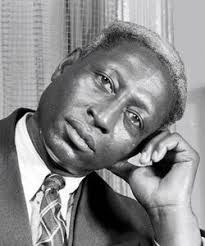
Huddie William Ledbetter was born to a poor African American family in Louisiana but moved at an early age with his parents to Texas. There he learned to play a number of musical instruments and by his teenage years was making money singing and playing playing his 12-string guitar “Stella”. Working in clubs, saloons, and brothels, he adopted the nickname Lead Belly.
Ledbetter was of a violent disposition and served time in prison for murder, attempted murder, and assault. It was in jail where he met the folklorists John and Alan Lomax who were touring the South making field recordings of prison musicians for the Library of Congress. The Lomaxes employed him and introduced him to audiences in New York. There, in the 1930s his reputation as a singer of folk songs grew. His renditions of “Midnight Special”, “Goodnight Irene” and “TB Blues” won him a recording contract and a tidy living playing on the radio, university campuses and touring. He died in 1949 of Lou Gehrig’s Disease.
Lead Belly’s influence on the folk music scene was immense. Bob Dylan, Pete Seeger, the Weavers, and the Beatles all cited him as an inspiration. In my teenage years a Smithsonian LP of his greatest hits had my young toes tapping. Here he is:
It is mid-January, the coldest part of a cold Manitoba winter. We are isolated in a plague-ridden world, ruled by nincompoops, submerged in a debased culture of endless Spider-Man movies, erectile dysfunction ads and pretty girls making a fortune selling farts-in-a-jar. (Oh, I wish I were kidding.) What we need is a blast of unexpected merry-making and rejection of reality. To that end I give you Old Twelfth Night.
What is January 17 on the Gregorian calendar would have been January 5 according to the Julian reckoning, a style abandoned by the English-speaking world only in 1750. Let us cast ourselves back to that early-modern time and revel in today as the eve of Epiphany as they still do in some parts of England.
Here is a website that will guide you to a covid-defying outburst of joy. Wassail!