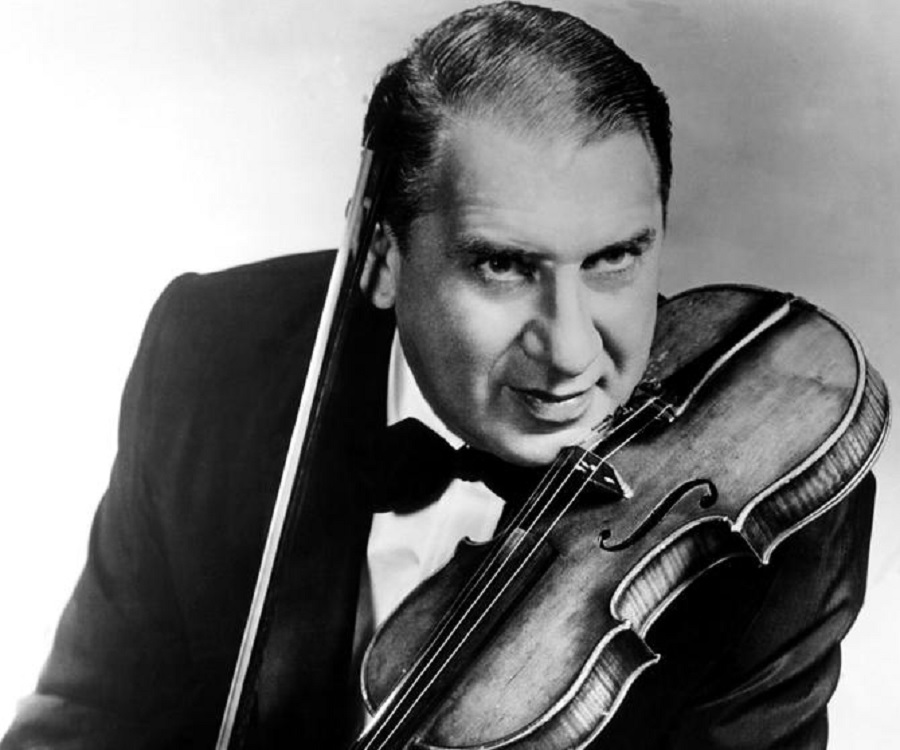
Henry “Henny” Youngman was born to a family of Russian Jews in England but moved to New York as a child. Working with a jazzband called the Swanee Syncopaters, he began to tell jokes between numbers and developed a reputation as a comedian. Working in radio from the late 1930s he developed a style of rapid-fire one-liners with an occasional riff on the violin he always carried as a prop. He worked in nightclubs, on television, and in the movies – in fact, anywhere people would pay him. Only his death in 1998 ended his performing career. Here are some of Youngman’s innumerable jokes, amny at the expense of his wife Sadie, to whom he was actually devoted:
My wife said to me, ‘For our anniversary I want to go somewhere I’ve never been before.’ I said, ‘Try the kitchen!’
I take my wife everywhere, but she keeps finding her way back.
My wife will buy anything marked down. Last year she bought an escalator.
We always hold hands. If I let go, she shops.
My wife told me the car wasn’t running well. There was water in the carburetor. I asked where the car was, and she told me it was in the lake.
My wife and I went to a hotel where we got a waterbed. My wife called it the Dead Sea.
My wife is on a new diet. Coconuts and bananas. She hasn’t lost weight, but can she climb a tree.
Last night my wife said the weather outside was fit for neither man nor beast, so we both stayed home.
I was so ugly when I was born, the doctor slapped my mother.
If you’re going to do something tonight that you’ll be sorry for tomorrow morning, sleep late.
I told the doctor I broke my leg in two places. He told me to quit going to those places.
My son complains about headaches. I tell him all the time: ‘When you get out of bed, it’s feet first!’
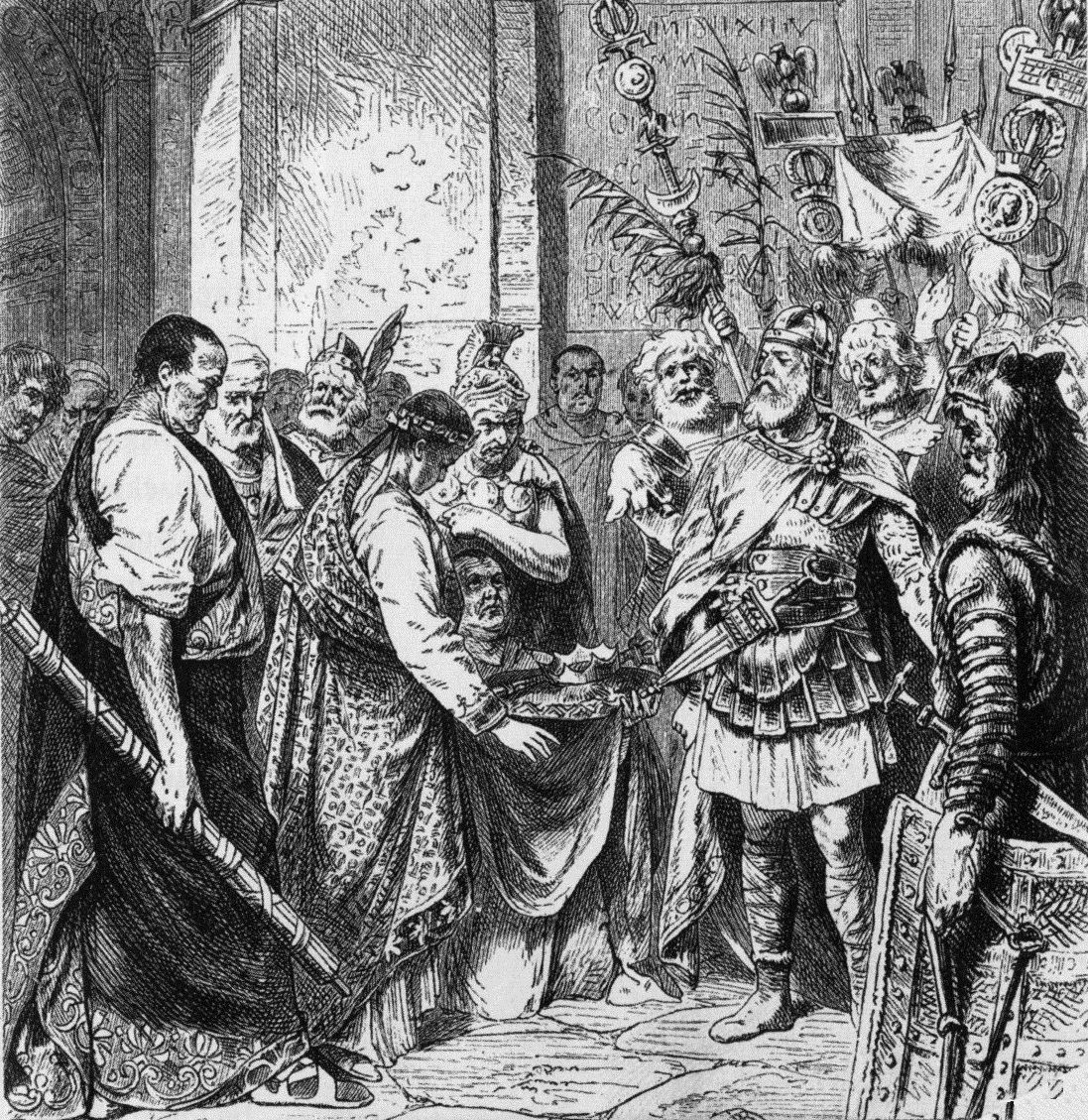
In the late 5th century the Roman Empire in the West was largely a fiction. The territories had been overrun by a number of Germanic tribes looking for loot and places to settle. The imperial throne was the plaything of rebellious generals and their barbarian allies. In 476 a Gothic/Hunnic military leader, Odoacer, deposed the last western emperor, Romulus Augustus, and sent the kid home without much ado.
Odoacer dispatched the regalia to Zeno, the eastern emperor in Constantinople, and henceforth claimed to be administering Italy in his name. For 12 years he ruled with notable success, collaborating with the Senate in Rome, keeping his land-hungry tribesmen happy, and making sure civilization still functioned. (Without the Roman civil service who was going to collect the taxes?) Though he was an Arian Christian he seems to have had decent relations with his Catholic subjects.
Odoacer’s big mistake was to join with other rebels in trying to depose Zeno, sensing that the emperor was viewing him as a danger. Zeno responded by turning to another Gothic general, Theoderic, who invaded Italy. After years of fighting, Theoderic had Odoacer cornered in Ravenna, where he was protected by easily-defended marsh land. In 493 a peace was negotiated whereby the peninsula was to be shared by the two warriors but at a banquet of reconciliation, Theoderic stabbed Odoacer to death, and ordered his wife and children to be murdered as well.
Theoderic wisely adhered to Odoacer’s policy of cooperation with the Roman elite and ruled Italy happily for over 30 years.
The 1830 revolution that toppled the Bourbon dynasty brought with it the disbanding of the regiments of foreign troops who had served those kings. In March 1831 the new French king Louis-Philippe created a Foreign Legion from those soldiers and quickly dispatched it to aid in the conquest of Algeria. Since then the mercenaries of the Legion – whose motto is Legio Patria Nostra, the Legion is our Homeland – have fought with distinction in every French war. Their toughness is legendary and their casualties were heavy, especially in Mexican, North African, and Vietnamese conflicts.
As with every elite unit, esprit de corps is essential. This can be seen in the eccentric lyrics of their marching song, “Le Boudin”. A boudin is a sausage and refers to the rolled pack carried on the soldiers’ backs.
Chorus:
Hey, here’s blood sausage, here’s blood sausage, here’s blood sausage,/ For the Alsatians, the Swiss, and the Lorrains, /For the Belgians, there is none left,/ For the Belgians, there is none left, They are ass shooters. [des tireurs au cul]
1st verse:
We are crafty,/ We are rogues, Not ordinary guys,/ We often have our dark moods/ We are Legionnaires./ In Tonkin, the Immortal Legion/ Honoured our flag at Tuyen Quang./ Heroes of Camarón and model brothers/ Sleep in peace in your tombs.
(Chorus)
2nd verse:
Our ancestors knew how to die/ For the glory of the Legion./ We will all know how to perish/ Following tradition./ During our far-off campaigns,/ Facing fever and fire,/ Let us forget, along with our sorrows,/ Death, which forgets us so seldom./ We the Legion.
The slandering of the Belgians refers to the incident in 1870 when the King of Belgium requested that his subjects in the Legion not take part in the Franco-Prussian War. These troops were left at their home base much to the disgust of their comrades sent to the fighting.
Jorge Mario Bergoglio was born in 1936 in Buenos Aires to a family of Italian immigrants. He became a Jesuit in 1960 and was ordained to the priesthood seven years later. He served the order as a teacher and theologian but his opposition to “liberation theology” and his emphasis on pastoral work rather than critiquing contemporary society led to a falling out with his Jesuit superiors in Argentina.
Despite a Jesuit rule forbidding members from attaining high office in the church Bergoglio was named a bishop in 1992 and became Archbishop of Buenos Aires in 1997. He became known for his decision to have his priests penetrate the poorer areas of his diocese and for curbing extravagant spending. He was also noted for his call for national repentance for the violence and terrorism of Argentine political life in past eras.
At age 75 he resigned as Archbishop but was named a cardinal by Pope John Paul II, whereupon he moved to Rome where his simple living attracted attention. At the papal conclave to elect a successor to John Paul he is said to have finished second to Cardinal Ratzinger in the voting. On Ratzinger’s resignation in 2013 Bergoglio was chosen pope and took the name Francis, after St Francis of Assisi. He thus became the first Jesuit pope, the first from the Americas or the Southern Hemisphere, the first non-European since 714.
Since his election, he has proved an enigmatic leader of the Roman Catholic world, giving off mixed signals about gay marriage, women as deacons, communion for divorced couples, and indigenous spirituality without actually directly challenging received teachings. Francis is perceived to be over-friendly to leftist regimes and has angered theological conservatives with his restrictions on the Tridentine mass. He is the first pope to have an Instagram account.
Only three popes have merited the title of “the Great” (though fans of John Paul II are trying hard to make it a quartet.) The second of these to be born (c. 540) was Gregorius Anicius, who renounced great wealth to become a monk. In 590 he was elected pope and became a powerful force for good in the ruins of the western Roman empire. You will not find a more loving tribute to him than this 19th-century account.
There have been Popes of every shade of human character. Gregory the Great is one distinguished by modesty, disinterestedness, and sincere religious zeal, tempered by a toleration which could only spring from pure benevolence. The son of a Roman senator, with high mental gifts, and all the accomplishments of his age, he was drawn forward into prominent positions, but always against his will. He would have fain continued to be an obscure monk or a missionary, but his qualities were such that at length even the popedom was thrust upon him (on the death of Pelagius II in 590). On this occasion he wrote to the sister of the Emperor: ‘Appearing to be outwardly exalted, I am really fallen. My endeavours were to banish corporeal objects from my mind, that I might spiritually behold heavenly joys. I am come into the depths of the sea, and the tempest hath drowned me.’
The writings of Pope Gregory, which fill four folio volumes, are said to be very admirable. The English King Alfred showed his appreciation of one treatise by translating it. In exercising the functions of his high station, Gregory exhibited great mildness and forbearance. He eagerly sought to convert the heathen, and to bring heretics back to the faith: but he never would sanction the adoption of any harsh. measures for these purposes. One day-before he attained the papal chair-walking through the market in Rome, he was struck by the beauty of a group of young persons exposed to be sold as slaves. In answer to his inquiry of who they were, and whence they came, he was told they were Angli, from the heathen island of Britain. ‘Verily, Angeli,’ he said, punning on the name: ‘how lamentable that the prince of darkness should be the master of a country containing such a beautiful people! How sad that, with so fair an outside, there should be nothing of God’s grace within! His wish was immediately to set out as a missionary to England, and it was with difficulty he was prevented. The incident, however, led to a mission being ere long sent to our then benighted country, which thus owed its first reception of Christian light to Gregory.
Almsgiving, in such Protestant countries as England, is denounced as not so much a lessening of human suffering as a means of engendering and extending pauperism. Gregory had no such fears to stay his bountiful hand. With him to relieve the poor was the first of Christian graces. He devoted a large proportion of his revenue and a vast amount of personal care to this object. He in a manner took the entire charge of the poor upon his own hands. ‘He relieved their necessities with. so much sweetness and affability, as to spare them the confusion of receiving alms; the old men among them he, out of deference, called his fathers. He often entertained several of them at his own table. He kept by him an exact catalogue of the poor, called by the ancients Matriculae; and he liberally provided for the necessities of each. In the beginning of every month he distributed to all the poor corn, wine, pulse, cheese, fish, flesh, and oil; he appointed officers for every street, to send every day necessaries to all the needy sick: before he ate, he always sent off meats from his own table to some poor persons.’ There may be some bad moral results from this wholesale system of relief for poverty, but certainly the motives which prompted it must be acknowledged to have been highly amiable.
Gregory was a weakly man, often suffering from bad health, and he did not get beyond the age of sixty-four. We owe to him a phrase which has become a sort of formula for the popes-‘Servant of the servants of God.’ His name, which is the same as Vigilantius or Watchman, became, from veneration for him, a favourite one: we find it borne, amongst others, by a Scottish prince of the eighth century, the reputed progenitor of the clan M’Gregor. It is curious to think of this formidable band of Highland outlaws of the seventeenth century as thus connected by a chain of historical circumstances with the gentle and saintly Gregory, who first caused the lamp of Christianity to be planted in England.
Johann Sebastian Bach (1685-1750) is now recognized as the towering genius of classical music but there was a time after his death when he had largely faded from public memory. His work was respected by later composers but JS Bach’s major works were seldom performed. Such was the case of his monumental musical treatment of the suffering and death of Jesus according to the Gospel of Matthew. Written for two choirs and two orchestras it was meant to be performed on Good Friday.
Felix Mendelssohn had been given a copy of The St Matthew Passion which Bach had written in 1727 and which had not been performed outside of Leipzig since 1750. Mendelssohn’s staging of the oratorio in 1829 attracted great crowds in three sell-our performances and contributed much to the revival of interest in Bach’s music.
Here is a video of the final chorus, performed by a Swedish choir and orchestra.
After the British conquered New France in 1759 during the Seven Years’ War, they decided to let the inhabitants keep their French language, Catholic religion, and civil law, partly as a counterweight to the restive English-speaking colonies to the south. This allowed the Québecois to develop a unique culture, as distinct from the rest of Canada as it was from France.
In the 1950s and 60s, this culture became self-consciously aware and aggressively separatist, producing writers, composers, and singers who were proud to flaunt their indifference to American and Canadian artists. This was particularly marked among the singer-songwriters known as chansonniers, such as Gilles Vigneault, Pauline Julien, and Georges Dor.
Dor was a radio disk jockey and news director who wrote poetry in his spare time. In 1968 he penned his masterpiece “La Manic”, a love letter from a lonely worker in the north of Québec labouring on the Manicouagan power project. It rose to the tops of the Quebec charts and even captured the fancy of Anglophone prairie boys a thousand miles to the west. He sings it here: https://www.youtube.com/watch?v=h2RzMhqbrkY
Its beginning in French goes:
Si tu savais comme on s’ennuie À la Manic Tu m’écrirais bien plus souvent À la Manicouagan.
Parfois je pense à toi si fort Je recrée ton âme et ton corps Je te regarde et m’émerveille Je me prolonge en toi Comme le fleuve dans la mer Et la fleur dans l’abeille.
An English translation:
If you only knew how bored we are at La Manic,
You’d write to me a lot more often in La Manicouagan.,
Sometimes I think of you so hard
I recreate your soul and your body,
I look at you and wonder,
I extend myself in you
Like the river in the sea
And the flower in the bee.
The chansonnier genre’s greatest hit was Gilles Vigneault’s beautiful “Mon Pays”, a hymn to winter in Québec, which became an unofficial separatist anthem
.
Mon pays, ce n’est pas un pays, c’est l’hiver Mon jardin, ce n’est pas un jardin, c’est la plaine Mon chemin, ce n’est pas un chemin, c’est la neige Mon pays, ce n’est pas un pays, c’est l’hiver.
Some cretin took the music and turned it into the thrice-execrable disco number “From New York to L.A.” Unforgivable.
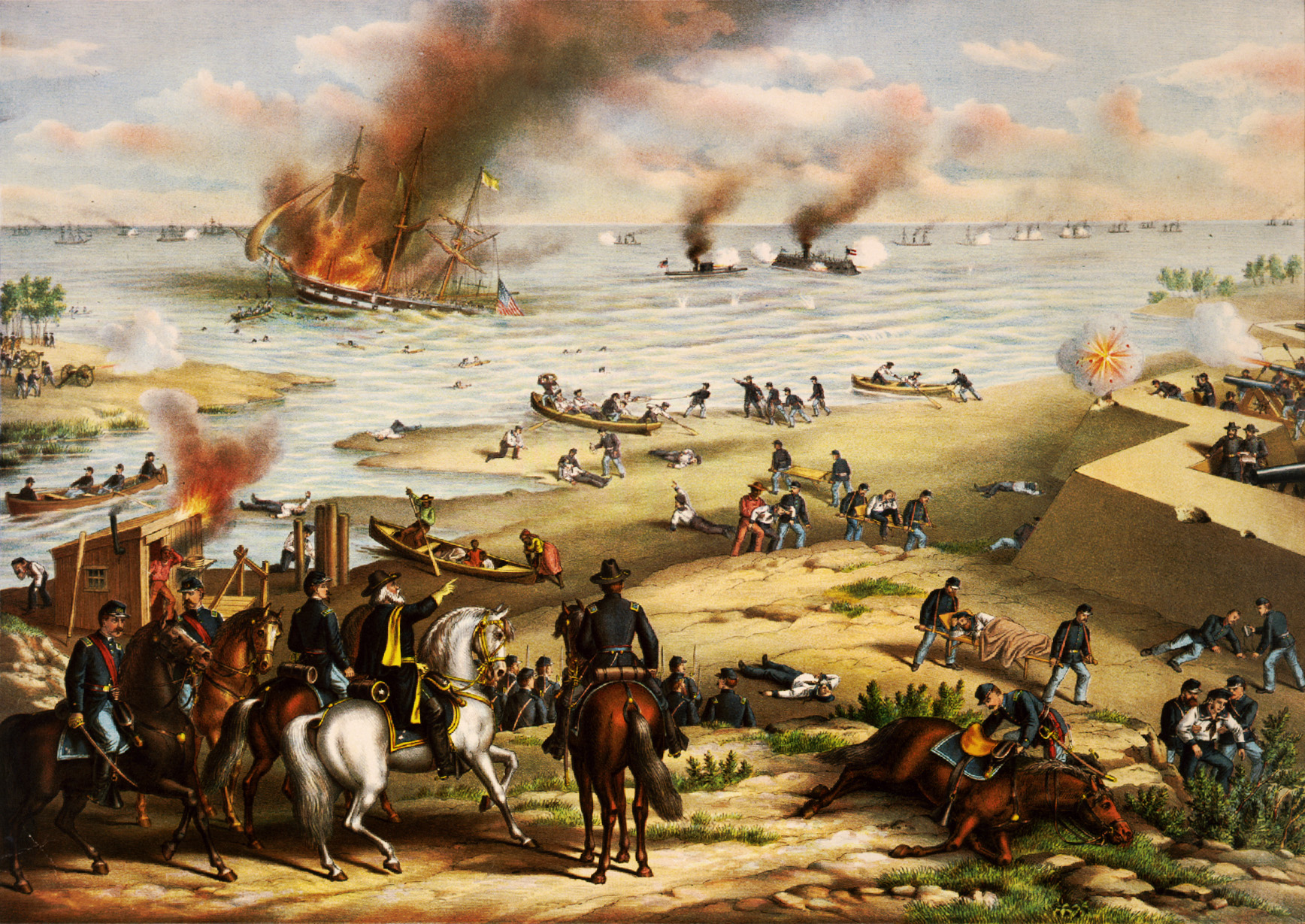
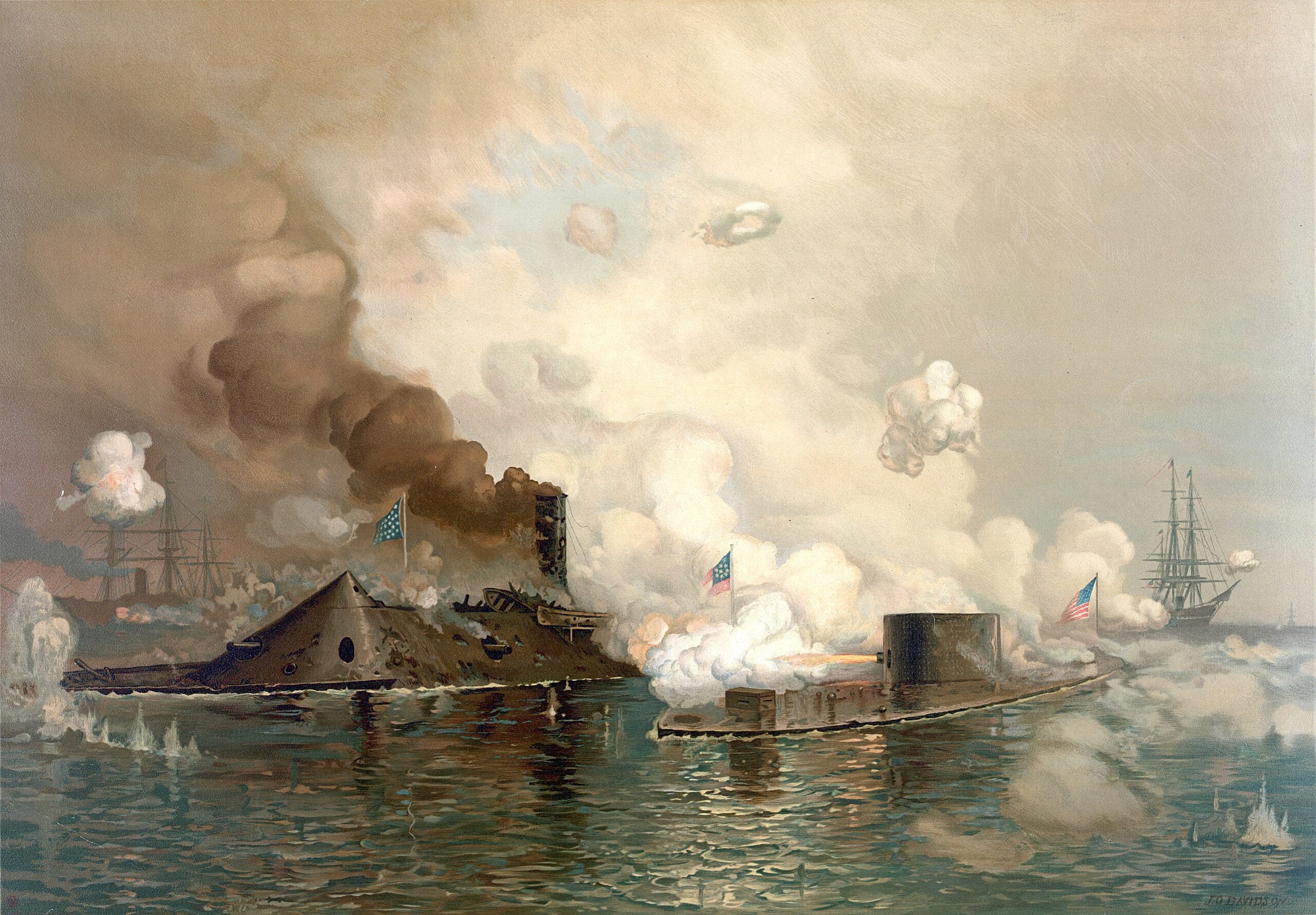
One of the North’s most effective tactics in the battle against the Confederacy was a naval blockade of southern ports. This hampered the import of arms and vital supplies and cut off the export of cotton to Europe, a major source of income. In order to thwart this embargo, the Confederate navy took the hull and engines of a captured US frigate USS Merrimack, armour plated it and mounted 14 guns and a ram, turning it into the ironclad CSS Virginia.
On March 8, 1862 the Virginia fought a successful engagement against the Union navy, sinking wooden vessels, USS Congress and USS Cumberland, and forcing a third, USS Minnesota to run aground. Virginia was mauled during the fray but returned the following day to complete her mission. In this she found herself confronted by a rival ironclad, USS Monitor, a vessel quite unlike the Virginia in build and armament which had hurried south from Brooklyn to confront its rival.
Monitor was lower and nimbler, though outgunned. She pounded Virginia with her two smoothbore guns in a revolving turret and Virginia thundered back but no significant damage was done to either vessel in this, the first battle between ironclads. Both ships retired from the action and never fought each other again. Virginia would be scuttled a few months later and Monitor would sink in a storm by the end of 1862.
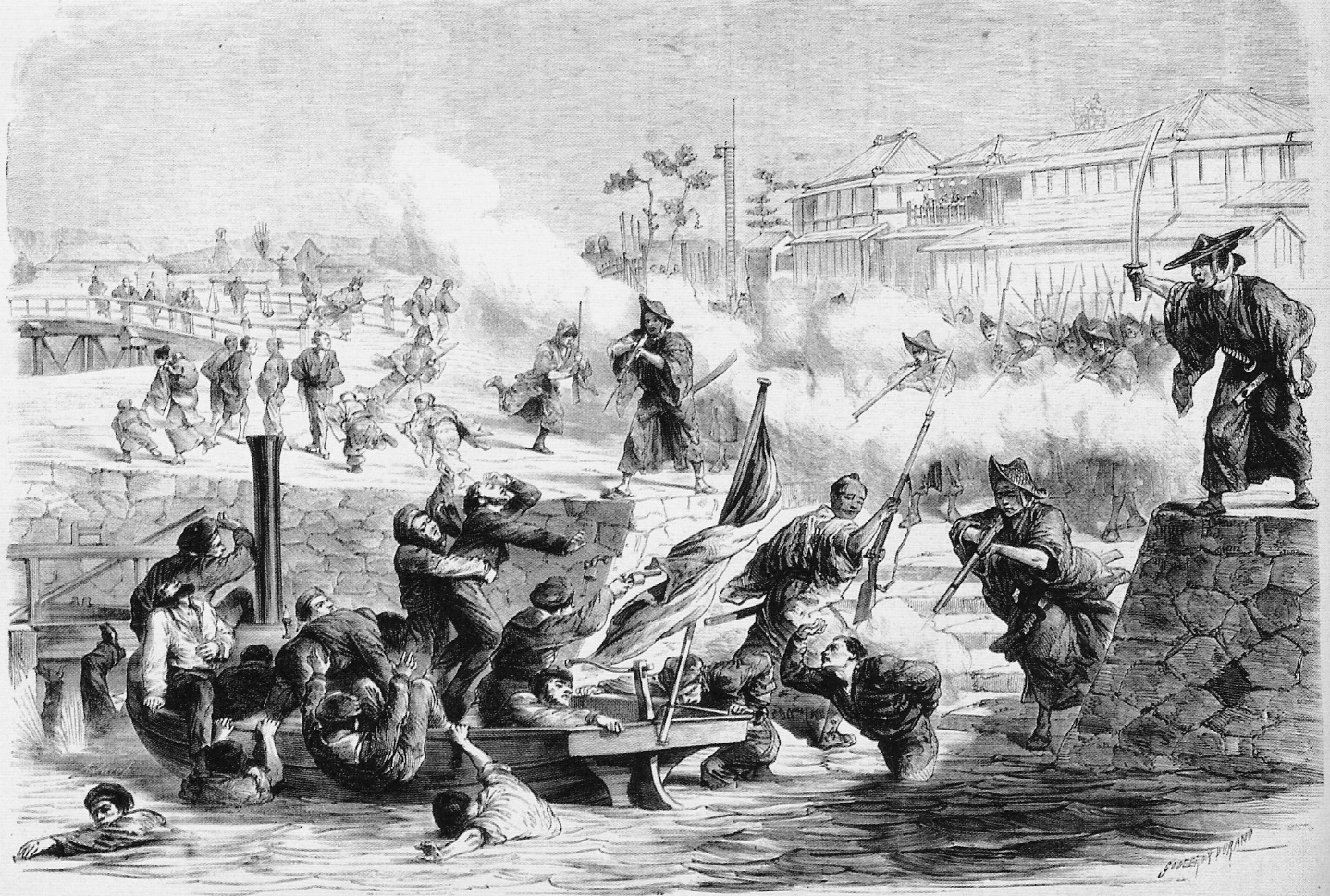
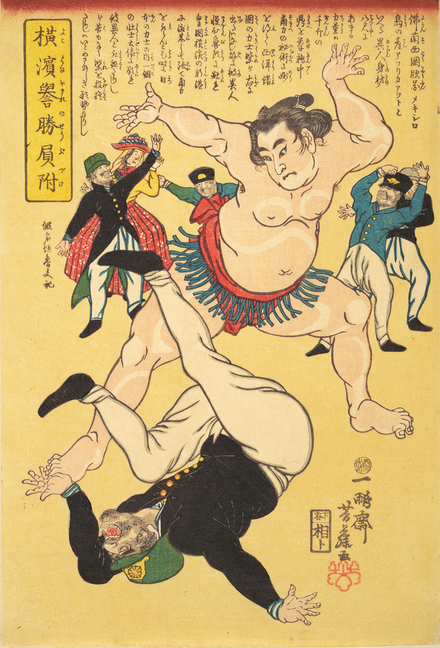
Japan, which had kept itself in isolation for over two centuries, punishing foreigners who landed or were shipwrecked there, and executing Japanese who returned from abroad, had its doors blown open in the 1850s by American and European navies. This enforced exposure to the outside world was welcomed by some but also inflamed anti-foreigner sentiment that often broke out in violence. The illustration below is an expression of the “expel the barbarians” movement.
OnMarch 5, 1868 a party of 11 French sailors in Sakai harbour was set upon by local samurai and massacred. To pacify the French, the government ordered that those responsible be ordered to commit seppuku, suicide by disembowelment. After 11 had done so, the French captain whose crewmen had been butchered said that sufficient penalty had been paid and asked that the remaining 9 be spared.
How we clothe and adorn our bodies has always been a public concern. Every religion has something to say about proper or improper dress or headwear or hairstyles. Every state has regulations regarding the outward show of a decent citizen. The outlandish garb of the 21st century against we oldsters impotently rail have their antecedents in every culture. Inevitably, the more outré clothing has been fingered as the cause of national calamities.
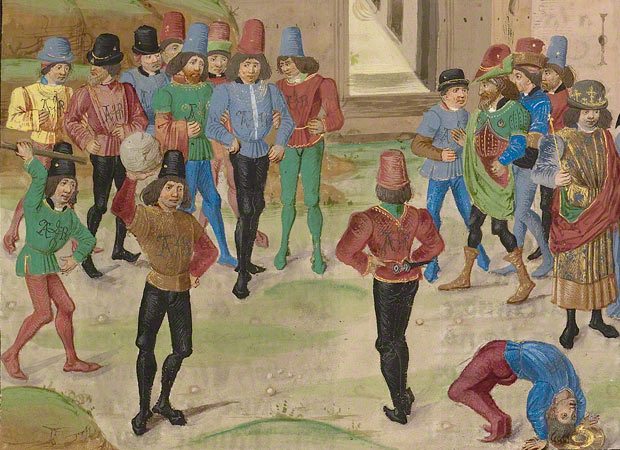
Pierre Lacroix, a writer of the 19th century – an era which produced such crimes against fashion as the bustle, tartan trousers, and leg-o-mutton sleeves – here rants against the dandies of the 14th century.
“We must believe that God has permitted this as a just judgment on us for our sins,” say the monks who edited the Grande Chronique de St. Denis, in 1346, at the time of the unfortunate battle of Crecy, “although it does not belong to us to judge. But what we see we testify to; for pride was very great in France, and especially amongst the nobles and others, that is to say, pride of nobility, and covetousness. There was also much impropriety in dress, and this extended throughout the whole of France. Some had their clothes so short and so tight that it required the help of two persons to dress and undress them, and whilst they were being undressed they appeared as if they were being skinned. Others wore dresses plaited over their loins like women; some had chaperons cut out in points all round; some had tippets of one cloth, others of another; and some had their headdresses and sleeves reaching to the ground, looking more like mountebanks than anything else. Considering all this, it is not surprising if God employed the King of England as a scourge to correct the excesses of the French people.”
Other contemporary writers, and amongst these Pope Urban V and King Charles V, inveigh against the poulaines, [long-toed shoes] which had more than ever come into favour, and which were only considered correct in fashion when they were made as a kind of appendix to the foot, measuring at least double its length, and ornamented in the most fantastical manner. The Pope anathematized this deformity as “a mockery of God and the holy Church,” and the King forbad craftsmen to make them, and his subjects to wear them. All this is as nothing in comparison with the profuse extravagance displayed in furs, which was most outrageous and ruinous, and of which we could not form an idea were it not for the items in certain royal documents, from which we gather that, in order to trim two complete suits for King John, no fewer than six hundred and seventy martens’ skins were used.