November 3

san_martin_de_porres_huaycan

St. Martin de Porres was born in Lima, Peru on December 9, 1579, the illegitimate son of a Spanish gentlemen and a freed slave  of African (or possibly native American) descent. His early life was spent in poverty and he was eventually apprenticed to a barber-surgeon. Despite the laws that forbade non-whites from becoming full members of religious orders, Martin joined the Dominicans as a volunteer helper, eventually becoming a lay brother.

He was renowned for his charity and love of the sick and poor. He established an orphanage and children‘s hospital for the poor children of the slums; he also set up a shelter for the stray cats and dogs and nursed them back to health. Even during his lifetime miraculous cures and powers were ascribed to him. Martin died on November 3, 1639 and was canonized by Pope John XXIII on May 6, 1962. He has become the patron saint of Peru, people of mixed race, innkeepers, barbers, public health workers and more.

As the American election nears

Home / Uncategorized / As the American election nears

A general Dissolution of Principles & Manners will more surely overthrow the Liberties of America than the whole Force of the Common Enemy. While the People are virtuous they cannot be subdued; but when once they lose their Virtue they will be ready to surrender their Liberties to the first external or internal Invader. How necessary then is it for those who are determin’d to transmit the Blessings of Liberty as a fair Inheritance to Posterity, to associate on publick Principles in Support of publick Virtue.

— Samuel Adams

October 27

Home / Today in History / October 27

constantine

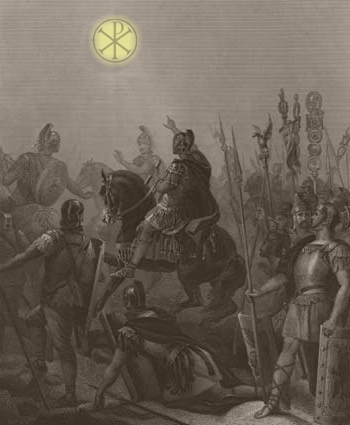
312 Constantine has a vision

The chaos in Roman politics that weakened the empire in the 3rd century was ended by reforms put in place by Diocletian (r. 284-305), particularly his institution of the Tetrarchy. Henceforth there would be four emperors: a senior Augustus in the East and in the West, each with a junior Caesar. There would be four capitals, each close to strategic border areas to allow rapid response to barbarian incursion. The plan was that when the senior rulers stepped down they would be replaced by their Caesars and the usual unseemly battles for power would be avoided. Alas, the scheme did not work in practice. After the retirement of Diocletian in 305, fighting broke out in the western part of the empire between rival generals who each thought they should be next in line. In the fall of 312, Constantine brought his army into Italy to contest the throne with Maxentius; they would meet outside Rome at the Battle of the Milvian Bridge.

According to Lactantius, on the evening of October 27 Constantine saw a vision:

Constantine was directed in a dream to cause the heavenly sign to be delineated on the shields of his soldiers, and so to proceed to battle. He did as he had been commanded, and he marked on their shields the letter Χ, with a perpendicular line drawn through it and turned round thus at the top, being the cipher of CHRIST. Having this sign (ΧР ), his troops stood to arms. The enemies advanced, but without their emperor, and they crossed the bridge. The armies met, and fought with the utmost exertions of valour, and firmly maintained their ground. In the meantime a sedition arose at Rome, and Maxentius was reviled as one who had abandoned all concern for the safety of the commonweal; and suddenly, while he exhibited the Circensian games on the anniversary of his reign, the people cried with one voice, “Constantine cannot be overcome!” 

Dismayed at this, Maxentius burst from the assembly, and having called some senators together, ordered the Sibylline books to be searched. In them it was found that:— “On the same day the enemy of the Romans should perish.”
Led by this response to the hopes of victory, he went to the field. The bridge in his rear was broken down. At sight of that the battle grew hotter. The hand of the Lord prevailed, and the forces of Maxentius were routed. He fled towards the broken bridge; but the multitude pressing on him, he was driven headlong into the Tiber. This destructive war being ended, Constantine was acknowledged as emperor, with great rejoicings, by the senate and people of Rome. 

Eusebius has another, more detailed account of the vision, which in his version seems to have taken place somewhat earlier. There is no doubt, however, that the triumph of Constantine led to the legal recognition of Christianity and its eventual conversion of the Roman Empire.

Something to chew on

Home / Something Wise / Something to chew on

Shakespeare is right when his Hamlet corrects Horatio’s skepticism of ghosts by telling him that “there are more things in heaven and earth, Horatio, than are dreamed of in your philosophy.”

That famous saying of Hamlet’s is the simplest way I know to define the difference between “post-modernism,” “modernism,” and “pre-modernism”.  Pre-modernism, or traditionalism, agrees with Hamlet.   There are more things in objective reality than in our minds and dreams and sciences and philosophies.  Modernism, or rationalism, says there are not more things but the same number of things in those two places, in other words that we can know it all.  Post-modernism says there are fewer things in objective reality than in our minds; that most of our thoughts are only dreams, prejudices, illusions, or projections.

I am neither a modernist nor a post-modernist but a pre-modernist. That’s why I habitually feel like a little kid living in a big house full of endless surprises, nooks and crannies. (I’m only 73 and I still don’t know what I want to be when I grow up.) I find the real world wonderful rather than ugly, fascinating rather than boring, mysterious rather than predictable, something that invites wonder, exploration, hope, fear, and innocence rather than cynicism, ironic distancing, and what the philosophers call a ‘hermeneutic of suspicion.’

— Peter Kreeft