![]()
1789
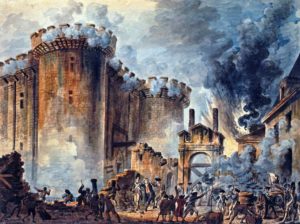
Paris mob attacks the Bastille prison
The French Revolution had begun. The king Louis XVI had summoned the nation’s political classes to meet at Versailles in the form of the antique Estates-General (which had not met since 1610). There, the Third Estate, representing all Frenchmen not in either the clergy or the nobility, had declared itself the true national assembly and compelled the other two estates to join them. The possibility of true reform had Paris in a frenzy of excitement but the king’s dismissal of the Finance Minister Jacques Necker was seen as a conservative counter-coup. Rumours of the use of mercenary troops to crush the new Assembly were rife. Camille Desmoulins, a young radical lawyer, pistol in hand, declared to a crowd: “Citizens, there is no time to lose; the dismissal of Necker is the knell of a Saint Bartholomew for patriots! This very night all the Swiss and German battalions will leave the Champs de Mars to massacre us all; one resource is left; to take arms!'”
On July 13, various Parisian mobs broke into royal armouries and seized weapons; local militias now had muskets and cannons at their disposal. The next day the target was the Bastille, the medieval prison which dominated central Paris. The fortress had a grim reputation; it often housed those enemies of the crown who had been whisked away behind its walls never to be seen again. On July 14, however, its inmates only numbered seven: 4 forgers, two lunatics and the Comte de Lorges, an aristocrat accused of incest, but who may have been sent there by relatives as part of a property dispute. The expenses of the latter three were all paid by their families. The real target of the rebels may have been the gunpowder housed in the fortress.
The siege of the Bastille lasted all afternoon. The defending troops resisted the attackers, killing 98 of them for the loss of one of their own, but having no supplies to endure a long conflict, the governor, the Marquis de Launay, surrendered at 5:30 pm. He and five of his men were lynched by the mob and their heads paraded about on pikes by capering rebels. The seven released inmates were also paraded about for a time and made much of, until it was realized just what kind of men they were. The forgers were soon returned to prison, the madmen were found asylums, and the aristocrat alone was allowed to go free.
Quite why the French should treat this bizarre incident as the occasion for annual national rejoicing remains a mystery.
