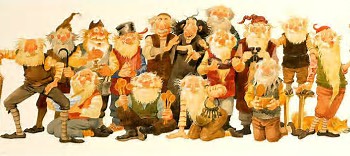
The Yule Lads

Home / Christmas / The Yule Lads

More from Iceland. Settled by Vikings a thousand years ago, Iceland was long isolated in the chilly North Atlantic and its people developed a number of interesting, and terrifying folk beliefs — tales of cannibal ogres and their offspring threatening isolated farmhouses during the Christmas season. The land was said to be haunted by monsters with a taste for human flesh whose thirteen offspring were prone to invade the house and make life miserable for the inhabitants.

These Jólasveinar, or Yule Lads, had names such as Meat Hook, Doorway Sniffer and Door Slammer which give clues as to their particular malicious specialties. They came down from the mountains one by one in the thirteen days before Christmas, practiced their nasty deeds and left one by one in the days after Christmas. Nowadays the Jólasveinar have mellowed with time and are welcomed into the home as gift bringers. Starting on December 12, the eve of St Lucia, children put out their shoes at night believing that each of the Lads as they arrive will leave them little treats. Once they have all arrived, they leave one by one, to be gone by Epiphany.

Standing Up of the Christ Child

Home / Christmas / Standing Up of the Christ Child

One of the most delightful of Christmas observances comes from the Andes of Venezuela. 

In the city of Mérida a fascinating local custom is the La Paradura del Niño or The Standing Up of the Christ Child. Here the Nativity scenes in homes are particularly cherished; some are table-top size, some are room-size with all of Bethlehem portrayed in the Venezuelan context  — the landscape is mountainous and divided by rivers. The figures often look like local people. On Christmas Eve the Holy Family is placed in the scene with the Wise Men nearby and moving closer daily. On New Year’s Day the tradition dictates that the baby Jesus must be moved to an upright position and stay there until Candelaria (February 2). If a friend or neighbour sees this is not done the baby may be kidnapped and the family who neglected their duty must hold a parandura party for the kidnappers and friends.

This consists of choosing godparents for the Niño — they will not only bring home the baby in a basket or handkerchief but arrange for the musicians, candles, fireworks, and refreshments. The procession consists of first of fireworks boys, followed by the musicians who will be mute until the baby is found, a pair of teens as Mary and Joseph, children as shepherds singing a carol about searching for the baby and, lastly,  the godparents. When the candle-lit procession gets to the house where the baby is stored, it is handed over to the kerchief and its god-parents and the joyous music breaks out. All march home joyfully where the party awaits after the baby is replaced standing up. Little kids may offer a poem of welcome, women will say the rosary and then all eat, dance and drink until dawn.

Nuts

Home / Christmas / Nuts


A symbol of fruitfulness long associated with midwinter festivals. During the early Roman empire the poet Marcus Valerius Martialis sent a present of them to a fellow-writer saying, “From my small garden, behold, eloquent Juvenal, I send you Saturnalian nuts. The rest of the fruit the rakish Garden God has bestowed on frolicking girls.” Romans believed each type of nut to be possessed of a special virtue: almonds were an antidote to drunkenness; walnuts counteracted poisons; hazelnuts prevented famine.

Christmas-time in many countries sees bowls of nuts on the table and nuts used in desserts. They are an indispensable part of the Thriteen Desserts of Provence; St Nicholas and his helpers throw them to children or put them with apples in their shoes. Boys and girls throw walnuts at each other in Poland on St Stephen’s Day and in other parts of eastern Europe nuts are thrown into corners of the house for good luck. Walnuts are a necessary component to the Bulgarian Christmas meal. Each member of the family cracks one in order to determine their fate for the next year. If the walnut is a good one, it is said that the year will be successful. Bad luck is predicted for the person who cracks a bad walnut. North American crooners sing of “Chestnuts roasting on an open fire..” and nuts have long been used as edible decorations on Christmas trees.