For those unhappy few who missed my appearance on CBC Radio on Christmas Eve, here is a link to the audio:
http://www.cbc.ca/listen/shows/cross-country-checkup/episode/15314696
For those unhappy few who missed my appearance on CBC Radio on Christmas Eve, here is a link to the audio:
http://www.cbc.ca/listen/shows/cross-country-checkup/episode/15314696

“John Canoe”, “Junkanoo”, “Jonkonnu”, “Koonering”, etc., are terms for carnival-like celebrations held in the Caribbean, Honduras, Belize, and North Carolina derived from a holiday and period of social inversion for slaves during the Christmas seasons of the eighteenth and nineteenth centuries. Slave owners used the custom as a safety valve, much like Saturnalia in the Roman empire; slaves used it to subvert and mock the the established order.
There is no agreement whatsoever on the origins of the name. Some hold it to be derived from African deities, others from Mayan ritual, others from the name of a slave owner and still others assert that it was the name of a slave. Today participants dance and parade in elaborate costumes and attract thousands of tourists to these spectacles.

The Feast of the Fools was usually held on January 1 and was under the direction of the lower clergy who used the occasion to elect a Bishop of Fools or Fools’ Pope and carry on outrageously, making fun of sacred ceremonies and revelling in a hierarchy turned upside down. However, what began as an exercise in social relaxation eventually turned into burlesque and excess. Church leaders complained in 1445 that
Priests and clerks may be seen wearing masks and monstrous visages at the hours of office. They dance in the choir dressed as women, panders or minstrels. They sing wanton songs. They eat black puddings at the horn of the altar while the celebrant is saying Mass. They play at dice there. They cense with stinking smoke from the soles of old shoes. They run and leap through the church, without a blush at their own shame. Finally they drive about the town and its theatres in shabby traps and carts, and rouse the laughter of their fellows and the bystanders in infamous performances, with indecent gesture and verses scurrilous and unchaste.
Such behaviour was legislated against by king and church but proved very hard to eradicate — records of the Feast of the Fools endured into the eighteenth century.

Evil monsters of Greek Christmas foklore whose description varies — in some places they are viewed as half-human with hoofs and claws, in others they are wolf-like or simian. They spend most of the year in the underworld, chopping away at the tree that supports the earth. This tree is renewed at Christmas by the birth of Christ so the demons come to earth for revenge: they urinate on fires, ride on folks’ backs, force them to dance to exhaustion and commit other enormities. They may be kept out of the chimney (through which they enter) by keeping the Christmas log alight or by burning salt or old shoes whose smell repels them; the lower jaw of a pig or certain herbs such as hyssop hung behind the door or inside the chimney will also keep them out. They roam the earth until January 6 when the Blessing of the Waters drives them underground.
Any child born during Christmas is in danger of becoming one of the kallikantzaroi; to prevent this the child must be bound in tresses of garlic or straw or have his toenails singed.

In the influential poem “A Visit from St Nicholas” which taught North America much of what it was to learn about Santa Claus, the author notes that “down the chimney St. Nicholas came with a bound.” That is how generations of Canadian and American children expected the gift-bringer to arrive, so much so that many fathers have been moved to clomp around on the roof or in the attic to imitate the noise of reindeer standing by the chimney. The chimney is also the mode of entrance for a number of other of the world’s Christmas gift-bringers. In Italy Befana comes down the chimney (and in true chimney-sweep fashion carries a broom with her); in the same way Father Christmas enters homes in England and Père Noël or Le pétit Jésus in France. In Holland the gift-bringer’s helper Black Pete goes down the chimney to keep St Nicholas from getting his clothes dirty. The chimney also serves to carry messages to the gift-bringer: in England children write letters to Father Christmas and burn them in the fireplace sending their smoky wishes via the chimney; in Scotland children “cry up the lum” — they shout their wishes up the chimney on Christmas Eve.
But the chimney is not just a way in for the gift-bringer. To psychiatrists it represents the birth canal and it also admits unpleasant creatures. Norwegians feared that witches would come down the chimney and, in order to prevent this, would burn dry spruce which emits sparks, or put salt in the fire. In Greece the “skarkatzalos” log is burned over the Twelve Days of Christmas to keep out the Kallikantzaroi who slip down the chimney — in Scotland they use a similar trick to keep the elves out.
There are other ways in for gift-bringers besides the chimney. In Brazil, where the tropic heat renders chimneys few and far between, Papai Noel comes through the front door. The direct method is also used in Sweden (where gifts are often thrown in through the door), Finland and Australia. In Hungary the Baby Jesus brings presents through the window and, like the Befana, rings a little bell when the deed is done. Germany’s Weihnachtsmann has been known to use both the window and the chimney, while Chile’s Viejo Pascuero prefers the window.
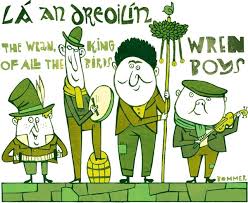
December 26 is the feast day of the first martyr of the Christian church, St Stephen. What little we know about him can be found in the Book of Acts where we learn that he had been chosen one of the seven deacons in Jerusalem and that his defence of Christianity resulted in his being stoned to death for blasphemy. Legend, however, has surrounded the protomartyr with a host of stories which link him to Herod’s household at the time of the birth of Jesus, to horses and to the stoning of the tiny wren.
Ever since the tenth century Stephen’s Day has been associated with horses, probably because the season was a time of horse sacrifice in pagan northern Europe and a time of rest from agricultural work for both man and beast. In England it is a time to bleed horses to ensure their health for the coming year. Across Europe December 26 is a time for horses to be fed extra food, raced, decorated, blessed by the priest or ridden in ceremonies honouring their species. This is particulalry true in Sweden where “Staffan Riders” would race from village to village and sing songs in honour of the saint. Some have tried (not very successfully) to explain the connection between horses and St Stephen’s Day by claiming it has stemmed from confusion between the martyr in the Book of Acts and a later saint, Stephen of Corvey, martyred c. 1075, whose feast day June 2. This Stephen was a lover of horses and was said to ride five of them in turn. When he was murdered his unbroken colt took him home to Norrtalje which became a shrine for horse-healing.
The water and salt blessed by the priest on St Stephen’s Day would be set aside and used as medicine for horses should they fall ill during the rest of the year or to sprinkle liberally about the barn and yard to bring prosperity. The salt could also be thrown in the fire to avert danger from thunder-storms. In some places the blood drawn from horses on this day was thought to have healing powers. In Poland, the blessing of food for horses led to other peculiar rituals on St Stephen’s Day. In what has been interpreted either as a remnant of pagan fertility rites or a re-enactment of the stoning of Stephen, people would throw the consecrated oats at each other and their animals. Moreover, it was customary on December 26 for boys and girls to throw walnuts at one another.
St Stephen’s Day is also marked in Ireland and other parts of Britain by hunting a bird considered protected every other the day of the year, the wren, and parading about with its body. Wren Boys used to carry a dead wren on a branch from house to house, and sing an appropriate song which solicited money:
Other customs associated with St Stephens’s Day include holming. In Wales holming or holly-beating was the practice for young men to beat each other (or female servants) with holly branches on December 26. In Britain generally December 26 is a day for sporting events and hunting and the day observed as Boxing Day.

“And it came to pass as the angels were gone away from them into heaven, the shepherds said one to another, Let us now go even unto Bethlehem, and see this thing which has come to pass, which the Lord hath made known unto us. And they came with haste, and found Mary, and Joseph and the babe lying in a manger.” (Luke 2: 15-16.)
The artistic portrayal of the visit of the shepherds to the baby Jesus was at first depicted as a visitation by two or three shepherds with simple gifts such as a lamb. The number of shepherds increased in later medieval art and the scene was often conflated with the Annunciation to the Shepherds or the Adoration of the Magi. In Le Brun’s 1690 Adoration of the Shepherds the host of angels filling the air above the Virgin contrasts with the earth-bound shepherds who crawl toward the centre of the canvas. The piety and simplicity of the shepherds made the scene a favourite subject for centuries — other artists who have painted the scene include Rembrandt, Bassano and El Greco whose Adoration was his last work, meant to hang over his tomb .
The incident is also the subject of carols, movies and television specials.
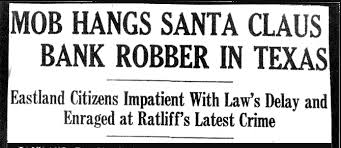
On December 23, 1927 Santa Claus robbed the First National Bank in Cisco, Texas. Dressed as St. Nick, Marshall Ratliff and three undisguised companions looted the bank and took hostages but were greeted by police and heavily-armed townspeople when they emerged from the building. In the shoot-out that followed, two officers and a bandit were mortally wounded. Though Ratliff and his two remaining partners temporarily escaped after a series of car-jackings and hostage takings, they were forced to abandon the stolen money and were all rounded up within a week.
The erstwhile Santa, who killed again in a failed escape attempt, was eventually taken from his jail cell by an angry mob and lynched. A piece of the rope used in the impromptu hanging is on display in the Callahan County Courthouse in Baird, Texas.
In Central Europe St Thomas Day was a time for driving out demons by making loud noises, cracking whips, letting off fireams or ringing bells — all while wearing horrible masks — or by using incense and holy water and saying the rosary. St Thomas himself was said in Bohemia to ride at midnight in a chariot of fire to the graveyard where he met the spirits of all the dead men named Thomas; there he blessed them and disappeared as they returned to their graves.
In other parts of Europe it was a time for schools to be breaking up for the Christmas vacation, an opportunity for social inversion, barring-out of teachers or extorting treats from them. “Thomas Donkey” is the title given to the last to wake up or who comes late to work on Thomas Day in some parts of Germany. In Norway it was once the custom for all preparatory work for the Christmas season to be completed by St Thomas Day. A two-week’s supply of wood for the stove had to be ready, else the saint would come and take away the axe; all baking and brewing had to be finished lest a string of kitchen mishaps take place.
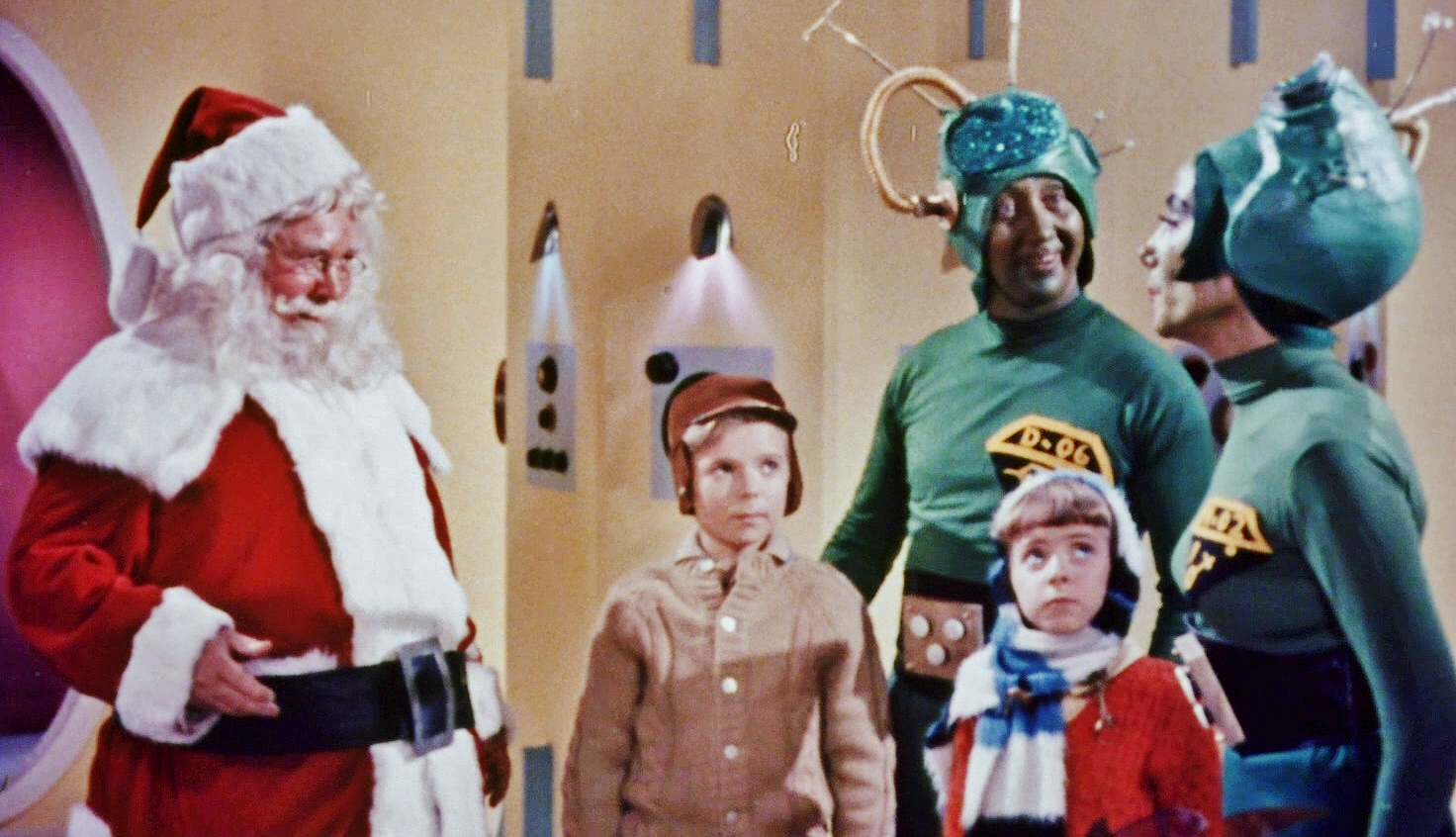
Here is a basket of holiday stinkers.
Jim Carrey’s 2009 version of A Christmas Carol. A star-studded cast is wasted as Carrey plays multiple parts, all of them with atrocious English accents. Those of you who thought Charles Dickens didn’t put in enough carriage chases into his novella will find them here.
Star Wars Holiday Special (1978). OK, technically it’s about Life Day, the Wookiee festival which Han Solo and Chewie want to make it home for. This film is so deliciously, excruciatingly awful — Bea Arthur sings! Harvey Korman as an alien chef! — that George Lucas yanked it and threw it down the memory hole. It exists on the Web, so enjoy.
A Very Murray Christmas (2015). Unforgiveable. Absolutely unforgiveable. Bill Murray can be a comedic genius but this self-indulgent piece of dreck is going to earn him a few more millennia in Purgatory. And I’ve never been fond of him in Scrooged either.
Santa Claus Conquers the Martians (1964) — the only way to enjoy this stink-fest is by seeing the Mystery Science Theater 3000 version.
Santa With Muscles (1996). Two words: Hulk Hogan.
Santa Claus (1959). A Mexican epic with Santa Claus, played by José Elías Moreno, battling demonic forces (clad in scary red tights and puffy shorts) and bad boys to continue his works of goodness. Luckily he is aided by Merlin and is able to triumph in the end.