October 14

Home / Today in History / October 14

keeping_up_with_the_kardashians_s11_logo

2007 An ornament of popular culture

Future historians may well note this date as the beginning of the end of Western Civilization. Keeping Up With the Kardashians, a “reality” television show of a particularly inane and sordid nature, aired for the first time on the E! Cable network.

At the end of the 20th century the name Kardashian meant very little in the public mind, except for those who remembered that one Robert Kardashian had been among the legal team that secured O.J. Simpson his acquittal for murder. It seems, however, that in 1978 Mr. Kardashian had married flight attendant Kris Houghton and spawned a number of daughters whose names began with the letter “K” — Kourtney (b. 1979), Kim (b. 1980), and Khloé (b. 1984) — and a son, Rob (b. 1987), for whom, apparently, no suitable “K” name could be found. The parents divorced in 1991 and a month later Kim married Olympic decathlete hero, Bruce Jenner. From his loins sprang two more “K” kids, Kendall (b. 1995) and Kylie (b. 1997) before he, through the miracle of surgery, transitioned to Caitlin Jenner, for some reason declining an opportunity to become “Kaitlyn”.

This blended family lived lives of little distinction: Kris opened a kids’ store; Kim was a stylist and personal shopper; she and her sisters ran a clothing store. Fortunately, Kim, in a moment of girlish innocence, had made a sex tape in 2007 with someone named Ray J and this tape (oops) was released to the public. Kim was now famous, or — even better — notorious. And she was rich, having made $5,000,000 from the tape’s distributor. All this whetted the public appetite for all things Kardashian and some genius decided that a television crew recording the family’s every move and utterance would prove to be gripping broadcast fare. And so it proved. Despite the sound of critics slashing their own wrists, Keeping Up With the Kardashians has become a staple of American popular culture making millionaires of its subjects. Of their failed marriages, breast enhancements, sex-changes, overdoses, spats, divorces, 325-page book of selfies, and all-encompassing family values, we shall say no more.

October 13

Home / Today in History / October 13

american_basketball_association_shield

The big four sports organizations in North America are Major League Baseball, The National Football League, the National Hockey League and the National Basketball Association. Rival leagues have come — the WFL, the XFL, the WHA, the ABL, etc. — and gone, but only one plucky challenger has had any real effect on their sport: the American Basketball Association which played its first game on this date in 1967, a contest between the Anaheim Amigos and the Oakland Oaks. (Oakland won 134-129).

As is usual with these upstart leagues, ownership was often shaky and fan support was sparse. Despite the presence of star players like Rick Barry, Julius Irving, and George “the Iceman” Gervin, changes of team names and locations were frequent. The Anaheim Amigos became the Los Angeles Stars and then the Utah Stars; the Oakland Oaks morphed into the Washington Capitals and then the Virginia Squires. The most extreme case of instability was the case of the New Orleans Buccaneers/Louisiana Buccaneers/Memphis Pros/Memphis Tams/Memphis Sounds/Baltimore Hustlers/Baltimore Claws.

The plan of franchise owners was to force a merger with the NBA which was feeling the influence of the higher salaries that the arrival of the ABA had produced. Only a few teams endured to reap the benefits of this plan. In 1976 the ABA folded with four teams — the Indiana Pacers, New York Nets, San Antonio Spurs, and Denver Nuggets — joining their older competitor. Though the league had died, a few of their innovations were attractive enough to be adopted by the NBA: the 3-point arc, the slam-dunk contest, and market penetration into states that had hitherto been college basketball hothouses.

October 12

Saint Edwin of Northumbria

Born a pagan, Edwin (585-633) became a Christian saint, the father of two saints, and the great-uncle and grandfather of two more saints.

The political life of early medieval Britain was brutal, resembling in many ways A Game of Thrones, though with, perhaps, slightly less sex and no dragons. A number of minor, pagan Anglo-Saxon kingdoms continually struggled against each other, against native Christian enclaves and against raiders from Ireland and Caledonia. These statelets rose and fell, occasionally producing a ruler who was strong enough to dominate his neighbours for a time and earn the title of Bretwalda or High King. One of these was a northern prince named Edwin of Northumbria.

Edwin appeared at a time when Christian missions were penetrating these pagan Germanic territories from the north, where Irish-trained monks brought a Celtic Christianity and from the south, where missionaries had been sent from Catholic Rome. In 627, under the influence of Catholic bishop Paulinus, Edwin agreed to convert from his pagan upbringing. Bede’s history tells us that the king and his nobles debated the opportunity of becoming Christians, with the speech of one of his men being decisive:

The present life of man, O king, seems to me, in comparison with that time which is unknown to us, like to the swift flight of a sparrow through the room wherein you sit at supper in winter amid your officers and ministers, with a good fire in the midst whilst the storms of rain and snow prevail abroad; the sparrow, I say, flying in at one door and immediately out another, whilst he is within is safe from the wintry but after a short space of fair weather he immediately vanishes out of your sight into the dark winter from which he has emerged. So this life of man appears for a short space but of what went before or what is to follow we are ignorant. If, therefore, this new doctrine contains something more certain, it seems justly to deserve to be followed.

Edwin’s conversion and his domination of northern England aroused enemies, particularly the very able and aggressive Penda, the pagan king of Mercia. In 633 Penda defeated Edwin, killing him and his two sons. His Christian wife and Paulinus fled south and the Christian project in northern England suffered a temporary set-back.

October 10

732 Charles Martel drives back the Muslims from France

A victorious line of march had been prolonged above a thousand miles from the rock of Gibraltar to the banks of the Loire; the repetition of an equal space would have carried the Saracens to the confines of Poland and the Highlands of Scotland; the Rhine is not more impassable than the Nile or Euphrates, and the Arabian fleet might have sailed without a naval combat into the mouth of the Thames. Perhaps the interpretation of the Koran would now be taught in the schools of Oxford, and her pulpits might demonstrate to a circumcised people the sanctity and truth of the revelation of Muhammed.

This was the judgement of Charles Gibbons in his Decline and Fall of the Roman Empire when he considered the importance of the battle of Tours (aka Battle of Poitier) in 732, a battle that pitted the army of semi-civilized Christian Franks against the undefeated forces of Muslim Spain. The victory of warlord Charles “the Hammer” Martel repelled an Islamic incursion and marked the rollback of Muslim penetration into France and back over the Pyrenees.

Muslim armies had crossed over the Straits of Gibraltar in 711 and rapidly conquered the Visigothic kingdom in Spain, leaving only a remnant of Christian rule in the mountains of the northwest of the Iberian peninsula. They surged across the mountains and invaded the old Roman province of Aquitaine in southern Gaul where they occupied a number of cities and raided north into Burgundy. In 732 a large army, probably over 30,000 cavalrymen, led by Abdul Rahman Al Ghafiqi struck out toward the rich shrine of St Gregory at Tours. Their plan was plunder and destruction of the Frankish kingdom, then under the weak Merovingian dynasty.

The Frankish “mayor of the palace” (the brains behind the weak kings) was Charles Martel who gathered an army of Frankish fighters, spear, axe and shield men, who would meet the enemy on foot. The two armies clashed somewhere between what are now the cities of Tours and Poitiers. Charles arranged his men on high ground in an impregnable shield wall, impervious to cavalry, and waited for the Muslims, or Moors, to become impatient and charge too impetuously. That break came after at least three (perhaps seven) days of stand-off when the Moors launched their attack and were beaten with their general falling in battle. They fled south toward Spain, leaving their loot behind. In the following years Charles moved his army south and drove the Muslims back across the mountains in Spain.

Historians have debated the significance of the battle; many are not as sure as Gibbon that the 732 encounter was all that important. It is clear, however, that Charles’s victory led to his family’s ascending the throne of the Franks and the reign of his grandson Charlemagne who took the fight against the Moors into Spain itself.

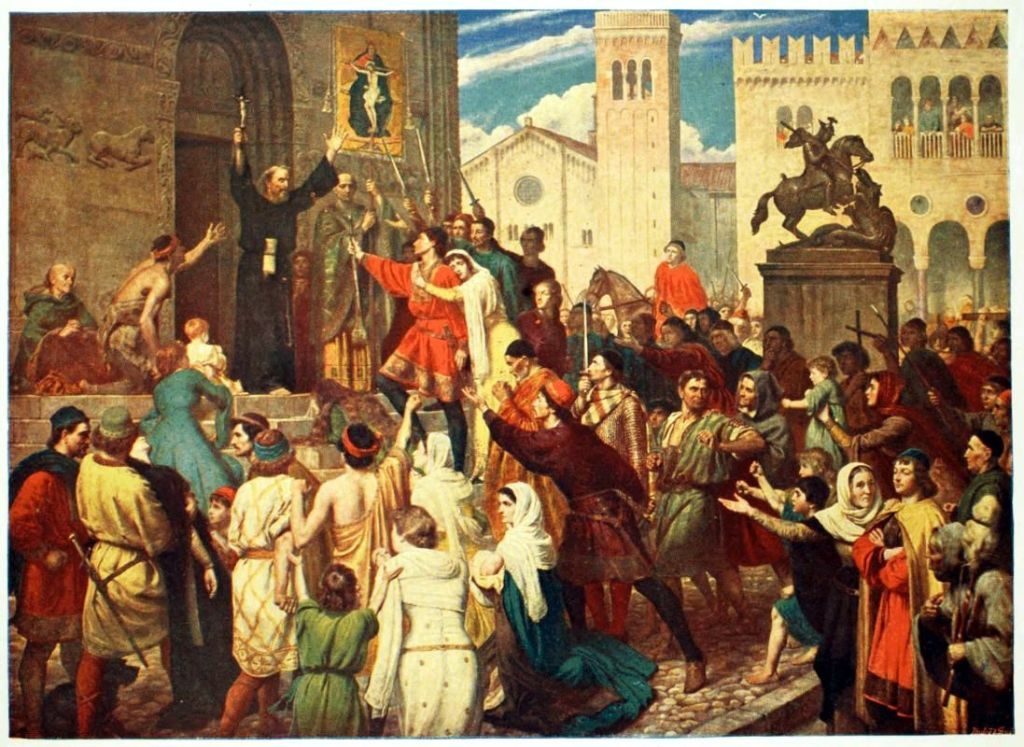
The painting above is a massive (4.6 m [15.2 ft] x 5.4 m [17.7 ft]) 1837 depiction, less accurate than allegorical — note the stone cross, and the imperilled woman and child.

October 9

Home / Uncategorized / October 9

Death of a cephalophoric saint

We expect saints to perform miracles. These days, proof of a miraculous cure or two is one of the ways the Catholic Church decides that an individual has exhibited saintly prowess. We do not routinely expect, however, that saints go about lugging their severed heads, but hagiographies abound in cephalophores (head-carriers) and today we celebrate the first of them: St Denis.

St Denis seems to have been sent from Italy to evangelize Roman-occupied Gaul in the third century. He converted so many in the region of what is now Paris that the authorities were alerted to his presence and he, with two companions, was beheaded on the city’s highest point, Montmartre. This execution does not seem to have deterred Denis from picking up his severed sense-organ cluster and walking six miles to his burial site, with the detached head preaching a sermon of repentance all the way.

Other cephalophoric saints include Nicasius of Rheims who was reading a psalm when he was decapitated — his head finished reciting the verse he was on — and St Gemolo who, after his execution, picked up his head mounted a horse and rode off to meet his uncle. St Paul’s head was separated from his body by a sword but, nevertheless, was reputed to have cried out “Jesus Christus” fifty times.

Denis is not to be confused (though he was for centuries) with Dionysius the Areopagite who was converted by Paul in Athens. And of the latter’s imposter, Pseudo-Dionysius the Areopagite, we shall remain silent.

October 7

Home / Today in History / October 7

1571 Battle of Lepanto


Since the 1370s the Ottoman Turks had been making themselves the dominant power in the Middle East and the Mediterranean, rolling back Christian and other Muslim opponents. In 1453 they took the last remnant of the Roman Empire when they smashed in the walls of Constantinople; in 1517 they seized Egypt and Arabia and claimed the Sunni Caliphate; in 1522 they drove the Knights of St John out of their fortress in Rhodes; 1527 they reached the gates of Vienna. Turkish fleets, including those of their North African pirate underlings, threatened every mile of the Christian Mediterranean coastline. From his Topkapi Palace their Emperor ruled territory from the Atlantic to the Euphrates.

Turkish success owed much to Christian disunity. Ogier Ghiselin de Busbecq, the ambassador of the Holy Roman Empire to Constantinople, surveyed the situation in the 1550s and declared:

 On their side is the vast wealth of their empire, unimpaired resources, experience and practice in arms, a veteran soldiery, an uninterrupted series of victories, readiness to endure hardships, union, order, discipline, thrift and watchfulness. On ours are found an empty exchequer, luxurious habits, exhausted resources, broken spirits, a raw and insubordinate soldiery, and greedy quarrels; there is no regard for discipline, license runs riot, the men indulge in drunkenness and debauchery, and worst of all, the enemy are accustomed to victory, we to defeat. Can we doubt what the result must be?

Though previous attempts at a Christian alliance against the Turks had failed, Pope Pius V laboured to put together a coalition to save Cyprus in 1571. The resulting “Holy League” included ships from Spain, Venice, Genoa, the Knights of St John, the Papal States and Florence. Keeping order in this fragile alliance was the job of Don John of Austria, the bastard brother of the Spanish King, who had to hang a few troublesome captains to assert the necessary unity.

The combined Christian fleet numbered 212 ships, almost all oar-propelled galleys, 40,000 sailors and 28,000 infantry. They faced a Turkish force of 251 ships, 50,000 oarsmen and 31,000 soldiers in the Gulf of Patras off the coast of southwestern Greece. The key to the battle was the deployment, in front of the Holy League’s ships, of four galleasses, large, clumsy, heavily-armed vessels bristling with cannons which blew up 70 Muslim galleys before they could reach the Christian line. The Turkish galleys carried crack Janissary troops, the elite fighting force of the Ottomans, but they were outgunned by their opponents. The day ended in a near-complete Christian victory; they sunk or captured over 150 enemy ships, killing or capturing 20,000 men and liberating 12,000 Christian slaves from the Turkish galleys.

The Turks would soon rebuild their fleet and continue to dominate the eastern Mediterranean but their defeat at Lepanto cost them dearly in experienced sailors and fighters. The Holy League would soon dissolve but Christian fleets would never face a serious naval threat again in the central or western Mediterranean. The boost to morale was incalculable and Lepanto still figures prominently in the civic mythology of Venice and Spain.

Our Lady of the Rosary

Pope Pius V atributed the triumph to the intercession of the Virgin Mary and created a new festival for Our Lady of Victory. Two years later Pope Gregory XIII changed the name to the “Feast of the Holy Rosary” and in 1960 Pope Paul VI renamed it again to the “Feast of Our Lady of the Rosary”

There are numerous churches dedicated to either Our Lady of Victory or Our Lady of the Rosary Maria del Rosario is a common Spanish girl’s name while Rosario is a popular name for boys in the Catholic world.

October 5

Home / Today in History / October 5

1793 The French Revolution dechristianizes the calendar

Since its beginning in 1789, forces of the French Revolution had been hostile to Christianity, especially the Roman Catholic Church. The monastic system had been abolished and all church lands seized by the government. The Catholic church was severed from its allegiance to the Pope and its clergy became civil servants, forced to swear loyalty to the state; priests who refused were subject to imprisonment, exile, or death. All church bells were seized and melted down to make artillery; church silver and precious objects were stolen; crosses were torn down, tombs were desecrated, and buildings turned over to secular uses. In place of Christianity, supporters of the Revolution offered the near-atheist Cult of Reason or the deist Cult of the Supreme Being.

On October 5, 1703 the traditional calendar with its Anno Domini dating from the birth of Christ, its seven-day week and names drawn from mythology was abolished and replaced by a revolutionary calendar. All months now had 30 days, divided into 3 ten-day décades, with a 5-day year-end holiday. Saints’ days were abolished and instead of a day of rest every 7 days, there was now one every 10 days — revolutionaries despised the idleness encouraged by the old church calendar and its many holidays. Dating was to take place from the beginning of the French Republic, months were named after climatic conditions and days were named after tools or common objects. Thus, Christmas Day 1793 was officially V nivôse II, le jour de chien — Year II, the fifth day of the snowy month, the day of the dog. (It could have been worse, December 28 was “the day of manure.”) There was even a short-lived attempt to decimalize the clock: a ten-hour day, each hour with 100 minutes. 

Such efforts were made to remove every-day religion from the minds of the common people but ordinary folk did not fail to notice that they now had to work more days in the year. Though governments tried to enforce the reforms, they never truly caught on and Napoleon ended the experiment on XIII frimaire XIII, January 1, 1806.

October 2

Home / Uncategorized / October 2

2006 Murder of five Amish children

On October 2, 2006, an employed church-going husband and loving father named Charles Carl Roberts IV entered a one-room schoolhouse in West Nickel Mines, Pennsylvania and took the teacher and students hostage. After allowing some of his prisoners to leave, Roberts then lined up the remaining ten students, all girls, and began to shoot them. He killed five and wounded five others before killing himself as police broke in to the building. His suicide notes gave a variety of reasons for his actions, including a history of sexual molestation and anger at God.

What astonished the world after these deaths was the reaction of the local Amish community which reacted not with anger or frustrated calls for vengeance but with compassion for the killer and pity for his family. A spokesman said, “I don’t think there’s anybody here that wants to do anything but forgive and not only reach out to those who have suffered a loss in that way but to reach out to the family of the man who committed these acts.” Amish residents attended Roberts’s’ funeral and embraced his relatives. These extraordinary examples of Christian behaviour helped healing in the lives of all concerned. The killer’s wife, Marie Roberts, said that she and her three young children had been overwhelmed by the community support. “Your love for our family has helped to provide the healing we so desperately need,” she wrote. “Gifts you’ve given have touched our hearts in a way no words can describe. … Your compassion has reached beyond our family, beyond our community, and is changing our world, and for this we sincerely thank you.” Terri Roberts, the killer’s mother, still volunteers to care for one of the victims, confined to a wheel-chair for life.

October 2

Home / Today in History / October 2

saladin_and_guy

1187 Saladin Captures Jerusalem

The Catholic knights of the First Crusade had taken much of the eastern coastline of the Mediterranean away from Muslim forces by 1100 and set up a number of Christian enclaves, principally the Kingdom of Jerusalem. The westerners had benefited from Islamic political divisions in the area but as the 12th century wore on, those divisions were healed and an Arab counter-attack had begun. In 1144 Edessaa fell to the Turks, prompting an unsuccessful Second Crusade that failed to return the city to Christian control.

In the person of An-Nasir Salah ad-Din Yusuf ibn Ayyub, known in the West as Saladin, Muslim forces in the Middle East found a powerful leader. In 1169 he conquered Egypt from the Fatimid dynasty and in 1174 he made himself master of Syria. Despite attempts to kill him by the Assassins (a Shi’ite sect) he managed to unite most of the Arab forces in a bid to oust the Crusaders from the Middle East.

On July 4, 1187 Saladin defeated a large Crusader army at the Battle of Hattin (depicted in the dreadful Hollywood film Kingdom of Heaven which you must never, ever watch if you value historical truth) taking the King of Jerusalem, Guy de Lusignan, prisoner, and massacring Templar and Hospitaller prisoners. He then moved against the city of Jerusalem and placed it under siege. Defenders under Balian of Ibelin swore to destroy sacred Islamic sites inside the city if reasonable surrender terms were not granted, so Saladin agreed to let Christians withdraw from the city on payment of a low ransom. On October 2, 1187 the city surrendered, with Saladin keeping about 15,000 Christian residents as slaves.

The fall of Jerusalem prompted the Third Crusade, led by Richard Lionheart of England who was able to defeat Saladin in battle but could not recapture the city. Saladin achieved a glowing reputation among Christians during the Middle Ages as a noble infidel. Dante placed him in Limbo along with other virtuous non-Christians such as Socrates and Plato.

October 1

Home / Uncategorized / October 1

October 1

St Theresa of Lisieux

There is nothing to say that saints have to live long and arduous lives; hagiographies are full of the tales of young people who have been canonized for flashes of sanctitude or a single action. Few saints of tender years can have had so great an influence as this French woman who died at the age of 24 after a long battle with tuberculosis.

Marie-Françoise-Thérèse Martin (1873-97) was born into a pious middle-class family in northwestern France and decided at an early age she wished to be a nun, a resolve that strengthened when she experienced a vision of the Virgin. At 15 she entered the Discalced (Shoeless or Barefoot) Carmelites, a contemplative order of cloistered women with a house at Lisieux, Normandy which her sisters had already joined. She took the religious name Theresa of the Child Jesus and the Holy Face. The rest of her short life she spent inside the walls of her convent, praying, serving and writing.

Love proves itself by deeds, so how am I to show my love? Great deeds are forbidden me. The only way I can prove my love is by scattering flowers and these flowers are every little sacrifice, every glance and word, and the doing of the least actions for love.

It is through her exposition of “the little way” that made Theresa famous, winning her sainthood after her death and the title Doctor of the Church. In her poetry and her autobiography, The Story of a Soul, Theresa advocated a life of child-like trust and small loving actions. She is the patroness of African missions, those suffering from AIDS or tuberculosis, air crews and florists.