A Pact Among the Saints

Home / Christmas / A Pact Among the Saints

In 1993, a pact of friendship was signed between Saint Martin, Saint Nicholas and Father Christmas to help Belgian parents sort out the confusion between the Gift-Bringers that there children would encounter.


We, the undersigned,

Martinus of Tours, also known as Saint Martin, living in various places in Heaven and on Earth;

Nicolas of Myra, also known as Saint Nicholas, living in Spain and various other places in Heaven and on Earth;

Father Christmas, also known as Santa Claus, living in the Arctic region;

Acknowledge each other’s traditions and popular customs as patron saints of children in wintertime;

Express our concern over current abuses violating the essence of our traditions and posing a threat to their continued existence;

Call on  parents, tradespeople, associations, public authorities and agencies and all persons who appeal to us henceforth to comply with the following three guidelines:


  1. Solemn entries, receptions, processions, celebrations etc. must not be held too far in advance of the actual saint’s day. Each of us is entitled to his festive season. Therefore, Saint Martin may be celebrated before and until November 11, Saint Nicholas from November 12 to December 6, and Father Christmas from December 7 to 25. We disapprove of more than one solemn entry of the same Giver in any town or city.
  2. All events must be child-oriented. Meetings with children should be small-scale. We categorically reject any form of ‘assembly-line’ approach on the part of any of us. A child-oriented approach also implies bringing  encouragement and reward rather than punishment and  intimidation. This also applies to Black Peter and other attendants attesting to our dignity.
  3. The primary value we undertake to bring to children is the realisation that they can and must share with and give to those who are less well-off, without expecting any benefit in return. We pledge to set the example. This value is diametrically opposed to the greed and consumer wastefulness which some unjustly associate with our feasts. 

Signed in Brussels , November 17, 1993


Nostalgia

Home / Christmas / Nostalgia

In “A Summer Christmas,” from 1885 Douglas B. W. Sladen (who described himself as “an Australian colonist and late Scholar of Trinity College, Oxford”) writes of the Australian festivities as experienced by Victorian English immigrants trying, in vain, to recreate the Christmas that they knew at home.


The Christmas dinner was at two,

And all that wealth or pains could do

Was done to make it a success;

And marks of female tastefulness,

And traces of a lady’s care,

Were noticeable everywhere.

The port was old, the champagne dry,

And every kind of luxury

Which Melbourne could supply was there.

They had the staple Christmas fare,

Roast beef and turkey (this was wild),

Mince-pies, plum-pudding, rich and mild,

One for the ladies, one designed

For Mr. Forte’s severer mind,

Were on the board, yet in a way

It did not seem like Christmas day

With no gigantic beech yule-logs

Blazing between the brass fire-dogs,

And with 100 in the shade

On the thermometer displayed.

Nor were there Christmas offerings

Of tasteful inexpensive things,

Like those which one in England sends

At Christmas to his kin and friends,

Though the Professor with him took

A present of a recent book

For Lil and Madge and Mrs. Forte,

And though a card of some new sort

Had been arranged by Lil to face

At breakfast everybody’s place.

When dinner ended nearly all

Stole off to lounges in the hall.

All save the two old folks and Lil,

Who made their hearts expand and thrill

By playing snatches, slow and clear,

Of carols they’d been used to hear

Some half a century ago

At High Wick Manor, when the two

Were bashful maidens they talked on,

Of England and what they had done

On bygone Christmas nights at home,

Of friends beyond the Northern foam,

And friends beyond that other sea,

Yet further—whither ceaselessly

Travellers follow the old track,

But whence no messenger comes back.

An Expedition to the Pole

Home / Christmas / An Expedition to the Pole


In 1869, Prussia sent out two vessels, the Germania and the Hansa, to attempt to reach the North Pole. Neither ship succeeded in making it through the pack ice and Hansa sank after getting lost. One of the officers of Germania wrote this account of Christmas trapped in the Arctic ice.

To the men who had already lived many weary months among the icebergs, Christmas signifies, in addition to its other associations, that the half of their long night with its fearful storms, its enforced cessation of all energy, its discomfort and sadness has passed, and that the sun will soon again shed its life and warmth-giving beams on the long-deserted North. From this time the grim twilight, during which noon has been hardly distinguishable from the other hours, grows daily lighter, until at length all hearts are gladdened, and a cheerful activity is once again called forth by the first glimpse of the sun. Christmas, the midnight of the Arctic explorer, thus marks a period in his life which he has good cause to consider a joyful one.

For days before the festival, an unusual activity was observable all over the ship; and as soon as the severe storm which raged from December 16th to 21st had abated, parties were organised, under our botanist, Dr. Pansch, to certain points of Sabine Island, near to which we were anchored, where, in strangely sheltered nook, several varieties of a native Greenland evergreen plant, Andromeda tetragona, were to be found. A great quantity of this plant was conveyed on board, to be converted into a Christmas-tree. Under the orders of Dr. Pansch, the Andromeda was wound round small pieces of wood, several of which were attached, like fir-twigs, to a large bough; and when these boughs were fastened to a pole, they formed a very respectable fir-tree. After dinner on Christmas Day, the cabin was cleared for the completion of the preparations; and on our recall at six o’clock, we found that all had assumed an unwontedly festive appearance. The walls were decorated with the signal-flags and our national eagle; and the large cabin table, somewhat enlarged to make room to seat seventeen men, was covered with a clean white cloth, which had been reserved for the occasion. On the table stood the ‘fir’ tree, shining in the splendour of many little wax-lights, and ornaments with all sorts of little treasures, some of which, such as the gilded walnuts, had already seen a Christmas n Germany; below the tree was a small present for each of us, provided long beforehand, in readiness for the day, by loving friends and relatives at home. There was a packet too for each of the crew, containing some little joking gift, prepared by the mirth-loving Dr. Pansch, and a useful present also; while the officers were each and all remembered.

When the lights burned down, and the resinous Andromeda was beginning to take fire, the tree was put aside, and a feast began, at which full justice was done to the costly Sicilian wine with which a friend had generously supplied us before we left home. We had a dish of roast seal! Some cakes were made by the cook, and the steward produced his best stores. For the evening, the division between the fore and aft cabins was removed, and there was free intercourse between officers and men; many a toast was drunk to the memory of friends at home, and at midnight a polar ball was improvised by a dance on the ice. The boatswain, the best musician of the party, seated himself with his hand-organ between the antlers of a reindeer which lay near the ship, and the men danced two and two on their novel flooring of hard ice!

The Question of Gratitude

Home / Christmas / The Question of Gratitude

One of the most remarkable things about the Santa Claus story is how parents choose to deflect any possible gratitude from their children to a mythical being. It is an altruistic act that increases their children’s sense of fantasy and magic. Here is an article from 1880 in which a parent decides that he should be getting credit for his gifts, not Santa.

December 28, Childermas

Home / Christmas / December 28, Childermas

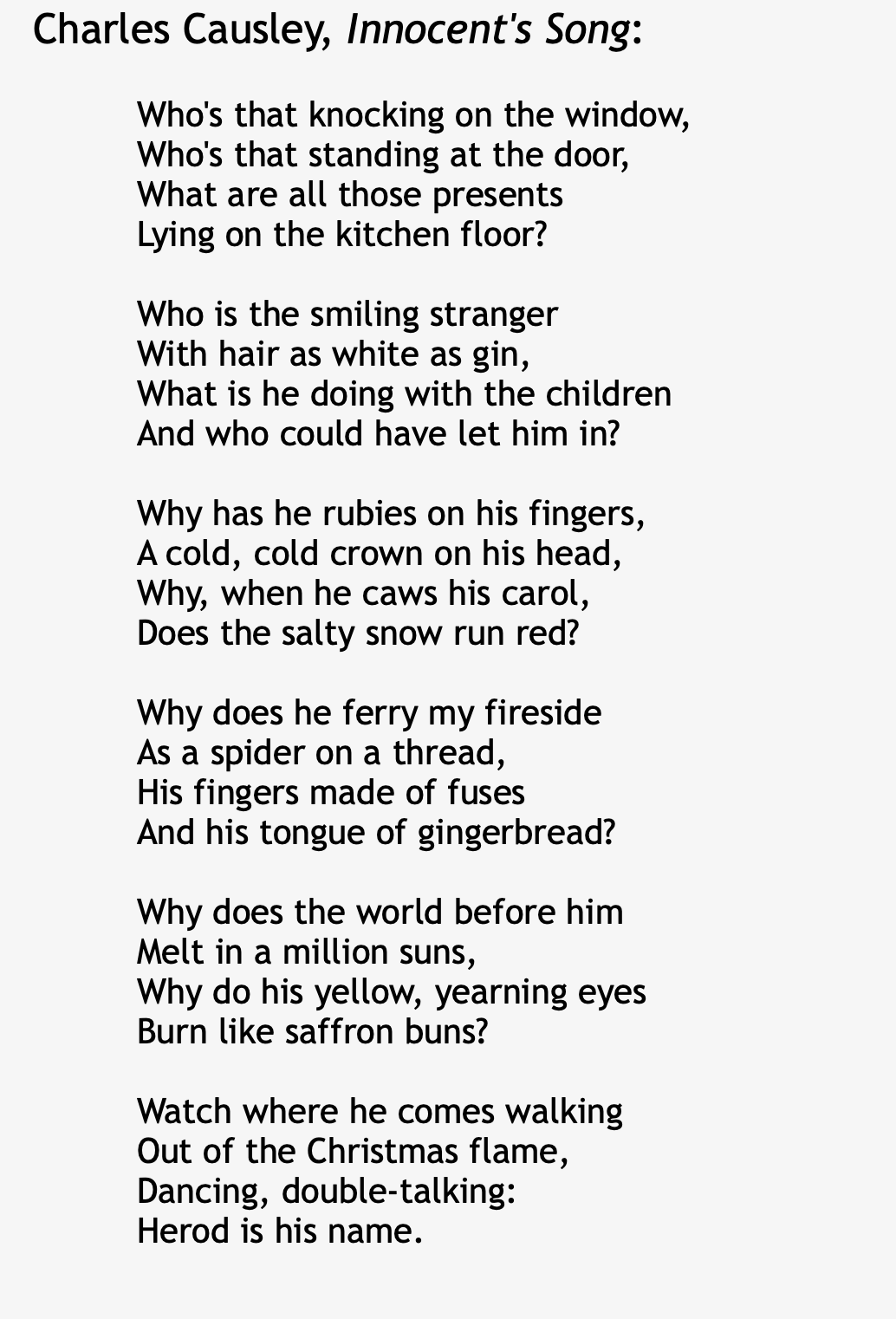
December 28, the Feast of the Holy Innocents, commemorates the murder of the male babies of Bethlehem by King Herod. In England the day was known as Childermas (or Dyzemas) and was considered an ill-omened time; few would want, for example, to be married on that date. Not only was no business conducted on that day, but the day of the week on which it fell was deemed unlucky for the rest of the year. In Ireland it was Lá Crostna na Bliana, the “cross day of the year” when no new enterprise was begun. Many sailors would not sail on that day; on the Aran isles no one was buried on Childermas (or the day of the week on which it occurred); and in Cornwall to wash on that day was to doom one of your relatives to death.

Childermas was also a day for ritual beatings. The seventeenth-century writer Gregorie notes the custom of whipping children in the morning of that day so that Herod’s murderousness “might stick the closer; and, in a moderate proportion, to act over the crueltie again in kind.”