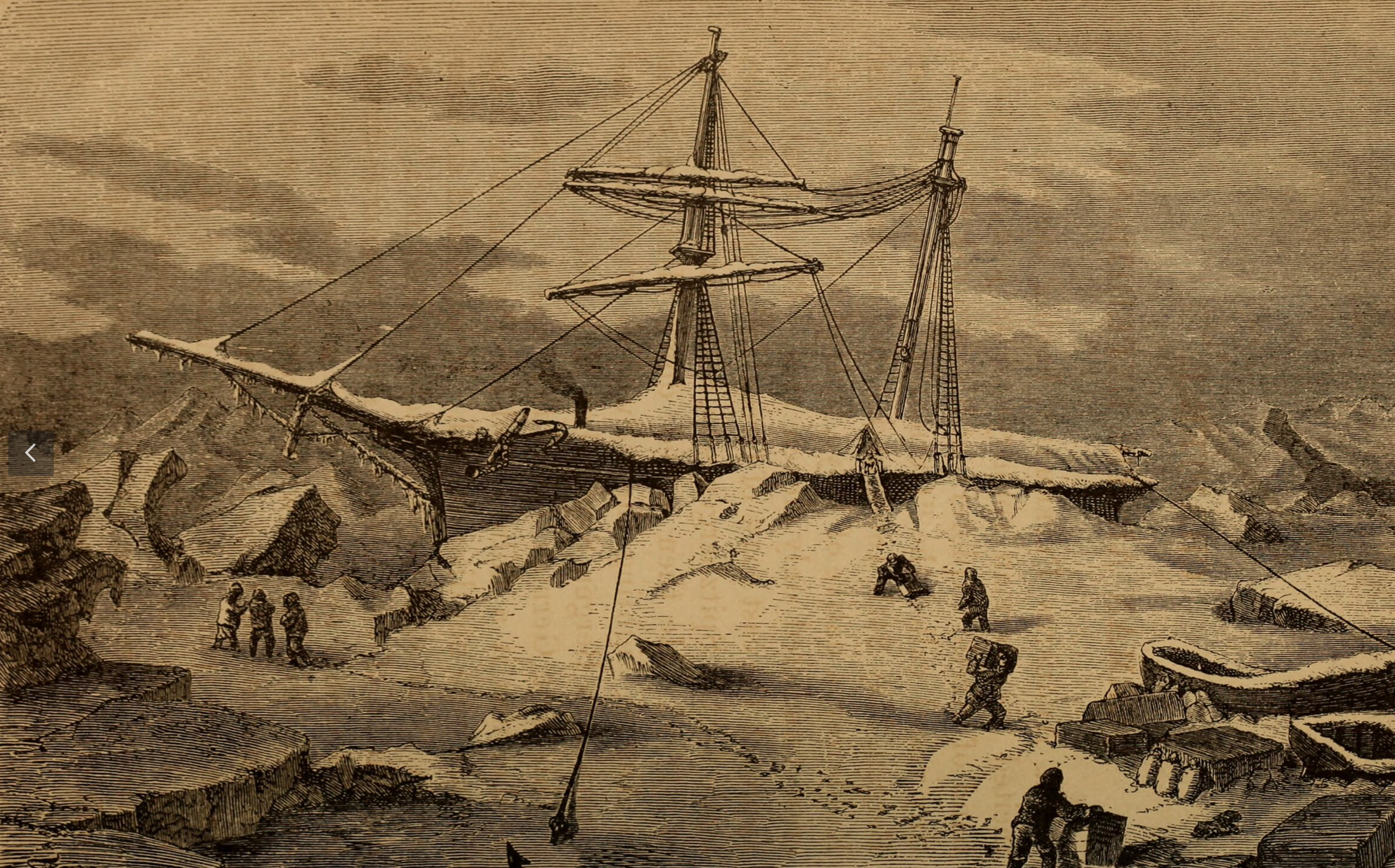
In 1869, Prussia sent out two vessels, the Germania and the Hansa, to attempt to reach the North Pole. Neither ship succeeded in making it through the pack ice and Hansa sank after getting lost. One of the officers of Germania wrote this account of Christmas trapped in the Arctic ice.
To the men who had already lived many weary months among the icebergs, Christmas signifies, in addition to its other associations, that the half of their long night with its fearful storms, its enforced cessation of all energy, its discomfort and sadness has passed, and that the sun will soon again shed its life and warmth-giving beams on the long-deserted North. From this time the grim twilight, during which noon has been hardly distinguishable from the other hours, grows daily lighter, until at length all hearts are gladdened, and a cheerful activity is once again called forth by the first glimpse of the sun. Christmas, the midnight of the Arctic explorer, thus marks a period in his life which he has good cause to consider a joyful one.
For days before the festival, an unusual activity was observable all over the ship; and as soon as the severe storm which raged from December 16th to 21st had abated, parties were organised, under our botanist, Dr. Pansch, to certain points of Sabine Island, near to which we were anchored, where, in strangely sheltered nook, several varieties of a native Greenland evergreen plant, Andromeda tetragona, were to be found. A great quantity of this plant was conveyed on board, to be converted into a Christmas-tree. Under the orders of Dr. Pansch, the Andromeda was wound round small pieces of wood, several of which were attached, like fir-twigs, to a large bough; and when these boughs were fastened to a pole, they formed a very respectable fir-tree. After dinner on Christmas Day, the cabin was cleared for the completion of the preparations; and on our recall at six o’clock, we found that all had assumed an unwontedly festive appearance. The walls were decorated with the signal-flags and our national eagle; and the large cabin table, somewhat enlarged to make room to seat seventeen men, was covered with a clean white cloth, which had been reserved for the occasion. On the table stood the ‘fir’ tree, shining in the splendour of many little wax-lights, and ornaments with all sorts of little treasures, some of which, such as the gilded walnuts, had already seen a Christmas n Germany; below the tree was a small present for each of us, provided long beforehand, in readiness for the day, by loving friends and relatives at home. There was a packet too for each of the crew, containing some little joking gift, prepared by the mirth-loving Dr. Pansch, and a useful present also; while the officers were each and all remembered.
When the lights burned down, and the resinous Andromeda was beginning to take fire, the tree was put aside, and a feast began, at which full justice was done to the costly Sicilian wine with which a friend had generously supplied us before we left home. We had a dish of roast seal! Some cakes were made by the cook, and the steward produced his best stores. For the evening, the division between the fore and aft cabins was removed, and there was free intercourse between officers and men; many a toast was drunk to the memory of friends at home, and at midnight a polar ball was improvised by a dance on the ice. The boatswain, the best musician of the party, seated himself with his hand-organ between the antlers of a reindeer which lay near the ship, and the men danced two and two on their novel flooring of hard ice!